Get in touch with Zeyu lntelligent Industrial Company

Nano Twist Pin Assembly Machine
Nano Twist Pin Assembly Machine — Automated Hyperboloid Contact Production
Produce Nano-D and Micro-D twist pin contacts at machine-grade consistency — without the scrap rate, the bottleneck operators, or the inspection backlog of hand winding.
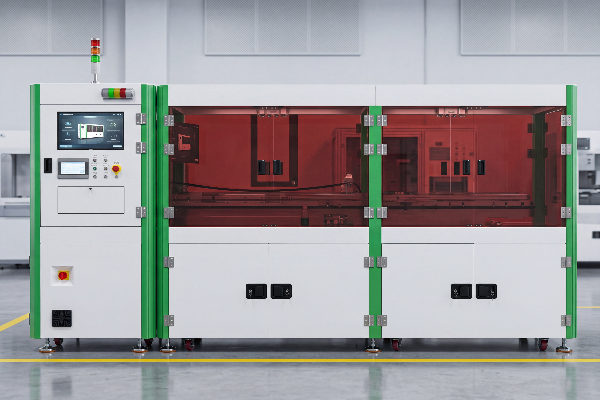
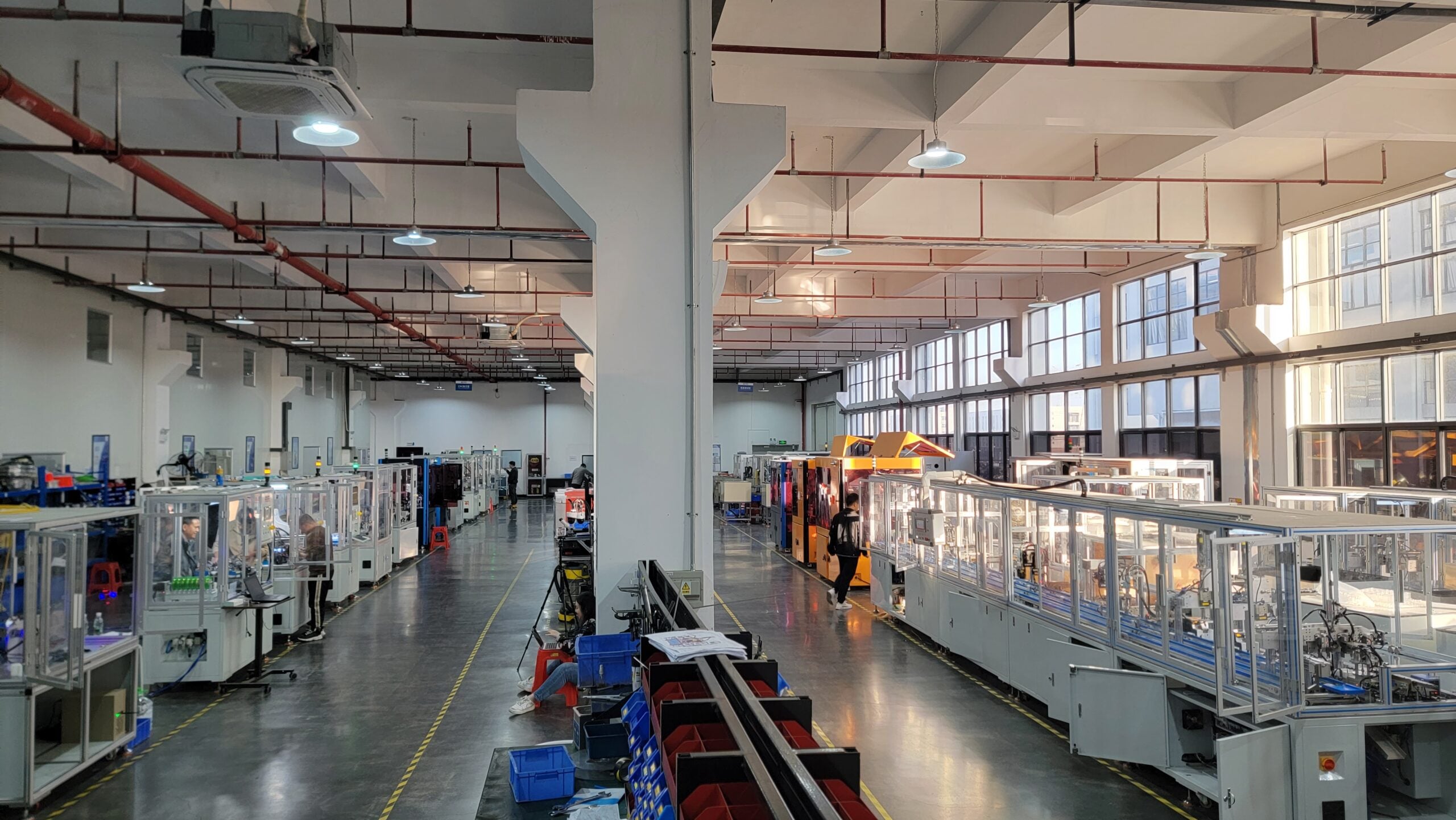
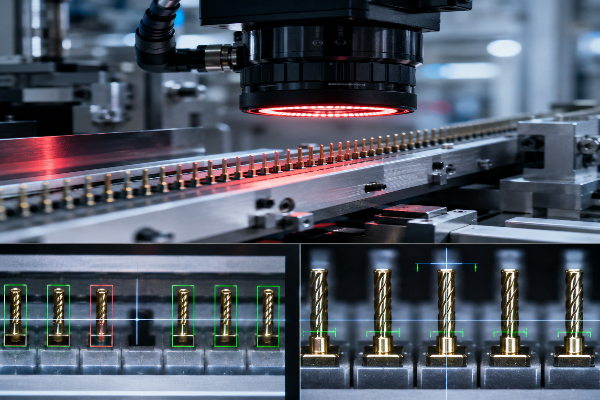
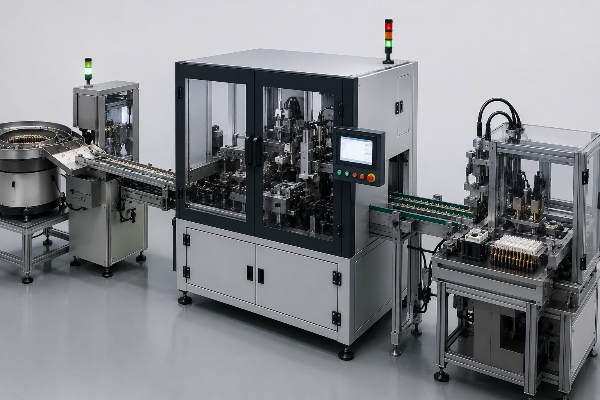
ZEUEE Nano twist pin assembly machine — automated hyperboloid contact production line with CCD vision and servo feeding
25 pcs/min
Continuous twist-pin output
±0.1 mm
Servo positioning accuracy
0.635 mm
Nano-D pitch capable
CCD vision
100% missing-pin check
10–50 PPM
Automated defect range
30+ countries
ZEUEE installed base
System Overview
From Hand-Wound Contacts to Automated Precision
A twist pin assembly machine exists to solve one problem that hand work cannot: making a hyperboloid contact the same way ten thousand times in a row. It is what gives Nano-D and Micro-D connectors their reliability under shock and vibration.
10,000
Consecutive Reps
1k–2k
PPM (Manual)
10–50
PPM (Automated)
0.1 mm
Station Tolerance
30+
Countries Installed
Mechanical Cause
This cause is mechanical, not human: a twist pin contact depends on strand pitch, weld integrity, and bulge symmetry that the eye cannot hold to micron tolerance across a shift. Manual and bench processes typically run defect rates in the 1,000–2,000 PPM range for repetitive contact work, while an automated assembly line holds 10–50 PPM. A connector component bound for a satellite wiring assembly makes that gap the difference between qualification and a field return.
Automated Solution
This twist pin automatic assembly machine closes the gap by turning the three hand steps — cutting and laser welding the strand bundle, expanding the bulge, then assembling and crimping the contact into its sleeve — into one servo-driven, vision-monitored line. Each station holds position to within 0.1 mm, turning each hand operation into a repeatable automatic machine process.
Field Reliability
For an EU or US buyer qualifying a connector line, that consistency is the differentiator — the structural reason ZEUEE customers across 30+ countries move repetitive twist pin assembly off the bench. A field return is the real exposure here — not one bad contact, but the one that ships months after a drifting bulge clears a visual check, surfacing only after thermal cycling.
ZEUEE Twist Pin Machine Range — Models & Selection
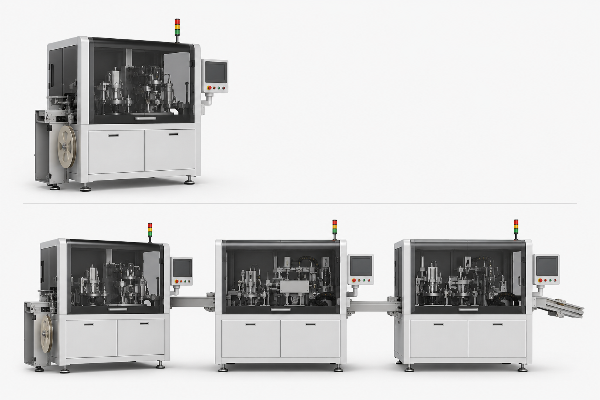
ZEUEE builds this twist pin automatic assembly machine as three modular, integrated process modules rather than a single black box, so the configuration matches the contact you actually produce.
Most connector assembly machine manufacturers ship a fixed insertion machine; ZEUEE lets you customize which modules you take and integrate them as one solution.
Selection Context
An engineer selecting equipment cares about three numbers above all: the pin pitch the feeder and tooling can hold, the throughput per shift, and the changeover effort when the contact count changes.
Specifications below come from ZEUEE’s automatic pin insertion machine platform, the same machinery deployed for electronics across 30+ countries.
Technical Specifications & Modular Configuration
Cutting & laser welding
Cut strand bundle, fuse rounded end
Expansion (bulge)
Form the hyperboloid cage bulge
Assembling & crimping
Insert + crimp contact into sleeve
Run the three modules in line for turnkey contact production, or integrate a single module into an existing cell. Selection is driven by pin pitch and required output, not a fixed model number. ZEUEE also builds connector crimping machines and wire assembly lines.
Output capacity
25 pcs/min
Sustains high-volume Nano-D/Micro-D contact runs
Positioning accuracy
±0.1 mm
Holds bulge and insertion geometry across the run
Contact pitch capability
down to 0.635 mm
Matches MIL-DTL-32139 Nano-D spacing
Drive system
Servo slide rails + lead screws
Repeatable position, not pneumatic drift
Vision / inspection
CCD camera + 4-axis robot
Per-board missing-pin detection, 100% check
Feeding
Flexible vibratory disk
Handles fine strand bundles without tangling
Footprint
2100 × 1350 × 2150 mm
Fits a standard production cell
Power / air
3500 W, 220V 50Hz, 0.5 MPa
Standard factory utilities
Changeover
Fixture swap + parameter set
Move between contact counts without a rebuild
Engineering Note — Why Servo, Not Pneumatic
Pneumatic actuators repeat to roughly ±0.3–0.5 mm and drift with line pressure; the servo slide rails on this platform hold ±0.1 mm regardless of the 0.5 MPa supply.
For a 0.635 mm Nano-D pitch, that margin is the differentiator — it is what keeps adjacent contacts from interfering during insertion, the structural reason ZEUEE specifies servo over pneumatic on this machine.
Match a module set to your contact print. Request a sample twist pin contact.
Get Instant Quote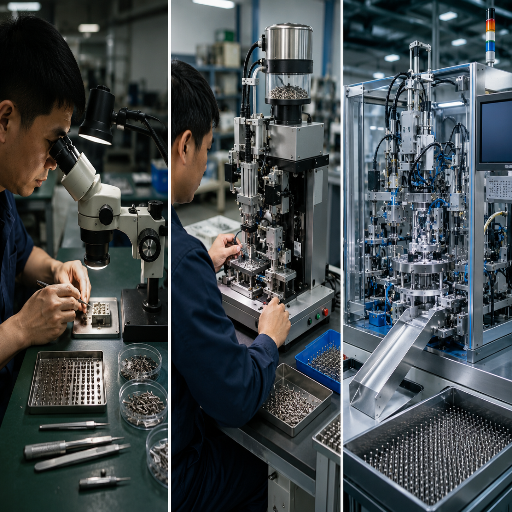
Factor
Manual / bench
Semi-automatic
ZEUEE automated line
Defect rate
1,000–2,000 PPM
200–800 PPM
10–50 PPM
Output
operator-limited
5–12 pcs/min
25 pcs/min
Position repeatability
operator-dependent
±0.3 mm
±0.1 mm
Manual-to-Automated Twist Pin Cost Crossover
The honest version is not “automate everything” — it is that the crossover point arrives sooner than most planners expect once scrap and rework are priced in. That is the structural reason ZEUEE sizes the line to your volume.
Customer Outcomes & Target Industries
Twist pin contacts earn their cost in places where a single intermittent connection is unacceptable.
ZEUEE’s automation equipment serves connector and contact manufacturers supplying these markets, where the value of a 10–50 PPM line is measured in avoided field failures, not just labor hours.
Nano-D / Micro-D Compatibility Map
| Connector family | Pitch | Contact counts |
|---|---|---|
| Nano-D (MIL-DTL-32139) | 0.635 mm | 9/15/21/25/31/37/51 |
| Micro-D (MIL-DTL-83513) | 1.27 mm | 9 to 100 |
20–40×
lower defect rate when moving repetitive contact assembly from hand work to an automated line.
Verify against your own baseline
From sampling to 100% inspection
- The Shift Moving from bench winding with sample-based inspection to an automated line gains per-contact CCD verification.
- The Impact Removes the statistical blind spot where a drifting bulge slips through a sampling plan but fails in the field.
- Mission-Critical Standard Eliminates the exact failure mode that drove NASA workmanship standards to specify twist-pin contacts for Micro-D builds.
Certifications, Compliance and Materials
When an overseas buyer is sourcing capital equipment, certifications are the first filter and the technical documentation the second. ZEUEE’s quality position is built on a certified ISO 9001:2015 management system and a deep patent base rather than claims alone. That verifiable paper trail is the structural reason ZEUEE clears procurement filters in 30+ countries.
20 Years of Automation Excellence
Across 20 years, ZEUEE’s automation equipment has been trusted by manufacturers including AVIC, TE, Sumitomo, Foxconn, and LEGO. Buyers also map equipment output against workmanship standards such as IPC-A-610 on their own line.
ISO 9001
Quality System
CE
Compliance
150+
Patents Total
Hi-Tech
Enterprise
01 / 16
[DOC-ID: PRO-GUIDE-01]
Procurement Guide
Pricing, Lead Time & Support
Opaque pricing is the norm in connector automation, and for a procurement team that is a budgeting risk because you cannot model payback against a number nobody will quote. ZEUEE prices this category transparently instead. Across ZEUEE’s published connector and assembly machine catalogue, equipment in this class lists in the following range depending on configuration.
Est. Capital Exp.
US $30,000
–
$50,000
For an EU or US buyer, here is what moves a quote within that band.
[SYS-VARS]
Pricing Factors Framework
Four variables drive where your configuration lands:
01
Process Scope
A single module (assembling & crimping, say) versus the full three-module line.
02
Contact Range
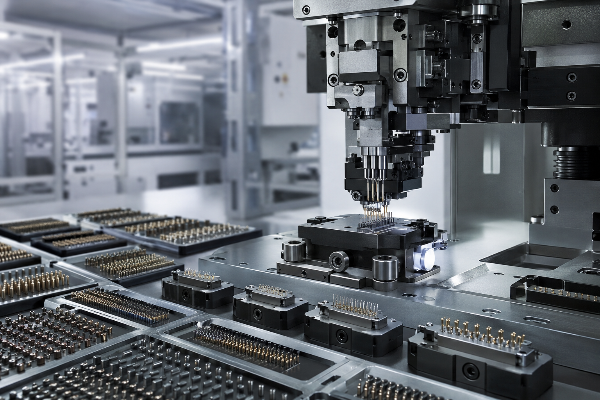
Drives tooling — how many pin pitches and contact counts must be covered.
03
Inspection Depth
A standard CCD missing-pin check, or added dimensional vision.
04
Integration
A standalone cell, or a handshake with upstream feeding and downstream connector assembly.
Interactive Resources
Production Calculation & Selection Tools
Manual-to-Automated Twist Pin Cost Crossover
Estimate where an automated line beats hand assembly on scrap + labor. Industry-calibrated; verify against your own baseline.
Access Tool
Nano-D / Micro-D Twist Pin Contact Spec Selector
Pick a connector family and contact count to see pitch, contact construction, the ZEUEE module set, and typical markets.
Access Tool
Twist Pin Throughput & Capacity Estimator
Check whether a 25 pcs/min ZEUEE line covers your annual demand — and how many lines a high-volume program needs.
Access Tool
ZEUEE
Knowledge Base
Frequently Asked Questions
Technical specifications, deployment strategies, and ROI insights for our Nano Twist Pin Assembly lines. Find the data you need to drive your manufacturing upgrade.
Engineering Support
For non-standard configurations or integration inquiries, our engineering team is available for technical review.
What kind of machine is used to make twist pin or hyperboloid contacts?
A dedicated twist pin assembly machine that cuts and laser-welds the strand bundle, expands the hyperboloid bulge, then assembles and crimps the contact into its sleeve. ZEUEE builds these as three servo-driven, CCD-monitored modules that can run in line or stand alone.
Automatic versus semi-automatic — which fits my volume?
Below roughly 3,000 contacts a year, a semi-automatic or bench process is usually more economical, because the equipment cost has not yet been offset by labor and scrap. Above that threshold, a fully automated line pulls ahead — it wins on scrap reduction, on the rework hours that scrap creates, and on direct labor, all at once. Rather than guess, we model the crossover point against your actual annual contact volume and your current defect baseline before recommending a configuration.
What pin pitches and contact counts can the machine handle?
This platform reaches the 0.635 mm Nano-D pitch (MIL-DTL-32139, contact counts 9 through 51) and the 1.27 mm Micro-D pitch. Pitch and count drive the feeder tooling and CCD recipe, which are confirmed during configuration.
How does automation improve twist-pin contact reliability?
By holding ±0.1 mm position on bulge formation and crimping, and by CCD monitoring of 100% of contacts rather than sampling, which moves the defect rate from a manual 1,000–2,000 PPM toward 10–50 PPM across continuous operation.
Which industries use twist-pin (hyperboloid) connectors?
Satellites, UAVs and air taxis, robotics, defense and avionics, downhole and offshore petrochemical, and implantable or portable medical devices — anywhere shock, vibration, and miniaturization meet a no-failure requirement.
What does a twist pin assembly machine cost?
ZEUEE’s connector and assembly machines in this class list in the US $30,000–$50,000 range, with the final figure driven by process scope, contact range, inspection depth, and integration. We quote the specific configuration rather than a placeholder.
What certifications does ZEUEE hold?
ISO 9001:2015, CE marking, National High-Tech Enterprise status, and 150+ patents. Full compliance files ship for vendor onboarding.
Can the line integrate with our existing connector assembly process?
Yes. Modules can run standalone or hand off to upstream feeding and downstream connector assembly. ZEUEE designs non-standard automation, so the integration scope is part of the configuration review.
Platform Context
Why We Build This Machine
ZEUEE has built non-standard automation since 2005, and the twist pin line grew out of repeat requests from connector makers who could not hold hyperboloid cage geometry by hand at volume. Specifications on this page reflect our published pin-assembly platform; exact throughput and tolerance for your contact print are confirmed in a configuration review, because a 0.635 mm Nano-D run and a 1.27 mm Micro-D run are not the same machine setup.
WHY WE WRITE THIS
About ZEUEE Engineering Insights
ZEUEE shares technical guides based on real automation project experience. Since 2005, we have designed and manufactured non-standard automation equipment for connector assembly, wire harness production, robotic lines, vision inspection, and smart factory upgrades.
Founded in 2005
20,000 m² production base
120+ specialists
150+ R&D patents
ISO9001:2015 certified