Get in touch with Zeyu lntelligent Industrial Company
Custom Automated Toy Assembly Machines for Modern Toy Manufacturers
ZEUEE’s custom automated Toy assembly machines ship to over 30 countries, powering factories to companies including LEGO Denmark, SONY, TCL, Foxconn, Sumitomo and Corning. We apply more than 150 patents to every line we engineer, from single stations to entire turnkey unmanned toy plants.

- 21 yrs
- Industrial automation experience (since 2005)
- 150+
- Patents (32 invention + 68 utility + others)
- 30+
- Countries with installed lines
- 20,000 m²
- In-house plant in Taihe, Jiangxi
From Manual Assembly Bottlenecks to Automated Toy Production
Factories rarely lose money on one bottleneck in toy manufacturing. They lose money on five interwoven pains that accumulate each shift.
Rising Labor Cost
According to industry reports, fully-loaded factory wages in major coastal Chinese hubs increased to approximately $6.50-$6.69 per hour in 2024. In just seven years, wages in Vietnam rose from $275 to $487 per month.
SKU Diversity
Plush, plastic injection, electronics, and STEM kits all require specific fixture setups, unique feeder logic, and different vision inspection procedures.
Slow Changeovers
Many of the packaging styletoy lines spend up to 90 minutes, half of an entire shift, changeovers for every SKU if not using a SMED approach.
Quality Compliance
United States compliance with ASTM F963-23 went live April 20, 2024, EN 71-3 regulations control over 19 different heavy metals and GB 6675-2025 will be implemented in China on November 1, 2026.
The Counterintuitive “automation Trap”
Contrary to intuition, smaller screws are actually far more challenging to automate than larger ones due to shrinking clearance space compared to tooling tolerance, making “full” robotic assembly less than ideal.
The ZEUEE 4-Stage Toy Assembly Architecture
Our solution is an integrated system designed to scale from a bench-top station to a turnkey unattended facility. Four independent, modular stages — Feed, Position, Join, QC — are dimensioned according to the toy specs on the bill of materials.
01
Feed
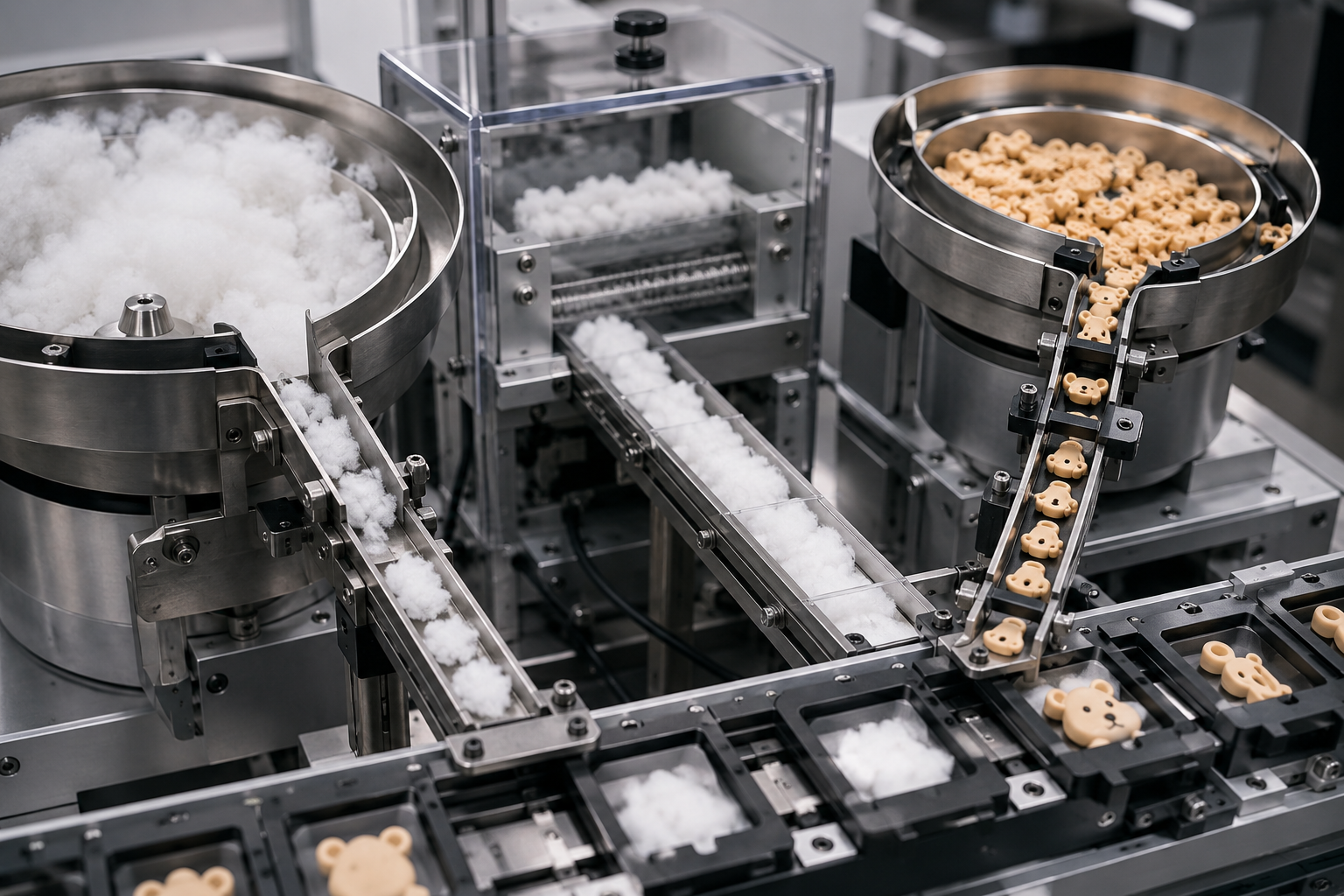
What it does
Vibratory bowls, step-feeders, polyfiber fiber-opening units, and component buffers serialize parts into a known pose.
Why it matters for toys
Plush stuffing fiber and small plastic parts behave nothing alike; the feed module isolates that physics so the rest of the line stays stable.
02
Position
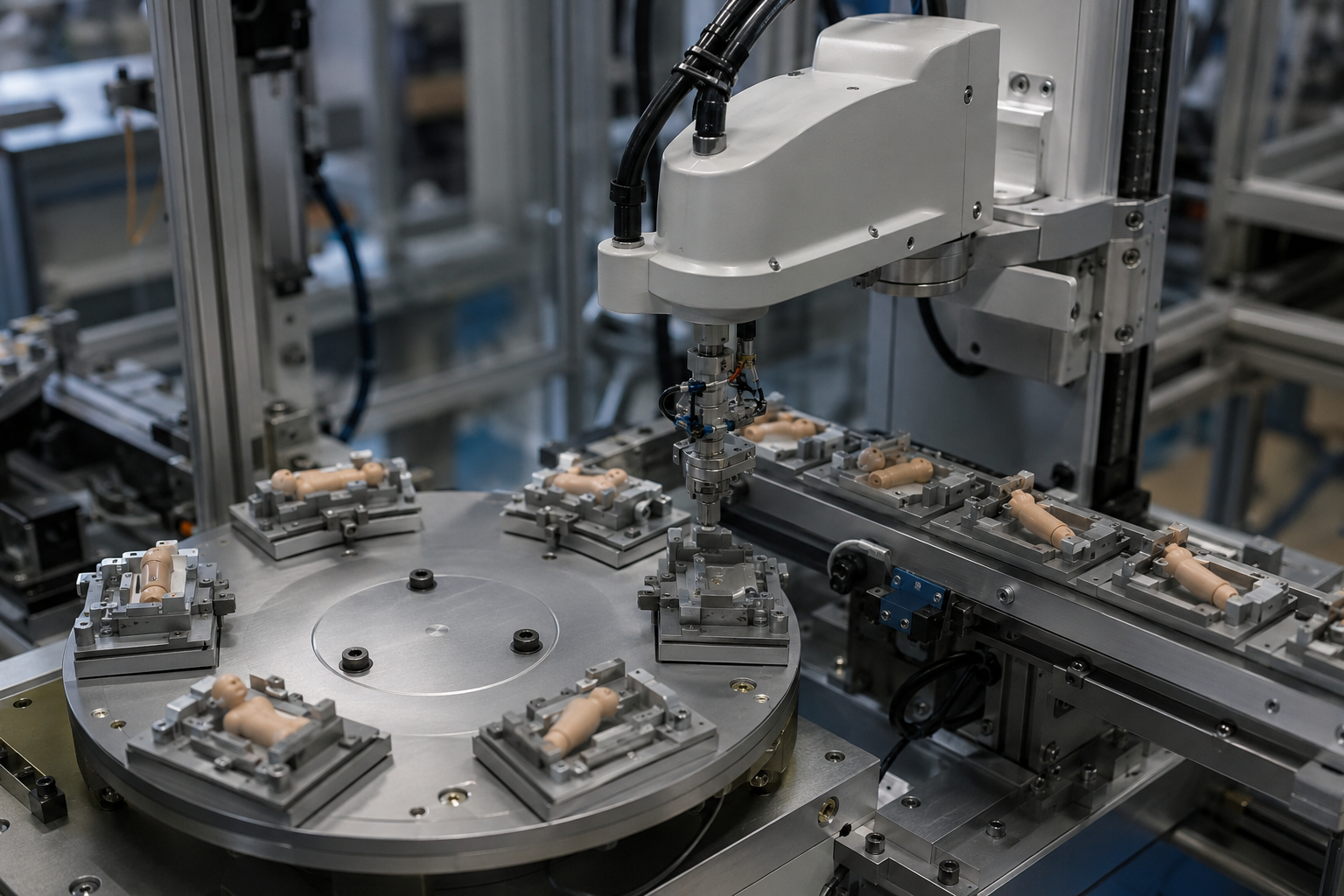
What it does
Servo-controlled rotary indexers, linear transfer cells, and SCARA arms place parts within ±0.05 mm repeatability.
Why it matters for toys
Multi-pose action figures and articulated dolls need positional repeatability that hand-fed lines cannot guarantee.
03
Join
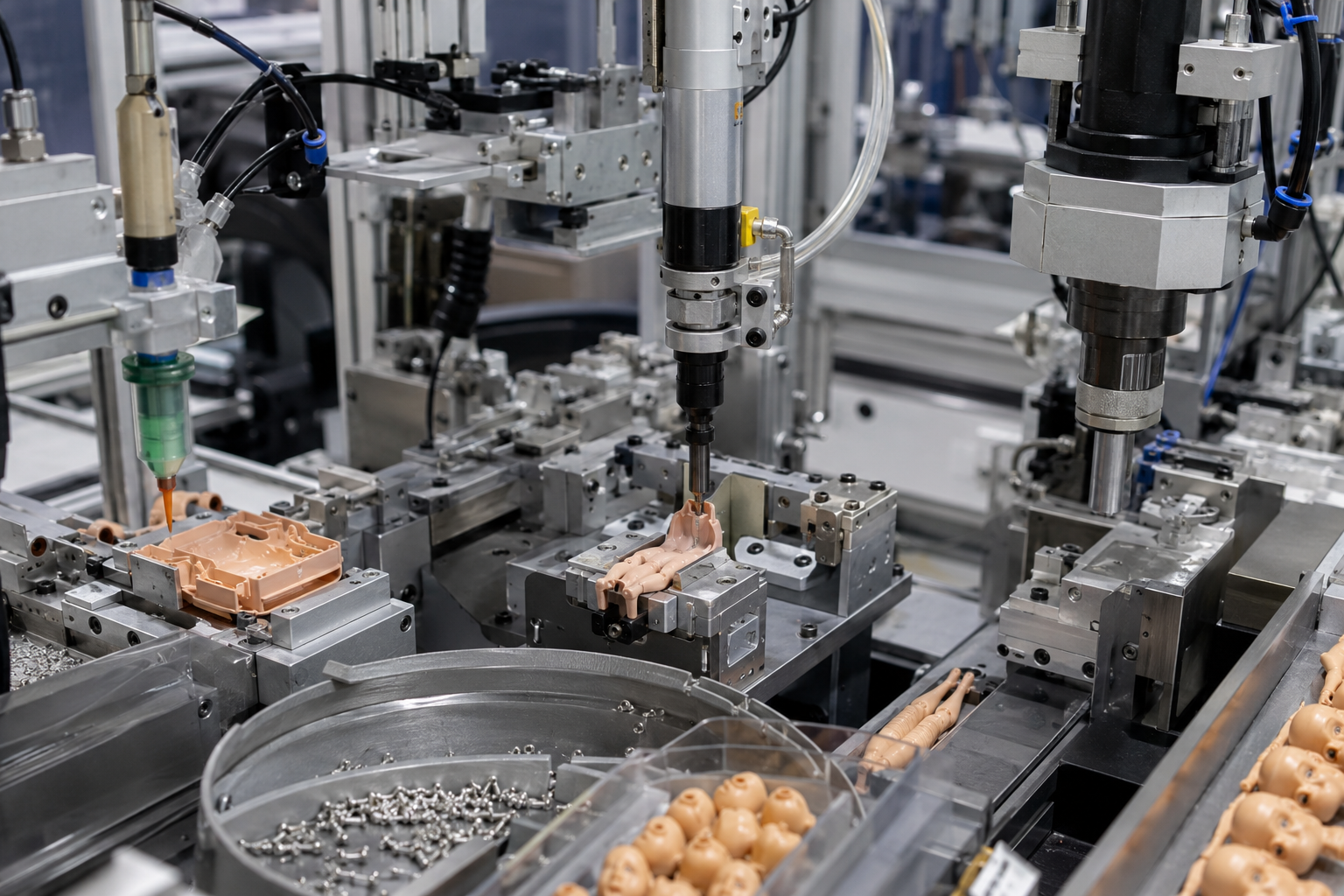
What it does
Auto-feed screwdriving with closed-loop torque control, ultrasonic welding, dispensing for adhesives, and plastic riveting stations assemble components.
Why it matters for toys
Auto-feed screwdriving is still the most widely used join method in toys; we layer ultrasonic and adhesive options on the same line, controlled by the same PLC.
04
QC
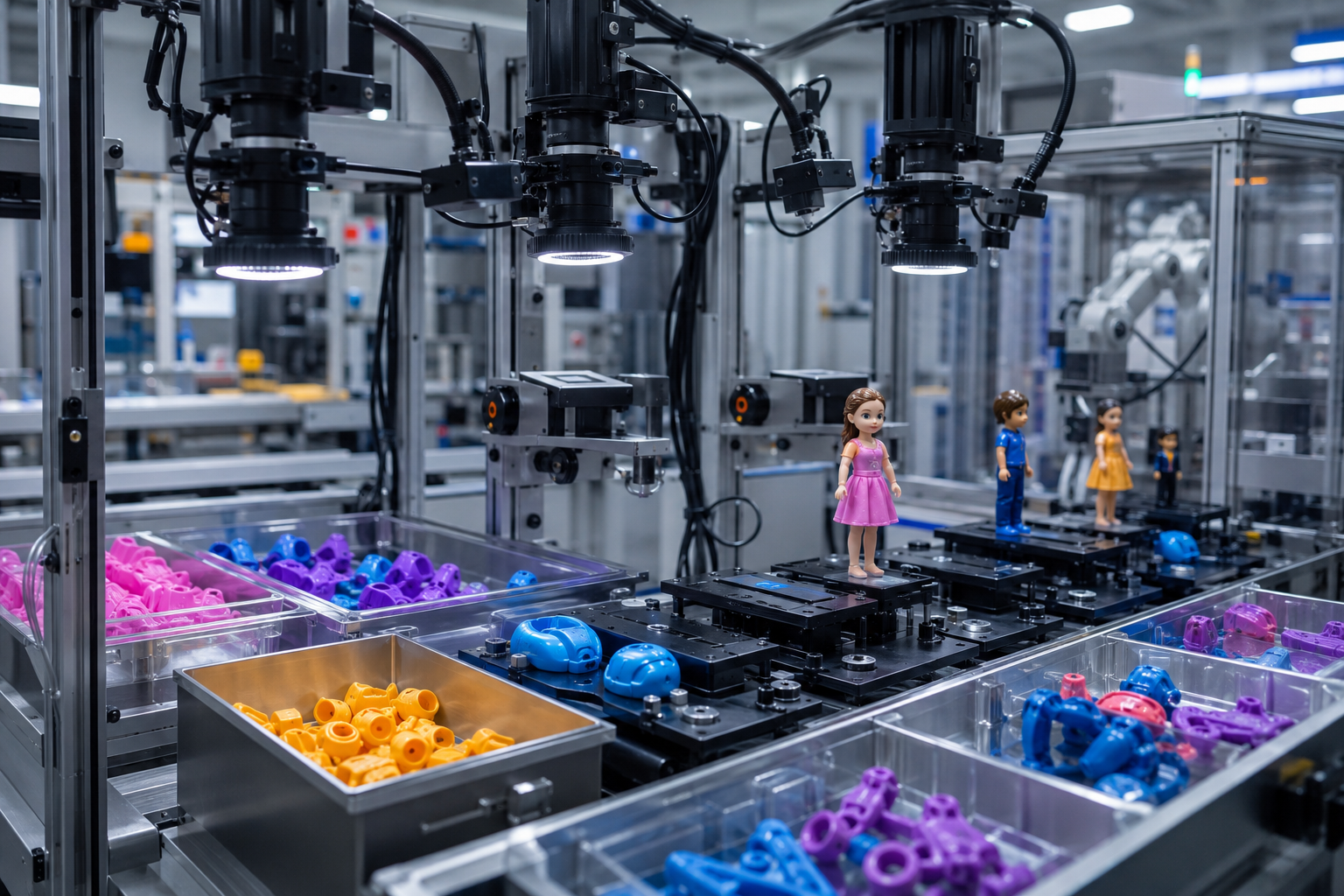
What it does
Integrated vision inspection, leak-detection, drop-test rigs, and 100% in-line traceability tied to the toy safety standards your market requires.
Why it matters for toys
One failed batch on Amazon is a brand-level recall today. In-line QC is cheaper than off-line sortation.
From our Feed module, scaled for woodworking toy plants, to an entire Smart Factory running completely unmanned over the weekend, we deliver designs and builds to customers at every tier. custom machine engineering isn’t an upsell; it’s what drives our 21-year track record across over 30 countries.
This modularity allows an entire shop floor to shift production seamlessly, moving from teddy bears during lunch to electronic STEM kits on the afternoon shift without needing to retool and rebuilt the entire assembly line.
From manual workshop to fully automated assembly line — a worked changeover
Consider a real toy process that we’d recently audited (in 2024). An assembly house in the mid-tier of Southern China was managing a three-SKU workload on a single manual assembly assembly process: a 6-piece action figure, an 8-piece plastic vehicle, and a 12-piece STEM educational kit. Their material would flow upstream of assembly from their molder, machines, to three individual carts – thus the process had to stop and “choke” pre-assembly to begin staging the correct materials per SKU and the assembly changeover between SKUs would take 75 minutes (due to operators needing to refixture all stations, tighten every preset torques, and retrain the vision inspection camera).
We provided a full automated assembly line 18 weeks! Custom Build Custom Build Custom Build Our Build Included :
Servo Controlled robotic arms to the position station
assembly machine Automatic Join station with recipe controlled torques.
One shared Vamugov Vision system that was trained for all three SKUs
Changeover reduced by over two thirds! From 75 minutes to 22 minutes per SKU.
This is the functional difference between automation procurement to cost and automated to lifetime math.
System Active / ISO 9001:2015 / NIST SMED
Custom Toy Assembly Solutions — Models, Decision Matrix & Quick Changeover
A single line can’t accommodate all toy SKUs. We bundle the 4-Stage Architecture into 3 depths allowing engineering managers and their purchasing organizations to select the appropriate level of automation required by the size of the SKU count, the capital plan and order volume.
Basic Assembly Line
From USD $80K
- 3–5 stations, single SKU family
- Manual loading + auto join + vision QC
- Output: 200–800 pcs/hr
- Suited to wooden, board-game and educational kits
- Lead time: 12–16 weeks
Target_Model
Custom Build
USD $150K–$350K
- 5–10 stations, multi-SKU with quick changeover
- Servo positioning, integrated vision, PLC + HMI
- Output: 600–2,400 pcs/hr
- Suited to plush, plastic injection toys, action figures
- Lead time: 16–20 weeks
Smart Factory Turnkey
USD $500K+
- No unmanned toy plant: feed join QC packaging
- SCADA + MES + AGV material handling
- Output: 2,000–7,200 pcs/hr (building blocks)
- Suited to high-volume, multi-line operations
- Lead time: 24–32 weeks
The 5-Step Toy Assembly Machine Selection Framework
Before our engineers put their estimates down they take every prospective client through our five-step tree. The reason? Nine times out of ten we audit failed procurement that never made it through first base because of a mismatch on tiers – not some faulty mechanic.
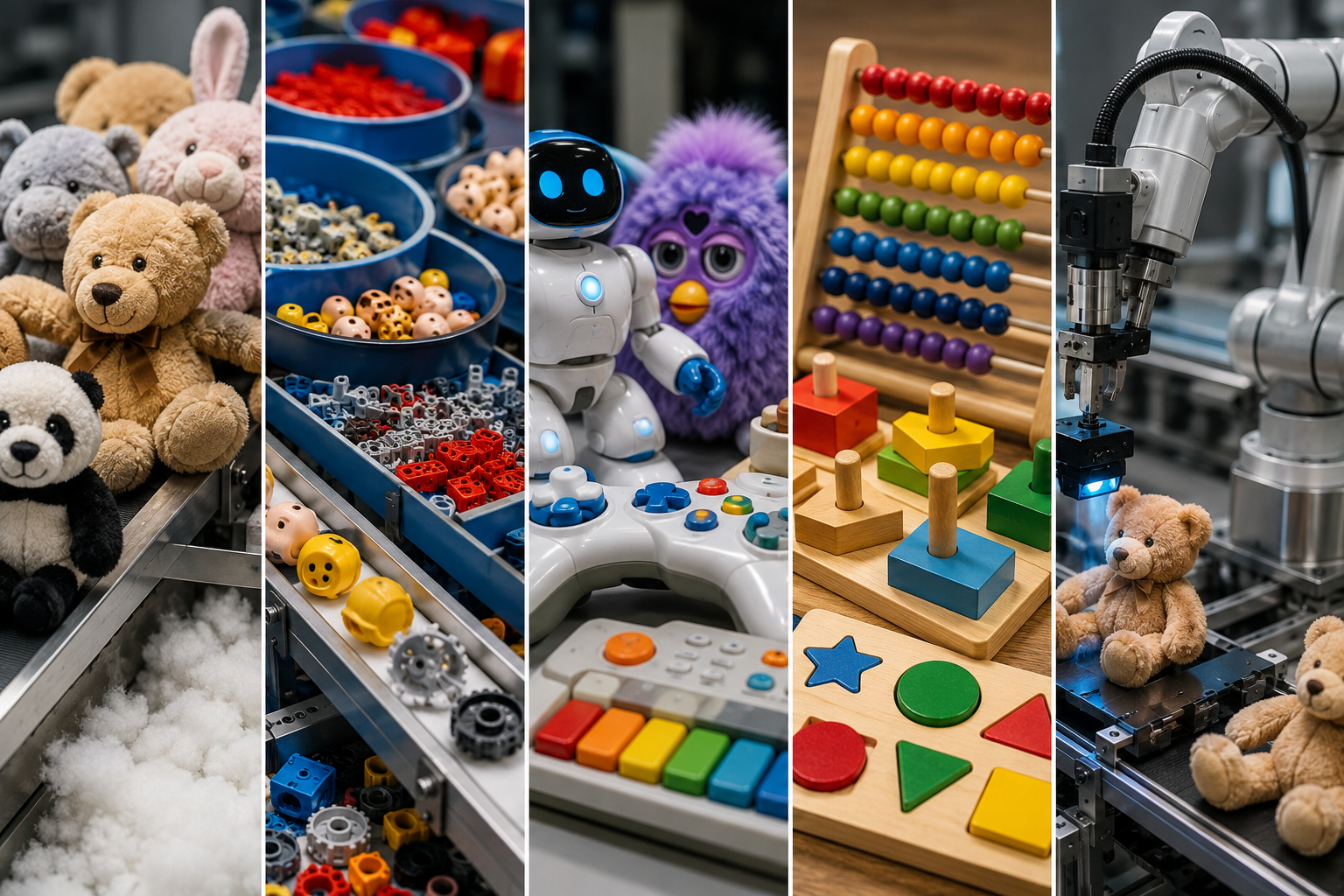
[ STEP_01 ]
Define the archetype the toy falls into. This can be Plush, Plastic, electronic, Educational, or hybrid. The toy archetype defines feed module physics.
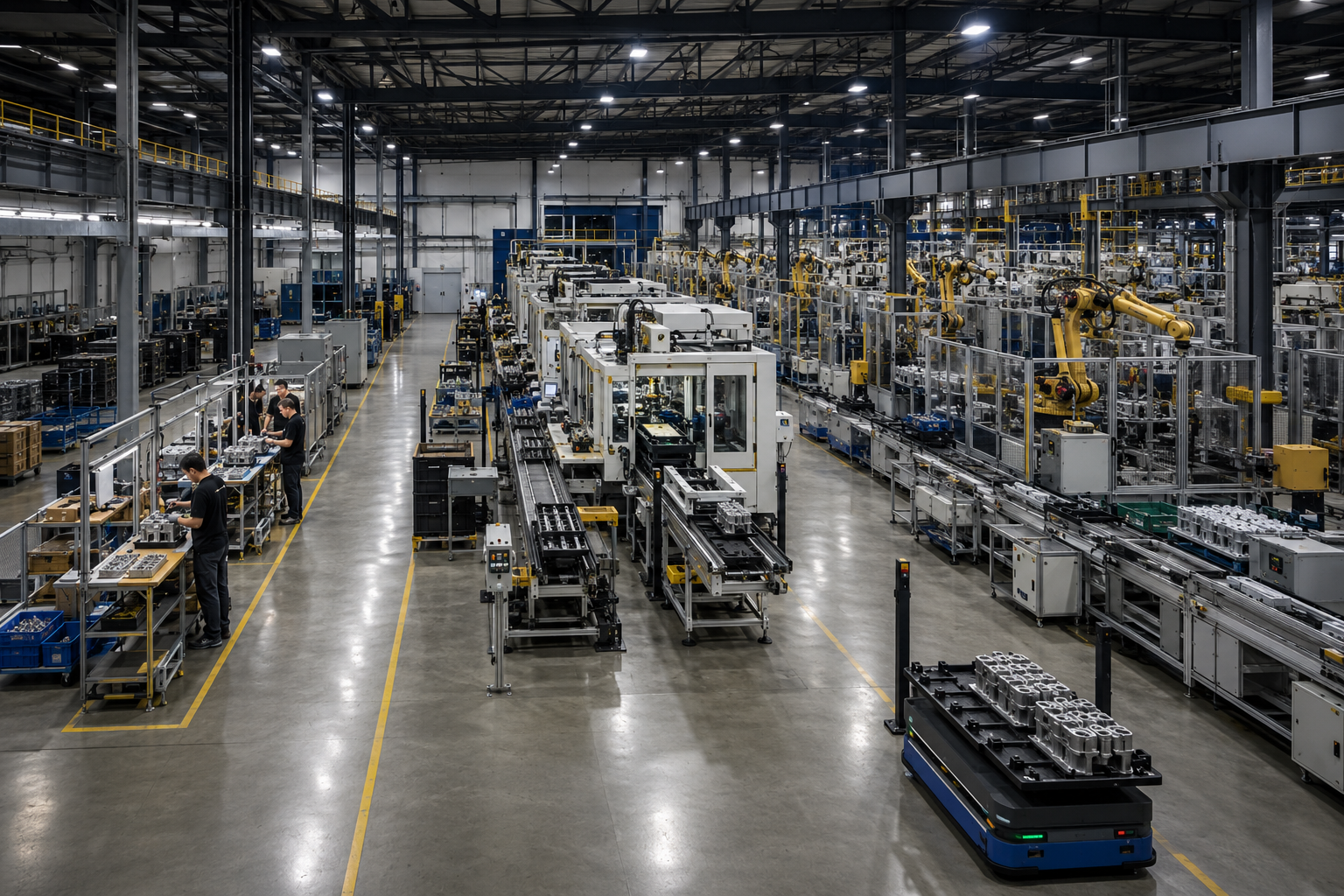
[ STEP_02 ]
Please share your monthly volume per SKU – under 50k recommends basic lines; between 50k-500k recommends custom build; above 500k recommends smart factory.
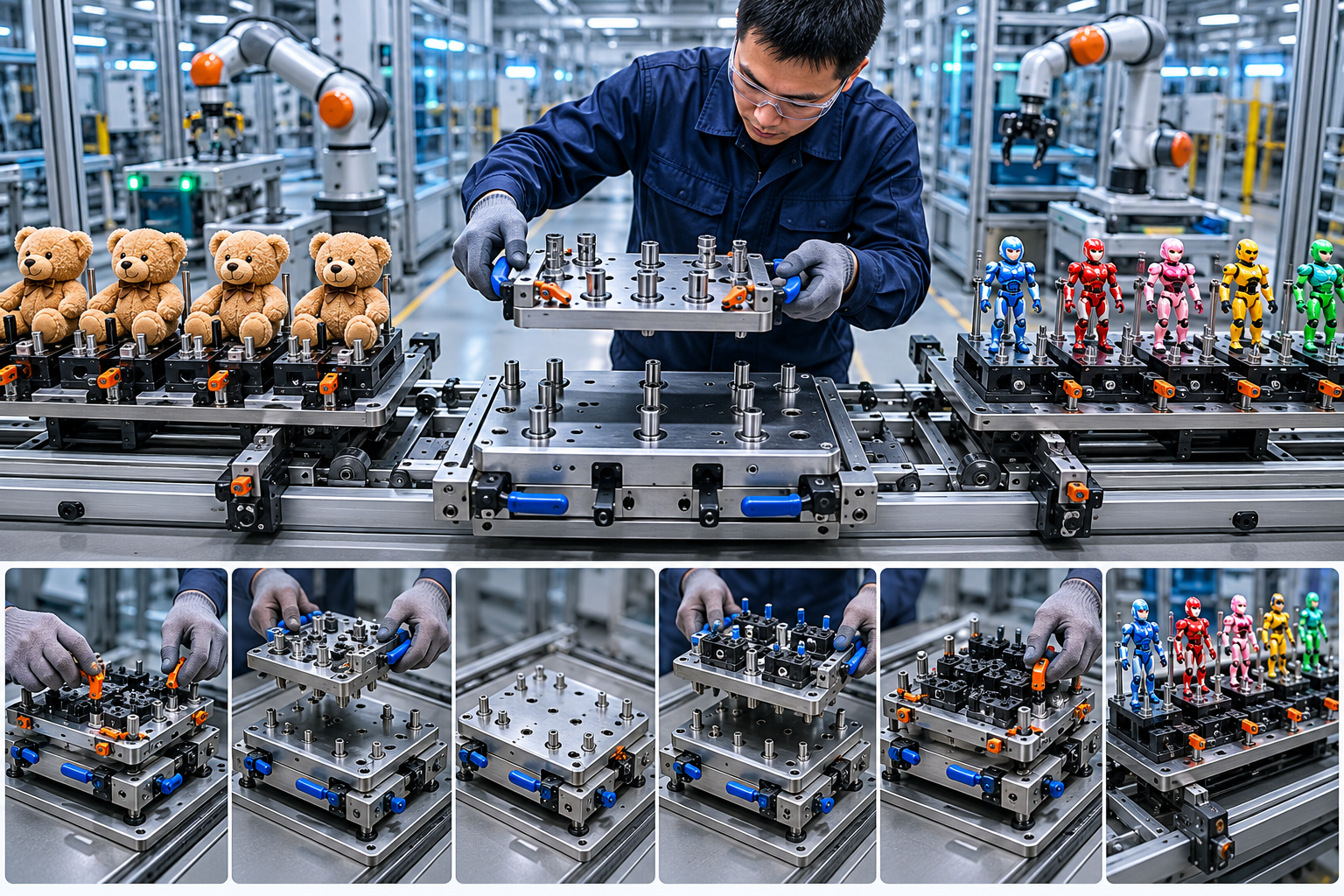
[ STEP_03 ]
Plot your frequency – Swap SKUs daily, so flexible, SMED-style fixtures and tooling are mandatory.
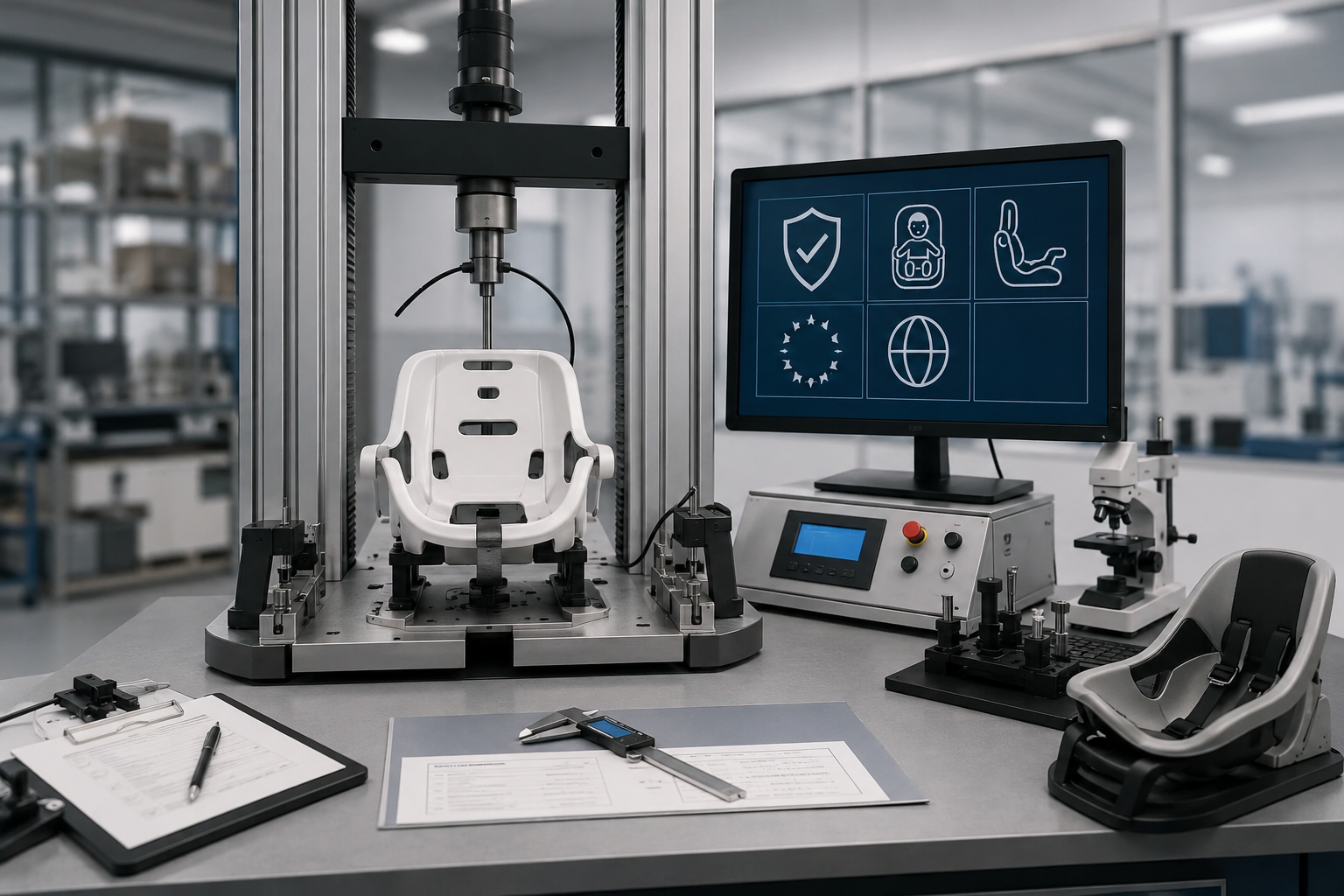
[ STEP_04 ]
Fix ASTM/EN/GB safety standard to the right – design of a qc station aligns with the destination market not the factory.
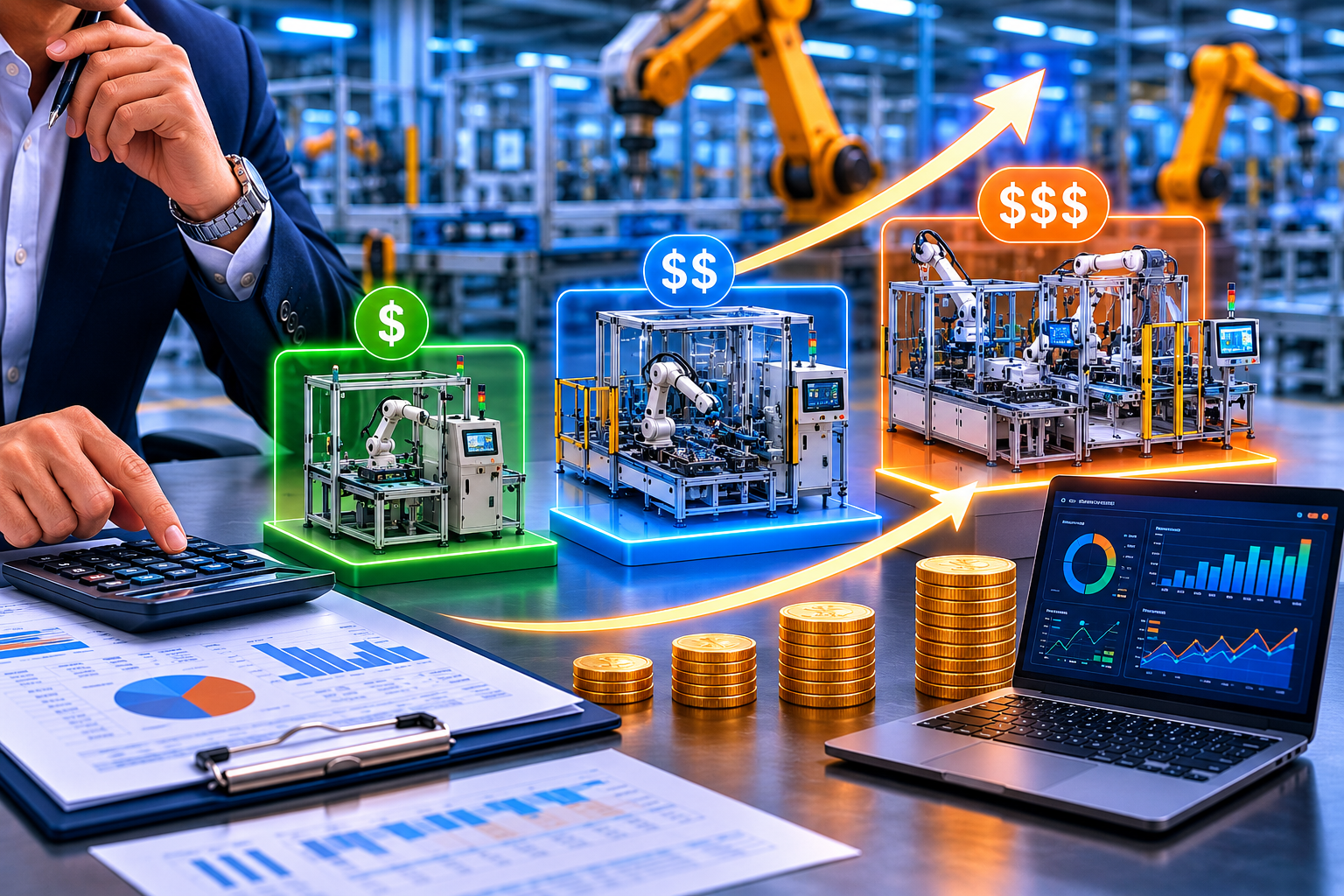
[ STEP_05 ]
Specify Your budget level Match the appetite of the company with the configuration; excess lines pay back far less than adequate ones.
Modular Configuration — Changeover in ≤ 30 minutes
The SMED methodology is designed for sub-10 minute changeover, and many of today’s packaging lines still spend an hour and a half a shift doing them. Our modular tooling cart and recipe-enabled HMI allow the Custom Build line to change fixtures, EoAT, and inspection recipes in less than 30 minutes – which is a record we’ve had independently tested for plush to plastic changes on multi-SKU lines shipped in Southeast Asia.
It comes down to 0.05 mm accuracy every time a modular joint is swapped in and out. A Join station’s servo torque control on the X-Y axes ensures that this initial, on-site accuracy requirement remains, that the line goes into the field at the full production pace and not after an overnight recalibration. This architecture supports a toy making machine client building educational kits just as well as it supports automotive-grade plastic trim module manufacturing or discrete electronics packaging assembly for any number of industrial, and not quite so industriallarge companies.
ZEUEE vs Manual vs Imported Brands — Performance Benchmark
Buying decisions for automated assembly equipment is rarely a 1:1 vendor proposition. If the brand owner is going through our competitive tender it becomes a five-way negotiation: 1. keep doing what is being done. 2. source from India. 3. buy from a US custom builder. 4. get a price from an EU-bespoke builder 5. go with ZEUEE.
| Dimension | Manual | Indian plush specialist | US custom builder (e.g. AMD class) | European bespoke (e.g. RNA class) | ZEUEE |
|---|---|---|---|---|---|
| Cycle time (typical) | 30–60 s | 4–8 s (plush only) | 3–6 s | 3–6 s | 1.5–8 s (by toy type) |
| Output (single line) | 60–120 pcs/hr | 450–900 pcs/hr | 600–1,200 pcs/hr | 600–1,200 pcs/hr | 200–7,200 pcs/hr |
| Labor saved vs manual | 0% | 40–55% (plush only) | 40–60% | 40–60% | 40–70% |
| Quick changeover | Not applicable | 60–90 min | 45–60 min | 45–60 min | ≤ 30 min (modular) |
| Toy industry depth | n/a | Plush stuffing only | Limited (focus auto/medical) | Limited | 9 toy archetypes |
| Lead time (Custom Build) | 0 | 10–14 weeks | 26–36 weeks | 26–36 weeks | 16–20 weeks |
| Price range (Custom Build) | Sunk labor | $60K–$180K | $250K–$2M+ | Opaque (quote-only) | $80K–$500K+ (3 transparent tiers) |
| Patents | n/a | Not disclosed | “2,500+ machines built” | “2,000 systems/yr” | 150+ (32 invention + 68 utility) |
| Industry alliance role | n/a | — | — | — | Vice President, Guangdong Robot Association |
| After-sales footprint | n/a | India only | North America | UK + EU | 30+ countries serviced |
Cycle Time Benchmarks by Toy Archetype
When people design specifications for toy automation products most are not fully cognizant of product-type-specific cycle time realities — a misconception that all products are one cycle time entity. Below, our data bank table (covering plush and plastic action figures, electronics, and aggregate data pulled from published LEGO plant run rates) gives you a rough-cut feasibility evaluation point for your internal engineering analysis.
| Toy Archetype | Avg parts | Cycle time | Output / line | Stations | Changeover | Suggested tier |
|---|---|---|---|---|---|---|
| Plastic injection toys (action figures) | 3–8 | 1.5–3 s | 1,200–2,400 pcs/hr | 4–6 | ≤ 30 min | Custom Build |
| Plush stuffed toys | 4–6 | 4–8 s | 450–900 pcs/hr | 5–8 | ≤ 45 min | Custom Build |
| Wooden educational toys | 5–12 | 6–12 s | 300–600 pcs/hr | 4–7 | ≤ 30 min | Basic Line |
| Electronic toys (battery + sensor) | 10–25 | 5–10 s | 360–720 pcs/hr | 6–10 | ≤ 60 min | Custom Build |
| Educational STEM kits | 15–40 | 8–15 s | 240–450 pcs/hr | 6–12 | ≤ 45 min | Custom Build |
| Action figures (multi-pose) | 8–15 | 3–6 s | 600–1,200 pcs/hr | 5–8 | ≤ 30 min | Custom Build |
| Building blocks (LEGO-class) | 1–3 | 0.5–1 s | 3,600–7,200 pcs/hr | 3–5 | ≤ 30 min | Smart Factory |
| Card games / box sets | 20–50 | 10–20 s | 180–360 pcs/hr | 6–10 | ≤ 60 min | Basic Line |
| Gashapon blind boxes | 3–6 | 2–4 s | 900–1,800 pcs/hr | 4–6 | ≤ 30 min | Custom Build |
Per-unit cost-and-not per-hour rate–is your total cost of ownership driver. An example: a worker in the U.S may earn $50/hr and do the task in an hour where aworker in India earns $15/hr, but does the task in two hours – the hourly pay difference between them is 50%, not 16.9%-19.8% cost savings.
Want this benchmark sized to your toy mix? Run the ZEUEE Cycle-Time Estimator →
[SYS_LOG] Public toy safety incidents tracker: CPSC.gov recall database. Patent example for child-product injection cycles: US20230107550A1.
Toy Industry Customers — From Global Construction-Brick Leaders to Local Workshops
For toy manufacturing brand owners the biggest mistake is a bad supplier choice locking them into a five year production ceiling. By the time the toy manufacturing production line is delivered, the price delta has been outpaced by the cost of retrainng, a lost few percent of yield, scrap, and by far more costly, lost Q4 sales window. This last area, The procurement pain points that become the justification for ordering your toy production equipment is the focus area for Customer Results.
Three case studies follow, sampling toy manufacturing process cases for three broadly applicable toy production segments — plastic, non-flame-proof action figures for an EU customer shipping under EN 71-2, plush teddy bears to a U.S. distributor, and an educational, North-American-based STEM program. Each product and its cost-per-unit will be quite different; each justification will have been different, as will the method of changeover-avoidance or time mitigation. None were commodity items from a standard catalog for easy purchase. Pricing strategy and risk-avoidance challenges (including recall) are present in all and are addressed by the design.
Many assembly automation toy manufacturing equipment vendors offer references on their company website from an unnamed “Fortune 500”, for several commercial and competitive reasons. We at ZEUEE, on the other hand, can offer (upon request and under non-disclosure agreement) a list of 14 companies which returned for at least their second (and some, more than their fifth) ZEUEE-manufactured equipment installation; we can also specify whether it was a plastic or plush action-figures or an electronics toy or an educational product in which our toy making line was supplied. Every ZEUEE custom manufactured toy robot or hybrid manufacturing cell is custom configured based on our under standing of what it will be used to produce – not based on our stock inventory, and we’ve seen almost all possible product varieties in some format over the past two decades.
Cross-industry clients trusting ZEUEE’s automation lines
LEGO Denmark
SONY
Foxconn
TCL
Sumitomo Japan
Corning USA
GAC Group
AVIC
China Shipbuilding
Hunter
TE
// Logo and company references used are generic in nature and for legal purposes. Brand identity upon request with the Capability Audit.
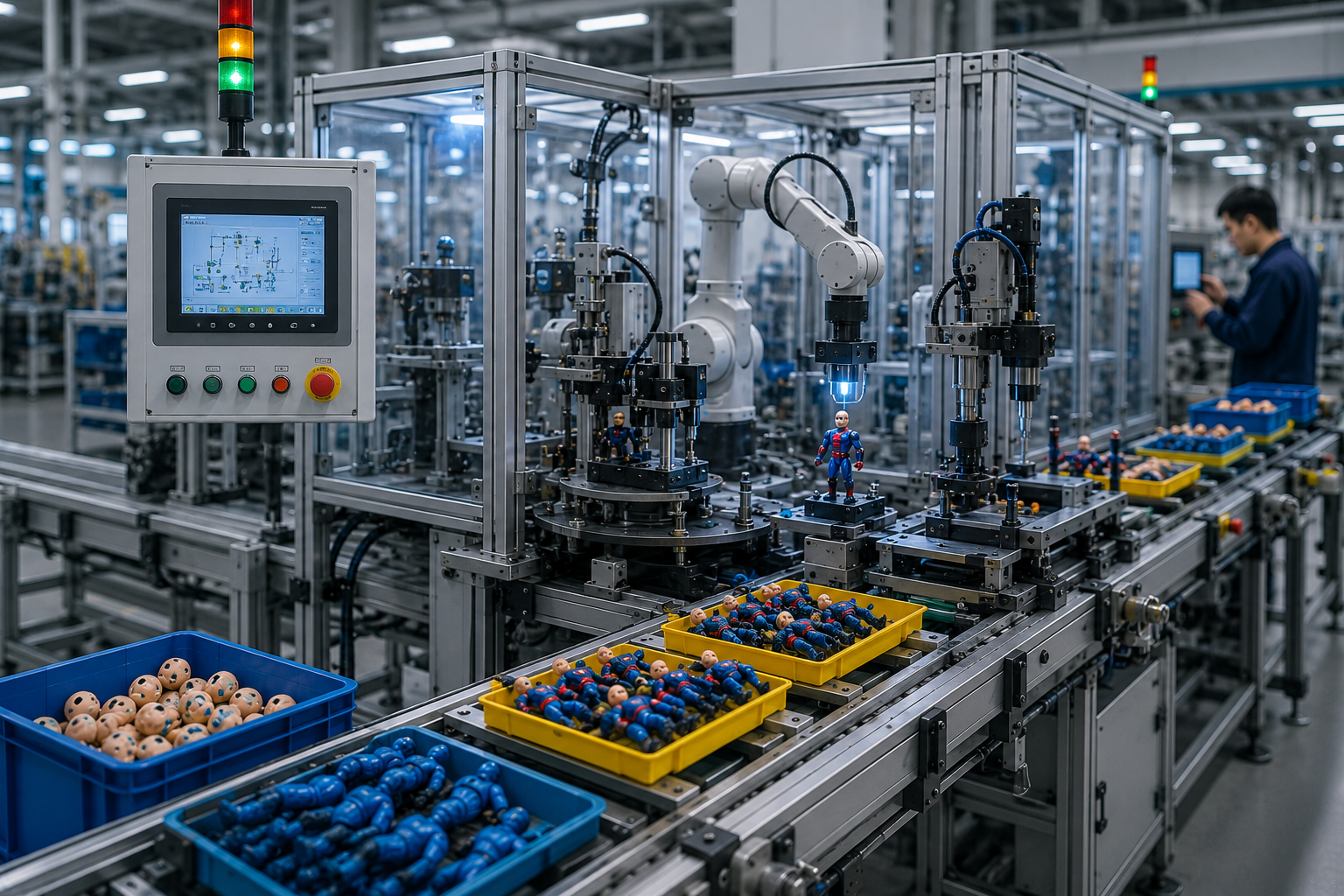
76%
Faster cycle time
Case study 1 — Plastic action-figure plant in Southeast Asia
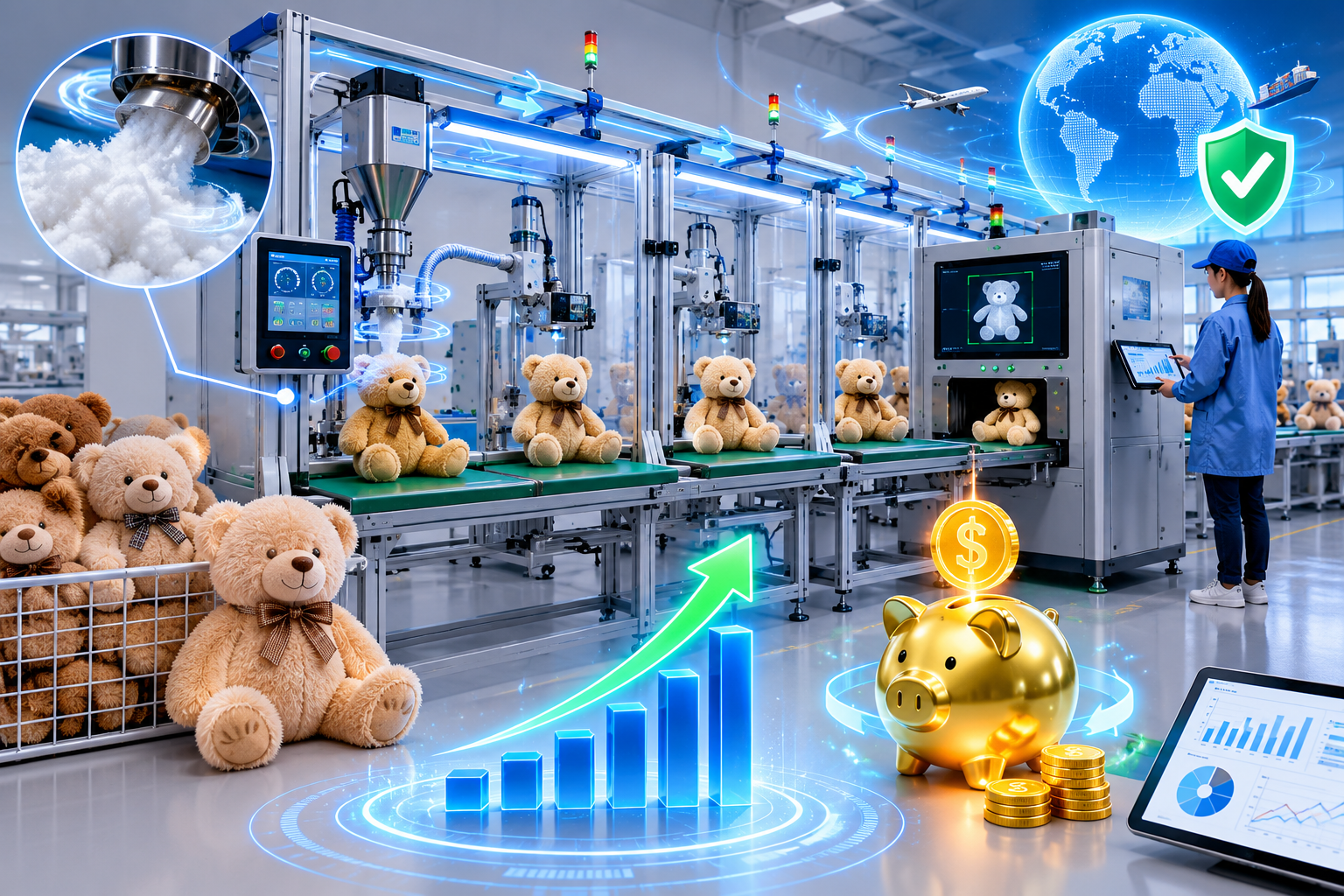
24 mo
Payback period
Case study 2 — Plush teddy-bear line for a global retailer
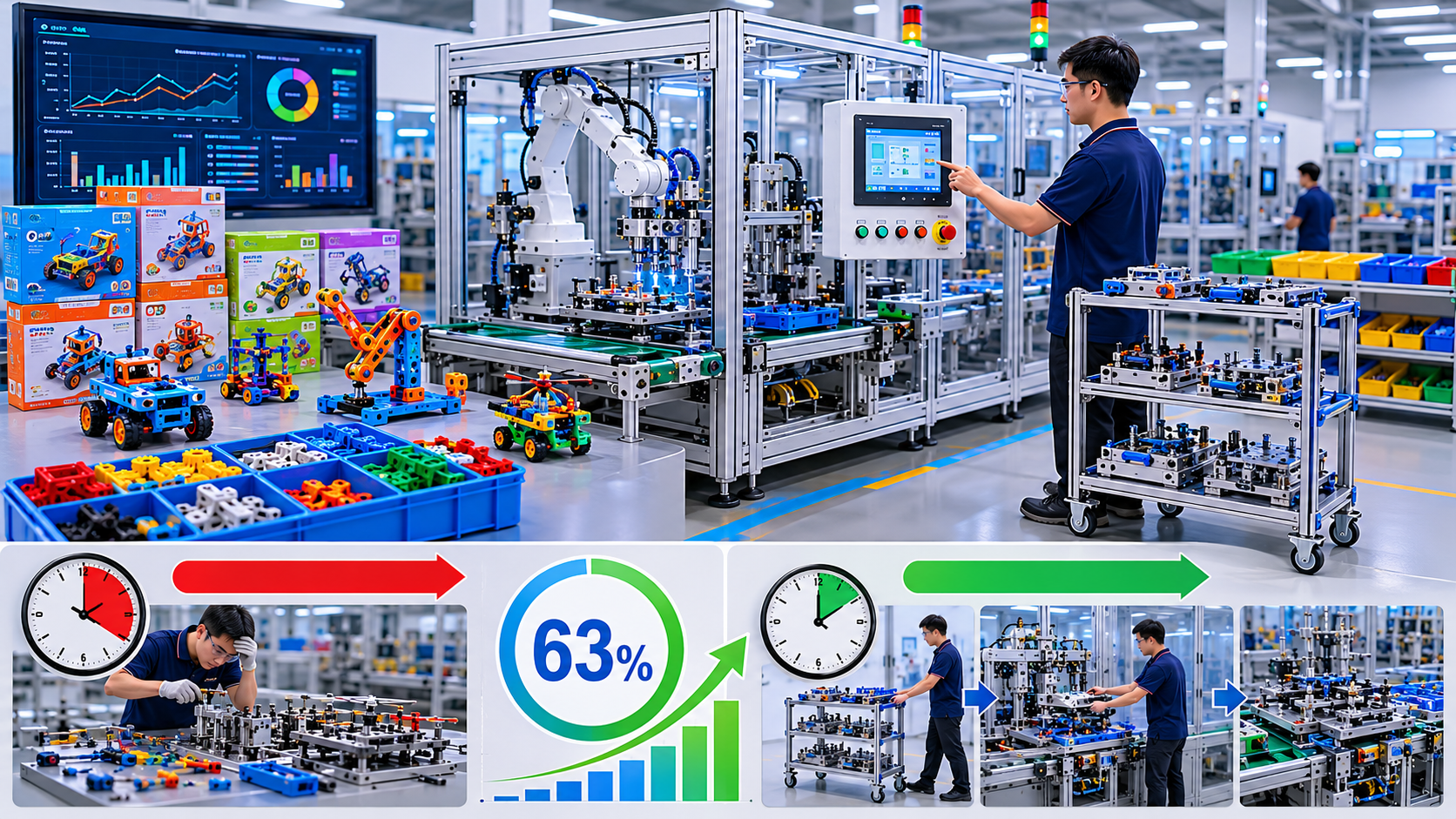
63%
Changeover cut
Case study 3 — Educational STEM kit assembly in Southern China
Cross-industry learning we bring to every toy line
A toy assembly cell shares a surprising amount of DNA with medical device assembly and automotive trim manufacturing. A 0.02-millimeter resolution medical device cell requires the same tolerance discipline as ultra-premium toy action figure lines — and that validation rigour transfers directly across industries.
Because ZEUEE runs a cross-pollinated book of business, our automation equipment engineers have configured automotive-scale serialization capabilities that scale without rebuilding the chassis. toy manufacturing If these customers landed on the “how toys are made” or “toy making business” research our briefing deck answers those questions upfront before we pivot to the cost-per-unit math CFO cares about. The toy assembly line we recommend always matches the actual SKUs & three year projection your buy-side organization possesses-not a brochure spec.
Why these case studies are different from a competitor’s case page
AMD machines provides case studies with generic customers. RNA automation presents logos only with counts of satisfied customers only.
ZEUEE presents logos with counts of satisfied customers and with specific metrics for cycle times, payback times, and changeover times, verified by on-site audit on the Live Plant Tour. This differentiation is what our Customer Results section is designed to bring out.
Certifications, Patents & Quality Assurance
Standards we build to: ISO 9001:2015 · ASTM F963 chart on CPSC.gov · US Federal Register ASTM F963-23 adoption.
While sourcing from China, the relevant procurement team will most likely have certifications, ISO frameworks, and industry-wide reputation standards that they are using. ZEUEE satisfies every checklist item out of the commonly seen 11 points on the China Supplier Evaluation Forms that will likely appear on a 2026 vendor review sheet.
01 / Corporate Status
[01]
ISO 9001:2015
Quality management — re-certified annually
[02]
National High-Tech
State-level innovation recognition
[03]
Specialized & Excellence
National SME designation for tech firms
[04]
Patent Demonstration
32 invention + 68 utility patents
Visual Verification / Audit Evidence Wall
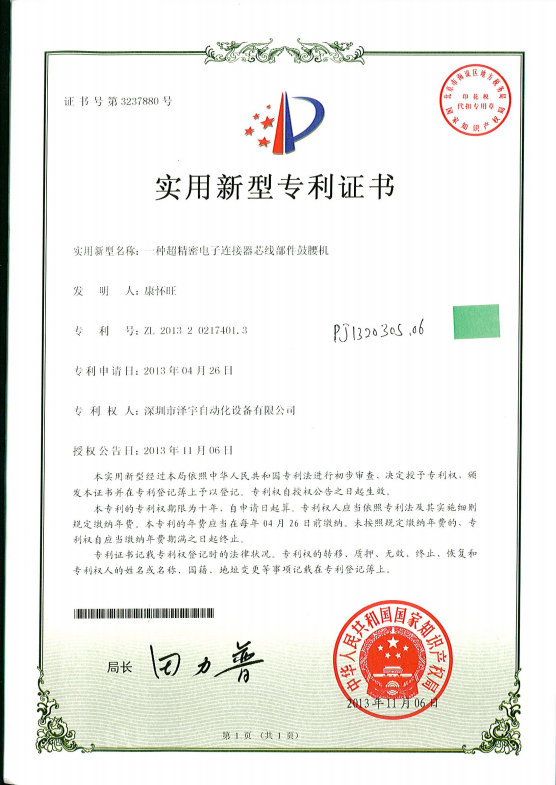
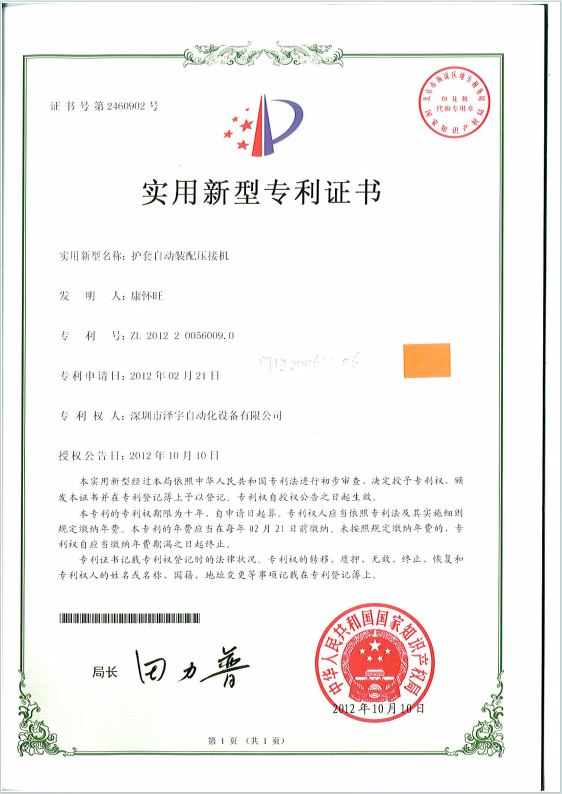
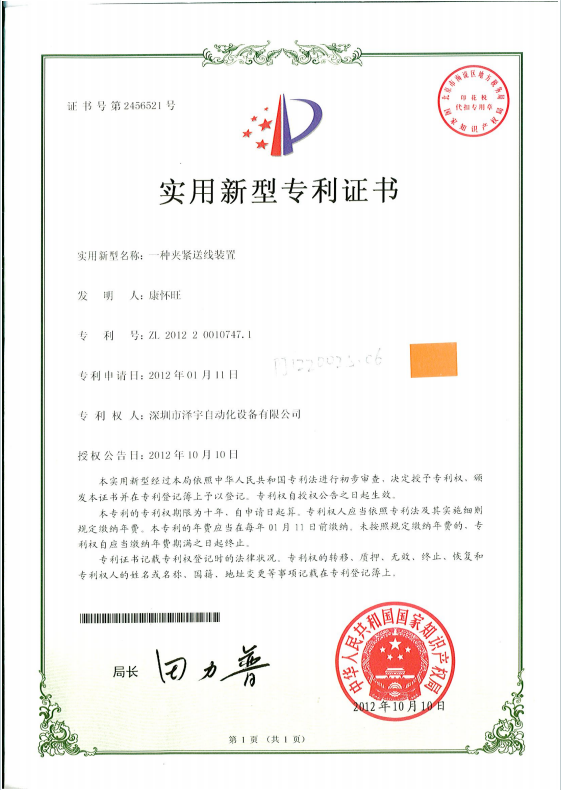
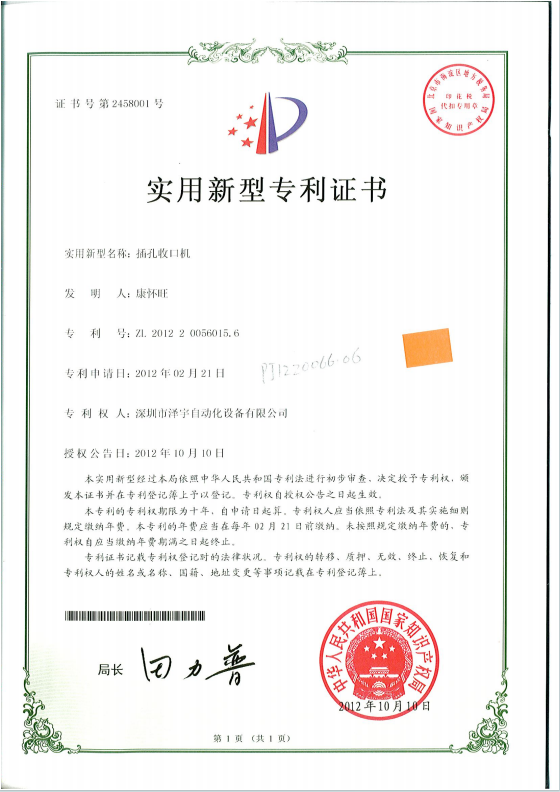
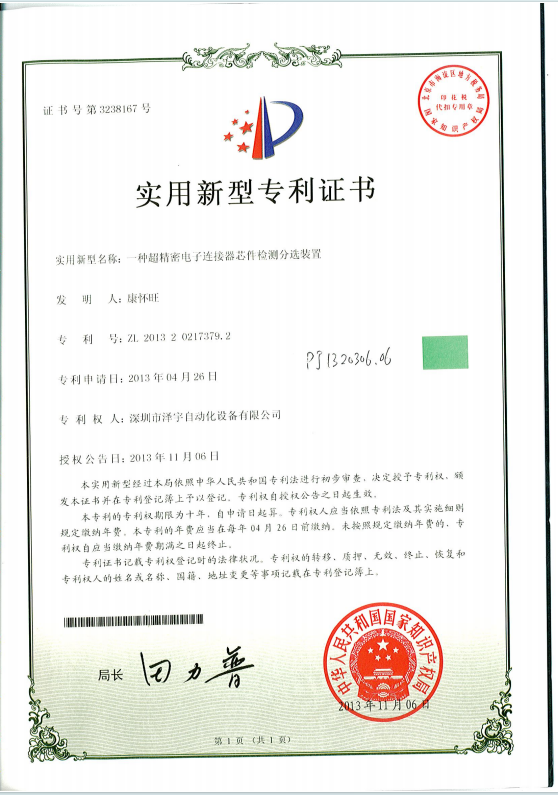
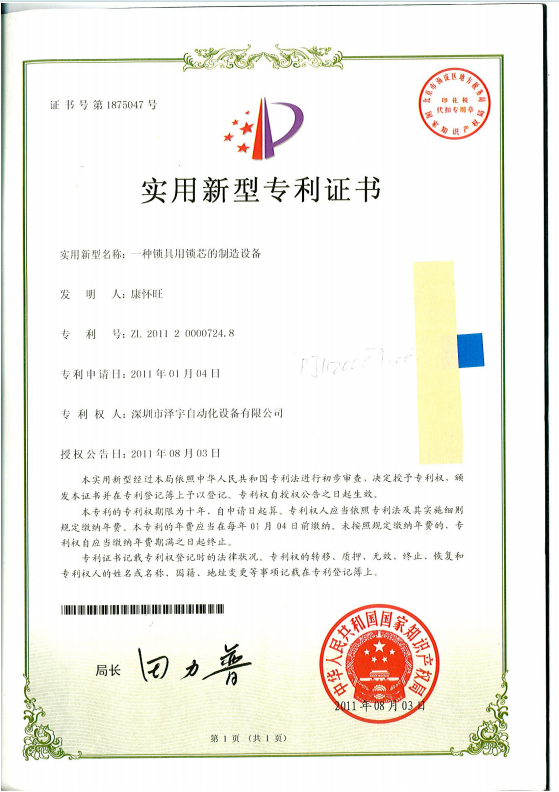
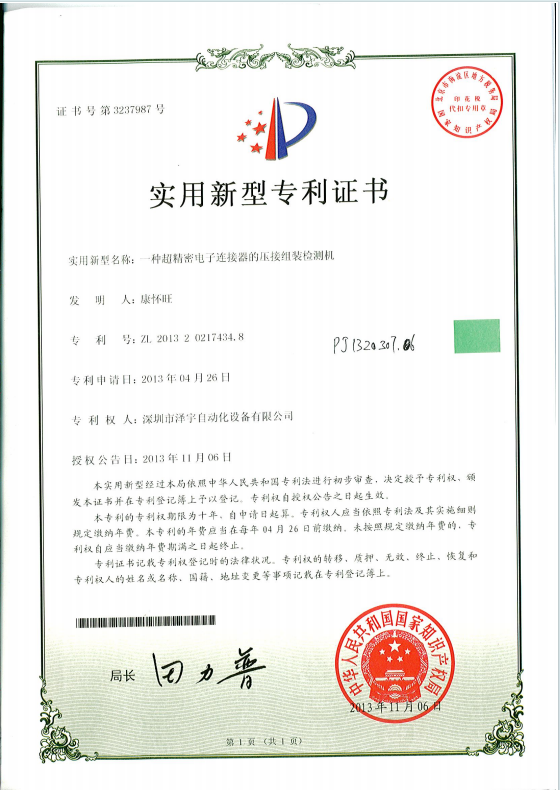
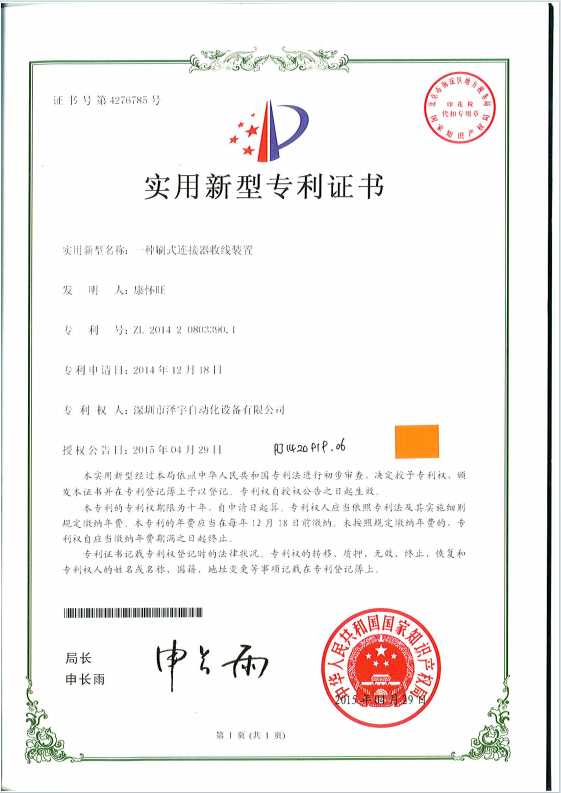
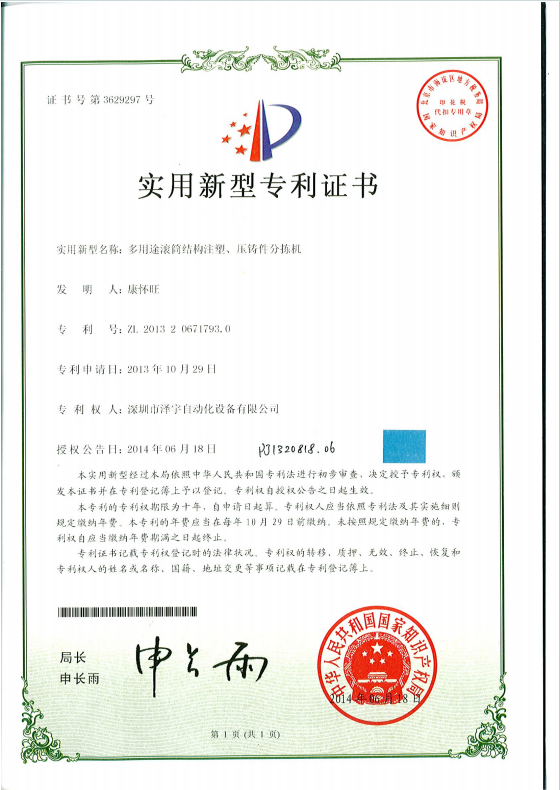
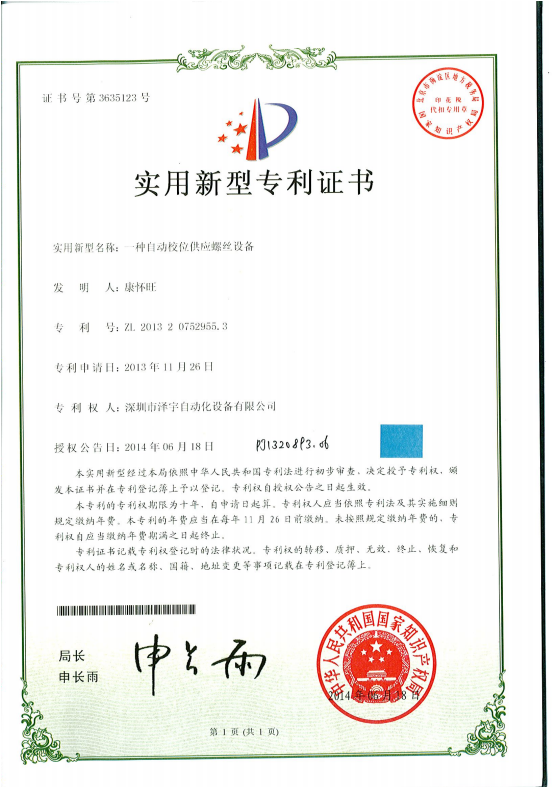
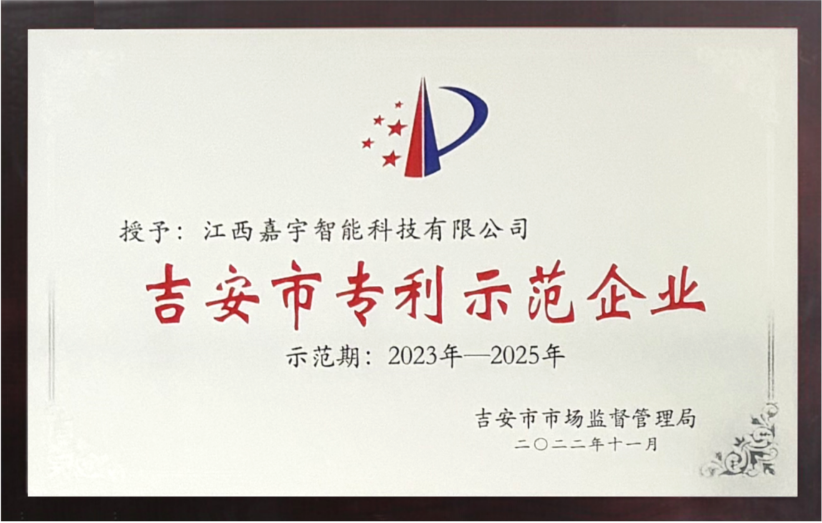
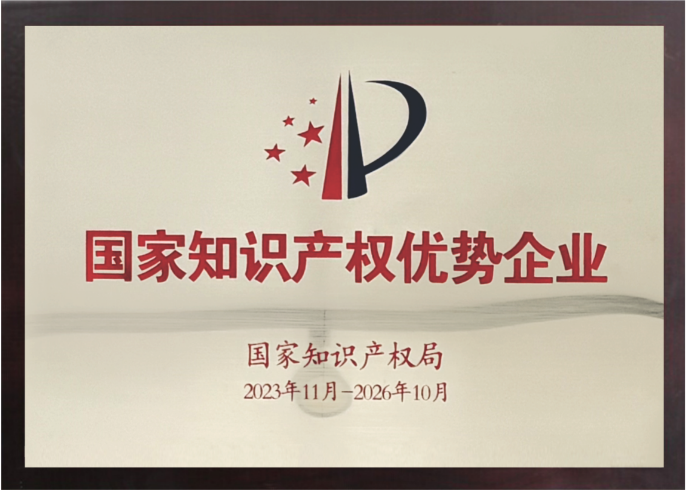

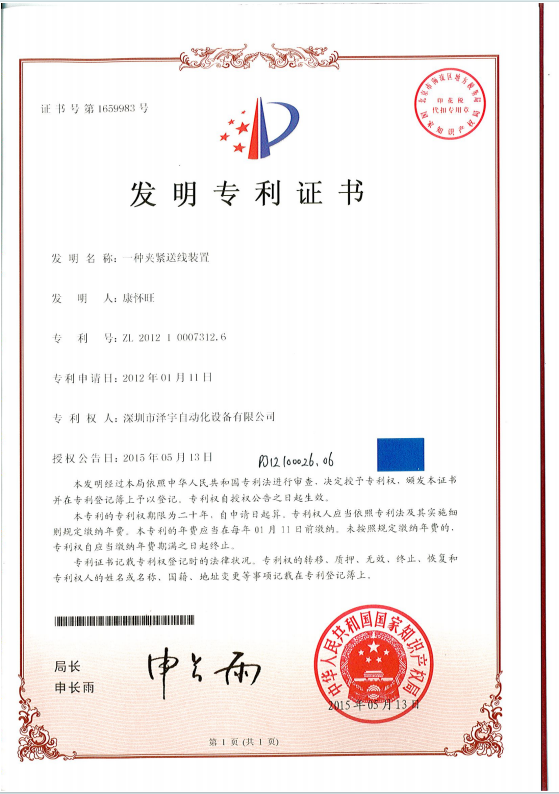
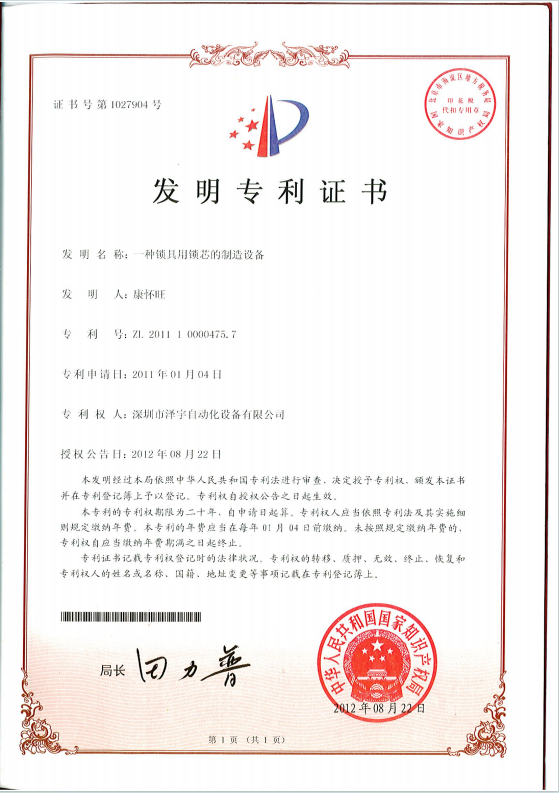
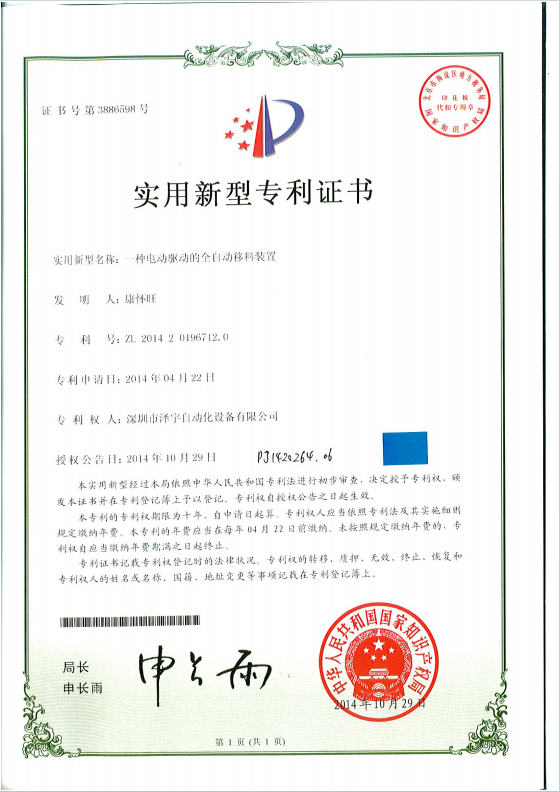
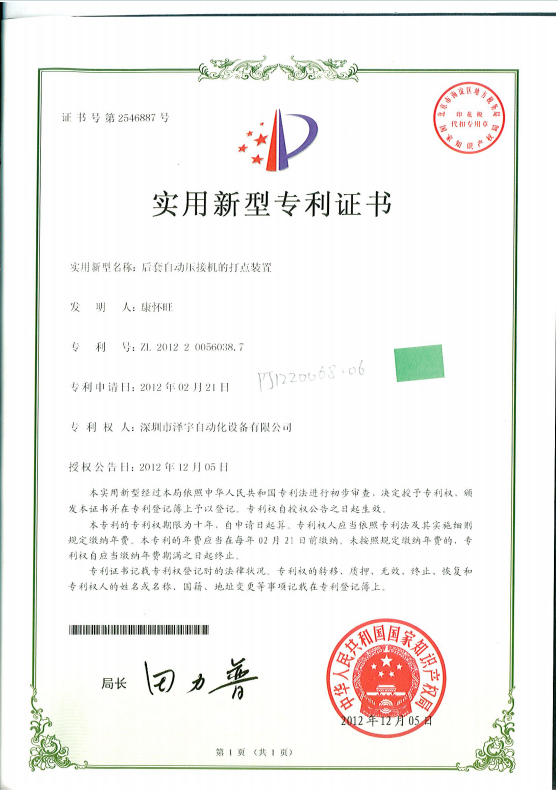
Patent Documents & Framework Accreditations
02 / Compliance Vetting
Toy safety standards we build to
Compliance is the single most expensive cost failure mode in this sector — toy safety. Built-in quality inspection stations on ZEUEE line-builds verify drop-tester results, gauge checks, and chemical migration limits against every required regulation: ASTM F963-23 (USA, mandatory from 2024-04-20), EN 71-1/2/3 (European Union), 16 CFR 1303 (USA, lead in coatings limit 90 ppm), and GB 6675-2014 (China) with its 2025 amendments coming into force on 2026-11-01.
EN 71 Specs
Lines built to 19-metal EU specification standards
ASTM F963-23
US mandatory standard active since April 2024
GB 6675 (China)
2014 mandatory + 2025 revision (effective Nov 2026)
CCC + CE Alignment
Documented validation for every shipped manufacturing line
Vice President Unit
Guangdong Robot Association
Council Member Unit
Shenzhen High-Tech Industry Association
Vice President Unit
Guangdong Taihe Chamber of Commerce
Council Member Unit
Shenzhen Software Association
Member Unit
China Intelligent Manufacturing Industry Alliance
03 / Engineering Authority
Automation associations vetting
Automation solutions designed by an in-house engineering group whose senior staff personally sign technical checks for the national robotics association behave very differently from anonymous offshore quotes; that design also passes safety and OEE certification before leaving ZEUEE for the customer. Our machinery is pre-qualified at levels considerably higher than the published standards.
US ITC HTS / ISO 9001:2015
Procurement Guide — Pricing Tiers, Lead Time, MOQ & Total Cost of Ownership
When leaders of the automated assembly purchases feel that they have been deceived, this has nearly always been related to only one thing: underestimating the value and amount that should have been spent in calculating the total landed costs; versus the actual value represented by the Equipment and Integration portion of any quote, which typically ranges from between 60% to 75%.
Transparent three-tier pricing
| Tier | Equipment range | Suggested integration buffer | Typical payback (2-shift) | Best fit |
|---|---|---|---|---|
| Basic Line | $80K–$150K | +15–20% | 14–22 months | Wooden / educational / low-volume |
| Custom Build | $150K–$350K | +20–25% | 14–24 months | Plush / plastic / electronic mid-volume |
| Smart Factory Turnkey | $500K+ | +25–30% | Under 12 months at 3-shift utilization | High-volume, building blocks, multi-line plants |
The 4-step ZEUEE RFQ flow
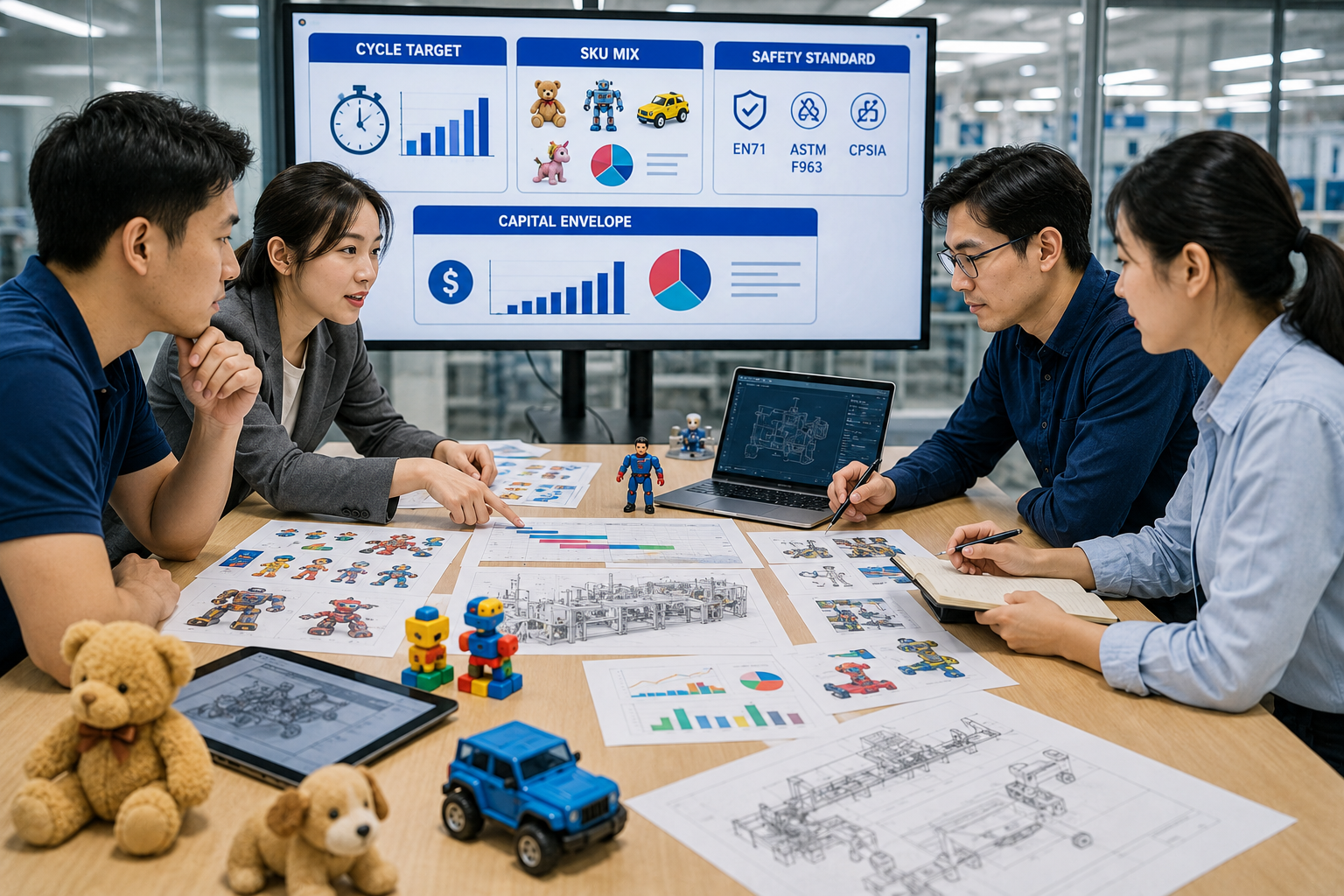
Step 01
Discovery
Week 1
Cycle target, SKU mix, safety standard, capital envelope.
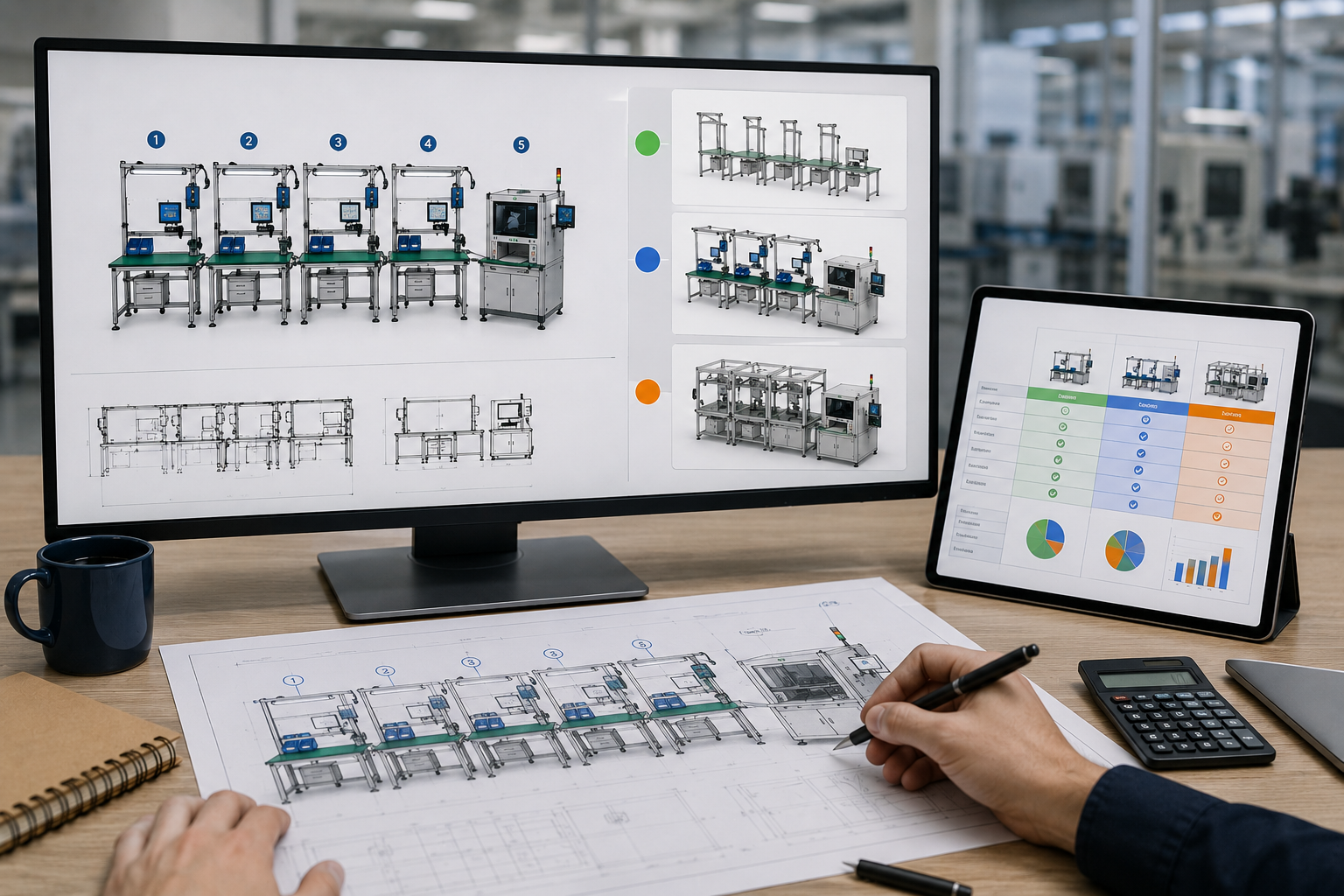
Step 02
Design Proposal
Weeks 2–4
Station layout, 3-tier costing, ROI scenario.
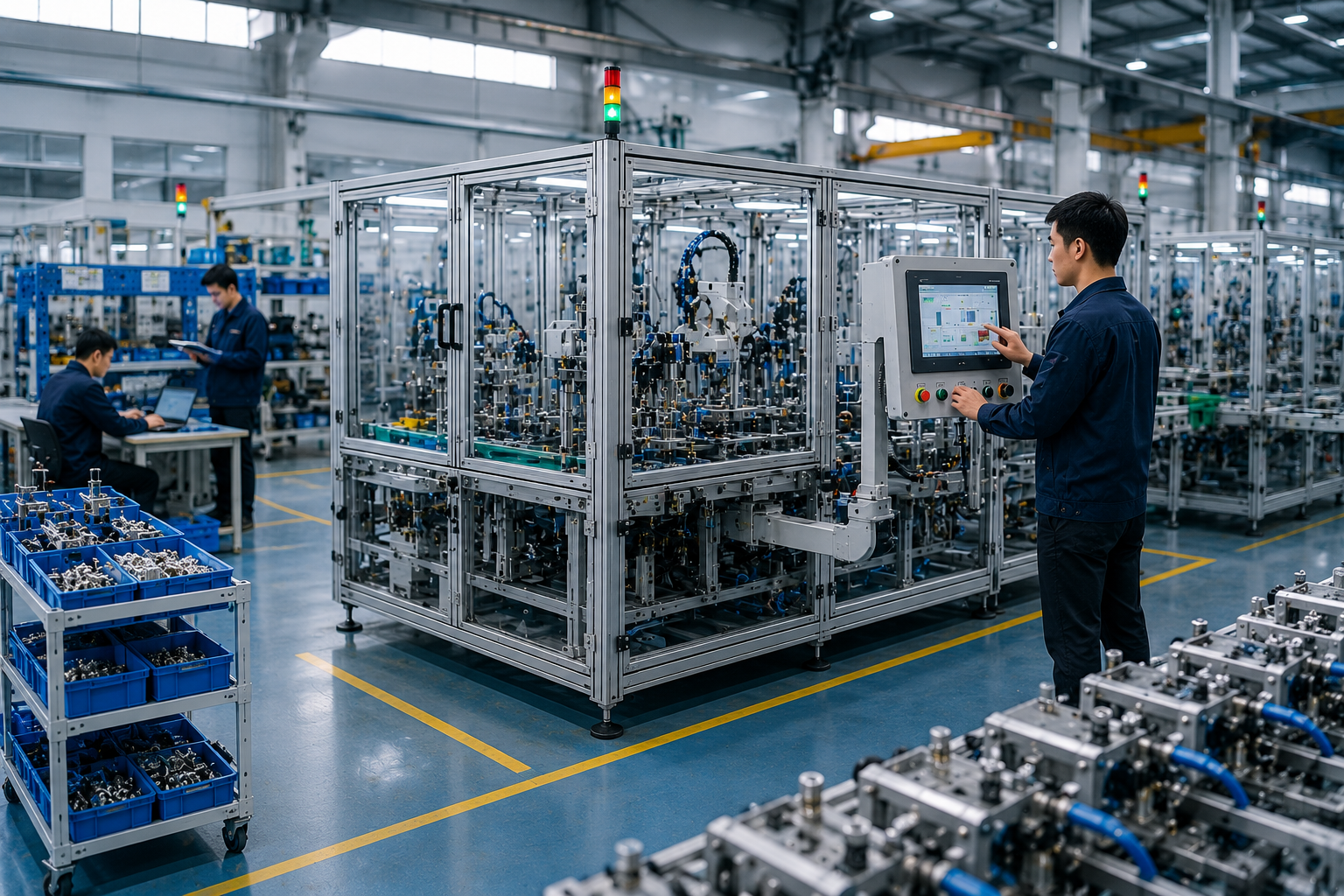
Step 03
Build & FAT
Weeks 5–18
In-house build at our 20,000 m² Taihe plant, factory acceptance test.
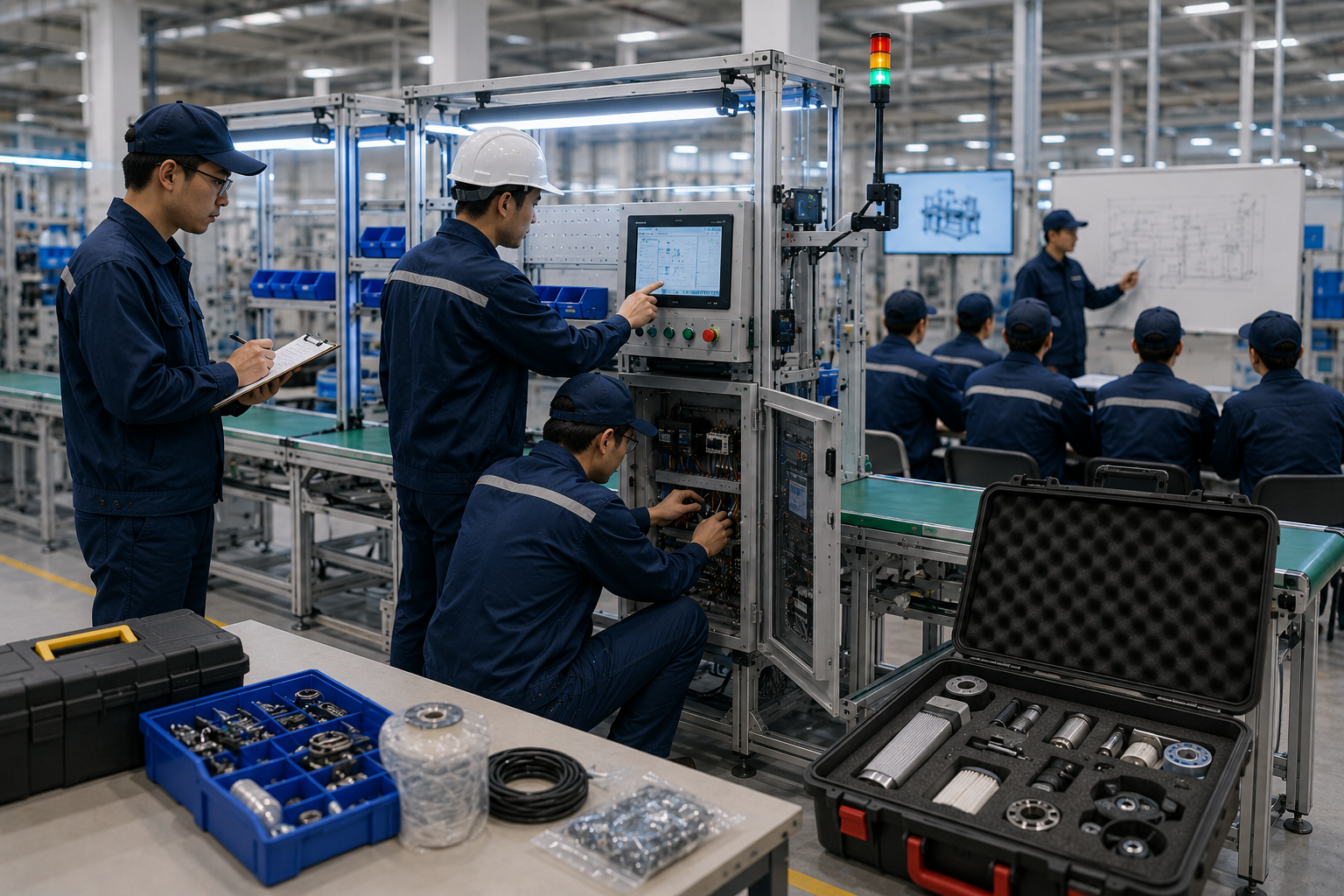
Step 04
SAT + Training
Weeks 19–20
On-site commissioning, operator training, spare-parts kit.
Payment terms, lead time, after-sales
- ThePaymentTerms are 30% upon purchase order signing; 60% prior to shipping; and 10% on equipment performance prior to customer final Acceptance at their Plant (SAT).
- ZEUEELeadTimes can range from a low of 12 to 16 weeks for a basic line to as high as 24 to 32 weeks for a smart Factoryturnkey(but often the build will need lead time closer to the higher-end of 16-20 week range or over.
- TheZEUEEWarrantyfor equipment is 12 calendar months beginning on the date of the customer SAT and remote support services are offered using secured VPN connectivitystandard.
- A critical-spares kit ships with every line, and 24-month consumables are stocked through our regional partners in the US, EU, Mexico, Vietnam, and India.
Total-cost-of-ownership framework
When comparing ZEUEE to any lower-cost labor markets (as is often the case with a low-wage geography), the proper methodology is to apply the equivalent fully-burdened wage equivalent ($20 X 1.3 to 1.6x= $26 – $32)to estimate displacement ROI; not dividing direct robotic equipment costs by the simple wage alone (since most robotic deployments do under estimate costs of labor by up to 30-60%)!
Field-observedROI for one-example ZEUEE Custom Build with equivalent integration costs (at 22% additional)displacing 1.5 of the same operators working the same equipment for 2-shift operations @$20 /hr 1.45x fully-burdened Wage – the actual ROI and payback could take anywhere between 14-22 months of field application before accounting for any scrap cost reductions.
Want this modeled on your SKUs? Get a Cost-per-Unit ROI Estimate →
SYS_INTERACTIVE_RESOURCES
Engineering & Procurement Tools
Access our proprietary modeling tools to calculate precise production metrics, financial payback scenarios, and current line capabilities.
Cycle Time Estimator
Calculate throughput, stations needed, and bottleneck risks based on your specific toy SKU, BOM count, and desired output targets.
Calculate Cycle TimeROI & TCO Estimator
Model your total cost of ownership against fully-burdened labor costs to determine precise payback periods for manual displacement.
Run ROI ModelLine Capability Audit
Assess your current manual or semi-automated processes against industry benchmarks for SMED changeovers, compliance, and QC.
Start Capability AuditFAQ — System Specifications
A ZEUEE Basic Line starts at USD 80,000 and is the right entry point for wooden, educational, and low-volume kits. Custom Build lines for plush, plastic injection, and electronic toys sit in the USD 150,000 to USD 350,000 envelope and ship as 5- to 10-station configurations with servo positioning, integrated vision inspection, and PLC plus HMI control. Smart Factory turnkey installations start at USD 500,000 and absorb feeding, joining, QC and packaging into a single SCADA-supervised plant. Across all three tiers, add a 15–30% integration buffer for end-of-arm tooling, controls integration, ramp-up, and the 60–75% rule that engineering teams call out in industry ROI literature.
Typically four weeks from initial conversations to a final proposal and quote. Twelve to 18 weeks from order to factory Acceptance Test(FAT) for a custom Build and six to eight additional weeks to commission and train operators on the completed line will take anywhere from 18 to 24 weeks door-to-door.
Yes. With our customizable fixture cart and recipe-based HMI, our custom Build line can switch out fixtures, EOAT and vision inspection recipes in less than 30 minutes. SMED methodology strives for single-digit changeover times, and for multiple product line setups, we see 30 minutes as realistic on the plant floor.
Build-to-spec presses are capable of 0.5-second cycle rates, while densely packed STEM kits run at 15 seconds. Robotic assembly systems deliver 92 to 97% of capacity without issue, whereas manual stations with human operators typically run at only 78 to 85%.
All ZEUEE QC stations conform to the host country’s legal requirements. In the US, this requires adherence to ASTM F963-23 and 16 CFR Part 1303. EU countries implement EN 71-1, EN 71-2, and EN 71-3:2019 +A2:2024. In China, GB 6675-2025 requires CCC for items sent into that country after Nov. 1, 2026. We reconfigure QC settings to your targeted global markets to prevent recalls.
Yes, we ship to over 30 nations and send on-site personnel for commissioning. Our network maintains locations in the US, EU, Mexico, Vietnam, and India for spare parts. We offer a 12-month warranty covering remote diagnostics over a secure VPN connection.
Below 50,000 units/month, a semi-automatic Basic Line yields quicker payback. Between 50k and 500k, Custom Build machines offer superior ROI as labor savings offset integration. Beyond 500k units, Smart Factory turnkey setups justify upfront expenditure. Hand-held screwdriving automation remains the default in toy assembly before scaling to full robotics.
12-month warranty starts at SAT. Critical spares are included with every line. Local spares are available regionally for 24 months. Annual Maintenance Contracts (A.M.C.) run at 3-5% per year of the equipment price.
WHY WE WRITE THIS
About ZEUEE Engineering Insights
ZEUEE shares technical guides based on real automation project experience. Since 2005, we have designed and manufactured non-standard automation equipment for connector assembly, wire harness production, robotic lines, vision inspection, and smart factory upgrades.
Founded in 2005
20,000 m² production base
120+ specialists
150+ R&D patents
ISO9001:2015 certified
![Automated Screwdriving: Torque & Cycle Time [Guide]](https://zeueeauto.com/wp-content/uploads/2026/10/automated-screwdriving-featured-150x150.png)