Get in touch with Zeyu lntelligent Industrial Company
ISO 9001:2015 Certified
Twist Pin Machine
Twist Pin Machine — Stranding, Cutting, Welding & Inspection
ZEUEE twist pin automated production line — precision stranding, laser welding, CCD visual inspection, in one ISO-certified machine. Built since 2005 for Corning USA, TE Connectivity, Sumitomo, AVIC, LEGO and Foxconn.
Precision Hyperboloid Contact Production
Wire Diameter Range: 0.2 – 0.8 mm
Strand Count: 3 – 9 strands
System View
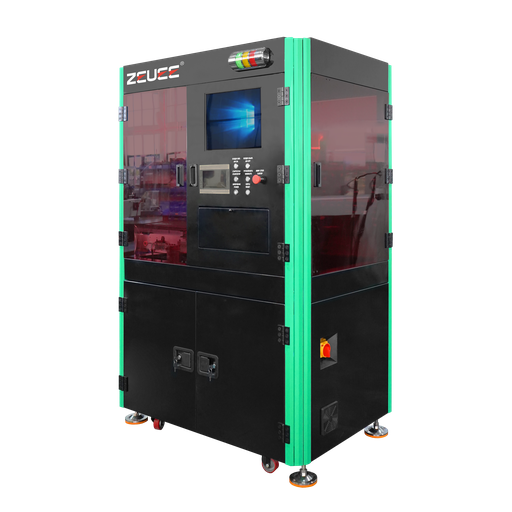
CCD Inspection
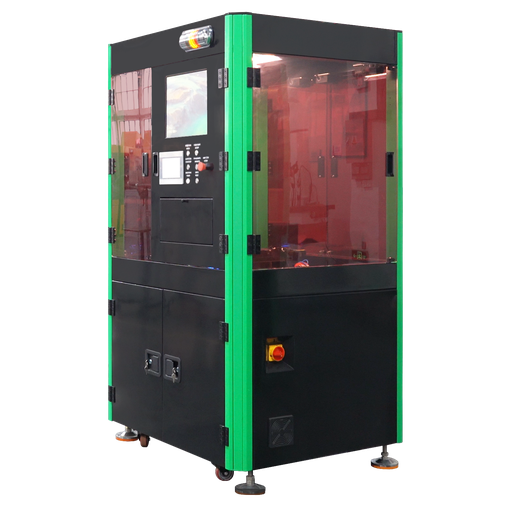
Production Line
6 Integrated MachinesCapacity Range
0.2 – 0.8 mm Dia.Quality Stack
4 Inspection LayersR&D Portfolio
150+ Patents (32 invention)From Hyperboloid Contact Demand to Production Reality
A twist pin-technically called a hyperboloid contact pin-is a precision spring contact. Three to nine very fine wires of copper or beryllium-copper alloy are stranded to form a helix, creating a bundle that generates up to seven or more unique, repeated contact points per pin.
The geometry of this bundle provides a contact with a 10x greater resistance to shock (500g compared to 50g, per Cinch Connectivity tests) and a useful life of over 10,000 mating cycles (with less than 2 percent rise in resistance). Aerospace, RF-coaxial, medical, and semiconductor-test connector makers value the twist pin for the same reason: the ability to survive damage. A single stamped-contact failure in an aircraft can be deadly, and in wafer testing can spoil a billion-dollar run. A twisted, 7-wire contact bundle can continue transmitting signals even if one or more strands fail.
Despite the contact pin’s 10x edge against shocks, its manufacturability has historically lagged: most twist-pin makers around the world have traditionally handled it via either a completely manual or a semi-automated process, which doesn’t always work out to the advantage of a producer.
Why manual and semi-automated twist pin lines fail
Operator-induced tension variation
The tiny diameter of 0.2mm be-cu wire may break when under inconsistent tension from manual handling, making twist pitch irregular, and the pins will not meet strength requirements, preventing shipment.
No inline detection on fine wire
Loss of some good parts-8%-15% of 0.2mm strands-may not be discovered without per-strand monitoring, only to appear at crimp inspection time when it’s too late to afford repair or reuse.
Hand cutting + arc welding
Burning on the pin ends, and variable pin lengths will throw down-line connector-housing fitment out of tolerance; then, parts will need to be shipped back on aerospace and medical orders.
Sequential standalone machines
As many as five or six times the operator to operator hand-offs lead to contamination and length variation issues-in contrast, three to five operators managing six machines running this same production line is sufficient for what usually requires 30 or more in smaller, fragmented assembly environments.
No traceability for compliance
Customers looking for 0.002in minimum electrical clearances in their parts-like the those mandated by NASA INST-EEE-002 standards or customers following IPC/WHMA-A-620E Class 3 requirements-can be at odds when they rely on manual assembly to maintain them because there are no individual bunch and strand level batch history records, meaning you’ll likely require an additional and time-consuming batch-record step.
ZEUEE engineered this integrated 6-machine twist pin assembly machine, first to solve precisely this deficiency. It features simultaneous CNC servo synchronization through all six processes, a fully integrated, 4-stage inline QC suite that will detect wire tension and integrity issues even before they appear at crimp time-not after.
And everything is routed through a single, synchronized PLC pipeline for at-will, batch-specific SPC and for generation of the full audit trail required for customers adhering to the IPC-A-620 Class 3 specification. The subsequent text below breaks out each of the six machines, and then analyzes the economic case for a 6-machine automated line compared to legacy methods.
ZEUEE’s twist pin automatic assembly machine integrates six modular production stages into one automation machine cell. Every component — from the strand-tension head to the drum-waist former — is engineered for automated assembly and IPC-A-620 traceability. This automatic assembly machine consolidates what would otherwise be sourced as separate insertion machines, terminal-handling tools, and mechanical inspection equipment from multiple machine manufacturers. An OEM placing this one integrated machinery cell improves production efficiency, reduces training overhead, and reclaims floor-space efficiency in compact footprints.
ZEUEE Twist Pin Stranding Machine — JY01-01 Series
It is stranding which determines whether the twist pin specs win or lose. A stranding machine which cannot keep per-strand tension to within milligrams will not create a 0.2 mm hyperboloid bundle which will make ten thousand cycles without resistance drift. Read technical details…
This JY01-01 was engineered with four real time monitor channels running in parallel – C.C.D. visual inspections, laser measured wire diameter, permanent-magnet per strand tension and an optical fiber material monitor — so that a strand defect is stopped on the strand, not a shipped pin.
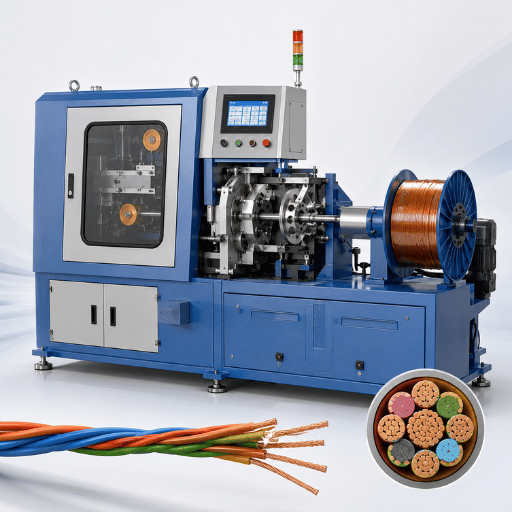
JY01-01 Stranding Machine — Specifications
| Dimension | 2100 × 900 × 1800 mm |
| Wire Diameter Range | 0.2 – 0.8 mm |
| Strand Count | 3 – 9 strands |
| Production Capacity | 100 – 200 mm/min |
| Total Power | ≤ 4600 W (service module: 3000 W) |
| Voltage | 480 V / 277 V / 208 V — 60 Hz |
| Air Pressure | 0.5 – 0.8 MPa |
| Drive System | Servo synchronization (Delta brand) |
| Twist Pitch | CNC-adjustable per recipe |
| Material Compatibility | Beryllium copper, phosphor bronze, brass, gold-plated wire |
Five engineered features behind the spec sheet
CNC stranding control-consistent twists across all counts and speeds with the correct length per rotation.Recipe library manages multiple specs without machine or process changeover.
C.C.D. inspection while rotating strand-microscope inspection of the twisted bundle samples each rotation, detecting any winding faults before they propagate downstream.
Constant tension head-Permanent magnet per strand tension controlled with real-time display; deviations trigger a system auto-pause, not a downstream reject.
Dynamic, laser controlled wire diamter monitor-measures continuously against the tolerance band. A nonconforming segment triggers subsequent material isolation.
Positioning repeatability to .01mm for the feed and take-up mechanisms ensures correct output from both machines for CCD inspection by the next system.
Cutting, Welding, Alignment & Expansion — The Full Process Stack
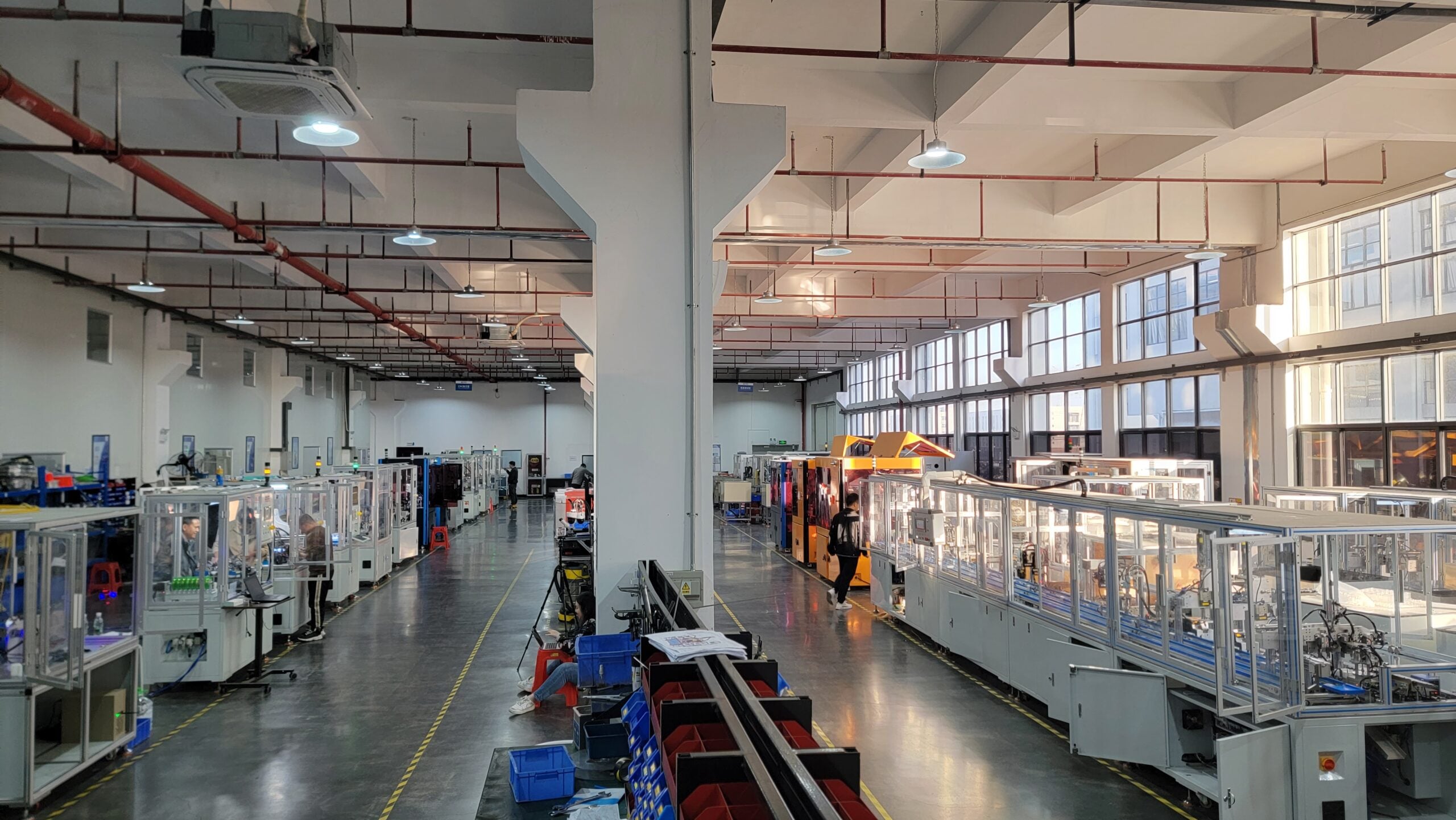
The finished twist pin is made in six stations. Here is a view of the four machine cell, including four stations, from the front, followed by the layer structure that supports it.
Six-station integrated twist pin production line at the Jiangxi Taihe facility.
1. Stranding
→
2. Alignment
→
3. Cutting & Welding
→
4. Expansion
→
5. Crimping
→
6. Wire Crimping
Downstream machines, in line order
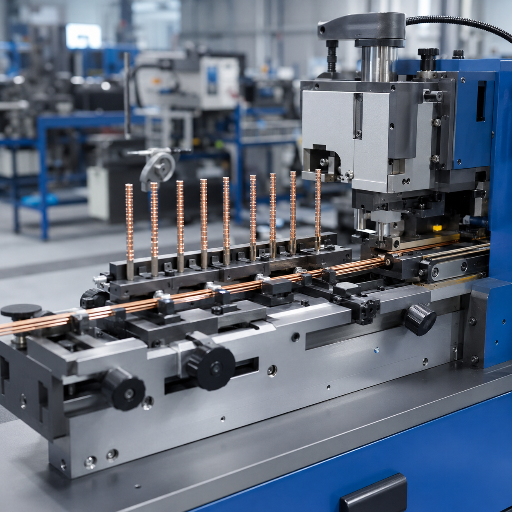
Twist Pin Alignment Machine
Hover to view specs ↗
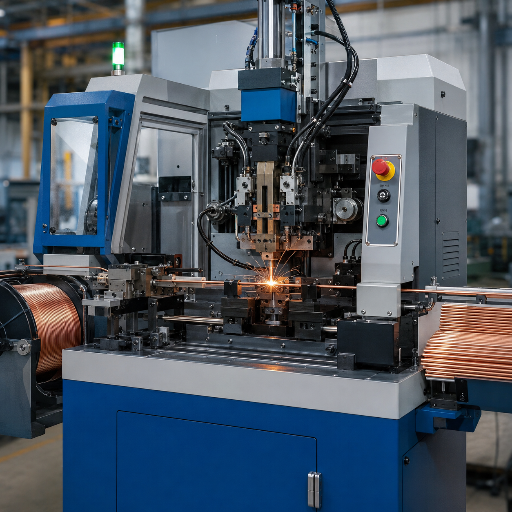
Twist Pin Cutting & Welding Machine
Hover to view specs ↗
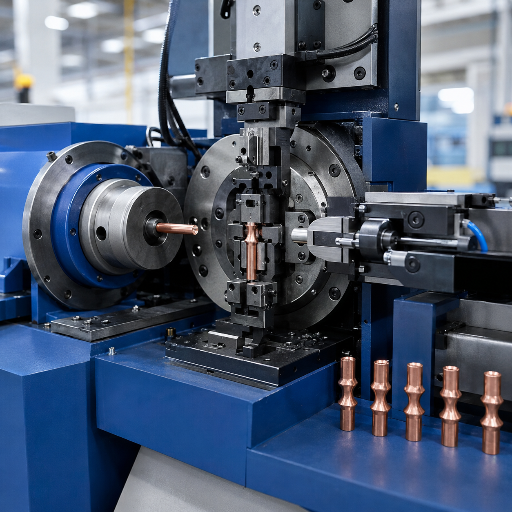
Twist Pin Expansion (Drum-Waist) Machine
Hover to view specs ↗
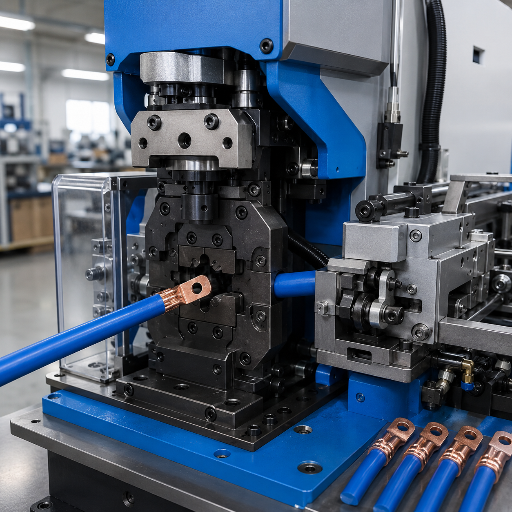
Crimping + Wire Crimping
Hover to view specs ↗
The four-layer quality stack
They have four inline inspection techniques on the line that are operating in parallel not in series. When a defect occurs at layer 3 (tension) the line will stop before layer 1 (CCD) that contained it. Therefore scrap at end of shift happens at the strand not the finished pin.
L1
CCD Vision — Microscope-Grade
Pattern twists, Weld spot integrity, dimension geometries, surface finishes. Scanning speed is in tune with slowest stage of system to ensure each and every pin to be visually verified.
L2
Laser Wire-Diameter Monitor
At-strand diameter measurement on real time basis; non-conformant material separated prior to entry into stranding head.
L3
Online Per-Strand Tension Monitor
Permanent magnet tension control with on-line display of each strand. Auto-stop for off-specification with display.
L4
Optical-Fiber Material Sensing
Detects loss and breakage of feedstock, immediately initiates immediate stop and alarms to avoid upstream contamination downstream.
“This line is built for that strand-level defect; by the time it reaches a bad weld at the CCD station, you’ve paid for material and machine time on a part that shouldn’t have been welded. And putting four layers on a stack takes that reject back to the wire, where it costs virtually nothing.”
ZEUEE vs Manual, Semi-Auto and Cable Stranding — Decision Matrix
The Real Choice – Comparison:
ZEUEE is no substitute for a Bartell-class power cable strander building 19-strand copper and, even when comparing with hand assemble twist pins, it’s neither the best bang-for-your buck or cheapest option for hand assembly. ZEUEE’s intended sweet spot is precisely targeting hand-assembled twist pins within 0.2mm – 0.8mm wire diameter with 3-9 strands of copper wire, as ordered by aerospace, RF and high-cycle test-probe industries. The matrix below shows you what strategy best fits your specific requirements.| Dimension | Manual | Semi-Auto | Cable Stranding (Bartell-class) | ZEUEE Twist Pin Line |
|---|---|---|---|---|
| Wire diameter range | > 1 mm (coarse) | > 0.5 mm | > 0.8 mm (power-grade) | 0.2 – 0.8 mm (precision) |
| Strand count | 2 – 3 | 3 – 5 | 5 – 19+ (cable) | 3 – 9 (precision adjustable) |
| Tension uniformity | Operator-dependent | Partial sensors | Speed-prioritized | Per-strand magnet + live display |
| Inline inspection | None | Partial dimensional | Speed-prioritized only | CCD + Laser + Tension + Fiber (4-layer) |
| Integrated cycle (pcs/min) | 2 – 5 | 5 – 8 | N/A (continuous) | 10 – 15 (full line) |
| Target product | Coarse pins | Mid-grade electrical | Power cables | Aerospace, RF, test-probe pins |
| Direct operators required | 30+ | 15 – 20 | 5 – 10 | 3 – 5 |
| Typical yield | 70 – 85% | 85 – 92% | 95%+ (coarse) | > 99% |
| IPC-A-620 Class 3 audit readiness | Manual records only | Limited logs | Process logs only | Per-pin batch traceability |
For the manufacturer of RF coaxial, aerospace, semiconductor test, or medical connectors requiring twist pin contacts, a cable stranding column is the wrong tool class and hand is the wrong economics class. 70-85 percent yield is built into either approach, but the choice will be made by ZEUEE or a hand-assembled twist pin line at a lower price at first, which implies minimum 30 operators and 70-85% yield.
Customer Results — Applications in Aerospace, RF and Test-Probe Manufacturing
Twist pin contacts manufactured by ZEUEE customers across five application categories.
Twist pins will be supplied into five end products supplied from our customer factories. Each application card below draws a representative specification and material to complement the example, from products produced in our Jiangxi Taihe plant during 2024-2025.
Aerospace
Hyperboloid Contacts for Mil/Aero Connectors
Twist pin for MIL-DTL-83513 Micro-D and MIL-DTL-38999 Series III circular connectors; NASA INST-EEE-002 makes use of this contact configuration for mission critical system.
Material Beryllium copper C17200 (ASTM B196) coated with gold 0.3-0.5 mm wire 5-7 strand.
End Customers AVIC and China Shipbuilding.
RF / Coaxial
RF Coaxial Connector Center Pins
High-Frequency Signal Integrity of Fine Wire Twist Pins for 5G base stations and satellite ground equipment: the multistrand bundle ensures consistent contact resistance over 10K + mating cycles.
Material Phosphor bronze and beryllium copper gold plating 0.2 to 0.4 MM wire, 3 or 5 or more (e.g.)
End Customers TE Connectivity or Sumitomo Japan.
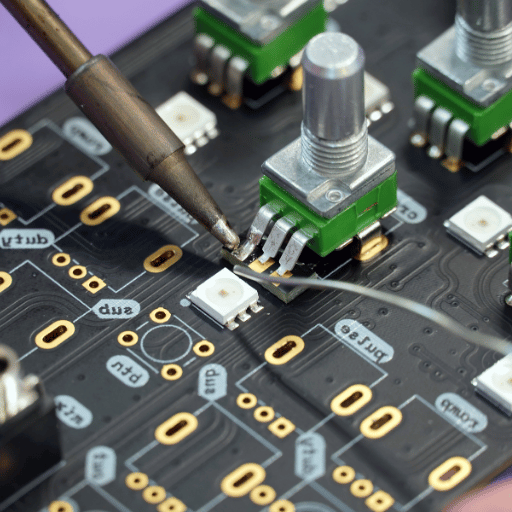
Test & Semiconductor
Test Probe Pins and Pogo Pins
Spring-grade twist pins for PCB ICT, semiconductor wafer probe and automotive ECU test sockets. Lifecycle is king here; a 2000-cycle stamped pin dictates five re-builds of a test fixture.
Material Spring-grade beryllium copper 0.2-0.3mm ultra-fine wire. Precision twist pitch held to 0.0005” tooling tolerance.
Medical
Medical Device Connector Pins
ISO 13485-aligned twist pin production with full batch traceability - essential for surgical robotics, imaging, and patient-monitoring connector platforms.
Material 304/316 stainless with gold plating. Full per-pin batch traceability for medical audit.
End Customers Hunter medical equipment OEM.
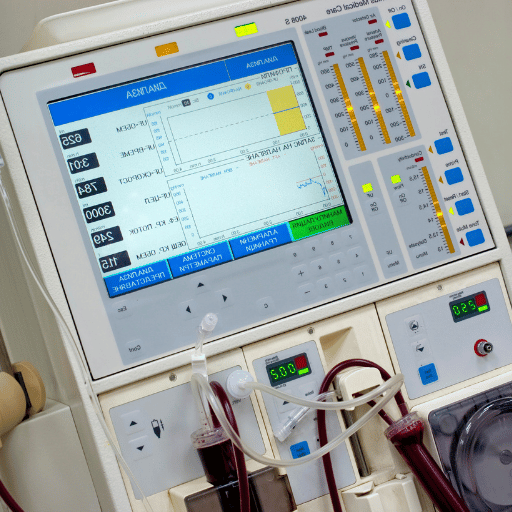
5G / EV
5G RF and EV High-Current Pins
Beryllium copper twist pins for high-current EV charging connectors and 5G millimeter-wave assemblies - low contact resistance at high mating cycle counts.
Material Beryllium copper alloy. High-current rated geometries.
End Customers TCL, SONY, and Tier 1 automotive suppliers.

Integrated Connector Solution Manufacturing
These applications span the full breadth of electronic connector and electrical connector manufacturing — from RF connectors and PCB interconnect assemblies to mil-spec circular connectors and high-current EV interconnection systems. Whether your downstream customer specifies custom connector geometries for telecommunications backbone equipment or aerospace wire-bundle sub-assemblies, ZEUEE's twist pin line is configured to deliver consistent contact pins for connector solutions across these verticals.
Production Lines Deployed For
AVIC
China Shipbuilding
GAC Group
Corning USA
Hunter
TE Connectivity
Sumitomo (Japan)
LEGO (Denmark)
TCL
SONY
Foxconn
Production Economics — Manual vs ZEUEE Line
View ROI Benchmark Methodology
Three payback scenarios drawn from published automation ROI benchmarks across 2500+ comparable industrial integration projects. Field deployments typically land between “Conservative” and “Expected” when integration and tooling costs are budgeted realistically (40-60% of equipment quote).
Exact payback depends on your wire diameter mix, two-shift vs one-shift utilization and integration scope - request a custom analysis for your part list.Conservative
Labor Savings Only18 – 24 months
Direct operator displacement from 30+ to 3-5 at a 1.3-1.6 fully-burdened labor multiplier.
Expected
Labor + Throughput12 – 18 months
Adds 30-40% capacity uplift from integrated 10-15 pcs/min cycles vs 2-5 pcs/min manual.
Optimistic
+ Quality + Uptime8 – 12 months
Adds scrap reduction (manual 2.3% vs automated 0.15% typical) and reduced rework on connector housing fitment.
Certifications, Patents And 20-Year Engineering Heritage
Trust in an OEM precision-machine partner reduces to a short list: certifications that survive audit, patent density that signals real R&D investment, and a production base that buyers can visit. ZEUEE has been designing twist pin production equipment since 2005 - long enough that the original engineering team is still building today's improvements on top of two decades of failure modes already solved.
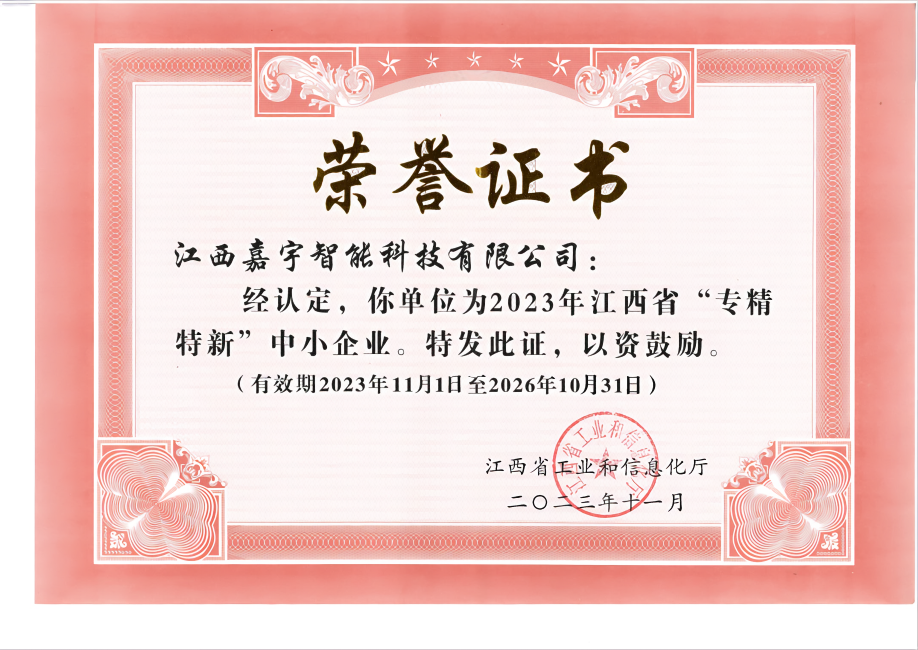
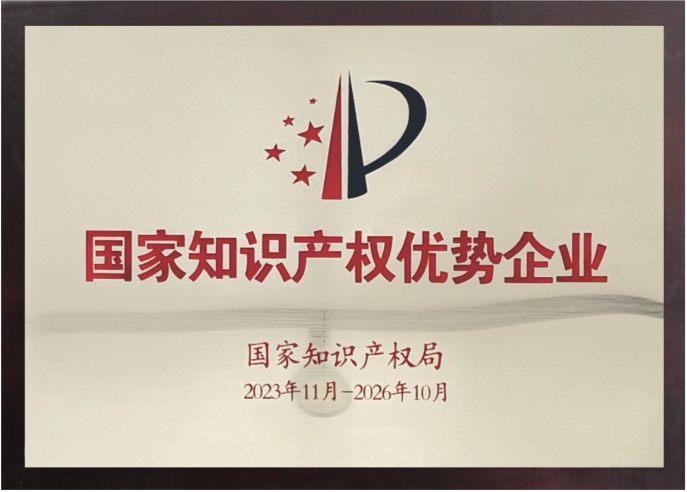
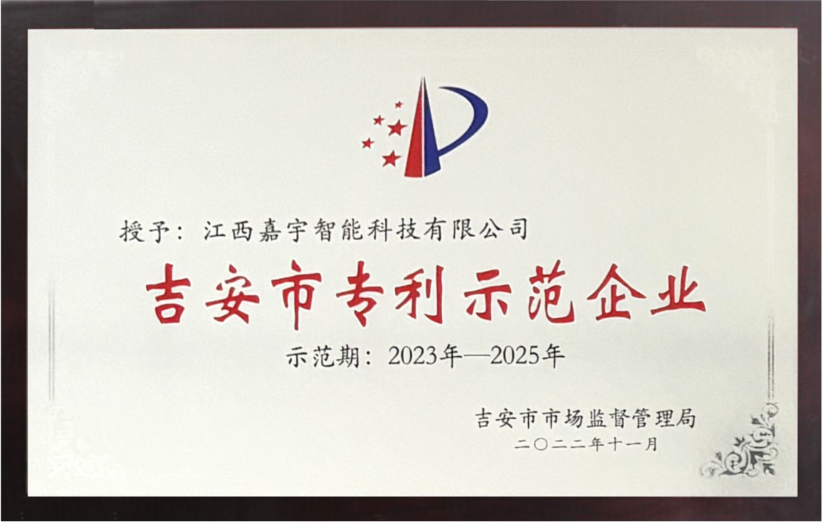
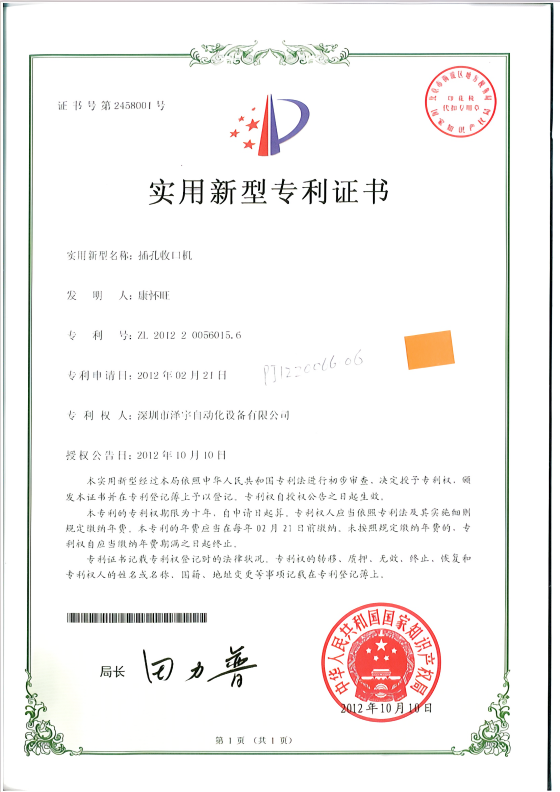
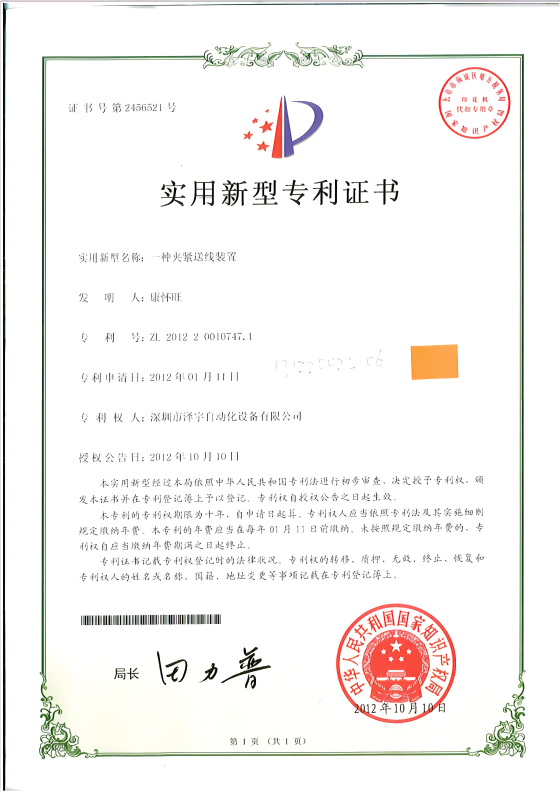
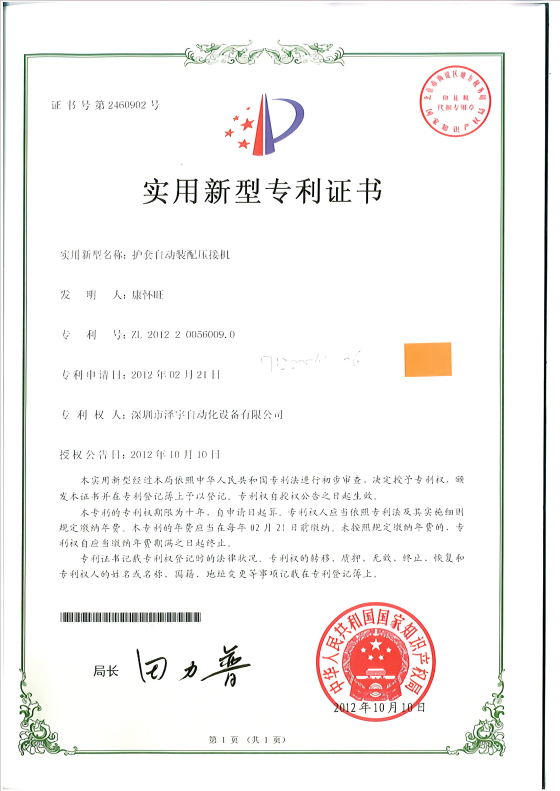
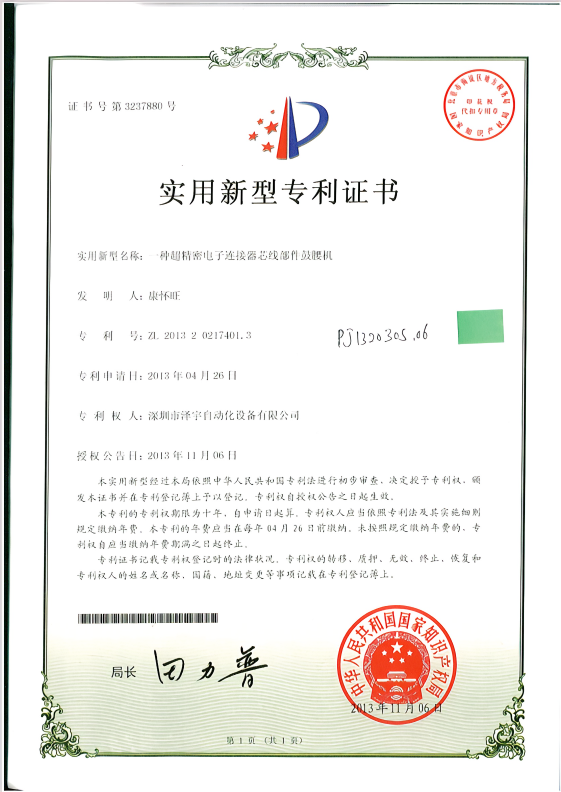
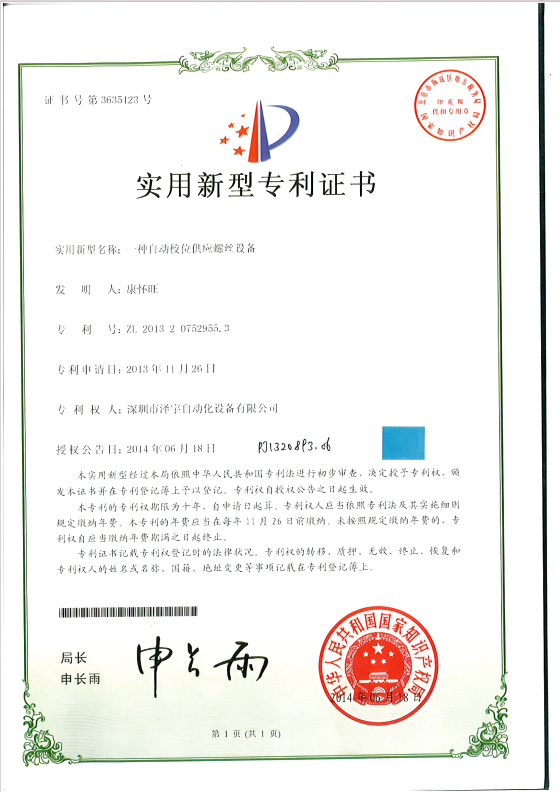
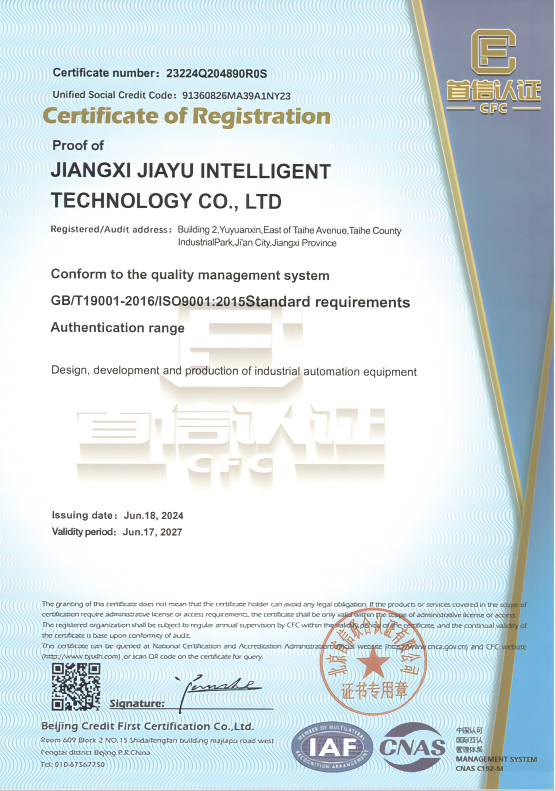
ISO
ISO 9001:2015
Quality Management System certification, audited annually.
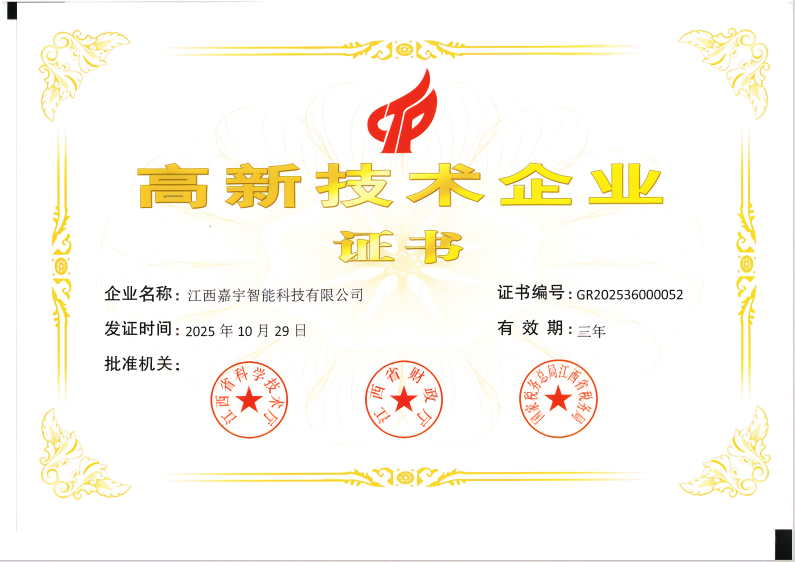
HT
National High-Tech Enterprise
Chinese national designation for technology innovation.
SI
Specialized & Distinguished
"Little Giant" national recognition for niche industrial leadership.
PD
Patent Demonstration Enterprise
Recognition for sustained IP development and protection.
Patent And Engineering Capability
R&D Portfolio
- 32+ Invention Patents Granted
- 68+ Utility Model Patents Granted
- 150+ Total R&D Patents In Portfolio
- In-House Design, Prototyping And Validation
Production Footprint
- Founded 2005 — 20-Year Operational History
- Headquarters: Shenzhen Phoenix Special Economic Zone
- Manufacturing Base: Jiangxi Taihe, 20,000 m²
- 120+ Employees Across R&D, Production, And QC
Industry Memberships
- Vice President Unit, Guangdong Robot Association
- Council Member, Shenzhen High-Tech Industry Association
- Council Member, Shenzhen Software Association
- Member, China Intelligent Manufacturing Industry Alliance
Procurement Guide — Pricing Factors, Lead Time, Customization & Support
Procurement of an integrated production line is not a price-list transaction. Variables that move a quotation are wire diameter range, inspection profile, stripping technology and downstream MES integration depth. Cards below break down what drives cost, what drives schedule and what you actually receive at handoff.
Pricing Factors (What Moves the Quote)
- Wire diameter range - 0.2mm fine wire requires premium servo and BeCu-rated tensioning
- CCD inspection profile - basic / advanced / microscopic multi-angle
- Stripping mechanism — thermal heating vs laser stripping
- Feeding system — aluminum vibratory disc vs belt
- Custom tooling — drum-waist geometry, special pin shapes
- Output speed target and shift utilization
- MES / PLC integration depth
Contact ZEUEE with your part list for a detailed quotation. Single machine and full-line packages quoted separately.
Lead Time (From PO to Shipment)
- Standard single machine — 60 to 90 days
- Custom-configured single machine — 90 to 120 days
- Full 6-machine production line — 120 to 180 days
- Sea-freight transit (Shanghai to US/EU) -typically 4-6 additional weeks
Production-slot booking requires deposit; first article inspection at the Jiangxi Taihe facility prior to shipment.
Customization Scope (Flexible Configuration)
- Wire diameter range, strand count, twist pitch (per recipe)
- CCD inspection: basic / advanced multi-angle / microscopic
- Stripping: thermal heater or laser module
- Feeding: vibratory aluminum disc or belt feeder
- PLC + HMI custom screens with operator-language localization
- MES integration: OPC-UA, Modbus TCP, or REST API
Service & Support Package
- 1-year warranty on the full machine (excluding wear parts)
- On-site installation and commissioning - typically 5-10 days
- Operator training - 3-5 days at Jiangxi Taihe facility (on-site option available)
- Technical support hotline plus remote diagnostics access
- Documentation: user manual, maintenance guide, spare parts list
Minimum order: 1 unit (single machine), 1 set (full-line)
Industrial-Grade Twist Pin Machine Solutions: Redefining High-Precision Production
Twist Pin Machine Engineering & Production Tools
Twist Pin Production ROI Calculator
Estimate the payback window for replacing a manual or semi-auto twist pin line with the ZEUEE six-machine production line. Calculation uses published automation ROI benchmarks (AMD Machines, 2,500+ industrial projects) plus your operating profile.
Twist Pin Material & Plating Selector
Choose your end application and operating environment — get a recommended copper alloy, plating, and wire diameter range backed by the relevant industry standard (ASTM B196, MIL-DTL, NASA INST-EEE-002). For binding material specs, request engineering review.
Frequently Asked Questions
What is a twist pin? Why does it look twisted?
A twist pin — also called a hyperboloid contact pin — is a precision spring contact made by stranding three to nine fine copper or beryllium-copper wires into a helical twisted bundle. Twist geometry creates radial spring force, producing seven or more redundant contact points instead of the two or three a stamped pin delivers. That geometry is what gives twist pins ten times the shock tolerance and over five times the mating-cycle lifetime of stamped contacts.
How does ZEUEE's stranding compare to cage or tubular cable stranding?
The company builds cage type and tubular stranding machines for large conductive elements, such as copper and aluminum, in conductors 0.8 mm and larger. ZEUEE’s expertise is specifically tailored to the manufacture of precise twist pins in diameters from 0.2 to 0.8 mm with up to 9 strands, including per-strand magnetic tension and on-line visual quality assurance from a CCD device. There are different classifications and quality levels available depending on the required application and product range.
Can the machine handle beryllium copper, phosphor bronze or brass wire?
Yes, ZEUEE’s machines can stranding of beryllium copper C17200, phosphor bronze, brass and specialty wires with precious metal plating and coatings - including gold - for the medical, RF, and military industries. Materials and parameters are selected from the PLC control’s recipes library and switched over without retooling of the machine itself.
What are the maintenance requirements?
A few simple daily, weekly, monthly and yearly checks of wear and tear elements can ensure that optimal output is maintained and reduce the likelihood of system down times. Such tests would include visual inspection of wear parts, lubrication of mechanical bearings, and recalibration of tension sensors.
Can the assembly machine be customized for our specific industrial use?
Absolutely! Configurations can be tailored with respect to diameters, strand counts, twists per inches, CCD camera inspection, wire stripping technologies, feeding mechanisms, and PLC/HMI control software, including integration to production supervision systems over various standard industrial communication protocols includingOPC-UA, Modbus TCP/IP and RESTful APIs. Custom-configuration lead time runs 90 to 120 days for a single machine.
How does ZEUEE ensure precision and consistency?
ZEUEE’s unique four-point quality monitoring system operates in real-time, as opposed to sequentially, to prevent wastage of wire materials. As each individual strand of wire proceeds through the stranding process, it passes through multiple inspection points: 1) a CCD microscopy vision station, 2) an optical quality monitor with laser diameter measuring capabilities for the raw wire, 3) a magnetic based system providing individual per-strand tension monitoring and adjustment, and 4) an optical sensor for real time identification of material composition. Every operation can be verified with precision, within the .01mm tolerance by the server-controlled drive mechanism.
What is the warranty and post-sale support package?
Your ZEUEE product is supported by a 1-year manufacturer’s warranty covering defects in materials and workmanship on the machine, excluding consumable wear parts. Included with every ZEUEE machine is: 5 to 10-day on-site installation and commissioning; 3 to 5-day operator training session; and remote diagnostic support including 24/7 support availability to ensure a single technical point of contact through out the life of the machine. Customers are assured of having a well documented, accessible parts and service inventory.
Do you provide factory tours and machine running videos?
We do. For customers seriously considering a ZEUEE machine we offer both a live “virtual tour” from our production floor located in Taihe, Jiangxi China; along with scheduled, on-site visits to your facility. To give you an idea of what our machines look like in action and to prepare your team for a review prior to receiving our official quote and pricing, we supply 2- minute long machine run time videos prior to initial quoting upon request.
What is the typical lead time and minimum order quantity?
60-90 days lead time for a standard machine, 90-120 days for a custom solution, and 120-180 days for our six machine production line package.Sea freight transit times (4-6 weeks) would apply in additional to standard delivery times and require MOQ (Minimum Order Quantity) purchase of one machine or one line. A production slot is secured by deposit at the time of Purchase Order placement.
Are twist pin connectors reliable for high-vibration, high-mating-cycle environments?
Certainly - and performance is the reason for Aerospace adoption. In fact, Cinch Connectivity test data show twist pin contacts rated to 500G shock, 200G continuous vibration, compared to 50G/20G for stamped pins. Connector mating cycle ratings exceed 10K with less than 2% contact resistance increase. Mission critical Micro-D connectors requiring twist pin (not stamped) technology are explicitly mandated by NASA per INST-EEE-002.
Build The Twist Pin Line Your Connector Roadmap Already Specified
Request a quote with your part geometry, target volume and shift profile; we respond with configured proposals specifying requirements, lead times and onsite commissioning Scope.
Request Custom QuoteWHY WE WRITE THIS
About ZEUEE Engineering Insights
ZEUEE shares technical guides based on real automation project experience. Since 2005, we have designed and manufactured non-standard automation equipment for connector assembly, wire harness production, robotic lines, vision inspection, and smart factory upgrades.
Founded in 2005
20,000 m² production base
120+ specialists
150+ R&D patents
ISO9001:2015 certified
![Automated Screwdriving: Torque & Cycle Time [Guide]](https://zeueeauto.com/wp-content/uploads/2026/10/automated-screwdriving-featured-150x150.png)