Get in touch with Zeyu lntelligent Industrial Company
Engineering · Procurement · Plant Manager
5-Machine Rectangular Connector Assembly Family — Pin Insertion · Crimping · Brush · Closing · QC
Five purpose-built machines that move a rectangular connector from raw pin and jack housings to inspected, sortable units — without the bench bottlenecks that drag a 1,000-unit shift into a 600-unit one. ZEUEE engineers built this family for MIL-spec, automotive, and 3C connector lines where a single missed crimp triggers a field-return cascade.
Request a Custom RFQ →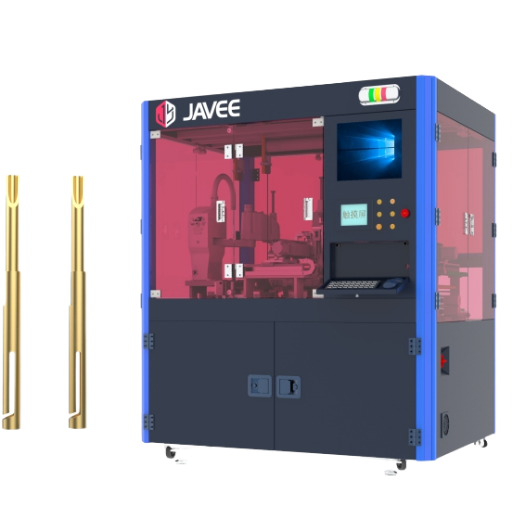
Family Snapshot
Machines in Family
5 stages
Connector Standards Covered
MIL-DTL-83513 · 38999 · D-Sub · IDC
Brush Wire Precision
0.2 mm bevel-cut
Crimping Mechanism
4-point cam (proprietary PPU)
QC Method
Fiber-optic + force-test sort
Compliance
ISO 9001:2015
Patents Behind It
100+ (32 invention, 68 utility)
Deployed Across
30+ countries
All Roles
From Manual Bench to a 5-Machine Family Pipeline
A rectangular connector assembly line that still leans on hand-fed pin insertion and bench crimping rarely loses time at the moments people expect. Misalignment usually arrives upstream — from a CAD-to-shop-floor handoff that assumed nominal connector geometry, then ran into a 0.05 mm housing variation no operator catches under fluorescent light.
Process Architecture
A rectangular connector automated assembly machine compresses that handoff into a single mechanical chain. ZEUEE’s family covers the five jobs a bench operator was doing one at a time — pin insertion, jack-sleeve crimping, brush pin insertion for dual-terminal seats, jack closing with digital depth control, and end-of-line separation-force inspection. Every stage uses a proprietary PPU manipulator and a vibratory disc feeding system, so a connector that enters at stage 1 leaves stage 5 sorted into a good-parts tray or a reject lane. The honest trade-off is real capital intensity up front in exchange for compounding yield gains across the chain — which is exactly the trade-off a procurement team is paid to model carefully.
Engineering Context
Altium engineers describe the same pattern across enclosure designs: “Misalignment often comes from disconnected workflows, manual file exchanges, assumptions about connector geometry, and missing mechanical context.”
[Source]Procurement and Yield
Bench bottlenecks are rarely a labor cost story alone.
Pulling the variance out of the connector line removes the upstream cause of those numbers, not just the labor headcount that catches them after the fact. However, the choice between a high-precision semi-automatic single station and a high-speed fully-automatic five-machine family is not a one-size answer — it depends on whether your line runs MIL-DTL Micro-D wire-to-wire cable bundles, board-to-board IDC modules, or mixed-standard automotive cabling where pin insertion machine plus terminal crimping must hand off cleanly.
But for a connector line the more interesting number is yield: a five-stage pipeline lets each station perform one task to capability rather than three at compromise, which is why field-validated rejection rates drop further than labor models predict. The configuration flexibility of a 5-machine family — chain three stages today, scale to five next quarter — is part of what makes the investment land within procurement’s payback window.
Procurement Audit
Procurement audits from SpecLens find that “specification-related rework and supplier disputes consumed an average of 12-18% of total procurement labor hours” — and that “total cost of spec-driven procurement failures often exceeds 3-5% of annual cost of goods sold.”
[Source]Industry Benchmark
Industry-average studies indicate roughly 40% labor cost reduction when assembly automation replaces a comparable manual workflow.
[Source]Industry Deployment
The pattern shows up across industries.
The same architecture deploys into aerospace MIL-DTL-83513 Micro-D cable assembly lines and into 3C twin-row IDC modules — different industries, same five-stage logic, different reject lane thresholds calibrated to the contact specification. Contrary to the assumption that a single multi-purpose machine wins on capex, the family approach actually wins on field-validated cost because the failure cost of one missed crimp is asymmetric to the labor cost of one extra inspection station.
Field Validation
A semi-auto cabling-connector cell documented in the Machines journal (Oct 2024) describes the Tier-1 automotive deployment: operator places one connector, the rest of the family auto-inserts pins and seals to a per-connector cycle benchmark that lets a plant manager swap shifts without recalibrating quality.
[Source]ZEUEE 5-Machine Production Family — Models & Selection Map
Each machine in the family handles one stage of rectangular connector assembly. Buyers selecting between a single-machine purchase and the full pipeline can use the map below to match a connector standard against the machine sequence that produces it.
ZEUEE 5-Machine Pin & Jack Family Stack-Up
| Stage | Machine (EN) | Core Function | Key Mechanism | Target Connector Type |
|---|---|---|---|---|
| Stage 1 | Rectangular Connector Pin Insertion Machine | Auto-feed straight or bent pins into housing | Vibratory disc + PPU manipulator + fiber-optic verify | MIL-DTL-83513 Micro-D · D-Sub · industrial rectangular |
| Stage 2 | Fully-Auto Jack Sleeve Crimping Machine | Crimp jack sleeve onto contact | 4-point cam, linear transfer, aluminum tray auto-feed | MIL-DTL-38999 crimp pots · rectangular jack housings |
| Stage 3 | Fully-Auto Brush-Type Pin Insertion Machine | Cut 0.2 mm brush wire, insert pin into dual-terminal seat | Servo-module feed, hollow rotary platform, bevel-cut | Twin-row dual-seat rectangular connectors · IDC |
| Stage 4 | Fully-Auto Jack Closing Machine | Close (seal) jack housing with digital depth control | Servo-controlled closure, vibratory disc auto-feed | Rectangular jack housings, post-crimp sealing |
| Stage 5 | Jack Separation-Force Inspection Machine | Measure insertion / extraction force, sort good vs reject | Auto force-test, dual-lane sorting, traceable log | Final QC for any rectangular connector post-closing |
Buyers running MIL-DTL-83513 production typically chain stages 1, 2, and 5. Per ITT Cannon's published Micro-D specification, MIL-DTL-83513 connectors carry contacts on 0.050-inch centers across pin counts of 9, 15, 21, 25, 31, 37, 51, and 100, with aluminum shells in electroless nickel, gold-over-nickel, or yellow-chromate plating options. [Source] Stage 3 enters the chain when the customer is producing twin-row dual-terminal rectangular connectors — for example, IDC variants used in 3C and lighting modules where 0.2 mm brush wire feeds replace traditional solder pots.
MIL-DTL-38999 lines lean differently. Per Glenair's contact-crimp installation guide, MIL-DTL-38999 uses removable crimp contacts qualified to MIL-C-39029 and operates from -65 °C to +200 °C — so stage 2's 4-point cam crimping becomes the central capability, with stage 5 force-test inspection acting as the field-failure firewall. [Source]
1
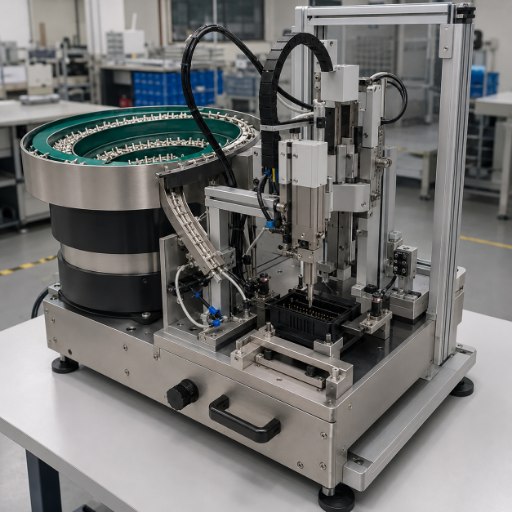
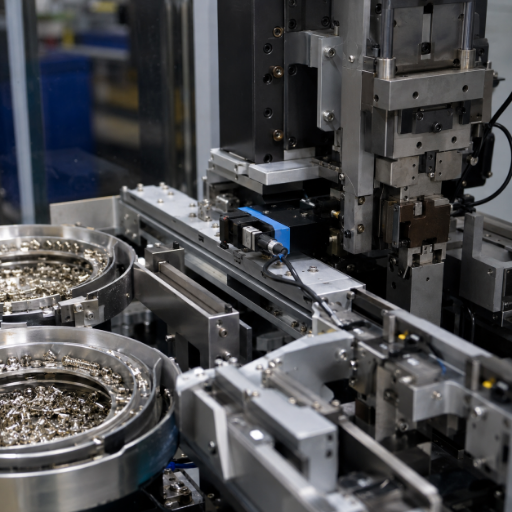
Rectangular Connector Pin Insertion Machine
Vibratory disc auto-feeds straight or bent pins to a proprietary PPU manipulator; fiber-optic sensors verify presence and orientation before placement. Line layout favors a single connector geometry per shift but supports tool-less changeover within a pin family.
Vibratory feed
Straight + bent pin
PPU manipulator
Fiber-optic verify
2
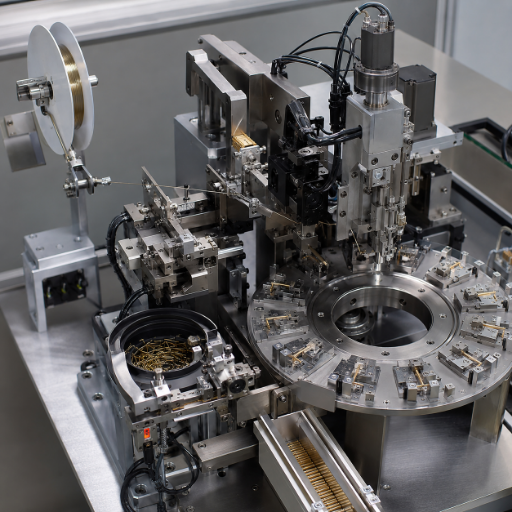
Fully-Auto Jack Sleeve Crimping Machine
Precision aluminum tray feeds jack sleeves into a 4-point cam crimping head driven by ZEUEE's PPU rapid-grip module. Linear transfer geometry keeps cycle time consistent across part numbers, and the cam four-point geometry reduces crimp-height variance compared with two-point fixtures.
Al tray feed
4-point cam crimp
Linear transfer
PPU rapid grip
3
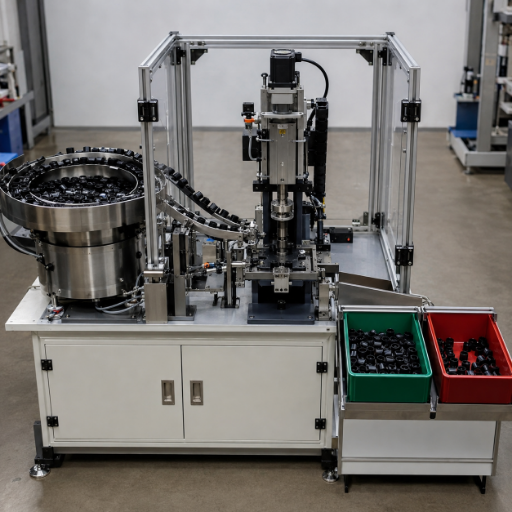
Fully-Auto Brush-Type Pin Insertion Machine
Compatible with two terminal-seat geometries. A 0.2 mm brush wire feeds through a precision bevel cutter and standardized arrangement station, then a servo module loads pins onto a hollow rotary platform for cam crimping and riveted assembly.
Dual seat support
0.2 mm brush wire
Bevel-cut precision
Hollow rotary platform
4
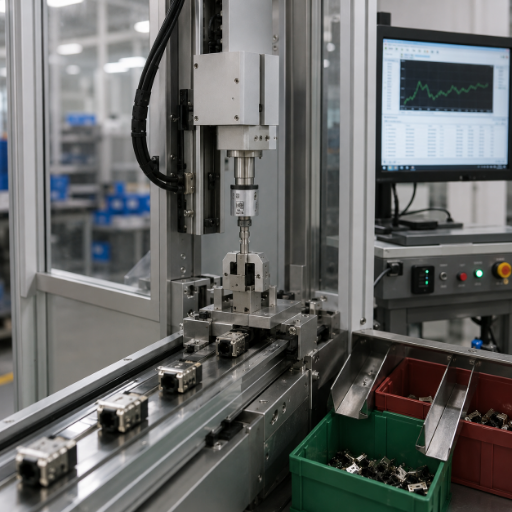
Fully-Auto Jack Closing Machine
Precision vibratory disc auto-feeds closed-end caps; servo control adjusts closure position and closing depth digitally so production engineers can save and recall recipes per part number. Output sorter routes good and reject parts to separate trays.
Servo depth
Digital recipe
Auto unload
Good / reject sort
5
Jack Separation-Force Inspection Machine
Post-closing QC. Auto-feeds finished connectors, measures insertion and extraction force, logs traceable per-unit results, and routes parts to good or reject lanes. This stage is the firewall that keeps misaligned or under-crimped units from reaching the field.
Force-test
Traceable log
Auto sort
Field-failure firewall
How the 5-Stage Sequence Compounds Yield
A single connector machine running three sequential tasks at a 95% per-task pass rate produces, by simple multiplication, an 86% line yield (0.95 × 0.95 × 0.95). Split those tasks across five purpose-built machines that each hit a 98% pass rate, and the line yield climbs to 90.4%. That four-point delta does not look dramatic until you push the units-per-shift number through it: at 1,000 units a shift, the difference is 44 fewer rejects per shift — and 44 reject units typically carry a downstream rework cost that exceeds the labor saved by the consolidation everyone wanted in the first place.
5-Stage Pipeline Yield Multiplier
| Configuration | Per-Stage Pass Rate | Stages | Compounded Yield | Rejects per 1,000 units |
|---|---|---|---|---|
| Manual bench (single operator, 3 tasks) | 95% typical | 3 | 85.7% | 143 |
| Multi-task automated machine | 96% typical | 3 | 88.5% | 115 |
| 4-machine family (no QC stage) | 97% typical | 4 | 88.5% | 115 |
| 5-machine ZEUEE family (with stage-5 QC sort) | 98% typical | 5 + sort | 90.4% accept · 9.6% inspected-reject | 96 (sorted, not shipped) |
Family vs Single-Machine TCO Comparison Framework
~40%
Industry-average labor cost reduction (assembly automation)
12–30 mo
Typical industry payback window
4.7 pt
Yield uplift, 3-stage manual vs 5-stage family (compounded math)
3–5%
Of annual COGS lost to spec-driven procurement failures (SpecLens benchmark)
Volume- and standard-dependent. Replace these averages with your shift volume, current reject rate, and connector standard for a Mass-grade payback model — ZEUEE engineers will build it during quote.
4-Point Cam Crimp & 0.2 mm Brush Wire — Quantified Repeatability Detail
An assembly engineer reviewing a connector crimping line does not buy on cycle time alone. What decides the buy is how tight a process can hold its crimp-height window across 50,000 units — and what happens when feed stock drifts within tolerance.
A spec sheet tolerance window is a starting point. What matters in the field is how a crimp mechanism holds geometry when input parts arrive at the wide end of their permitted variance.
ZEUEE's 4-point cam geometry distributes crimp force (press load) across four contact zones rather than two, which keeps the crimp-height range narrower as the cam wears. Combined with the PPU manipulator's rapid-grip module, the linear transfer geometry produces what production engineers describe as "low standard-deviation, low-drift" output — variability that does not climb across a shift the way two-point fixtures often do. This press-cycle consistency is the technology layer that underpins the whole family's reproducibility across customer lines.
Brush pin insertion adds a different precision problem. The 0.2 mm brush wire is bevel-cut before standardized arrangement, then loaded by a servo module onto a hollow rotary platform for cam crimping and riveted assembly.
Brush wire precision is therefore an insertion-quality problem, not a brush-cut cosmetic problem.
Field deployments show why the precision detail matters. In a typical aerospace MIL-DTL-83513 Micro-D line producing 100-contact layouts on 0.050-inch centers for avionics cable assemblies, the 4-point cam holds crimp-height variance under FAT-defined limits across a 30,000-unit production run — the same window the FAT report set on day one. In an automotive EV battery-management cable deployment producing twin-row IDC modules, the 0.2 mm brush wire feed limits dual-terminal seating drift, with stage-5 force-test logging providing the per-unit traceability automotive IATF 16949 audits expect. Different connector standards, different acceptance thresholds — same press-cycle technology layer underneath.
"We chose four-point cam crimping after watching two-point cam wear drift our crimp height by 0.018 mm across a 30,000-unit production run. That drift never shows up on a freshly-tooled machine in an FAT — it shows up on month six. The four-point geometry buys us another quarter of consistent production before re-tool, which is the number our customers actually care about."
Fiber-optic verification at the pin-insertion stage acts as the second line of defense. Rather than rely on mating force as a proxy for proper seating — the assumption Altium's engineers explicitly contradict — fiber-optic sensors confirm the pin is present, oriented correctly, and seated to depth before the line releases the part to the crimping station. Instead of treating mating-force checks as the primary gate, the family uses force-test as the end-of-line firewall, with fiber-optic verification absorbing the upstream insertion-quality decisions.
Boeing's solution treats connector geometry variance as a first-class problem — not an FAT-only concern — which mirrors the production reality ZEUEE customers report. In fact, the deployment patterns repeat across industries: aerospace MIL-DTL-83513 Micro-D lines using 0.050-inch pin pitch geometry, automotive battery-management cable bundles where a 0.018 mm crimp-height drift turns into a field warranty event, and 3C twin-row IDC lines where the 0.2 mm brush wire feed sets the limiting tolerance on dual-terminal seating. Each industry calibrates the same five-stage architecture against its own field-failure cost function — same logic, different acceptance thresholds.
Customer Outcomes & Application Industries
ZEUEE machines run inside 30+ country deployments, primarily across four industries where rectangular connector consistency drives field-failure rate.
Aerospace & Defense
MIL-DTL-83513 Micro-D production for avionics and ground-vehicle cable assemblies, where pin-count layouts up to 100 contacts on 0.050-inch centers require the proprietary PPU manipulator's positioning consistency. Stage 5 separation-force inspection is the firewall — a single under-crimped contact returning from the field costs more than a year of QC capex. Customers running adjacent contact-family programs frequently pair this 5-machine family with ZEUEE's micro twist-pin contact assembly line for hyperboloid socket production and the wire cut-strip-crimp assembly line for end-to-end cable assembly manufacturing.
Automotive & New Energy
Rectangular jack housings for EV battery management systems and conventional automotive wire assemblies. Recent research in the Machines journal (Oct 2024) documents the design pattern: "operator places a connector and components like pins and seals are automatically inserted." [Source] ZEUEE's family runs that pattern across 4 of the 5 stages without operator placement past stage 1.
3C Electronics & Precision E/E
Brush-type insertion (stage 3) shines here. Twin-row dual-terminal seats common in 3C connector designs need the 0.2 mm brush wire bevel-cut precision rather than traditional solder pots — which is a workflow where bench operators introduced 12-18% specification rework hours per the SpecLens procurement benchmark.
Medical & Industrial
Rectangular IDC connectors and industrial sensor cable runs, where every electrical connection in the field has to verify the same way it did at FAT. Compliance evidence at stage 5 (force-test traceable log) supports audit trails for medical and industrial QC frameworks.
Compliance & Engineering Authority — ISO 9001:2015 + 100+ Patents Stack
Procurement teams evaluate connector machinery suppliers on a weighted model — not on unit price. As ISM's published supplier evaluation guidance puts it, leading practices assess suppliers across "cost, quality, delivery, financial stability, compliance, ESG, and resilience." [Source] ZEUEE answers that weighted model with documentation rather than marketing.
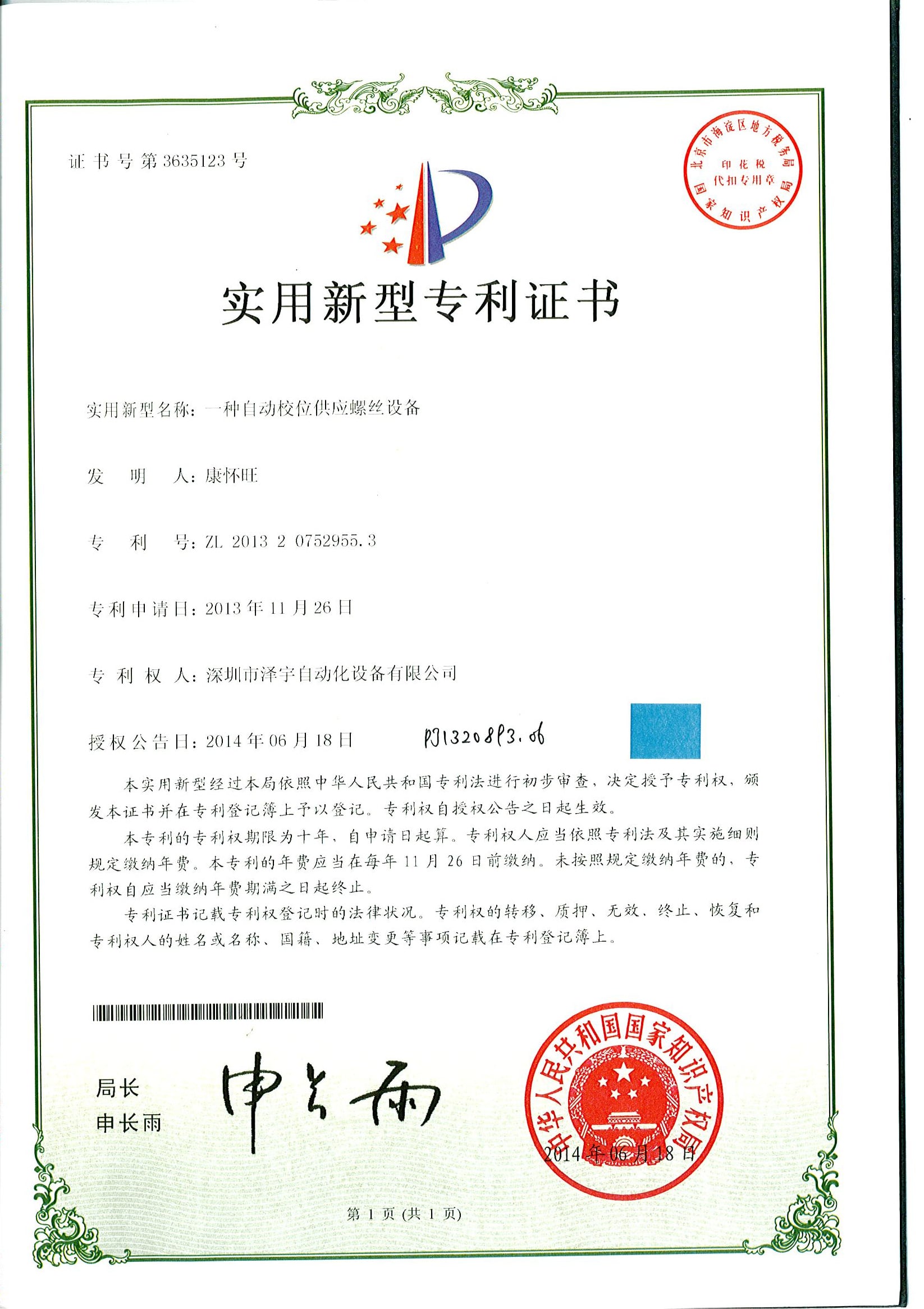
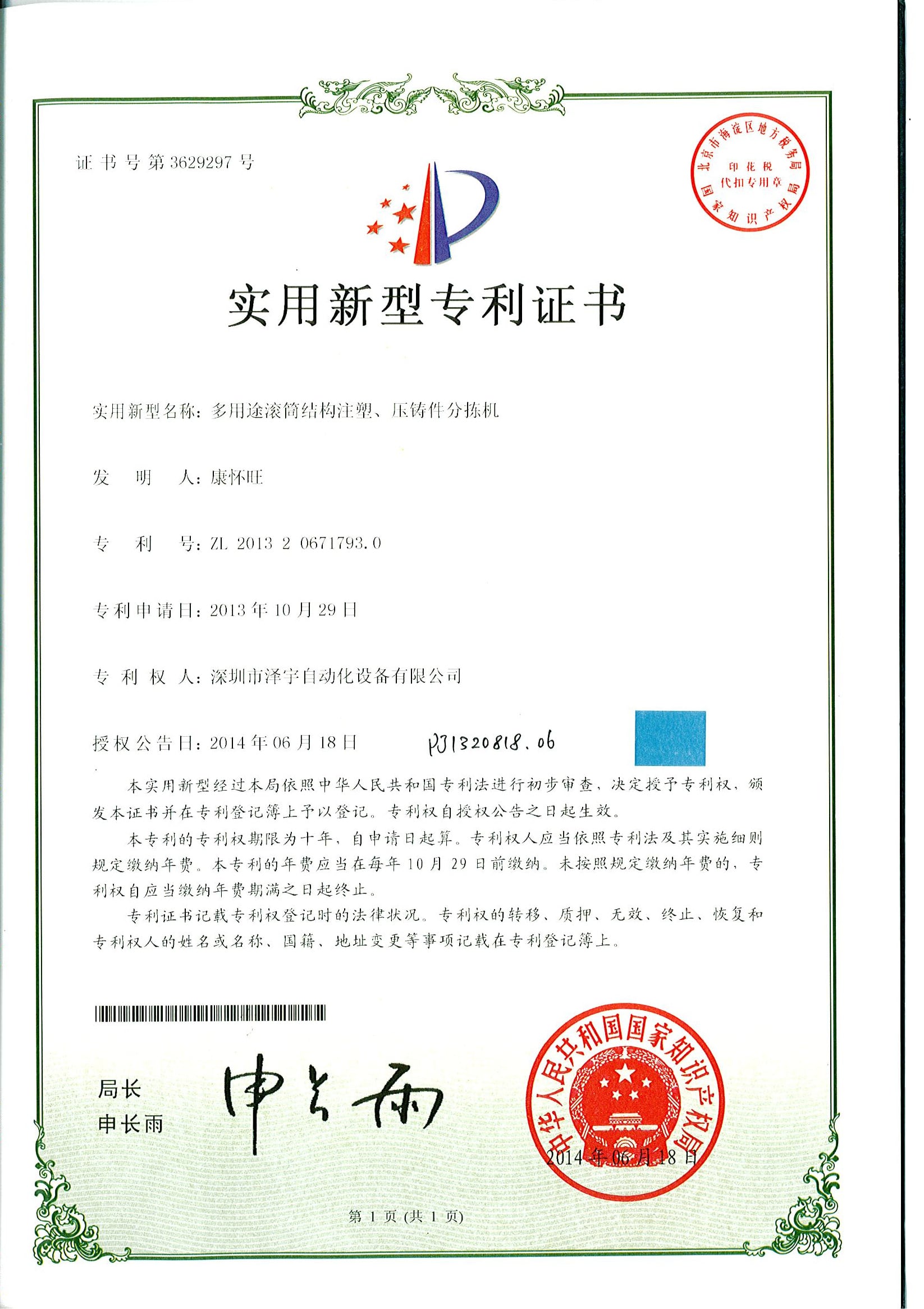
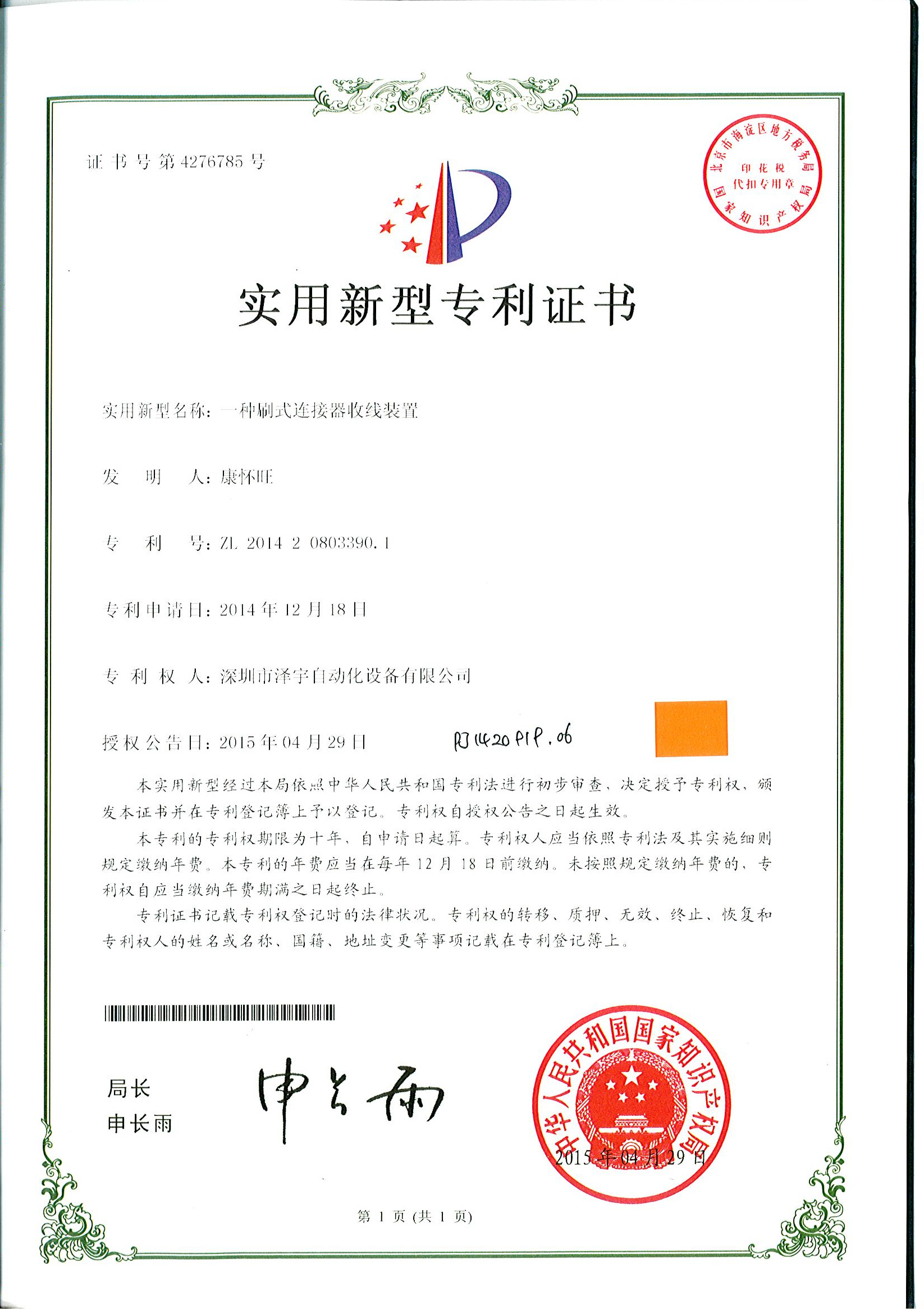
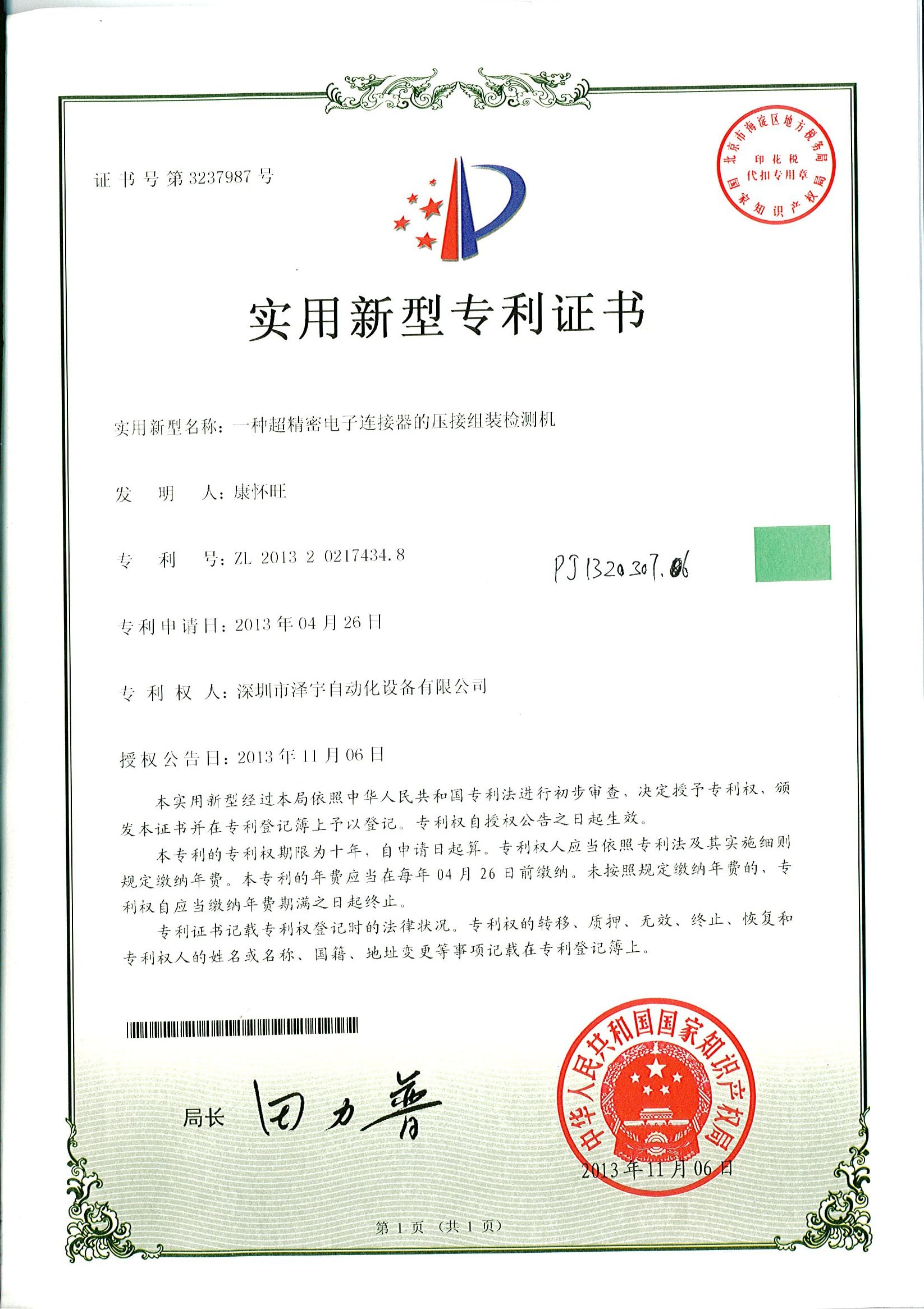
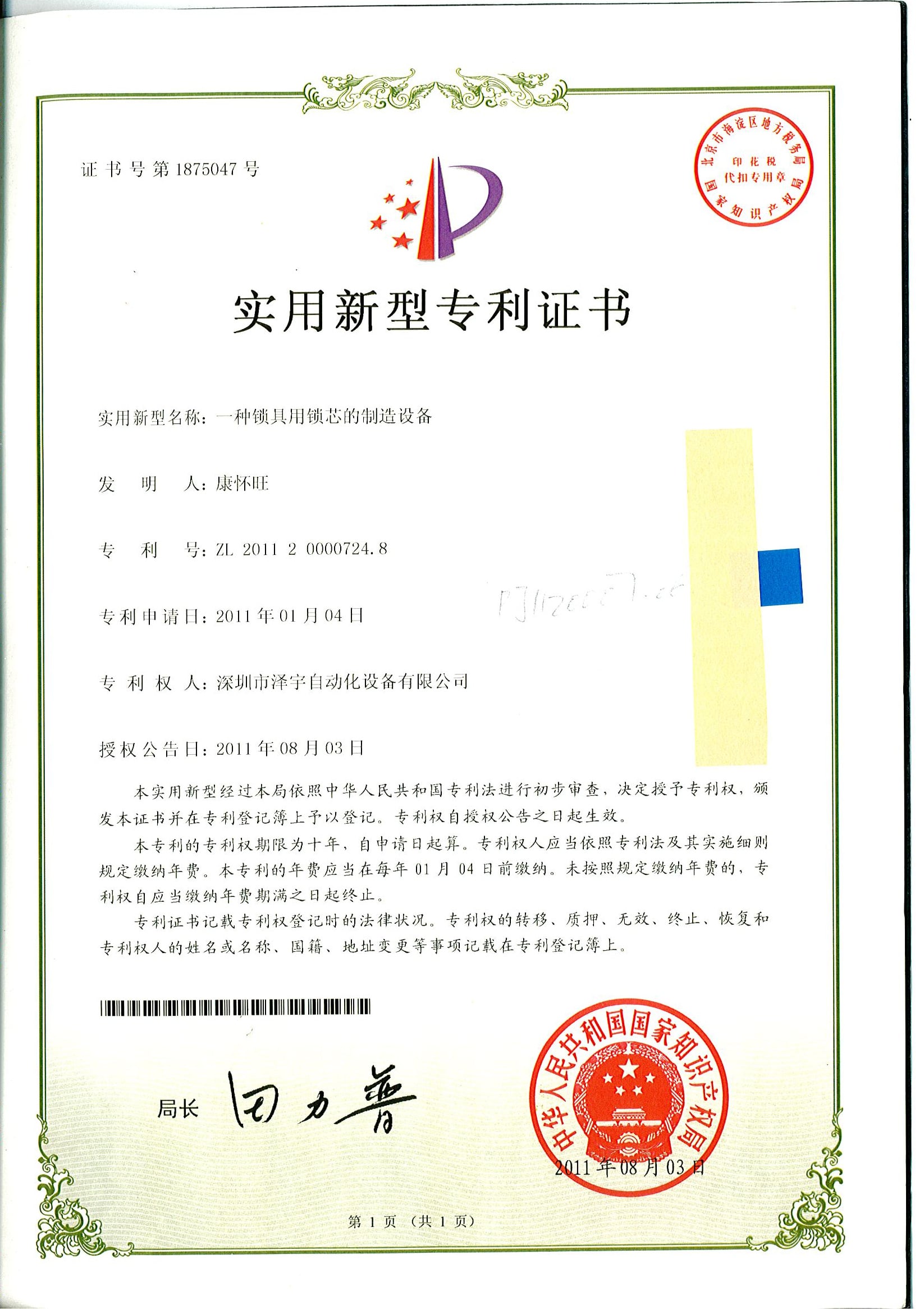
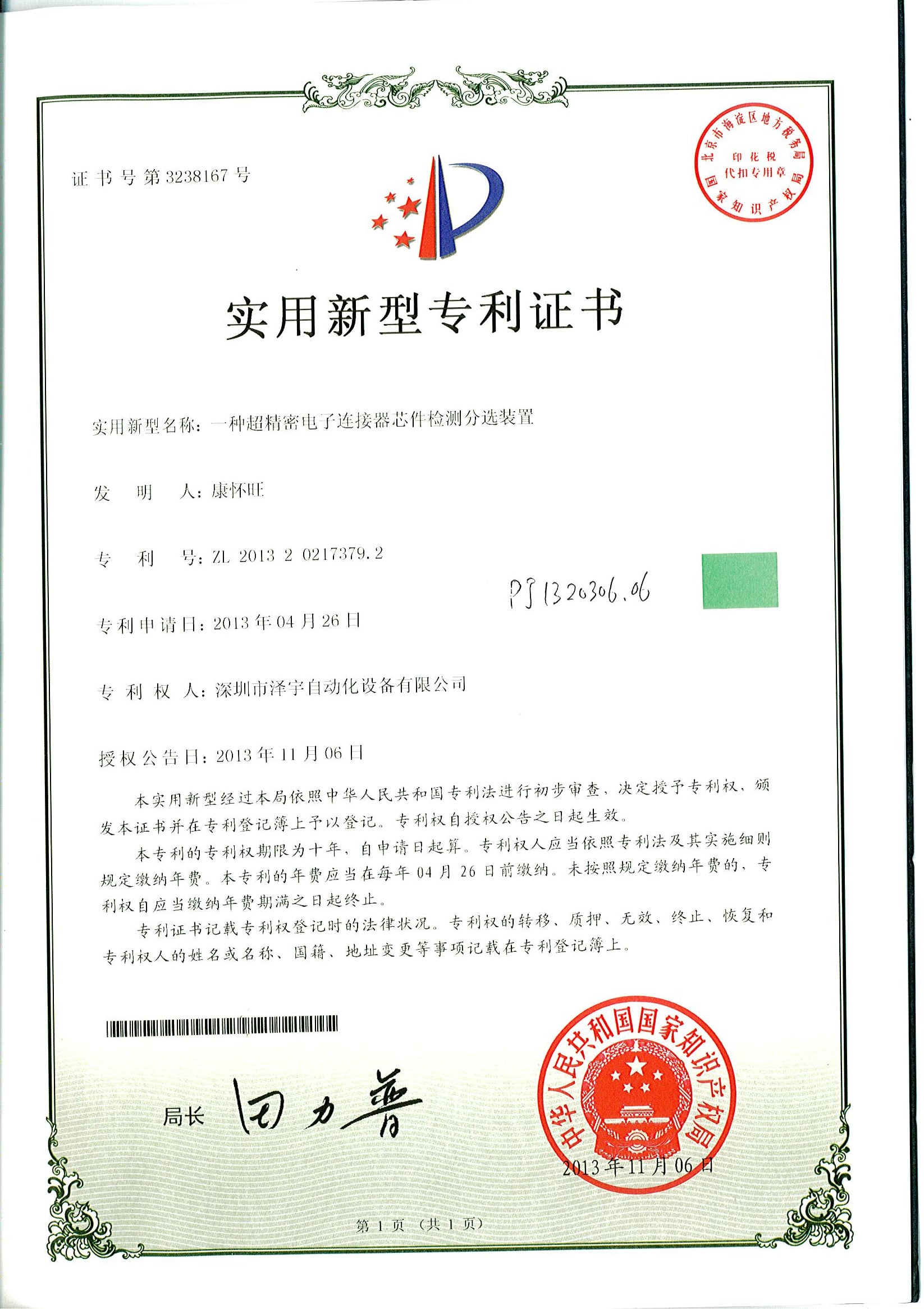
01/10
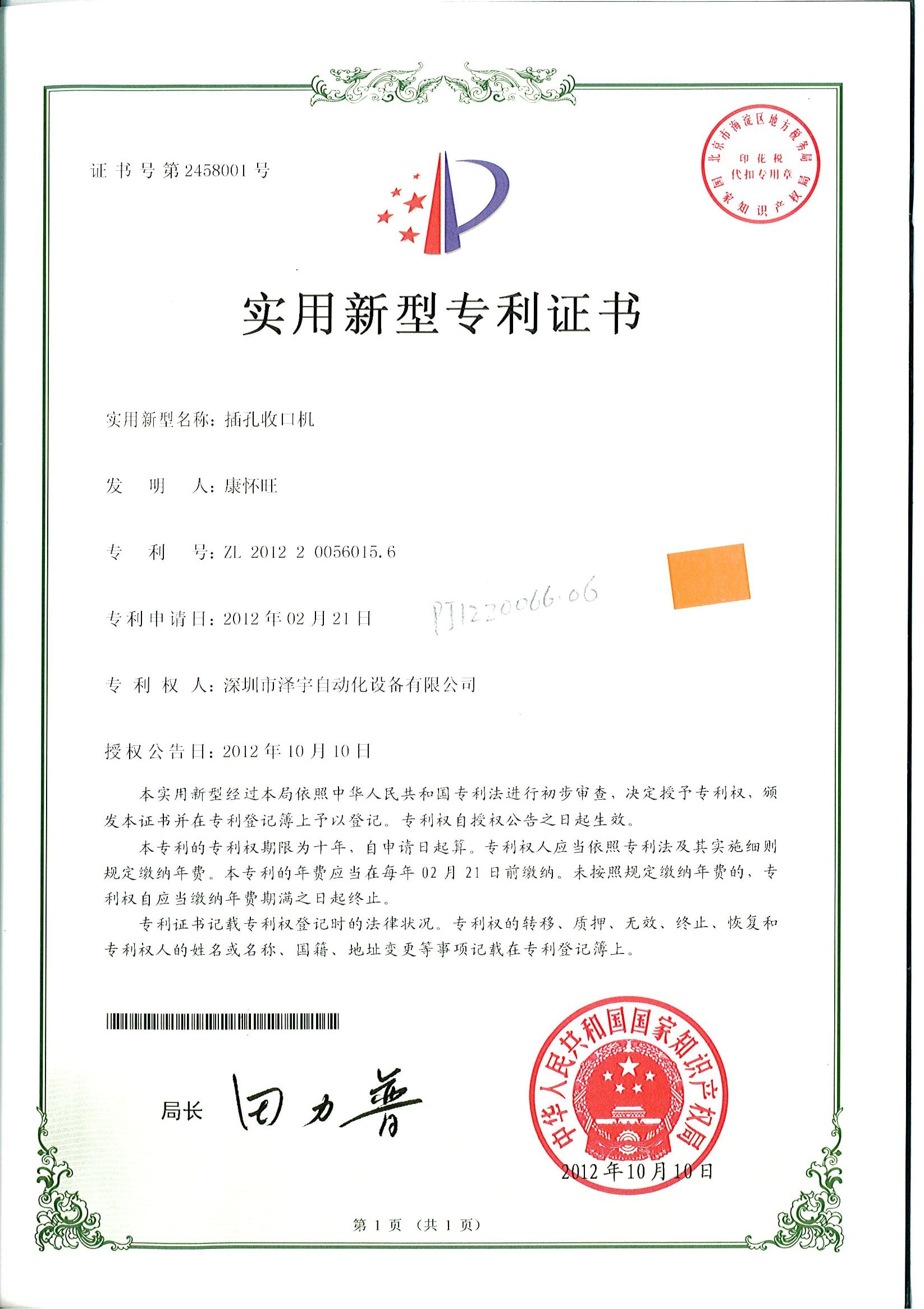
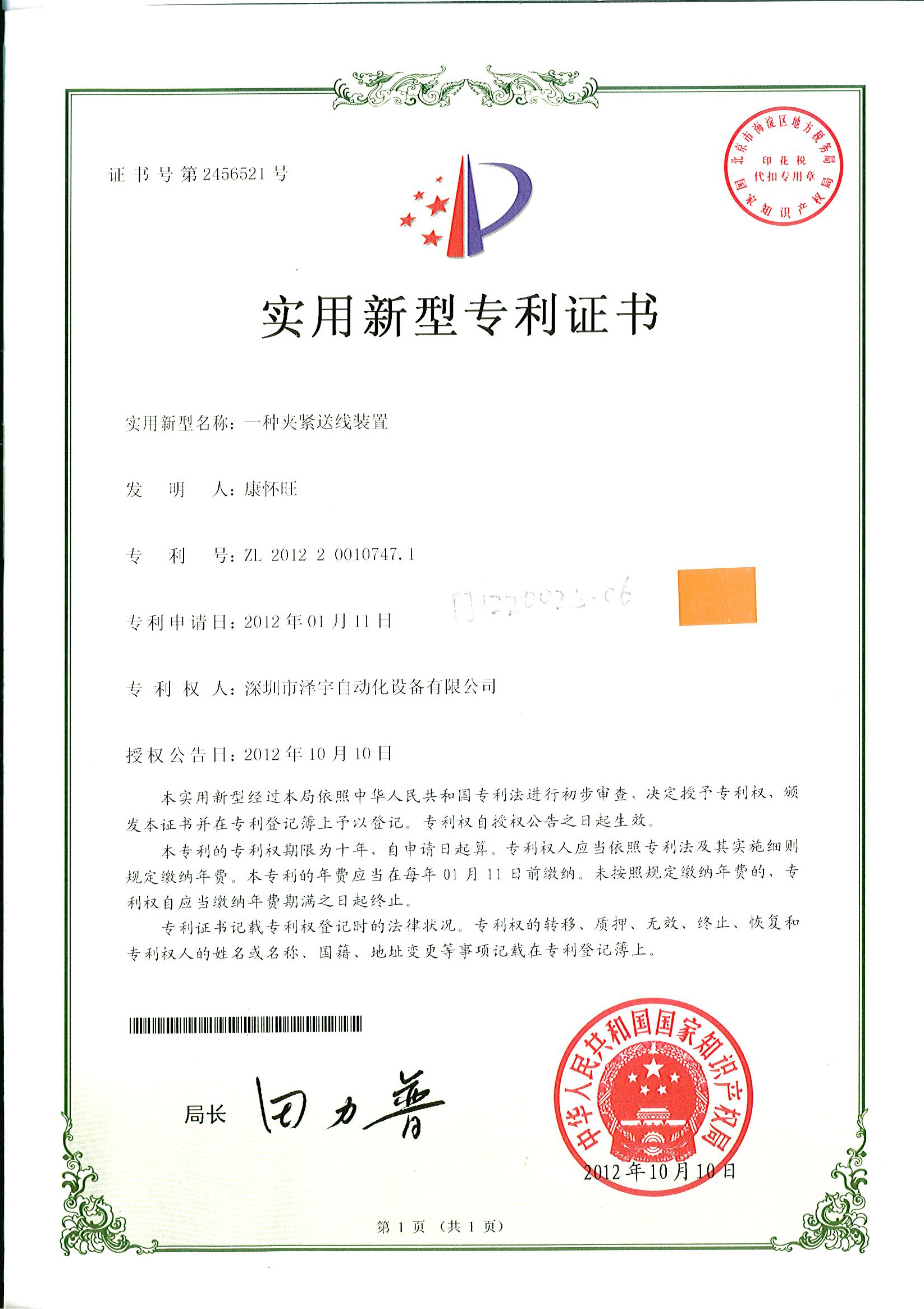
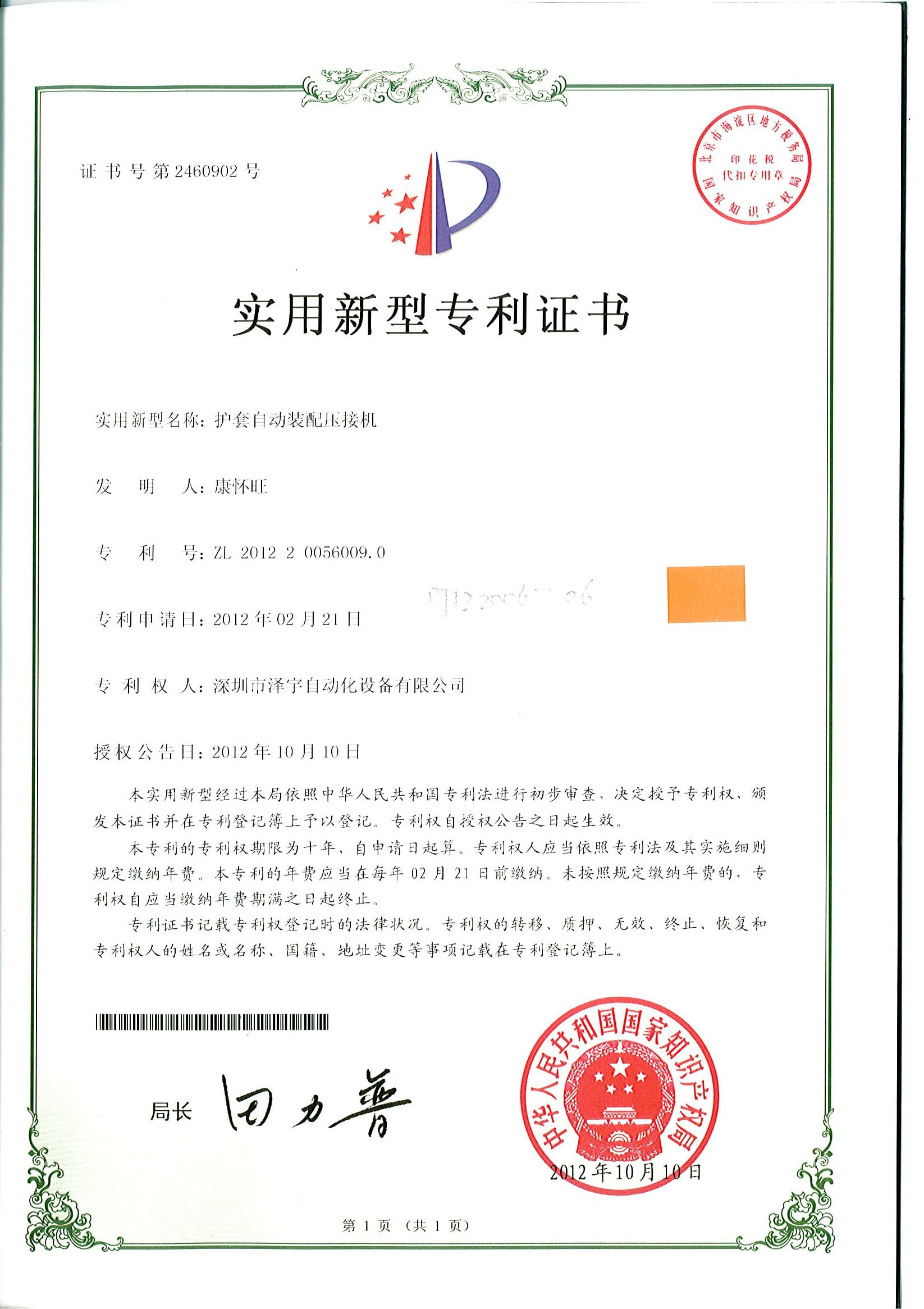
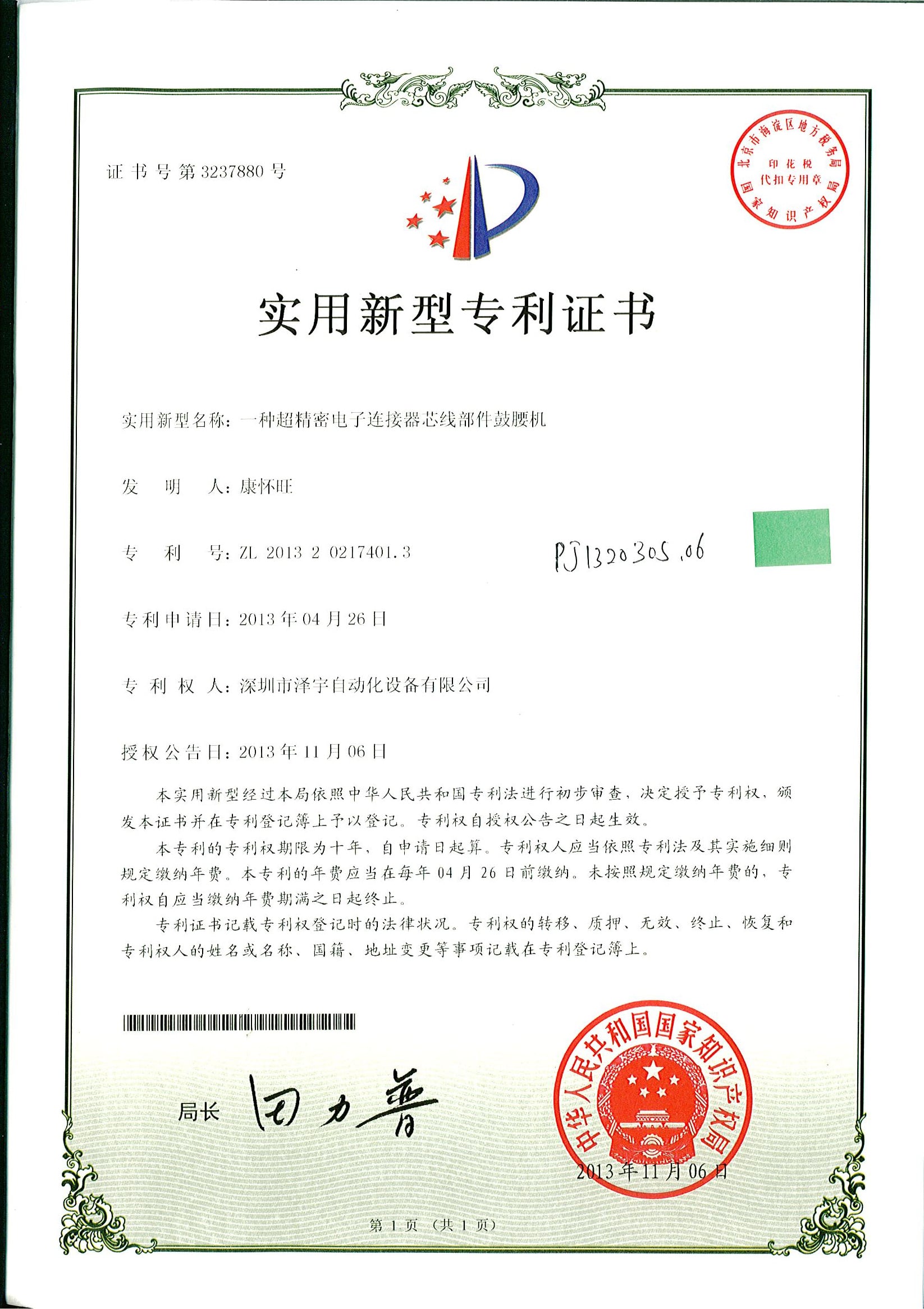
Patent count alone is not a marketing aggregate. The honest version is this: ZEUEE holds 32 invention patents (the more demanding category under China's patent system, requiring substantive examination) and 68 utility model patents covering PPU manipulator mechanisms, four-point cam crimping geometry, vibratory feeding configurations, and the digital servo recipe management used in stage 4 jack closing. That patent stack is what makes the family pipeline reproducible across customer lines — each stage's mechanism is documented and protected, so a customer running production for a decade is not relying on an undocumented vendor workflow. ZEUEE will not claim the 100-patent number as evidence of better connectors than Komax or TE; it is evidence that the mechanisms producing those connectors are documented in defensible form.
Honor qualifications include National High-Tech Enterprise status, Vice President Unit of the Guangdong Robot Association, Council Member Unit of the Shenzhen High-Tech Industry Association, and Member Unit of the China Intelligent Manufacturing Industry Alliance. These are industry-association memberships that signal the supplier financial-stability and compliance dimensions procurement frameworks ask about.
On the MIL-spec side, ZEUEE machines are engineered to assemble connectors qualified to the published MIL-DTL specifications. MIL-DTL-83513 covers polarized rectangular shell connectors with crimp or solder contacts; MIL-DTL-38999 series cover environmentally resistant circular variants with removable crimp contacts under MIL-C-39029. The machine itself does not certify the connector — the connector manufacturer does. ZEUEE's role is to provide the production line that produces connectors meeting those specifications consistently at volume. On the contrary to a single-machine OEM offering, the family architecture is calibrated so each stage holds its own specification window rather than pushing tolerance budget into the next station downstream — which actually matters when production teams audit cumulative tolerance stack at month-six review.
Procurement Guide — 3-Tier Lead Time · RFQ Workflow · Payment Tiers · IPQC Milestones
A procurement team building a Mass-grade connector line is rarely surprised by the equipment list. What surprises them is what arrives after PO: missing test data, lead times that shift, fixture amortization fees that were not in the original quote. SpecLens benchmarks the cost of that ambiguity at "3-5% of annual cost of goods sold" — most of it from "specification-related rework and supplier disputes." Removing the ambiguity is a vendor selection criterion, not a delivery promise.
RFQ Workflow
Send a connector drawing or the relevant MIL-DTL specification along with target volume, shift pattern, and current reject rate. ZEUEE engineers will respond with a configuration recommendation (single machine vs cell vs full family), an indicative quotation, and a sample-part trial proposal. Customer drawings are reviewed under NDA. Detailed quotation includes per-machine specification, factory acceptance test (FAT) criteria, and proposed in-process quality control (IPQC) milestones aligned with ISO 9001:2015 quality management requirements (the standard ZEUEE production is certified against).
IPQC Milestones During Build
Procurement transparency at build phase typically lags equipment pricing transparency. ZEUEE's IPQC milestone structure exposes the build at four defined checkpoints:
Design Sign-Off
Customer reviews mechanical drawing and recipe table for each machine in the cell, with a 5-business-day response window for revision feedback before tooling release.
Sub-Assembly QC
Per-machine sub-assembly inspection report covering PPU manipulator geometry, cam alignment, vibratory disc calibration, and sensor zero-point verification.
Pre-FAT Trial Run
500-unit trial production on customer-supplied sample parts, with full traceable per-unit log delivered for review before formal FAT scheduling.
Factory Acceptance Test
Signed FAT against pre-defined yield, cycle time, and crimp-window criteria. Equipment ships only after milestone 4 sign-off, with customer or representative encouraged to attend in person.
Engineering & Procurement Tools
FAQ — Procurement Questions Answered
Q1
Can ZEUEE's family handle both MIL-DTL-83513 Micro-D and MIL-DTL-38999 circular connectors on the same line?
Can ZEUEE's family handle both MIL-DTL-83513 Micro-D and MIL-DTL-38999 circular connectors on the same line?
Not on the same line in the same shift, no. MIL-DTL-83513 production typically uses stages 1, 2, and 5 (pin insertion + jack sleeve crimp + force-test). MIL-DTL-38999 leans on stage 2 (4-point cam crimp for removable contacts per MIL-C-39029) plus stage 5 for traceable per-unit force logs. Mixed-standard customers usually deploy two configured cells or run alternating shifts with a documented changeover protocol; ZEUEE engineers walk through that tradeoff during RFQ. A small number of mid-volume customers run a hybrid configuration with shared stage 5 inspection across both connector families — this works only when the shell-handling fixtures at stage 5 are designed for dual-geometry sorting from day one, which is a configuration decision made at quote, not in the field.
Q2
Changeover time between part numbers within the same standard?
Changeover time between part numbers within the same standard?
Within one pin-family geometry, changeover is tool-less and managed via the digital recipe system. Across geometries (for example, 9-pin Micro-D to 51-pin), physical tooling change at stages 1 and 2 is required. Indicative changeover times and tooling costs are quoted per part-number pair.
Q3
How is rejected output handled at stage 5?
How is rejected output handled at stage 5?
Stage 5 separation-force inspection sorts inspected-reject units into a separate tray with a per-unit force-test log entry. Customers can review reject patterns during shift handoff to identify whether the cause sits upstream (pin geometry, crimp height drift, brush wire feed) or in feed stock variance arriving from a contact supplier. Reject rate trending is part of standard FAT acceptance criteria, so the trend line you see in week six matches what we agreed in the FAT report.
Q4
Does the 4-point cam crimp meet MIL-C-39029?
Does the 4-point cam crimp meet MIL-C-39029?
Crimp geometry consistency supports production of contacts qualified to MIL-C-39029. Final qualification of the contact is the connector manufacturer's responsibility against the relevant MIL-DTL spec sheet.
Q5
What spare parts and consumables should we budget for?
What spare parts and consumables should we budget for?
Primary wear items are the 4-point cam crimping head, brush wire feed mechanism, vibratory disc components, and fiber-optic sensors. ZEUEE stocks standard wear kits and ships under 7-day expedited terms for active customer accounts. Indicative annual consumable budget is provided per family configuration at quote, and active accounts get usage-based reorder reminders so wear items arrive before they fail rather than after — a small operational detail that matters at the end of month six when the cam starts drifting.
Q6
Can you support installation and operator training outside China?
Can you support installation and operator training outside China?
Yes. ZEUEE has supplied equipment to programs in 30+ countries. On-site installation, commissioning, and operator training are scoped per country at quote time. Remote diagnostic support runs through the digital recipe system; on-site visits are arranged per active service agreement.
Q7
Fiber-optic verification vs vision-camera inspection at pin insertion?
Fiber-optic verification vs vision-camera inspection at pin insertion?
Fiber-optic verification confirms pin presence, orientation, and seat depth at one inspection point per cycle — fast and low calibration overhead. Vision-camera systems capture more data per cycle but introduce calibration cost. Fiber-optic is the production-rate choice at stages 1 and 3; vision is an optional add-on when customers need image-archive logging for audit or warranty traceability beyond what the force-test log at stage 5 already captures. Most customers running MIL-spec lines pick fiber-optic at stages 1 and 3 and use the stage 5 force log as their primary archive; customers running medical or automotive lines with image-record requirements sometimes add vision at stage 1 only.
WHY WE WRITE THIS
About ZEUEE Engineering Insights
ZEUEE shares technical guides based on real automation project experience. Since 2005, we have designed and manufactured non-standard automation equipment for connector assembly, wire harness production, robotic lines, vision inspection, and smart factory upgrades.
Founded in 2005
20,000 m² production base
120+ specialists
150+ R&D patents
ISO9001:2015 certified
![Automated Screwdriving: Torque & Cycle Time [Guide]](https://zeueeauto.com/wp-content/uploads/2026/10/automated-screwdriving-featured-150x150.png)