Get in touch with Zeyu lntelligent Industrial Company

HYPCON Contacts Machine: Complete Engineering Guide to Hyperboloid Wire-Cage Assembly, Inspection, and Sizing

By Cherry, Senior Automation Engineer at Shenzhen Zeyu Intelligent Industrial Science Technology Co., Ltd (ZEUEE) · Updated November 2026
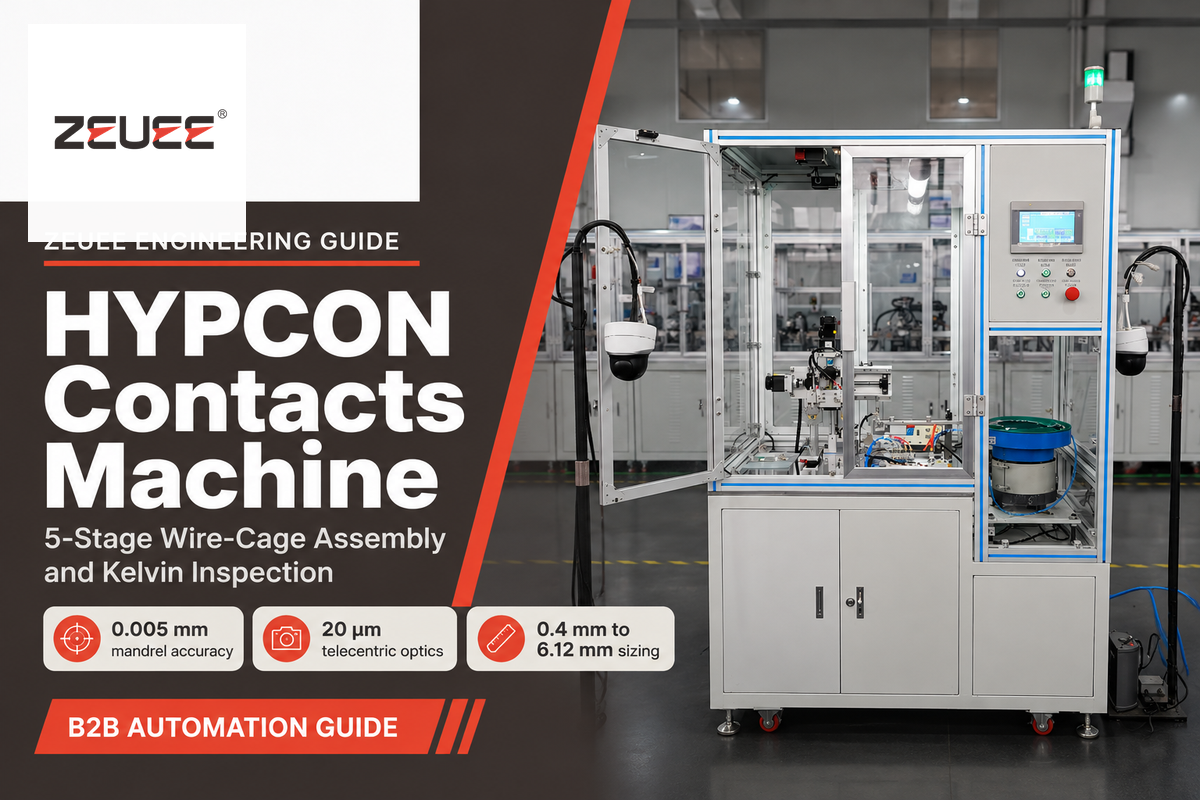
A HYPCON Contacts Machine is an automated multi-station assembly system for hyperboloid electrical socket contacts. Precision feeders index spring tempered beryllium copper wires into a grooved mandrel and twist a single-sheet wire basket. Dedicated stations then seat the inner sleeve, lock the wire ends, and verify inline micron dimension and milliohm resistance.
Consumer optical suction cups share a similar retail acronym, yet industrial hyperboloid equipment serves defense, medical, and electric-drivetrain interconnects. Across 0.4 mm signal sockets up to 6.12 mm (260 A DC) MIL-DTL-38999 Series III barrels (-65 °C to +125 °C), no single fixture runs every gauge. Engineers group parts into diameter bands and review custom HYPCON Contacts Machine configuration and RFQ specifications once drawings freeze.
Direct Engineering Summary
Every production HYPCON Contacts Machine synchronizes five operations: tensioned wire feeding, 0.005 mm mandrel skew forming, sleeve seating, servo crimp or micro-laser anchoring, and inspection. Inline 20 µm diffuse-dome telecentric optics pair with 20 mV / 100 mA 4-wire Kelvin testing.
100,000 cyclesrated hyperboloid mating life on gold pins
30–52 gnormal contact force per skewed wire
0.005 mmmandrel and core-rod machining accuracy
<20 msinline global-shutter vision decision time
Key Engineering Takeaways
- Modest normal force (30 g minimum, 52 g typical per wire) beats stiff slotted tines on wear life. Gold-plated cages survive 100,000 matings without stripping plating.
- Turned wire-basket sockets feed as discrete sleeves from bowls or trays. Stamped hyperboloid contacts (0.8 mm, 1.0 mm, and 2.0 mm) run on carrier reels through a contact applicator.
- Coaxial ring lights frequently cause false rejects on reflective gold barrels. Diffuse dome lighting plus 20 µm bi-telecentric optics and 20 mV Kelvin probing stop escapes.
- Machine builder ISO 9001:2015 (or ISO 9001:2026) and CE certificates cover equipment quality and safety. Finished aerospace lots still require MIL-DTL-38999 or SAE AS39029 qualification.
How Does a Hyperboloid Wire-Basket Socket Work Inside a HYPCON Contacts Machine?
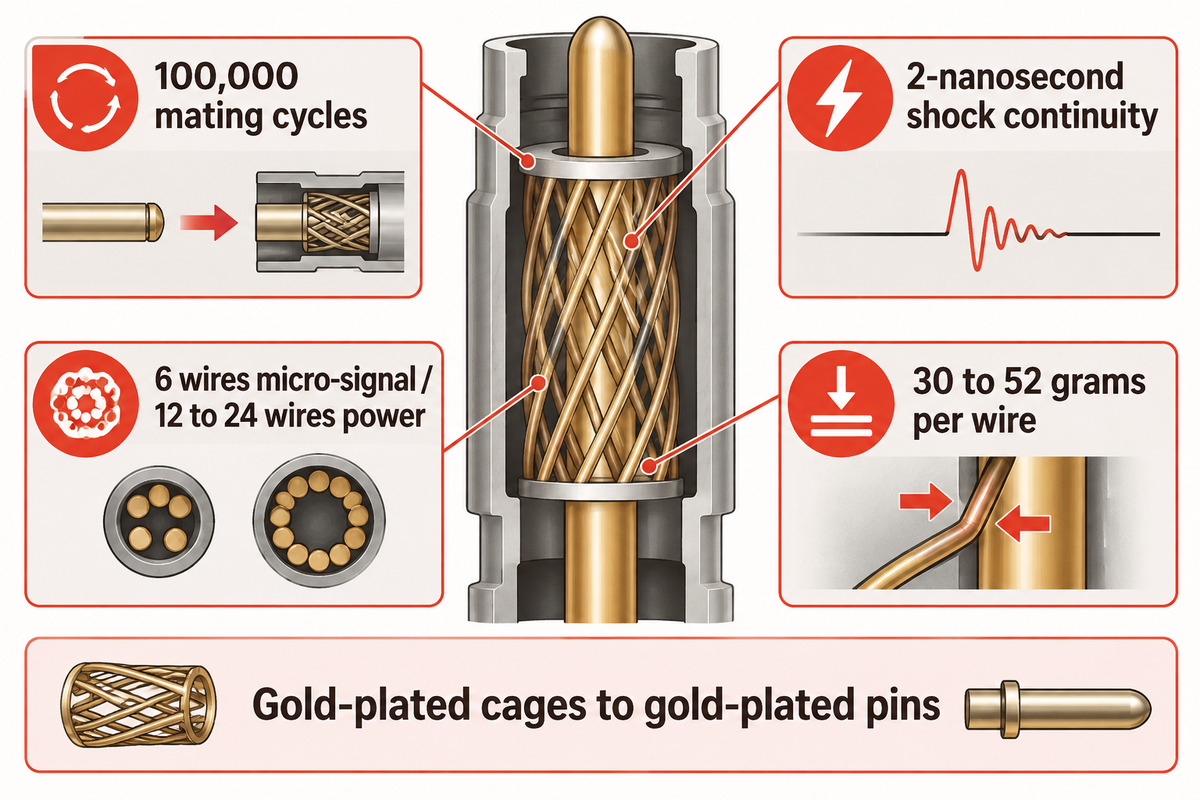
A hyperboloid wire-basket socket contact holds straight spring wires at a fixed skew angle in a cylindrical barrel. During mating, wires stretch along a helical path, lowering pin insertion force while maintaining milliohm contact resistance.
François Robert Bonhomme invented hyperboloid contact technology in 1956 for high-vibration rolling stock, as described in the Connector Supplier’s technical history of hyperboloid contacts. Published hyperboloid connectors are claimed to withstand 100,000 mating cycles, and standard medical connectors average approximately 5,000 cycles. Shock monitoring, as described in Tech Briefs on hyperboloid wire-basket interconnects, shows zero electrical discontinuities longer than 2 ns.
In a pin and socket contact assembly machine, four mechanical variables must be locked to achieve the desired amount of contact. Wire count (typically 6 wires on micro-signal pins and 12 to 24 wires on power sockets) sets parallel current paths. Twist angle determines the constriction in the unloaded throat. Inner-sleeve concentricity allows for radial clearance between the barrel and the sleeve. Smooth tangential contact prevents plating wear.
A strict metallurgical limitation imposes a life limit on field use. 100,000 cycles with stable milliohm readings require mating gold-plated cages to smooth gold-plated pins at 30 to 52 grams per wire. Mixing gold wire baskets with tin-plated pins causes fretting corrosion debris and increases contact resistance.
Why Does Wire Inclination Angle Control Both Mating Force and Milliohm Stability?
Wire inclination sets the unloaded throat diameter relative to the incoming male pin diameter. A steeper angle makes a narrower waist of the wire-cage and increases both insertion and removal force and normal contact pressure. A shallower inclination reduces unilateral mating force to about 2 ounces on micro-signal pins.
The majority of engineers assume that maximum spring force provides the best contact conductivity, but that isn’t the case. Normal force must be held at a minimum of 30 grams per wire, and a contact load of 52 grams is typical. The load is spread over multiple contact paths, and the mating of contacts feels almost effortless. ZEUEE rotary servo indexers lock that skew angle before a wire end is fixed.
How Do Turned Wire-Basket, Stamped HCS, Crown-Spring, and Slotted Sockets Compare?
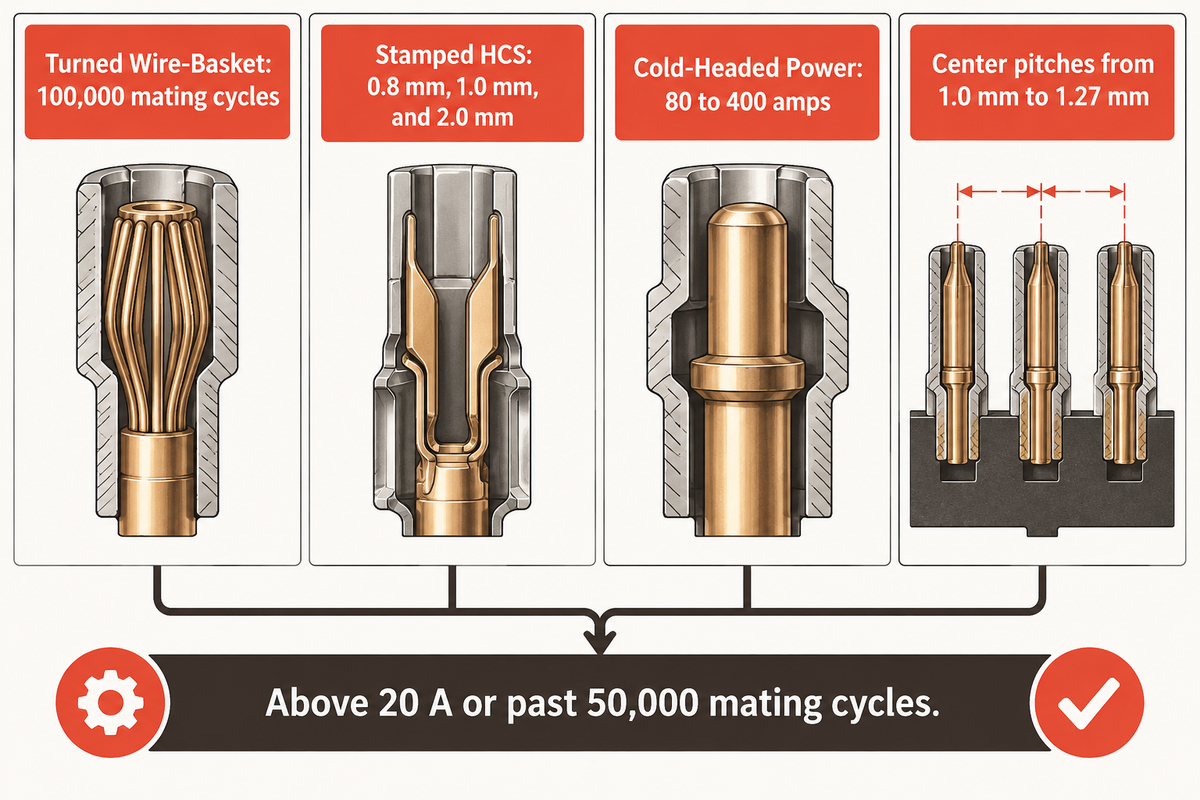
Turned wire-basket sockets deliver up to 100,000 mating cycles and 2-nanosecond shock continuity using machined barrels fed from bowls or trays. Stamped hyperboloid contacts (0.8 mm, 1.0 mm, and 2.0 mm) trade peak current density for high-speed carrier-reel feeding through an automated crimp applicator.
Procurement teams sometimes confuse cable-assembly crimping presses with contact-cage assembly cells because catalog sheets omit upstream forming steps. Cold-headed power barrels disclosed in U.S. Patent US9490562B2 for high-current hyperboloid sockets carry 80 to 400 amps. Flattened self-spacing wire ends make those sockets about 20% smaller in outer diameter than legacy carrier-sleeve designs.
At the miniature extreme, deep-drawn single-wall micro hyperboloid contact system sockets cut 0.4 mm outer diameter by roughly 40%. Designers can pack contacts on center pitches from 1.0 mm to 1.27 mm. Teams focused on broader contact geometries can refer to our industrial pin, socket and spring contact family comparison and the nine-row matrix here.
| Architecture Type | Pin Size & Current Band | Rated Mating Cycles | Automated Feeding Mode | Primary Cell Process Bottleneck |
|---|---|---|---|---|
| Turned Micro Wire-Basket Socket | 0.4–1.0 mm (1–6 A) | Up to 100,000 cycles | Vision flexible tray or fine vibratory bowl | Fine BeCu wire payoff tension and 0.005 mm mandrel alignment |
| Turned Mid-Range Wire-Basket Socket | 1.5–3.6 mm (12–80 A) | Up to 100,000 cycles | Centrifugal or vibratory bowl + fiber optic track | 12-wire circular spacing uniformity and 4-indent crimp symmetry |
| Turned / Cold-Headed Power Wire-Basket | 3.6–6.12 mm (80–260 A, up to 400 A custom) | 50,000–100,000 cycles | Escapement magazine or heavy pallet nest | High-force press-fit ring seating or pulsed laser thermal control |
| Stamped Hyperboloid Contact (HCS) | 0.8 / 1.0 / 2.0 mm (5–20 A) | 10,000–50,000 cycles | Continuous carrier strip reel + crimp applicator | Roll-forming seam closure and carrier cutoff burr control |
| Crown-Spring Louvered Power Socket | 3.0–10.0 mm (60–350 A) | 5,000–10,000 cycles | Stamped louver strip insertion into turned barrel | Crown band snap-ring seating depth and louver beam coplanarity |
| Torsional Louver Band (Multilam) | 6.0–25.0 mm (150–1,000 A) | 10,000–25,000 cycles | Cut-to-length contact band forming into groove | Internal retention groove undercut tolerance and band overlap gap |
| Helical Twist-Pin Micro Contact | 0.3–0.6 mm (3 A micro-D / nano-D) | 500–2,000 cycles | Stranded spring-wire bundle crimping into sleeve | 7-strand helical bulge diameter control and tip weld bead size |
| SAE AS39029 Closed-Entry Slotted Socket | Size 22D to Size 4 (5–80 A) | 500 cycles (QPL baseline) | Swiss-turned slotted body + stainless hood assembly | Slotting saw burr removal and hood press-fit axial concentricity |
| Commercial Dual-Beam Stamped Box | 0.5–2.5 mm (1–15 A) | 50–500 cycles | High-speed progressive die reel-to-reel line | Cantilever beam springback drift after high-speed die stamping |
Synthesis: U.S. Patent US9490562B2, Defense Logistics Agency SAE-AS39029 records, Connector Supplier benchmarks, and ZEUEE assembly cell files.
When Should Connector Engineers Choose Turned Wire Cages Over Stamped Reel Contacts?
Connector engineers should pick turned wire-basket sockets whenever designs demand above 20 A continuous current, below 0.8 mm medical pitch, or survival past 50,000 mating cycles. Stamped hyperboloid reel contacts fit high-volume industrial I/O cable assemblies built around standardized 0.8 mm, 1.0 mm, or 2.0 mm pins.
Between 2026 and 2028, stamped and turned platforms will grow side by side rather than converge. Stamped reel contacts reduce termination costs for factory sensor cables. Turned wire baskets are mandated in MIL-DTL-38999 Series III aviation connectors, surgical catheters, powered prosthetic joints, and 260 A EV power lines.
Inside the 5-Stage HYPCON Contacts Machine Process Architecture and Tolerance Budget
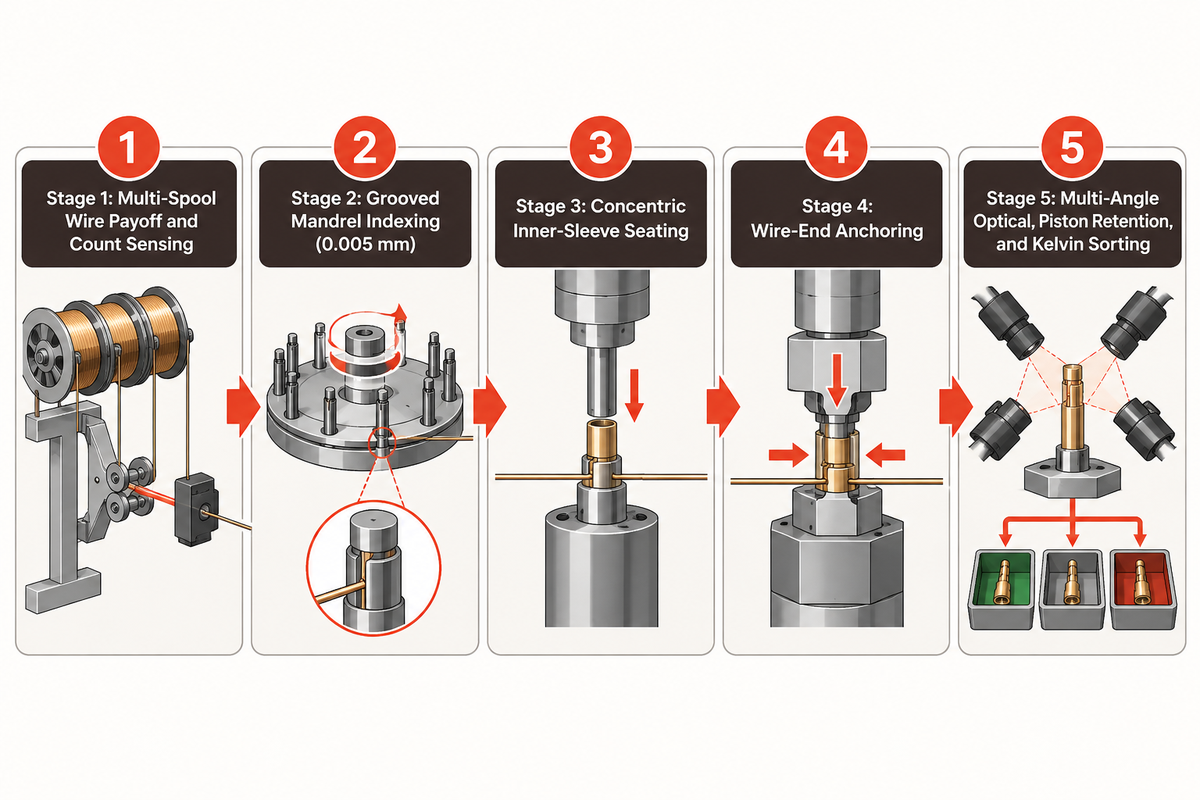
A HYPCON Contacts Machine automates five coupled assembly operations: guided wire feeding, grooved-mandrel skew forming, seating the inner sleeve, anchoring the wire end, and verifying each part. The mandrel is machined to within 0.005 mm, thereby avoiding wire crossover, collapsed throats, and plating scuffs.
Legacy concentric press-fit construction increased contact length and risked loose wires in service, as noted in U.S. patent records:
“At each end of the inner sleeve the wires are bent 180 degrees outward so as to return axially between the inner and outer sleeves.”
Source: U.S. Patent US7775841B2, Hyperboloid Electrical Contact, United States Patent and Trademark Office
Rotating a longitudinally grooved spline inside a deep-drawn tube and crimping the lip makes the socket about 65% shorter, per US Patent US7775841B2. After finished contacts pass end-of-line sorting, downstream block loading follows our 9-point contact-to-housing insertion acceptance guide. This keeps the quality boundary clear when separating the contact-cage assembly from the insulator cavity insertion.
5-Stage Wire-Cage Tolerance Budget: Station-by-Station Error Allocation
A 5-Stage Wire-Cage Tolerance Budget allocates microns of position, angular, and force error so the cumulative error never constricts the throat diameter.
- Stage 1: Multi-Spool Wire Payoff and Count Sensing. Gram-level tension is held steady on beryllium-copper wire spools by closed-loop dancers. Thin-wall barrels arrive via vision-guided flexible feeder systems for delicate connector barrels. Plated sleeves are in a sealed anti-tarnish storage box magazine.
- Stage 2: Grooved Mandrel Indexing and Skew Forming. ZEUEE grinds core rods and grooved mandrels to 0.005 mm repeatability with mirror flutes. Precise servo rotation twists the wire array to the target angle without damaging gold-over-nickel plating.
- Stage 3: Concentric Inner-Sleeve Seating. A servo linear slide mounted on a rigid machine base seats the sleeve to the datum depth. Force-displacement sensors measure press curves to assess how well the stroke curve conforms to target force limits, every millimeter of the stroke.
- Stage 4: Wire-End Anchoring. Synchronous 4-indent radial jaws, press-fit collars, or galvo fiber lasers lock wire ends before mandrel withdrawal.
- Stage 5: Multi-Angle Optical, Piston Retention, and Kelvin Sorting. A multifunction turret tests wire geometry, axial retention with a piston, and measures dry-circuit milliohms. Conforming sockets are transferred to tray pockets by a PEEK vacuum suction holder.
On the shop floor, front-access spool bays sit at an ergonomic height. Each operator station offers an ergonomic design that removes the need for manual handling using fingers or a metal tweezer.
Servo Press-Fit vs 4-Point Indent Crimp vs Laser Welding: Wire-End Fixing Physics
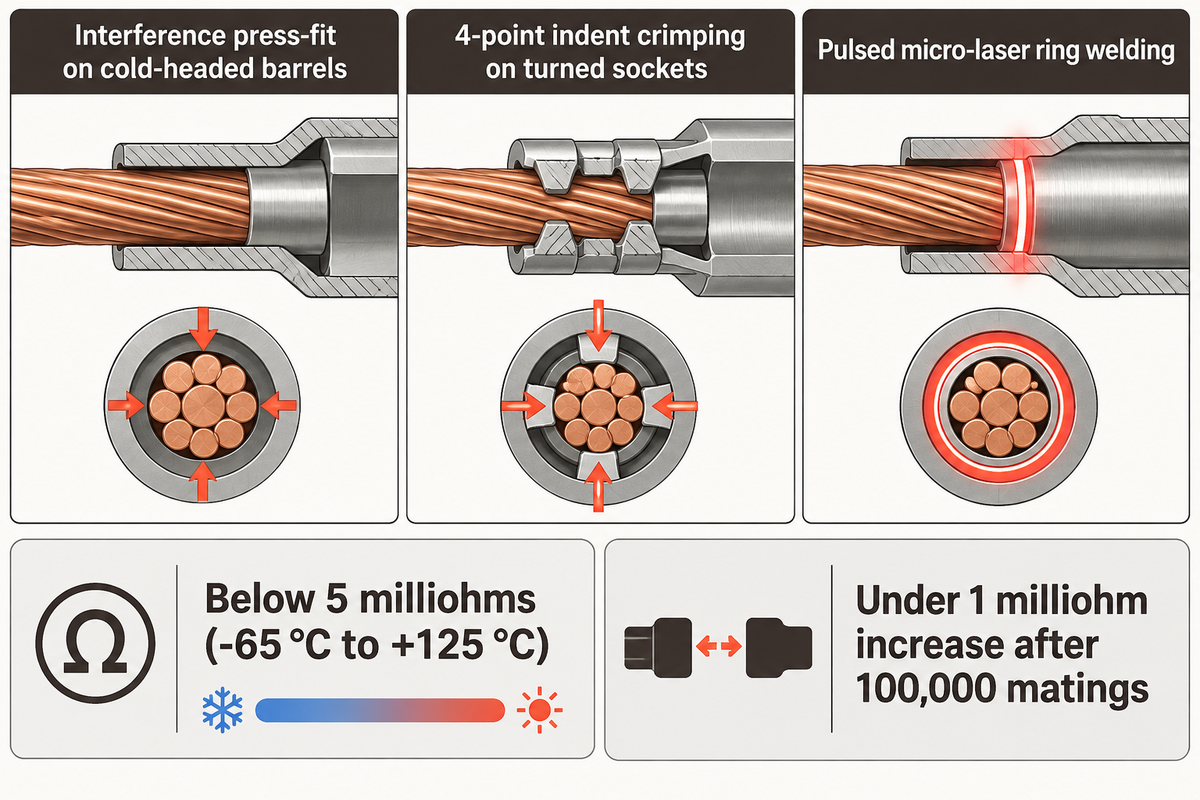
A HYPCON Contacts Machine performs three mechanisms of wire-end fixing, either mechanically or by heat. Cold-headed barrels use an interference press-fit. Turned sockets use 4-point indent crimping. Miniature high-density sleeves use pulsed micro-laser ring welding to eliminate extra retaining collars.
High-speed assembly disclosed in U.S. Patent US6767260B2 for laser-welded hyperboloid contacts loads straight wires into longitudinal grooves and laser welds the upper ends of the wire. Servo rotation then twists the hyperboloid waist before a second laser pulse welds lower wire ends. Removing the 180 degree reverse wire bend thins the barrel wall and stops wire pull-out.
Spring contact degradation in Microelectronics Reliability on electrical connector failure mechanisms is caused by thermal aging, corrosion, wear and fretting. One of the process limitations therefore governs laser stations: while micro-laser welding prevents wire slippage, excess heat input anneals Beryllium copper, and radially reduces spring constant.
Which Wire-End Fixing Method Prevents Cage Loosening Under Thermal Cycling?
Synchronous 4-point indent crimping and pulse-shaped fiber laser welding both keep post-cycling contact resistance below 5 milliohms across the -65 °C to +125 °C operating envelope. This stability is primarily dependent on radial jaw symmetry and servo limits, along with the precise control of millisecond laser pulse energy.
Two-jaw crimpers deform thin copper-alloy sleeves, over-straining adjacent wires, and leaving two ends free. Four-point servo indent heads ensure equal pressure in all four quadrants. Validated sockets hold under 1 milliohm resistance increase after 100,000 matings and stay below 5 milliohms through 50 hours of 35 g three-axis vibration.
Inline Optical and Electrical Verification: Diffuse-Dome Telecentric Vision Plus 4-Wire Kelvin Testing
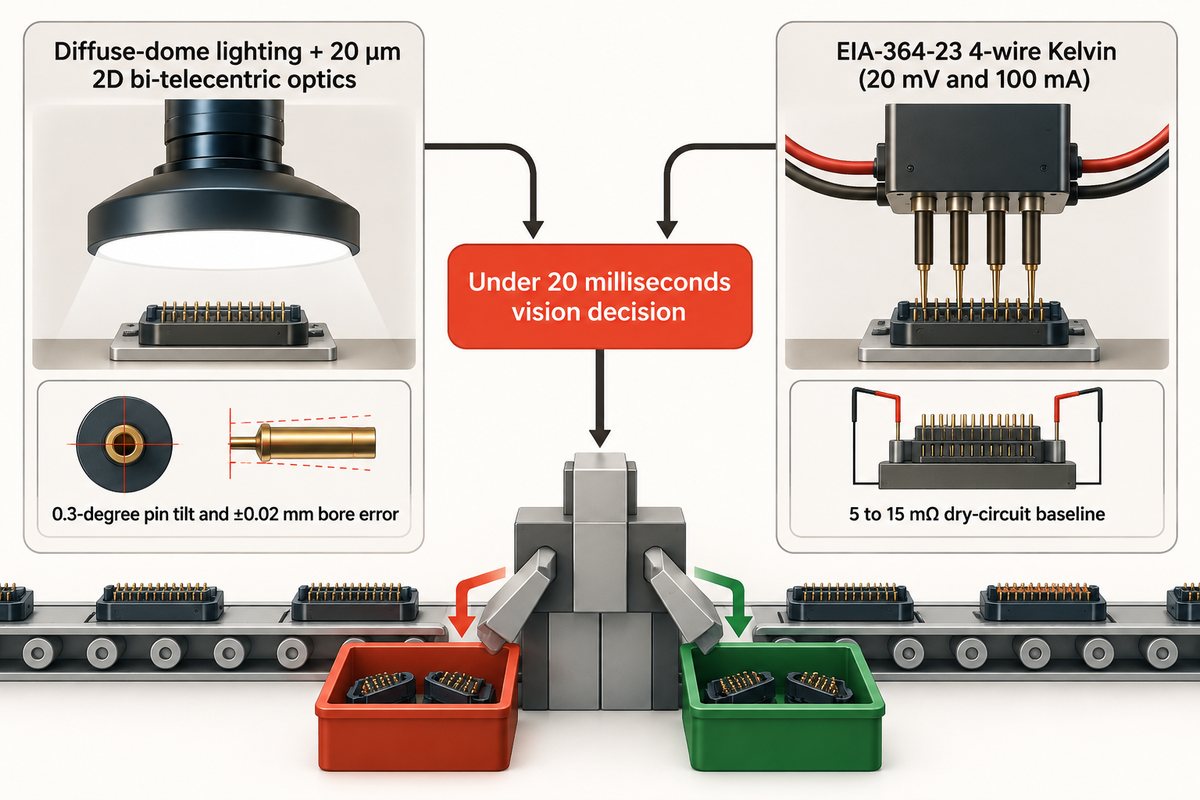
Zero-defect hyperboloid contact manufacturing combines diffuse-dome lighting, 20 µm 2D bi-telecentric optics, 3D structured-light profiling, and EIA-364-23 dry-circuit 4-wire Kelvin testing. Milliohm probes and optics, working in conjunction, are needed to catch a crossed wire or resistive oxide films.
Curved gold-plated barrels behave like cylindrical mirrors under standard coaxial ring lights. Before optical tuning, specular glare on reflective contacts drives frequent false rejects and wastes good parts. Deploying multi-CCD connector vision inspection automation wraps barrels in uniform diffuse-dome light. Global-shutter cameras detect 0.3-degree pin tilt, 20 µm position drift, ±0.02 mm bore error, and 0.05 mm depth offset in under 20 milliseconds.
Space interconnect screening rules in the NASA Electronic Parts and Packaging (NEPP) Connector Guide require low-level contact resistance testing per EIA-364-23 or MIL-STD-1344 Method 3002. Dry-circuit 4-wire Kelvin probes limit open-circuit voltage to 20 mV and current to 100 mA (normal baseline 5 to 15 mΩ). Low energy helps avoid puncturing thin tarnish films. Portable bench meters assist setup checks, while inline Kelvin turrets verify every socket prior to tray sorting.
How Do Engineers Size Tooling Bands and Cycle Time From 0.4 mm Signal Pins to 6.12 mm Power Sockets?
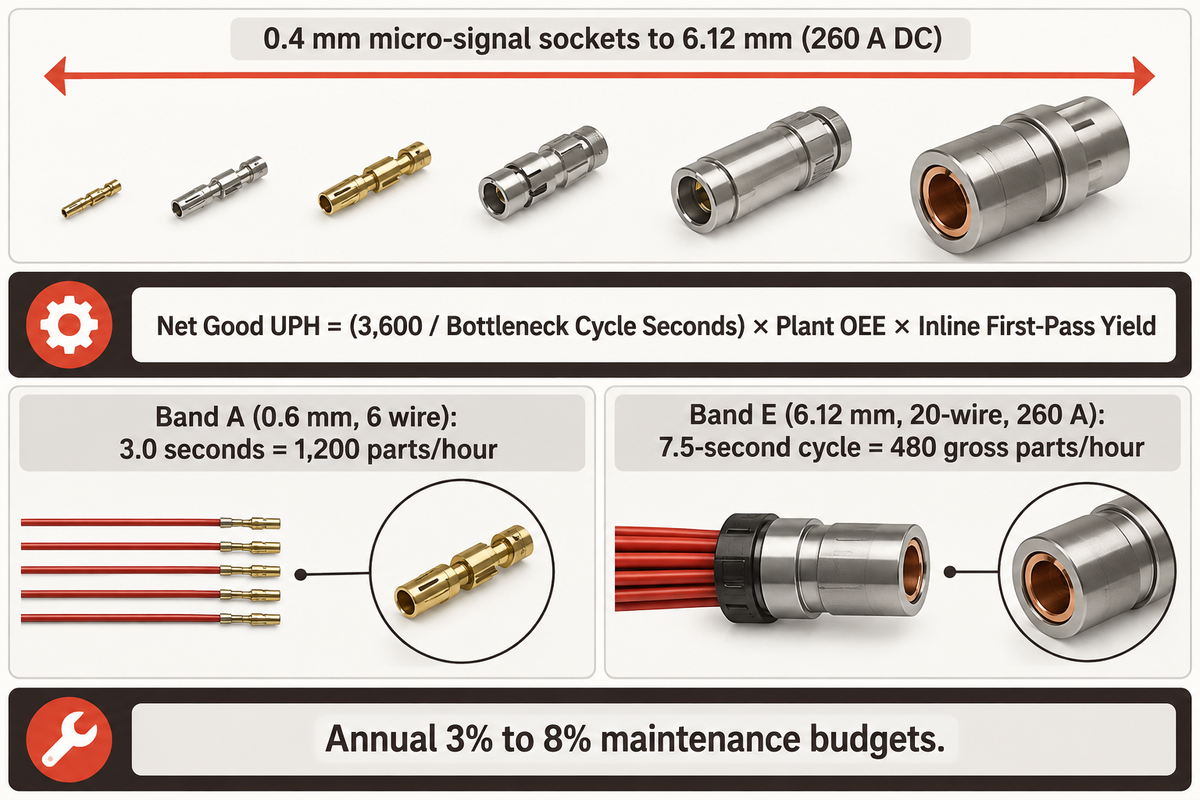
Process engineers size a HYPCON Contacts Machine by partitioning SKUs into diameter bands from 0.4 mm micro-signal sockets to 6.12 mm (260 A DC) power barrels. Capacity is then governed by the inverse bottleneck station cycle time multiplied by the overall equipment effectiveness and the in-line inspection yield.
Wire count and stiffness increase with current rating. Six fine wires on a 0.6 mm pin carry 4 amps typically, while 12 wires on a 1.5 mm pin carry above 12 amps. Heavy cold-headed cages in U.S. Patent US9490562B2 span 80 to 400 amps. One hardware limitation applies universally: no single fixture runs both 0.4 mm signal sockets and 6.12 mm (260 A) power barrels at zero changeover, so cross-band runs require swapping wire collets, mandrels, and fixing heads.
| Tooling Band / Cell Configuration | Pin Diameter Span | Typical Wire Count & Current | Preferred Wire-End Fixing | Changeover & Transport Setup |
|---|---|---|---|---|
| Band A: Ultra-Micro Medical & High-Density | 0.40–0.60 mm (1.0 mm pitch) | 5–6 wires (1–4 A) | Controlled deep-drawn crimp or micro-laser | Cleanroom linear servo + PEEK vacuum suction tool |
| Band B: Aerospace Signal (Size 22D / Size 20) | 0.76–1.02 mm (1.27 mm pitch) | 6–8 wires (5–10 A) | 4-point synchronous servo indent crimp | High-speed precision cam-servo rotary dial |
| Band C: Industrial & Avionics Mid-Power (Size 16 / 12) | 1.50–2.40 mm | 10–12 wires (12–35 A) | 4-point servo crimp or grooved-spline swage | Rotary indexing table + dual vibratory bowl tracks |
| Band D: Heavy Auxiliary Power (Size 8) | 3.00–3.60 mm | 12–16 wires (45–80 A) | Servo press-fit ring + force-curve windowing | Heavy-duty servo indexer + escapement sleeve loader |
| Band E: EV Drivetrain & Defense High-Power | 5.00–6.12 mm | 16–24 flattened or round wires (150–260 A DC) | Press-fit inner plug + outer collar or ring laser | Linear pallet transfer + high-thrust servo press |
| Band F: Stamped HCS Carrier-Reel Cell | 0.80 / 1.00 / 2.00 mm | Stamped skewed beams (5–20 A) | Progressive roll-forming + carrier cutoff | Reel payoff + motorized storage take-up winder |
| Band G: Intra-Band Quick-Change Family Cell | Adjacent SKUs sharing barrel outer-diameter family | Same wire gauge & wire count | Shared servo crimp or laser head via HMI recipe | Dowel-pinned nest swap + calibration accessory check |
| Band H: High-Mix Aerospace Small-Lot Cell | 0.76–3.60 mm modular sub-plates | 6–14 wires across MIL-DTL-38999 SKUs | Interchangeable crimp / press sub-plate modules | Vision flexible feeder + barcode recipe lock |
| Band I: Dual-Track High-Volume Signal Cell | 0.60–1.02 mm twin parallel lanes | 6–8 wires (4–10 A) | Twin-head synchronous 4-point indent crimp | Dual mandrels + dual 20 ms telecentric/Kelvin heads |
Gross-to-Net UPH Sizing Formula (0.6 mm Signal vs 6.12 mm Power Socket)
The throughput equation is: Net Good UPH = (3,600 / Bottleneck Cycle Seconds) × Plant OEE × Inline First-Pass Yield. The two examples below demonstrate how wire count determines gross ceiling before shift losses:
- In a 0.6 mm 6 wire medical signal socket in Band A, a bottleneck cycle of 3.0 seconds sets a gross ceiling of 3,600 / 3.0 = 1,200 parts/hour before Plant OEE and inline yield are taken into account.
- On a 6.12 mm 20-wire 260 A power socket in Band E, feeding 20 heavy wires and pressing a retention collar sets a 7.5-second cycle, or 480 gross parts/hour prior to OEE and yield deductions.
Engineers who want to assess shift payback and annual 3% to 8% maintenance budgets can enter exact SKU volumes in our HYPCON contact assembly automation ROI calculator.
Qualification Standards That Govern Hyperboloid Contact Assembly (MIL-DTL-38999, SAE AS39029, and EIA-364)
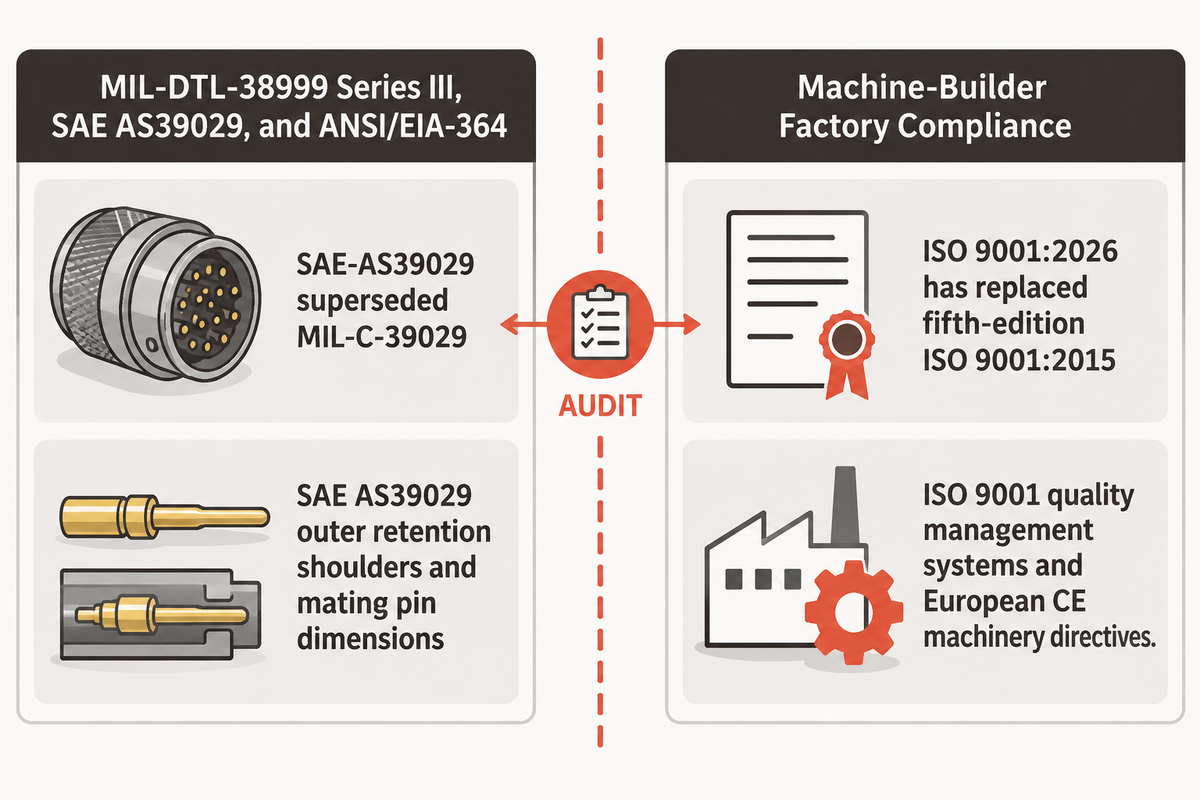
Specifications must separate finished-contact qualification standards from machine-builder factory compliance before purchase orders can be placed. MIL-DTL-38999 Series III, SAE AS39029, and ANSI/EIA-364 procedures govern mil-dtl-38999 hyperboloid contacts. ISO 9001 quality management systems and European CE machinery directives govern the automated assembly equipment builder.
U.S. military standardization records in Defense Logistics Agency ASSIST for MIL-C-39029 / SAE-AS39029 confirm SAE-AS39029 superseded MIL-C-39029 for removable connector contacts. SAE AS39029 defines outer retention shoulders and mating pin dimensions. Proprietary wire-basket interiors follow source-control drawings tested under ANSI/EIA-364 electrical connector test procedure revisions, including EIA-364-23 (20 mV / 100 mA resistance), EIA-364-28 (vibration), and EIA-364-29 (retention).
Official lifecycle notices from the International Organization for Standardization for ISO 9001:2015 and ISO 9001:2026 show ISO 9001:2026 has replaced fifth-edition ISO 9001:2015. One compliance boundary prevents audit mistakes: machine-builder ISO 9001 and CE certificates cover equipment quality management and electrical safety only, so Qualified Products List approval still requires independent MIL-DTL-38999 or SAE AS39029 lot testing by the connector plant.
Wire-Cage Defect Root-Cause Troubleshooting: Missing Wires, Collapsed Waist, and High Milliohm Drift
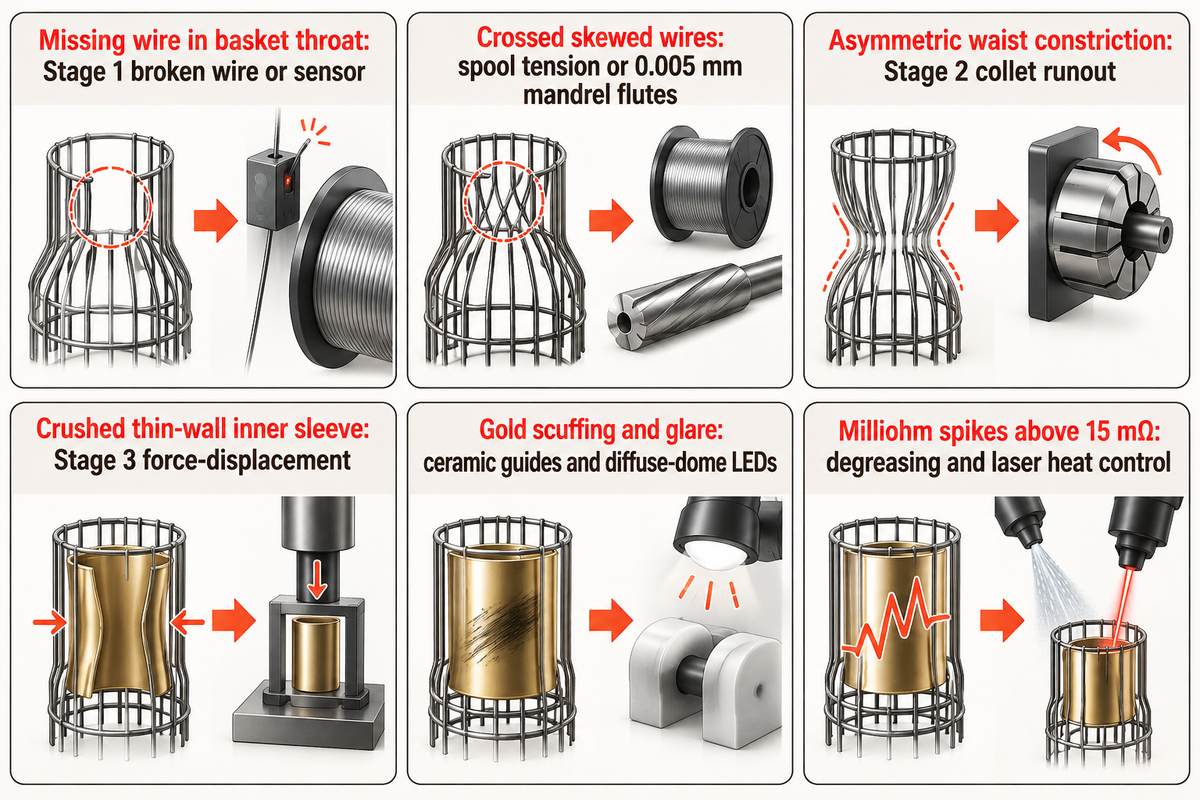
During ramp-up, if inline inspection flags wire-cage rejects, changing downstream crimp depth or widening camera limits covers up the real mechanical problem. Recurring hyperboloid socket assembly defects originate upstream in wire payoff tension, grooved mandrel flute wear, barrel surface cleanliness, or laser pulse drift.
Automotive plants target below 25 DPPM and medical plants target below 10 DPPM, against a 3.4 DPPM benchmark of Six Sigma. Sandia National Laboratories’ testing of 82 inspectors across 140 precision parts showed that manual visual checks captured only 85% of defects and incorrectly scrapped 35% of good parts. Combining station reject logs with peer-reviewed connector fretting and thermal relaxation models isolates six shop-floor root causes:
- A missing wire in a basket throat traces to a Stage 1 broken wire or a fouled fiber optic sensor; clean payoff guides and check each wire encoder.
- Crossed or overlapping skewed wires stem from uneven spool tension or burrs inside 0.005 mm mandrel flutes; inspect grooves under magnification and rebalance dancers.
- Asymmetric waist constriction is caused by eccentric mandrel to sleeve collet runout during Stage 2 rotation; re-zero the servo home position and check collet runout.
- A crushed thin-wall inner sleeve is caused by Stage 3 over-stroke or barrel length drift; change servo pressing from fixed depth to force-displacement.
- Gold scuffing and recurring glare false rejects indicate worn wire guides or coaxial lighting hot spots; polish or replace ceramic guides while maintaining cleanliness and retune diffuse-dome LEDs.
- Milliohm spikes above a 15 mΩ dry circuit baseline indicate hydrocarbon residue or excessive heat from the laser softening BeCu. Enforce ultrasonic degreasing and strict part-handling hygiene.
Do
- Quarantine rejected cages by station code and inspect Stage 2 mandrel flutes first.
- Check 20 mV / 100 mA Kelvin probe tips against a certified milliohm shunt block every shift.
- Run dry oil-free air and hygienic PEEK wire guides on cleanroom medical contacts.
Don’t
- Increase Stage 4 crimp depth to mask loose wires from Stage 1 tension drift.
- Widen 20 µm telecentric tolerances when gold specular glare causes false rejects.
- Clear jammed micro-barrels with bare fingers or a sharp steel tweezer.
What Drives HYPCON Contacts Machine Cost, Changeover Time, Vendor Selection, and FAT Acceptance?
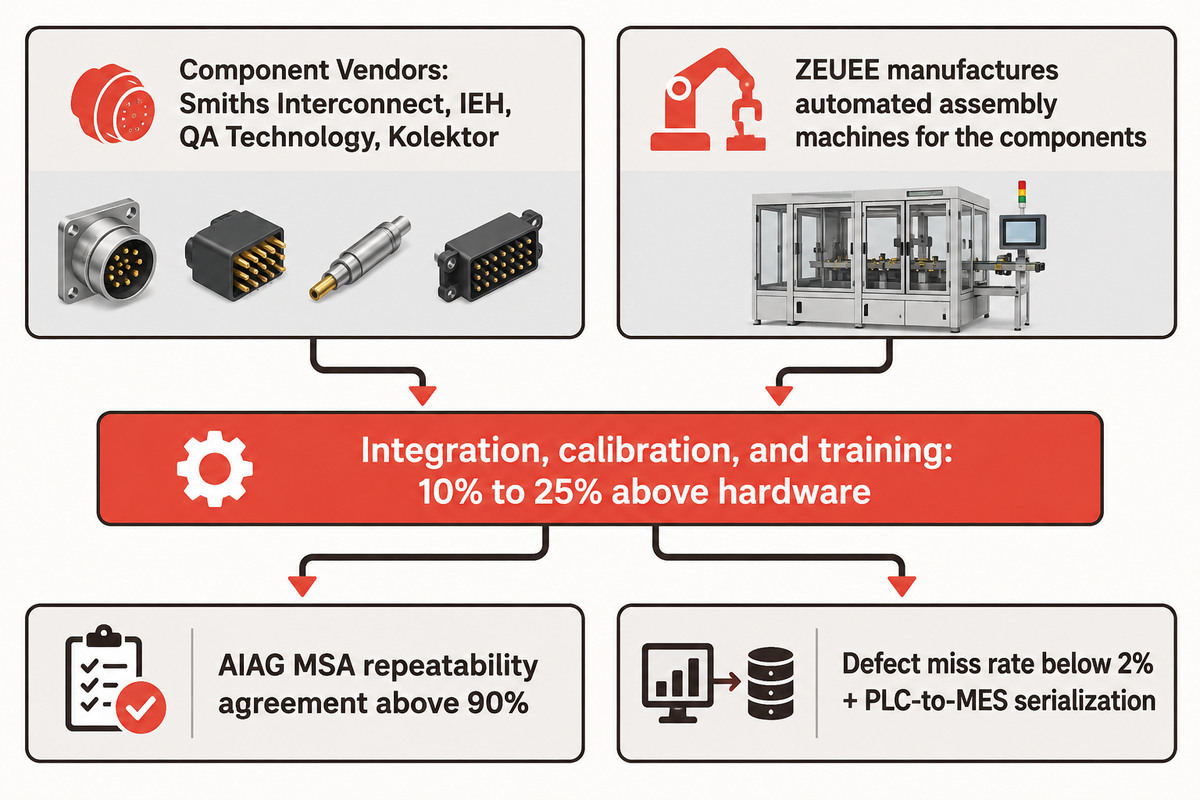
Pricing and lead time for Custom HYPCON Contacts Machines are supplied with written quotes based on frozen part drawings. Key cost drivers include diameter-band count, servo crimp versus fiber-laser fixing, cleanroom hooding, and 3D vision plus Kelvin inspection scope. Industry-wide, system integration, calibration, and training add 10% to 25% above hardware.
Buyers need to distinguish between finished-contact suppliers and custom machine builders. Component vendors including Smiths Interconnect, IEH Corporation, QA Technology, and Kolektor Tesla Jihlava (owner of a HYPCON high-power contact trademark) sell finished contacts. Conversely, Shenzhen Zeyu Intelligent Industrial manufacturing capabilities (ZEUEE, founded in 2005 with a 20,000-square-metre Jiangxi base, 120+ specialists, and 150+ patents) build custom assembly lines under ISO 9001 quality management standards.
When Should a Connector Plant Buy Finished Hyperboloid Contacts Versus Building In-House on a Custom Cell?
For low volume and early prototypes, connector plants should purchase finished hyperboloid sockets from component catalogs. When annual demand justifies dedicated capital, critical sleeve geometries stay proprietary, or customers demand serialized lot traceability, a HYPCON Contacts Machine is warranted.
Production-plated sleeves and wire spools undergo an automated assembly machine Factory Acceptance Test prior to shipment. Sign-off occurs at AIAG MSA repeatability agreement above 90% and a defect miss rate below 2%. During verification, engineers challenge the cell with master missing-wire, reversed-barrel, and high-milliohm parts. While doing so, they verify PLC-to-MES serialization.
Key takeaway
Pairing 0.005 mm grooved mandrels, diameter-banded fixing heads, 20 µm diffuse-dome telecentric optics, and 20 mV Kelvin probing makes 100,000-cycle hyperboloid contact assembly repeatable at scale.
Frequently Asked Questions
Can one universal fixture run every contact size between 0.4 mm and 6.12 mm without hardware swaps?
No universal fixture exists that can assemble 0.4 mm micro-signal sockets and 6.12 mm power barrels without mechanical changeover.
Although the ZEUEE machine platform spans 0.4 mm to 6.12 mm with modular toolsets, wire physics changes drastically across that range. 0.4 mm medical sockets employ low-inertia wire collets and require delicate handling with vacuum. Heavy 260 A power barrels require rigid pallet nests, thick wire guides, and high-thrust press or laser modules.
Why do dry-circuit milliohm probes remain mandatory even after multi-angle camera checks pass?
Diffuse-dome 20 µm telecentric cameras confirm wire count, skew angle, and seating depth, whereas dry-circuit 4-wire Kelvin probes catch invisible resistive films and cold joints.
Testing under EIA-364-23 caps open-circuit voltage at 20 mV and current at 100 mA so probes never arc through surface oxides. Because of this, the surfaces of the contacts never undergo arcing. If there’s a concern with a part, it’s isolated before it ships.
How does the Kolektor HYPCON contact trademark differ from a ZEUEE HYPCON Contacts Machine?
Kolektor Tesla Jihlava manufactures power hyperboloid sockets, and ZEUEE manufactures automated assembly machines for the components.
Procurement teams purchase completed contacts from firms like Kolektor, Smiths Interconnect, IEH, or QA Technology when outsourcing hardware. Connector factories purchase a ZEUEE HYPCON Contacts Machine to run their own wire-basket forming, crimping, laser welding, and inline Kelvin verification processes.
Does the automated assembly cell electroplate beryllium-copper wires or brass barrels inline?
Gold-over-nickel electroplating is always done off-line, prior to assembly.
Wet chemical plating baths run separately, and cleaned and dried wires, along with turned barrels, enter the mechanical cell.
What determines whether a part-number changeover takes minutes via HMI recipe recall or requires modular sub-plate replacement?
Intra-band changeovers that involve the same wire diameter and wire count switch quickly via an HMI servo recipe, along with a quick-release mandrel and nest.
Cross-band changeovers include adjusting the spring-wire gauge, wire count, and width of the bowl feeder track, along with changing fixing hardware on Stage 4. Operators swap dowel-pinned feeder and termination sub-plates, along with the mandrel, and load the PLC recipe. The changeover is completed with first-off Gage R&R and EIA-364-23 shunt checks. The exact time it takes to perform the changeover is logged for the part drawings during Factory Acceptance Testing.
Can cleanroom-enclosed configurations assemble medical hyperboloid contacts without lubricant contamination?
Yes, completely enclosed, dry, lubricant-free motion component cells assemble hyperboloid medical sockets.
Dry PEEK wire guides, sealed servo drives, HEPA laminar airflow, and vented pneumatics protect surgical contact surfaces.
Which six engineering documents and tolerances must be frozen before requesting a formal machine quotation?
Freeze the six engineering inputs prior to requesting a formal machine quote: part drawings, wire specs, desired fixing mode, expected net UPH, inspection limits, and data integration means.
Give male pin diameter and turned barrel tolerance drawings. Give beryllium-copper wire diameter and count, plating thickness and skew angle. State press-fit collars, 4-point indent crimps, or pulsed laser welding requirements. Give annual volume per SKU and shift hours. Give EIA-364-23 milliohm and axial retention force specs. Give PLC/MES barcode and lot traceability field maps.
Engineer Your Custom HYPCON Contacts Machine Cell
Send your socket barrel drawings, wire count, diameter band (0.4 mm to 6.12 mm), and target net UPH to ZEUEE’s engineering team for a custom station and tolerance evaluation.
About This Engineering Analysis
Written by Cherry, with engineering input from Shenzhen Zeyu Intelligent Industrial Science Technology Co., Ltd (ZEUEE), with two decades of connector pin, core-rod, and hyperboloid wire-basket assembly equipment design experience, from 0.4 mm medical sockets to 6.12 mm power barrels. Unlike downstream housing-insertion checklists, this guide covers upstream 0.005 mm grooved-mandrel forming, diffuse-dome 20 µm telecentric optics, and EIA-364-23 Kelvin verification.
References & Sources
- What is Hyperboloid Contact Technology? : Connector Supplier Technical Trade Publication
- Hyperboloid Wire-Basket High-Reliability Interconnects : SAE Media Group / Tech Briefs Engineering Review
- U.S. Patent US9490562B2: Reduced Diameter Hyperboloid Electrical Contact (80–400 A) : United States Patent and Trademark Office
- U.S. Patent US7775841B2: Grooved-Spline Hyperboloid Electrical Contact : United States Patent and Trademark Office
- U.S. Patent US6767260B2: Automated Grooved-Mandrel and Laser-Welded Hyperboloid Contact : United States Patent and Trademark Office
- Electrical Connector Contact Failure Mechanisms: Corrosion, Wear, Fretting, and Thermal Aging : Microelectronics Reliability (ScienceDirect)
- Space-Grade Electrical Connector Screening and EIA-364-23 Low-Level Contact Resistance Guide : NASA Electronic Parts and Packaging (NEPP) Program
- MIL-C-39029 / SAE-AS39029 General Specification for Removable Electrical Connector Contacts : U.S. Defense Logistics Agency ASSIST
- ANSI Standards Action: ANSI/EIA-364 Electrical Connector Test Procedure Revisions : American National Standards Institute (ANSI)
- ISO 9001:2015 Quality Management Systems Requirements and ISO 9001:2026 Replacement Notice : International Organization for Standardization (ISO)
WHY WE WRITE THIS
About ZEUEE Engineering Insights
ZEUEE shares technical guides based on real automation project experience. Since 2005, we have designed and manufactured non-standard automation equipment for connector assembly, wire harness production, robotic lines, vision inspection, and smart factory upgrades.
Founded in 2005
20,000 m² production base
120+ specialists
150+ R&D patents
ISO9001:2015 certified