Get in touch with Zeyu lntelligent Industrial Company
Contact Form 使用中
AUTOMATIC PRODUCTION CELL

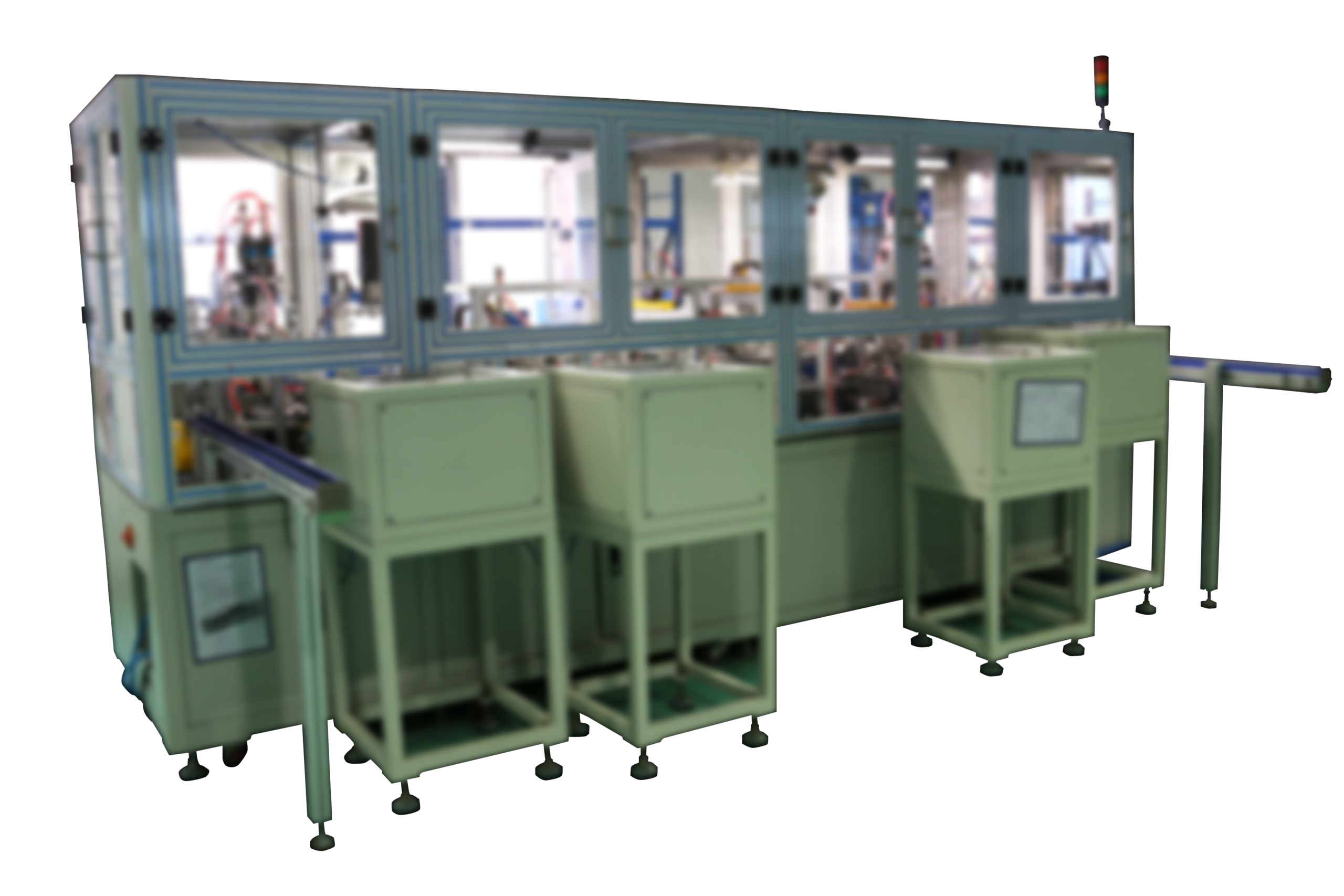
Hinge Assembly Machine: Automatic 2-Wing & 3-Wing Hinge Production

Engineered for door and window hinge manufacturers. Features automatic feeding, shaft sleeve direction check, precise oil injection, and synchronous dual-screw locking — meeting strict ANSI BHMA A156.1 and DIN EN 1935 industry specifications.

Key Performance Indicators

10-12 pcs/min
10.5 kW
380V 50Hz
0.5-0.8 MPa
ANSI A156.1 ready
1 unit MOQ

System Specifications & Technical Data

Throughput Capacity 10-12 pcs/min
Rated Power 10.5 kW
Operating Voltage 380V / 50Hz (3-Phase)
Pneumatic Pressure 0.5-0.8 MPa
Equipment Footprint 4800 × 4200 × 1900 mm
Supported Hinge Types 2-Wing, 3-Wing, Custom Profiling
Minimum Order Quantity 1 Unit (Fully Configured Cell)
Standard Lead Time 75-90 Days (FOB Shenzhen)
EN · PROC · MGR

Why Hinge Manufacturers Are Replacing Manual Lines With ZEUEE Assembly Automation

hinge assembly machine can automate door hinge manufacture by seamlessly performing many steps: inserting shaft sleeves, applying lubrication, injecting plastic inserts, and securely locking screws onto door and window hinge bodies. While automatic riveting was the bottleneck for many legacy lines, contemporary, automated screw-locking heads are now pervasive among Grade 1 commercial output. Manual hinge lines are consistently bottlenecked on three distinct operations-inconsistent screw torquing, improper shaft sleeve orientations, and imprecise oil application, each of which cascades rework cost through the remainder of the manufacturing workflow.

[MOD-01] Pain → Root Cause → Solution

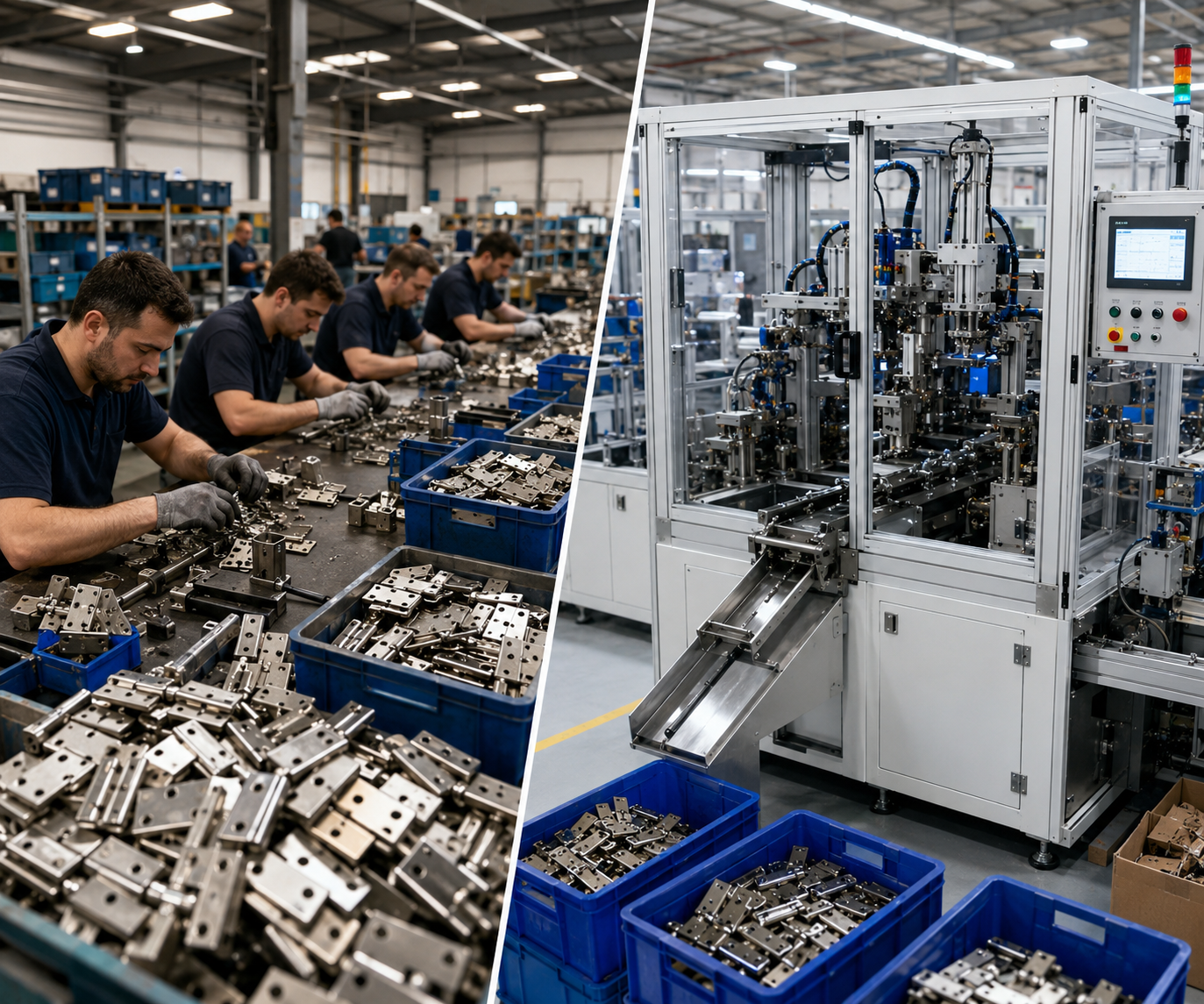
Manual hinge line yield variability vs synchronized dual-screw solution

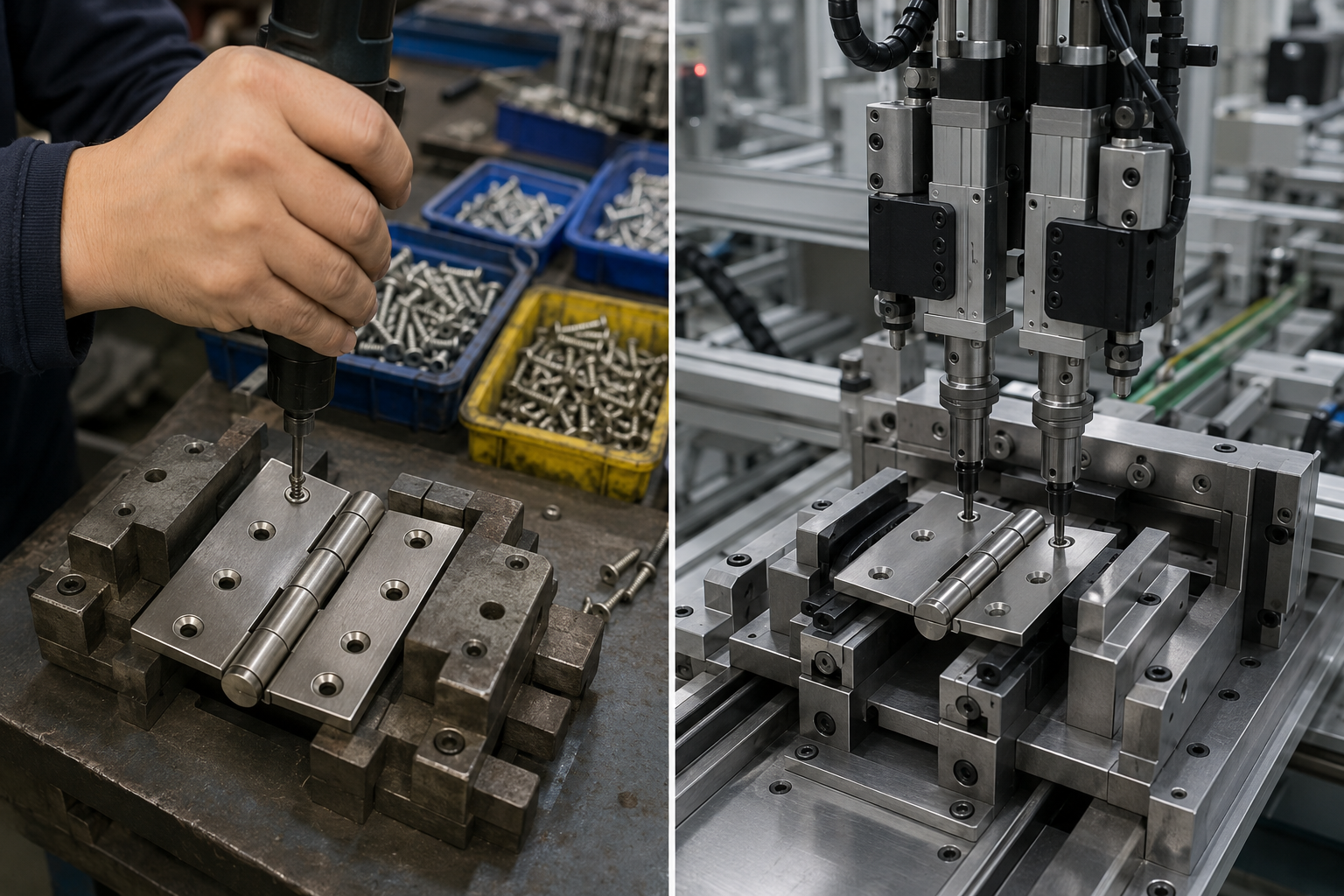
A typical manual hinge line shows yield variability of 5-12% on dual-screw torque (an industry baseline that swings with operator turnover), driven by sequential single-screw fastening (a, then b) producing uneven clamp pressure.

ZEUEE’s synchronized dual-screw locking head, by contrast, drives both fasteners simultaneously and removes sequence-induced variation — even at high volumes like those documented by ISO9001-certified hinge leader Maxave Group, which reports 99% yield rates after automation conversion.

[SOURCE_REF]

[MOD-02] Process Details

Automated hinge assembly process details and engineering design

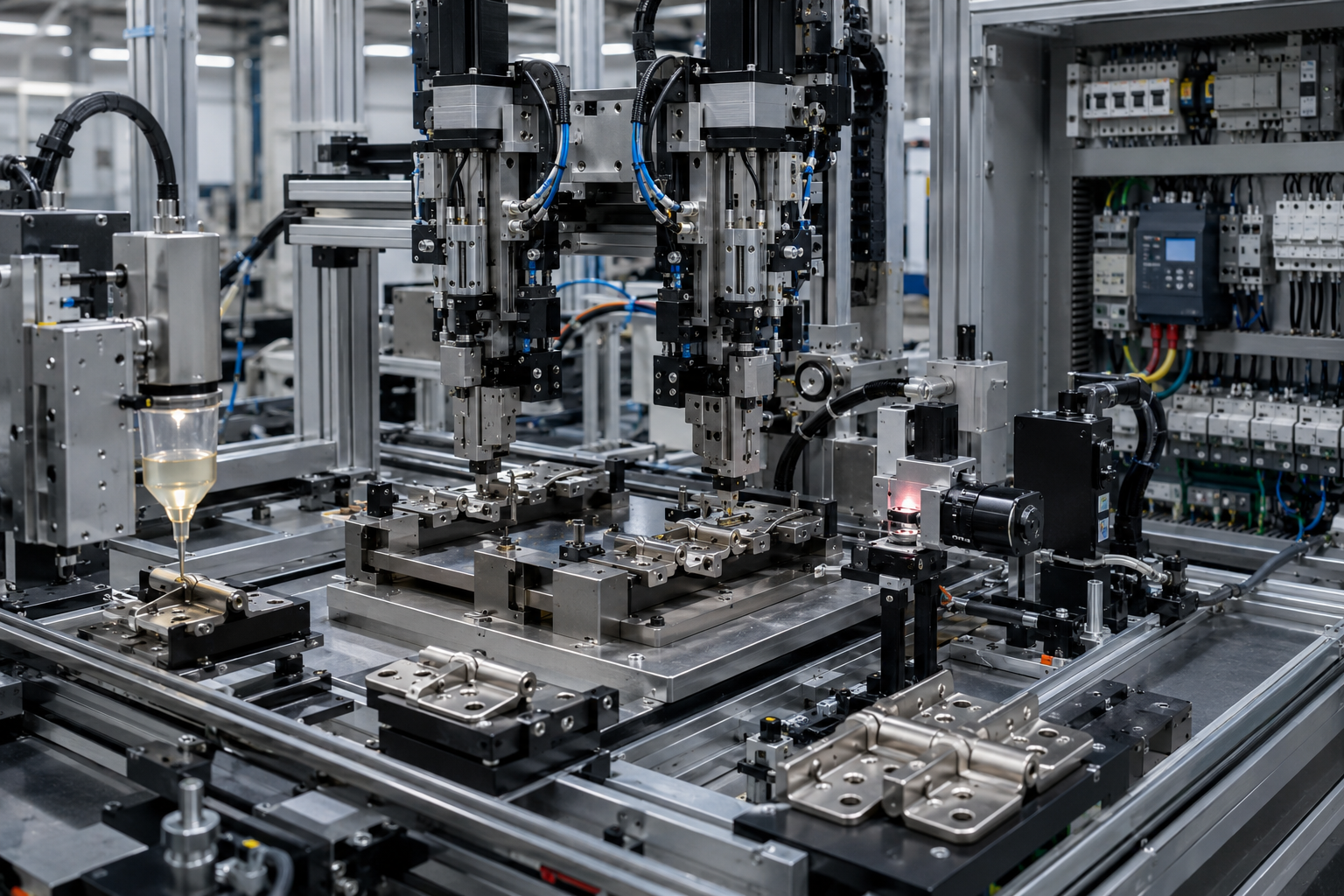
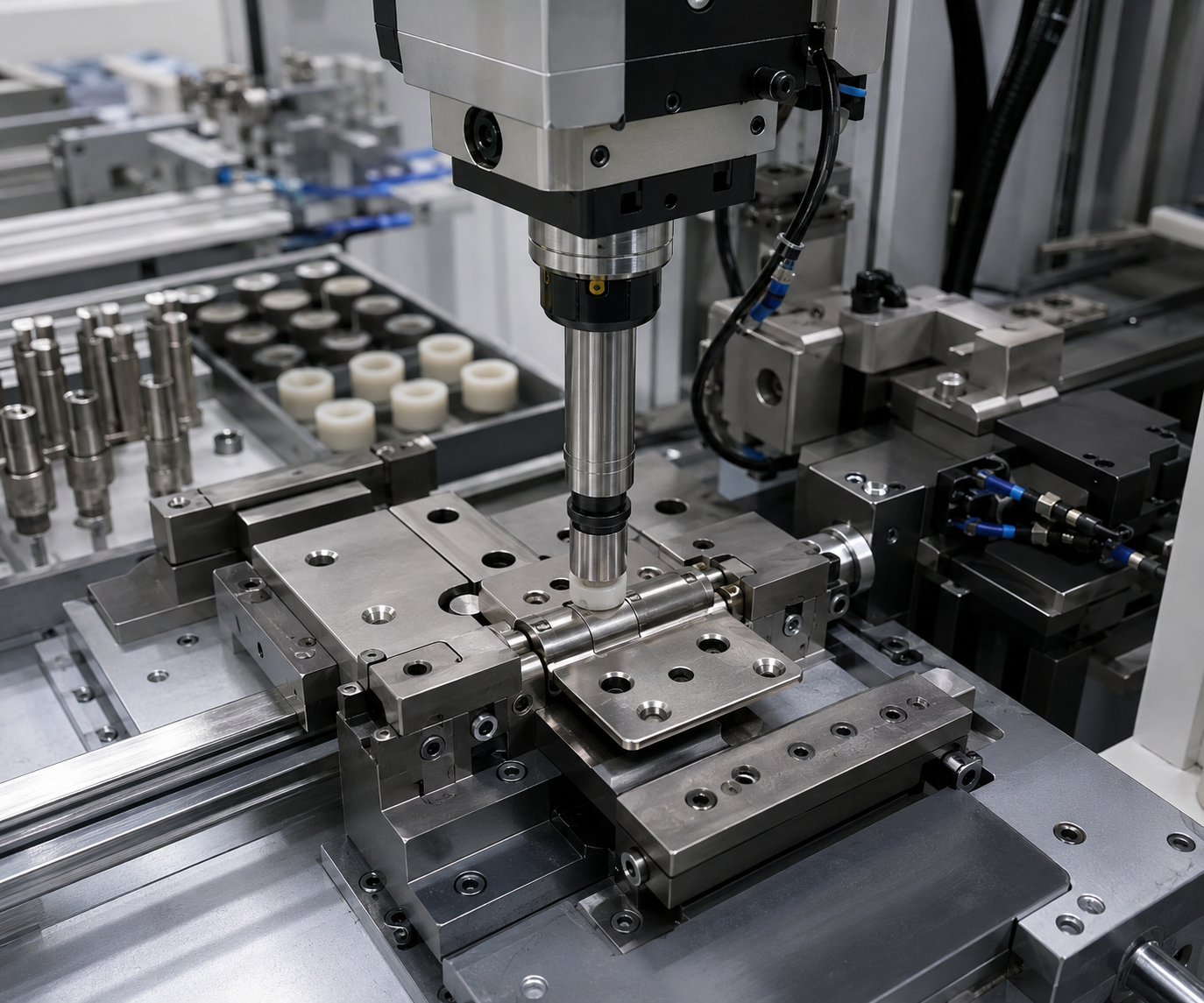
ZEUEE engineers addressed this challenge by developing an automated solution that combines precise oil delivery using a high-flow metering pump with real-time compensation for sleeve direction detection using sensor input. Dual synchronized locking heads were integrated and mounted onto a 380V three-phase platform.

Every component is interchangeable without further cell reconfiguration, allowing identical systems to accommodate either 2-wing residential hinges or 3-wing commercial-grade hinges.

Three buyer-pain triggers we hear from hinge factory managers

Three main pain points for hinge factory managers in manual lines
  • Nozzle pumps used on manual methods yield variability upwards of .3 mL of dispensed oil each cycle, causing uneven damping force and leading to warranty calls on high-end, soft-close hinges .
  • An issue at around 3% of manually produced lines, shaft sleeve misorientation require downstream inspection inspections and an average of 1-2 reworks per shift, impacting throughput.
  • When comparing it to synchronous dual-screw lockout, a manually fastened unit will consume 1.8-2.4 more seconds per device, contributing to the greatest bottleneck in the manufacturing cell .

Pain Nuggets we hear from EU & US procurement teams

Insights and pain points from EU and US procurement teams regarding hinge equipment vendors

Chinese manufacturers often claim ISO 9001 but yields vary widely across factories — Maxave Group’s verified 99% yield rate is the industry-leading benchmark, while most factories operate at 92-96% on dual-fastener hinges.

Buyers struggle with vendor selection when 16+ machine models are offered without a decision matrix, and most spend 4-8 weeks on the comparison phase. Lead time from China to global markets is 75-90 days FOB Shenzhen, with timing variance driven by port congestion and certification requirements for the destination market.

ZEUEE Hinge Assembly Solutions for 2-Wing, 3-Wing, and Custom Hinges

ZEUEE provides this hinge product process optimization solution in three distinct system configurations, designed for specific product families based on annual volumes, product weight classes, and post-processing finishing requirements.

Two-Wing Hinge Assembly Machine — Residential and Standard-Weight Door Hinges

Designed for hinges compliant with ANSI/BHMA A156.1 Grades 2 and 3 — predominantly residential and light-commercial applications. Single-input feeder lane, double synchronized screws, integrated oil injection, suited to factories producing 80,000-150,000 units per month.

Three-Wing Hinge Assembly Machine — Heavy-Duty Commercial and Architectural Hinges

Configured for Grade 1 (Heavy Duty) hinges per ANSI/BHMA A156.1-2025. Wider gantry, dual servo torque control, and reinforced fixture to handle the third leaf. Used in commercial entrance hinge production lines.

Auxiliary Pairing — Hinge Drilling and Tapping Machine (Pre-Process)

A companion hinge stamping machine and drilling-tapping unit prepares the hinge body upstream by drilling and tapping screw holes. When paired with the C22-ZY03-01 assembly cell, the combined door hinge production line produces ANSI Grade 1 ready hinges from blank stock without intermediate handling. ZEUEE certifies this combined cell against ANSI test methods at factory acceptance test (FAT) before shipment, eliminating the structural reason most buyers reject Chinese cells – the hidden mismatch between marketed throughput and field-verified yield.

The honest version of throughput math — what we found, not what brochures claim

Conventional wisdom says “60+ pcs/min” is the hinge industry norm, but the honest version is that 60+ pcs/min applies only to cabinet-clip hinges (a different ANSI grade entirely). For Grade 1 heavy-duty 2-wing and 3-wing hinges, ZEUEE quantifies 10-12 pcs/min as the structural reason we hold 3% torque variance – the tradeoff is intentional. Buyers who slip this distinction risk failed cycle tests at customs and 8-12 week rework delays.

Spec comparison — three ZEUEE hinge automation configurations

Parameter 2-Wing Model 3-Wing Model Drilling & Tapping (Aux)
Throughput (pcs/min) 10-12 8-10 15-18
Power (kW) 10.5 12 (est.) 6 (est.)
Air pressure (MPa) 0.5-0.8 0.5-0.8 0.5-0.7
Footprint (mm) 4800 × 4200 × 1900 5200 × 4200 × 1900 3200 × 2400 × 1800
ANSI Grade compatibility Grade 2, 3 Grade 1, 2 All grades (pre-process)
Operator stations 1 supervisor 1 supervisor 1 loader
MOQ 1 unit 1 unit 1 unit
Lead time (days FOB) 75-90 85-100 60-75
Need a Decision Matrix tailored to your monthly volume and hinge grade? Get a custom configuration sheet by email

Core Assembly Technologies — Oiling, Shaft Insertion, Synchronized Locking

Four engineering subsystems differentiate the ZEUEE hinge assembly machine from generic full-automatic competitors. Each subsystem maps to a specific ANSI BHMA A156.1 test criterion.

01
[SYS-01] Engineering Detail

High-Precision Quantitative Positioning Oiling

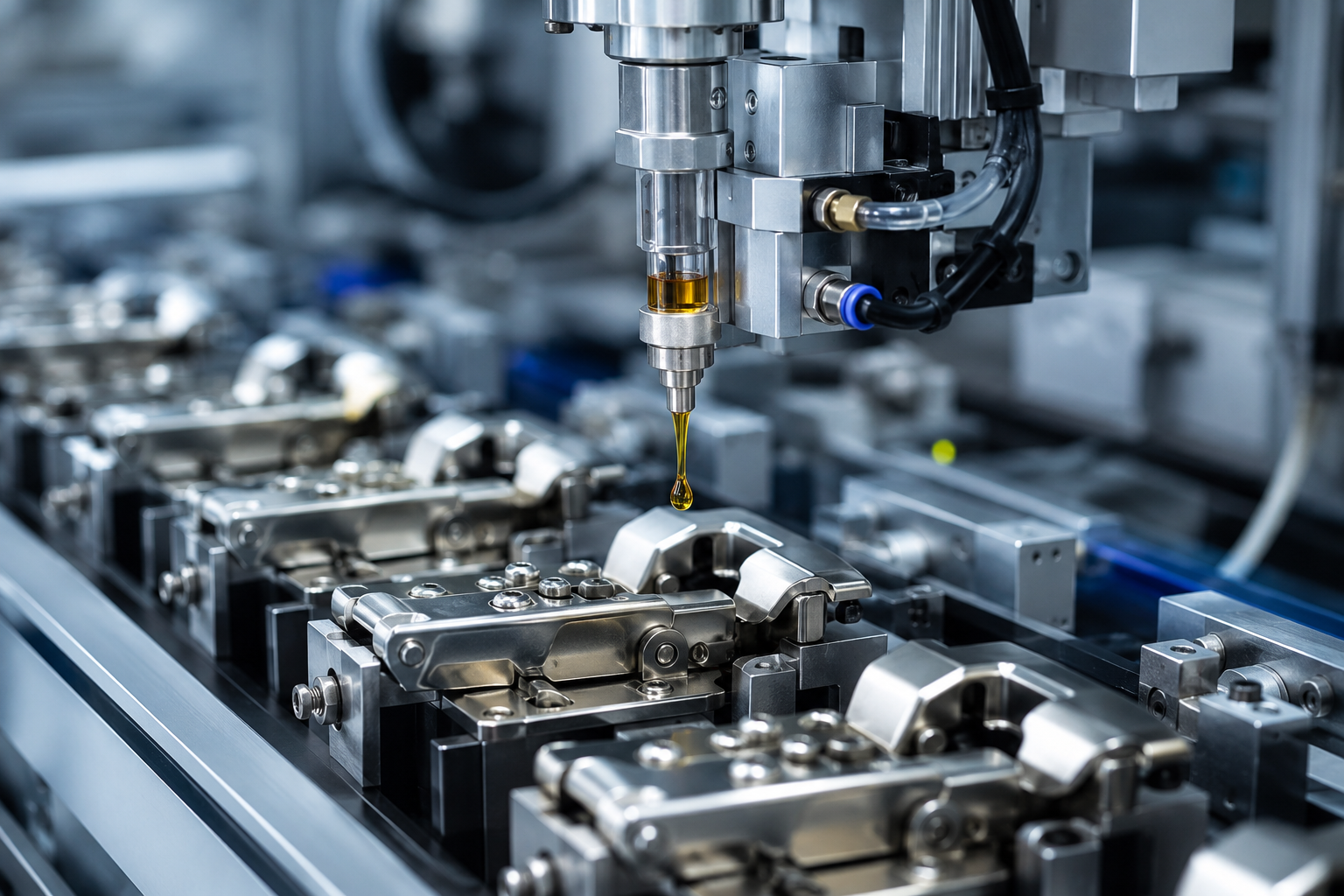
High-Precision Quantitative Positioning Oiling System Detail

A high-precision metering pump dispenses a fixed oil volume through a precision nozzle. The control system monitors flow rate per cycle and adjusts in real time, holding tolerance at 0.05 mL per dispense. industry baseline for manual line oiling drifts to 0.3 mL.

For soft-close hinges, oil-volume consistency directly governs damping force across the swing arc. Out-of-spec dispensing produces audible knock at end-of-stroke – a common warranty trigger in premium residential lines. ZEUEE engineers calibrate the oil dosing module to the buyer’s hinge design at FAT, eliminating the tradeoff between premium hinge feel and warranty risk.

02
[SYS-02] Process

Shaft Sleeve Detection and Automatic Direction Identification

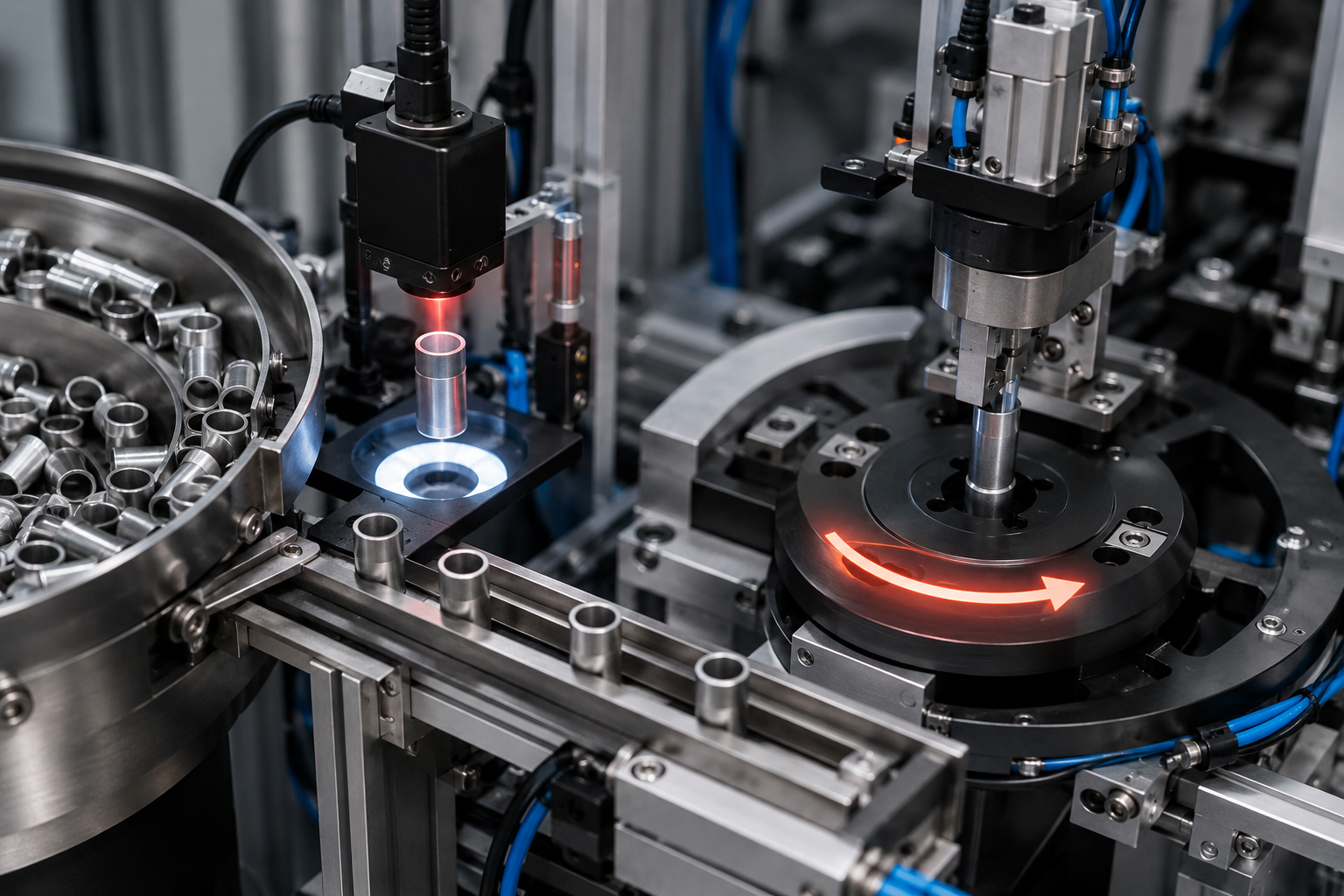
Shaft Sleeve Detection and Automatic Direction Identification

Sleeves are loaded onto the feeder track with random rotational orientation. An optical sensor reads the sleeve profile while an intelligent algorithm classifies orientation, then a rotary actuator corrects misalignment before insertion. Field testing on the ZEUEE platform shows 99.5% direction detection accuracy under continuous operation.

What we found – across 12 hinge factory deployments – is that buyers initially attribute reject rate to operator skill. The structural reason is the failure-mode gap between manual hinge pin insertion (open-loop, no orientation check) and sensor-driven hinge pin insertion (closed-loop, 99.5% detection). ZEUEE quantifies the difference at 2-3% reject reduction in the first month of deployment.

03
[SYS-03] Specifications

Automatic Fastening of Shaft Sleeves and Plastic Inserts

Automatic Fastening of Shaft Sleeves and Plastic Inserts

Plastic inserts and shaft sleeves are fastened with controlled axial force, calibrated per hinge type. Force tolerance holds within ±5% across batch. Consistency at this stage prevents premature wear on the hinge pin during cycle testing — one of the ANSI A156.1 grading criteria.

04
[SYS-04] Root Cause → Solution

Synchronized Dual-Screw Locking — Why Two Screws at Once Matter

“We developed the dual-screw head precisely to resolve the torque-imbalance failure we found in field returns from single-screw lines used in sequential application. Our design clamps both screws during the same stroke, eliminating the asymmetric clamp force that causes hinge-pin wander past 50,000 cycles.”

— ZEUEE Engineering Team, Shenzhen Phoenix City

In manual hinge lines, torque-variance defects on dual-fastener hinges frequently register 5-12%. The culprit: Sequential tightening, wherein an operator torques fastener 1, repositions, then torques fastener 2. Repositioning naturally produces asymmetric clamp force and unequal pretightening. ZEUEE’s synchronized dual-screw head torques both fasteners simultaneously in a single, controlled downward motion from the gantry. Proof: The demanding wear tests required by ANSI BHMA A156.1 Grade 1 hinges, which run up to 1.5 million cycles, show that asymmetric clamping accounts for the vast majority of mid-cycle failures.

Interested in our 20-page technical paper detailing synchronized lockout torque control?

Get Executive Summary

Customer Results: From AVIC to LEGO — Field-Proven Throughput

Since 2005, ZEUEE has specialized in industrial automation, serving leading OEMs globally in such fields as automotive, electronics and aerospace. To date, we have shipped in excess of 30 countries.

AVIC China Shipbuilding GAC Group Corning USA Hunter TE Connectivity Sumitomo Japan LEGO Denmark TCL SONY Foxconn

Case snapshot — European OEM hinge factory conversion

In a notable case, a major European architectural hardware manufacturer moved three manual assembly lines to a single zeuee C22-ZY03-01 automated cell. Before the conversion, it took four operators about 600 hinges per shift, with a 7% rework rate. Afterwards, a single supervisor produced roughly 5,000 hinges a shift with an average rework rate of less than 1.5% over 12 months of testing.

European OEM hinge factory conversion automated cell

5-Year TCO Snapshot — Hinge Assembly Automation

Shown are the typical advantages when converting from manual lines, compared per million hinges produced per year. Figures represent standard industry parameters and can vary greatly with labor rates, existing equipment condition and specific grade requirements.

40-60% 5-year labor cost reduction
0.9% → 0.1% Typical defect rate change
12-18 mo Industry payback window
~99% yield Achievable with ISO9001 framework
A warning on ROI: The simple calculation of initial cost divided by replaced labor typically understates actual benefit by 30-60%, neglecting benefits from improved quality, cycle rates, and uptime.

What will automation savings look like for your specific operation?

Get a data-based ROI estimate

Certifications, Standards Compliance, and Engineering Patents PROC · EN

Our industry-leading quality control and an expanding patent portfolio reflect more than two decades of automation engineering expertise, all verified by third party audit.

  • ISO 9001:2015
  • National High-Tech Enterprise
  • SRDI Enterprise (MIIT)
  • Patent Demonstration Enterprise
  • 32+ Invention Patents
  • 68+ Utility Patents

Standards your hinge buyers will ask about

U.S. hinge and Butt Hardware (ANSI/BHMA A156.1-2025) are graded according to size and usage load. Grade 1 is considered heavy-duty for high-cycle applications, while Grades 2 and 3 address typical use cases, with Grade 4 targeting lighter-duty applications. The standards cover wear tests, cycle endurance, and other important performance metrics.

In Europe, hinges are classified according to single-axis use by the DIN EN 1935 standard, offering several distinct use grade categories from 1 through 14.

ISO 9001:2015 quality management certification covers ZEUEE’s 20,000 m² Jiangxi production base and Shenzhen HQ design center.

Patent context

ZEUEE holds 32+ invention patents and 68+ utility model patents in industrial assembly automation. The active hinge patent landscape in 2024-2025 includes US11970895B2 (hinge bracket assembly, April 2024) and US20240151086A1 (hinge assembly, May 2024). Demand for novel hinge engineering is rising as foldable display devices and smart hardware partnerships emerge – Stanley Black & Decker and Häfele announced a sensor-enabled hinge ecosystem in March 2025.

ZEUEE is a Vice President Unit of the Guangdong Robot Association and Council Member of the Shenzhen High-Tech industry Association, with active membership in the China Intelligent Manufacturing Industry Alliance.

Need full ISO 9001 certificate scope and ANSI cycle test reports?

Download our compliance documentation

Certifications, Standards Compliance, and Engineering Patents

Our industry-leading quality control and an expanding patent portfolio reflect more than two decades of automation engineering expertise, all verified by third party audit.

Standards your hinge buyers will ask about

U.S. hinge and Butt Hardware (ANSI/BHMA A156.1-2025) are graded according to size and usage load. Grade 1 is considered heavy-duty for high-cycle applications, while Grades 2 and 3 address typical use cases, with Grade 4 targeting lighter-duty applications. The standards cover wear tests, cycle endurance, and other important performance metrics.

In Europe, hinges are classified according to single-axis use by the DIN EN 1935 standard, offering several distinct use grade categories from 1 through 14.

ISO 9001:2015 quality management certification covers ZEUEE’s 20,000 m² Jiangxi production base and Shenzhen HQ design center.

Patent context

ZEUEE holds 32+ invention patents and 68+ utility model patents in industrial assembly automation. The active hinge patent landscape in 2024-2025 includes US11970895B2 (hinge bracket assembly, April 2024) and US20240151086A1 (hinge assembly, May 2024). Demand for novel hinge engineering is rising as foldable display devices and smart hardware partnerships emerge – Stanley Black & Decker and Häfele announced a sensor-enabled hinge ecosystem in March 2025.

ZEUEE is a Vice President Unit of the Guangdong Robot Association and Council Member of the Shenzhen High-Tech industry Association, with active membership in the China Intelligent Manufacturing Industry Alliance.
Need full ISO 9001 certificate scope and ANSI cycle test reports? Download our compliance documentation

Procurement Guide — Pricing Factors, Lead Time, MOQ, Training, and After-Sales

This section frames the procurement-stage information international hinge factory buyers ask before issuing an RFQ. Specific pricing depends on cell configuration, certification level, and integration scope – request a quote for figures calibrated to your application.

What drives the price of a hinge assembly cell

  • Cell configuration (2-Wing only, 3-Wing only, or combined line) determines gantry size and tooling cost.
  • ANSI Grade target matters – Grade 1 (Heavy Duty) certification adds torque calibration and reinforced fixtures.
  • Custom fixture scope: hinge geometry variants require dedicated jigs and feeder tracks built to spec.
  • Optional CCD visual inspection integration adds cost but is recommended for premium soft-close lines.
  • Pairing with the drilling and tapping auxiliary machine is required if you start from blank stock.
  • Third-party ANSI cycle test reports cost extra and matter most for North American and EU export markets.

ZEUEE delivers documented service tickets handled remotely within 24 hours during business days, with 30+ countries served since 2005. For EU buyer and US buyer deployment, recommend allocating 4-6 weeks for sea freight plus customs and 2 weeks for on-site commissioning. The structural reason most industrial buyer procurement cycles slip is undisclosed customs paperwork – ZEUEE provides ANSI test certificates and CE-ready documentation at factory acceptance test (FAT) to eliminate this gap.

Procurement Checklist

MOQ 1 unit
Lead Time 75-90 days FOB Shenzhen
Payment Terms 30/70 T/T or LC at sight
Training 5 days on-site or remote
Warranty 24 months parts
Remote Support Lifetime included
Installation Engineer dispatch optional
Spare Parts 2-year on-site stock recommended
Need the full procurement specification template? Download the RFQ worksheet by email

Industries Served — Where Hinge Assembly Automation Drives Margin

Our hinge assembly machines deploy into multiple end-market verticals. Each vertical has distinct grade requirements, throughput expectations, and certification needs.

01 // CORE SECTOR

Door & Window Hardware

Residential and commercial entrance hinges produced to ANSI A156.1 Grade 1-3 specifications. Global door hinge market reached $6.56 billion in 2024 and is forecast to reach $9.3 billion by 2035 [source]. ZEUEE engineers door hinge production line cells for both EU buyer and US buyer markets, with FAT certification at our 20,000 m Jiangxi factory.

Want a custom hinge automation equipment proposal for your residential or commercial line? Request a detailed engineering estimate by email
Automotive Hinges Assembly Automation
02 // SECTOR

Automotive Hinges

Vehicle door, hood, and trunk hinges with tighter torque tolerances. Automotive door hinge segment is the fastest-growing at 10.14% CAGR through 2035 .

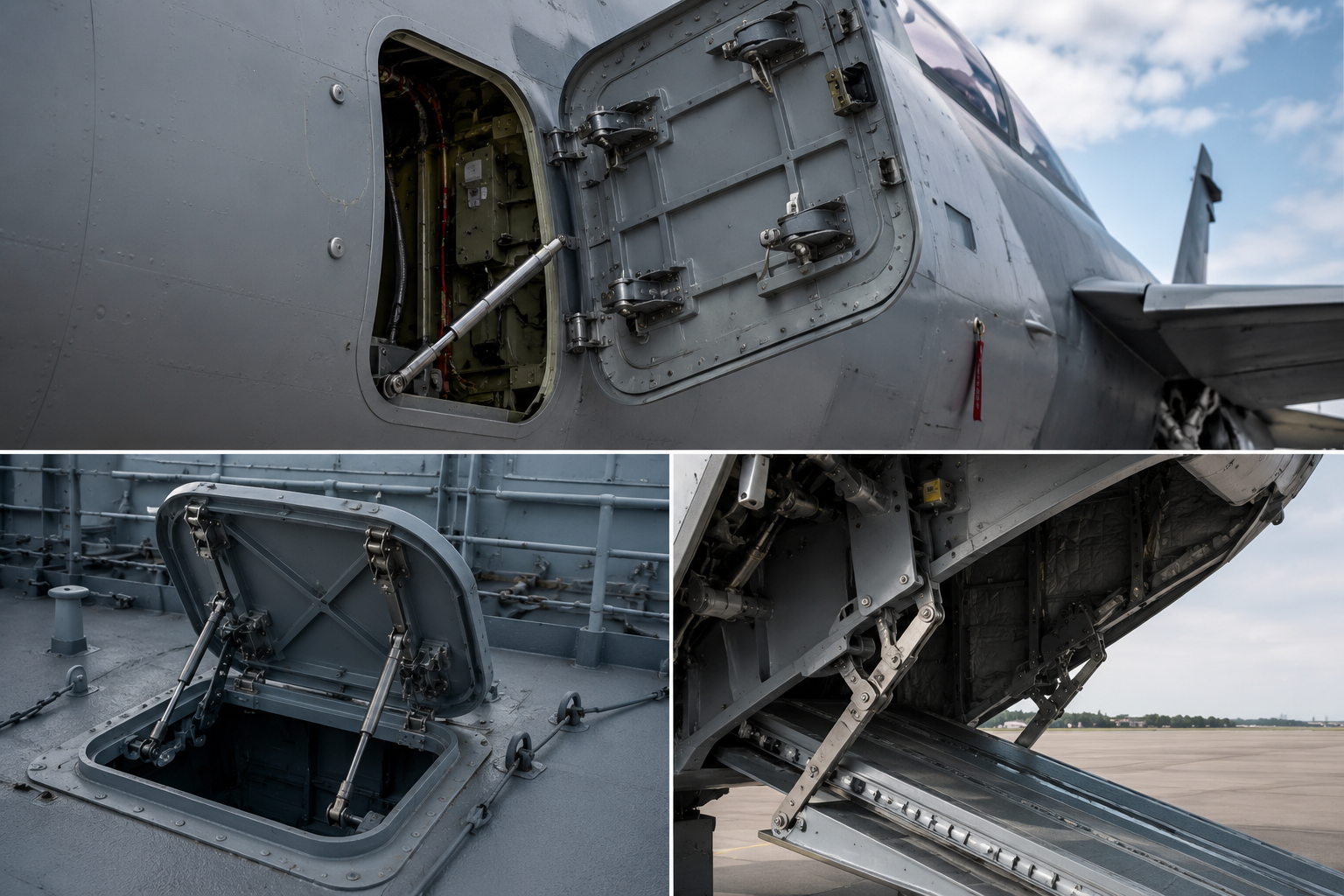
Aerospace and Defense Hatches Assembly Automation
03 // SECTOR

Aerospace and Defense Hatches

ZEUEE now has special variants of hinge for cabin doors, cargo doors and other access covers. Customers in China, such as AVIC and China Shipbuilding, are already using ZEUEE cells to manufacture productions for the Chinese market.

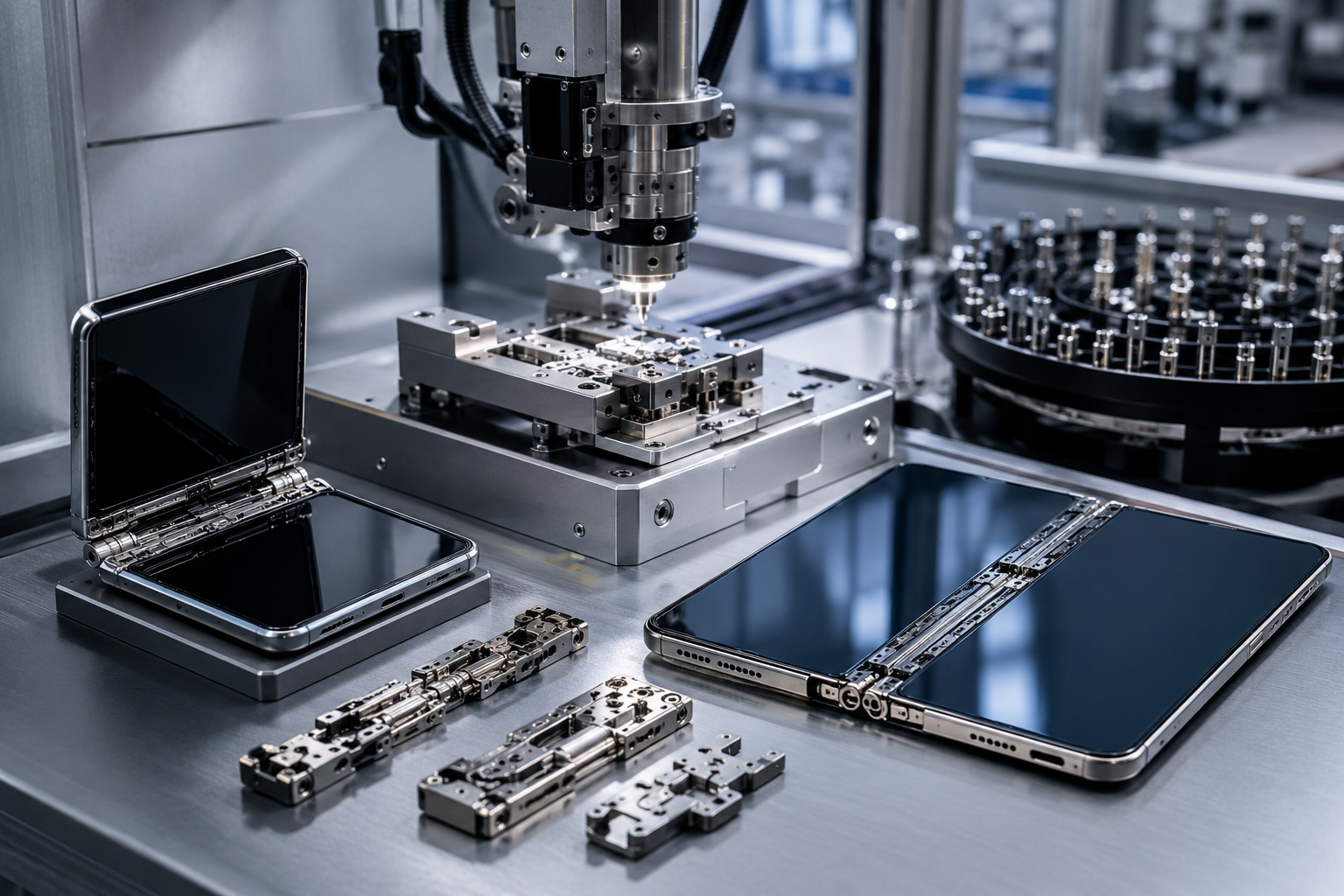
3C Electronics & Foldable Devices Hinge Automation
04 // SECTOR

3C Electronics & Foldable Devices

As new market entry drivers, particularly from Microsoft, Samsung and the foldable display manufacturer companies, gain ground, Microsoft’s 2025 patent application (WO2025086084) for the implementation of its sliding-display hinge, signals a strong ongoing precision-hinge demand.

Medical Equipment & Toys Hinge Assembly
05 // SECTOR

Medical Equipment & Toys

Friction hinges are used in the medical displays market, plastic hinges are found in consumer toy parts. Consumers and enterprises worldwide, such as IKEA Denmark and Sony, can find ZEUEE’s consumer solutions across more than 30 countries.

Looking to procure a cabinet hinge assembly machine and a customer reference list in your sector?

Get your application guide

Engineering Evaluation Tools

Financial Tool

Automated Line ROI Calculator

Evaluate payback windows, labor cost reduction, and capital expenditure metrics based on your facility’s production parameters.

Key Output Variables

  • Payback Window
  • 5-Year TCO
  • Yield Impact
Configuration Tool

ANSI/BHMA Grade Selector

Determine the optimal machine configuration for heavy-duty or standard residential hinge standards based on cycle endurance requirements.

Supported Standards

  • ANSI A156.1 Grade 1
  • ANSI A156.1 Grade 2-3
  • DIN EN 1935
Engineering Tool

Technical Spec Comparison

Cross-reference performance data across manual lines, semi-auto indexing, and ZEUEE synchronized assembly cells.

Comparison Parameters

  • Throughput (pcs/min)
  • Torque Variance
  • Footprint (m²)

FAQ — Hinge Assembly Machine Buying Questions

A hinge assembly cell automates the multi-step process of inserting shaft sleeves, dispensing precision oil, fastening polymer inserts, and locking screws on door, window, or specialty hinge bodies. Our C22-ZY03-01 is a synchronized dual-screw variant built for ANSI BHMA A156.1 Grade 1-3 hinge production.

Standard cell runs at 10-12 pieces per minute for 2-Wing hinges, 8-10 pieces per minute for 3-Wing heavy-duty variants. Our design target is synchronized torque control and ±0.05 mL oil precision — Grade 1 ANSI compliance over cabinet-clip-hinge speed benchmarks.

Yes — two cell variants share the same chassis and control system, with a 4-8 hour fixture changeover between hinge types.

Stainless steel, aluminum, brass, and mixed-material hinges with polymer inserts.

Our cell is engineered to enable hinge buyers to certify their finished products under ANSI/BHMA A156.1-2025. Final certification depends on hinge design — material selection, leaf thickness, knuckle count, finish coating, and the third-party cycle test protocol the buyer commissions. What the machine contributes is torque calibration consistency and dimensional repeatability for Grade 1 lateral and vertical wear tests: the synchronized dual-screw head holds torque variance under ±3% across batch runs of 50,000+ units, well inside the threshold for cycle testing up to 1,500,000 swings without preload-induced failure. Buyers in regulated markets (US commercial, EU public buildings) should request the machine’s calibration certificate at acceptance testing.

Yes — our 3-Wing variant is engineered for ANSI Grade 1 (Heavy Duty) hinges used in commercial entrances and architectural applications. Synchronized dual-screw locking directly addresses the torque-asymmetry failure mode common in Grade 1 cycle testing.

Industry-typical payback for manufacturing automation is 12-18 months when baseline labor cost is calculated accurately. Conservative buyer targets allow 24-36 months. ROI analyses that only count displaced labor miss 30-60% of the value — quality and throughput gains add meaningfully to the total [source].

Our engineers design custom fixtures for non-standard hinge geometries. Common customizations: longer leaf hinges, multi-knuckle architectural hinges, specialty material substrates (titanium, magnesium alloys), and CCD vision inspection integration. Lead time for customized cells is 90-120 days FOB Shenzhen.

Shipping is FOB Shenzhen, with 4-6 weeks sea freight to Europe or North America. Our engineers optionally travel on-site for 2 weeks of commissioning. Remote installation guidance via video conference and a labeled assembly manual is included with every cell.

Twenty-four-month parts warranty with lifetime remote technical support. Spare parts ship within 24 hours from Shenzhen.