Get in touch with Zeyu lntelligent Industrial Company

High-Speed Assembly Equipment: Architecture Types, Cycle Sizing, Cost, and Buyer Selection Guide

Updated November 2026 | Technical Review: Shenzhen Zeyu Intelligent Industrial Science Technology Co., Ltd
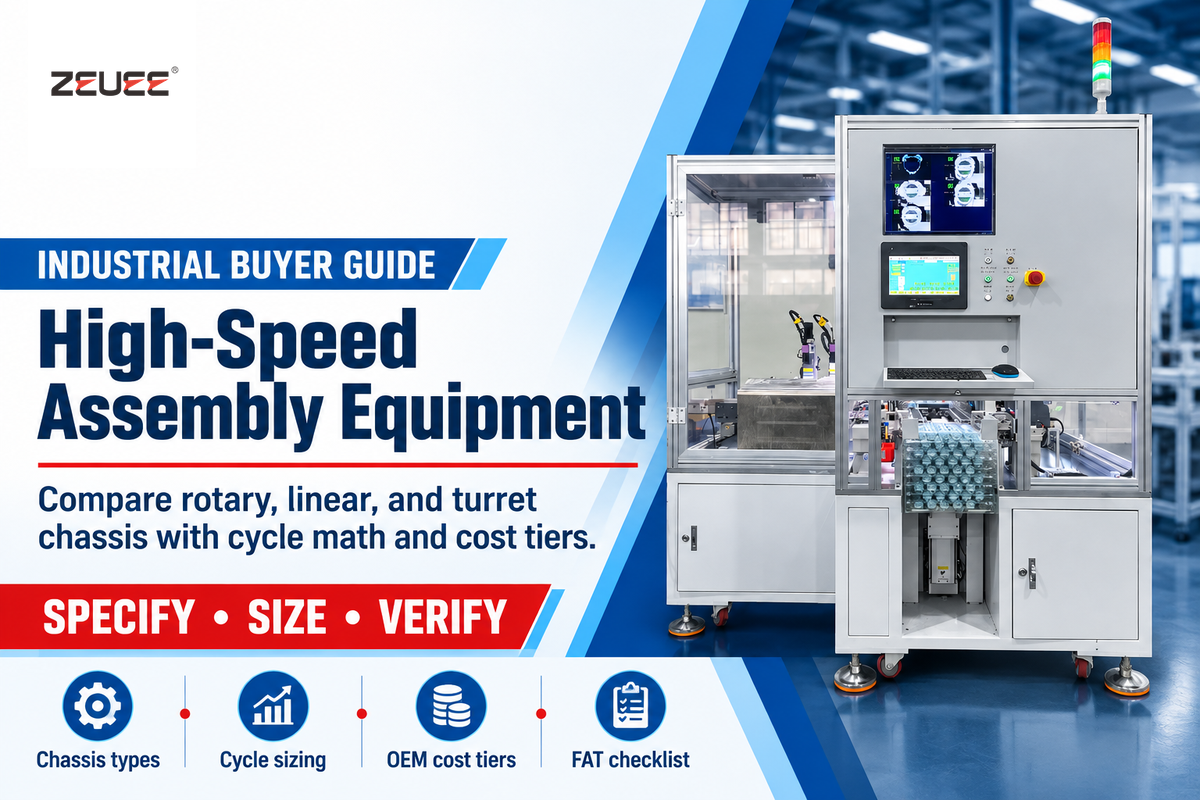
High speed assembly equipment is dedicated or modular automated equipment that feeds, transfers, joins, and inspects discrete parts at high sustained output. The speeds of published systems on modular lines (ATS Industrial Automation) range from 0.2 to 20 seconds per part, and speeds on continuous turret (JR Automation) systems exceed 1,000 parts per minute. Unlike a hand-operated hydraulic shop press, these multi-station lines run synchronized PLC controls and automated inspection.
Chassis choice influences shift OEE, capex spend and commissioning schedule. Magnetic linear, rotary dial, and continuous turret options all respond to part variation and SKU changeover in different ways. This guide decodes high-speed automation platforms, drive trade-offs, capacity math, published OEM prices and factory acceptance thresholds.
What Does High-Speed Assembly Equipment Do and When Do You Need It?
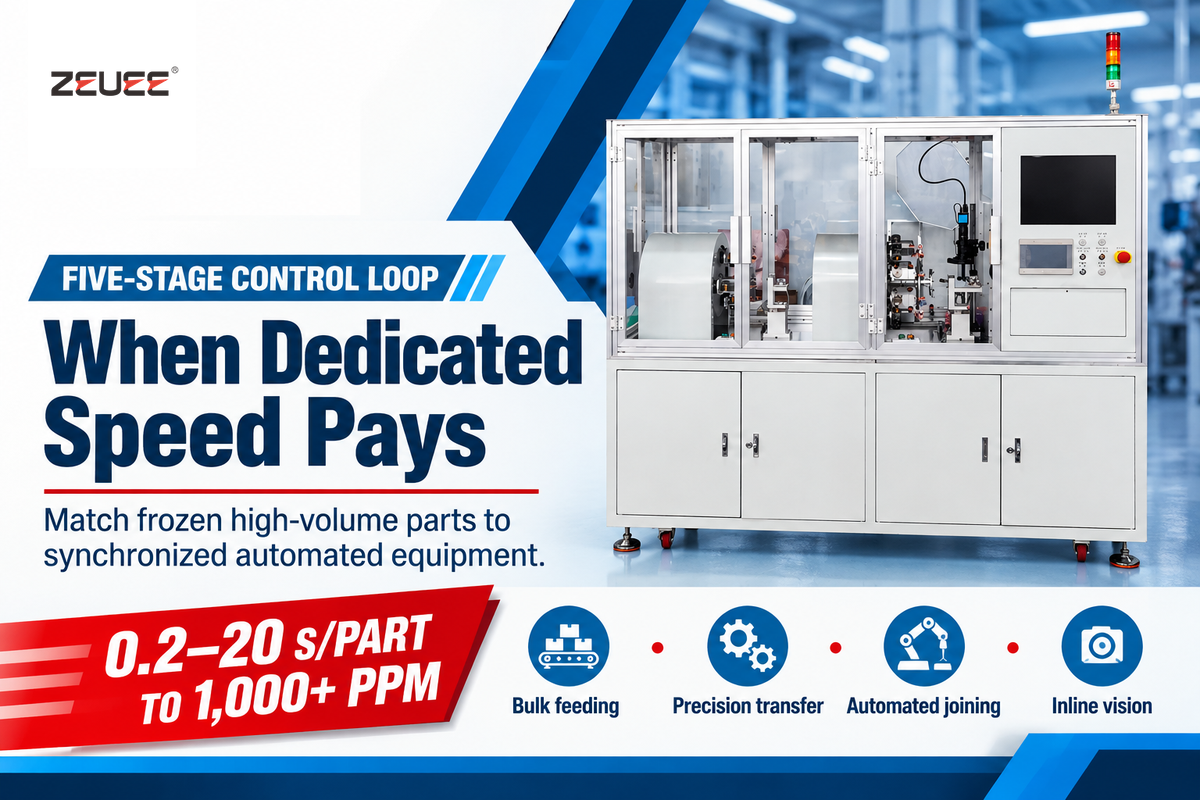
High-speed assembly equipment executes feeding, transfer, joining, and inline inspection inside tight cycle windows for high-volume production. Dedicated high-speed machinery fits best when multi-shift annual demand is high and part drawings are frozen. Lower-volume or evolving lines, such as 10K to 500K units per year in ZEUEE’s robotic cell band typically fit robotic cells or semi-automated benches better.
General automated assembly machines often rely on flexible robotic cells running 10 to 30 seconds per cycle. Dedicated high speed assembly equipment cuts cycle time sharply by pairing mechanical cams, high-acceleration linear shuttles, or multi-track nests. Across consumer manufacturing processes, ATS Industrial Automation publishes modular assembly rates spanning 0.2 to 20 seconds per part.
What really makes the difference for high-speed assembly automation is the consistency of part geometry. Quick feeders and escapements jam easily if molded parts have flash or displaced parting lines. When part drawings still change every quarter, flexible automation systems protect the investment far better than hardened cam tooling.
What Is an Automated Assembly System?
An integrated system containing the feeding units, conveyors, joining units, sensors and industrial control systems for the finished parts with minimal hands-on involvement, that’s automated assembly. Each unit carries out five consecutive operations under the control of a single deterministic control loop that sustains productivity and quality control.
- Feeding and orientation can be carried out by vibratory bowls, centrifugal drums or vision conveyors feeding into escapements to singulate parts from bulk.
- Precision transfer moves base parts between stations on rotary dials, synchronous chains, or magnetic pallet conveyors.
- Joining and fastening stations run pneumatic presses, servo presses, ultrasonic welders, dispensers, or screwdrivers on assembly tasks.
- In-line vision systems, laser micrometers, continuity probes, and load cells verify assembly processes at full speed.
- PLC shift registers track failed assemblies to locked reject chutes and confirm physical ejection before good parts exit.
Types of High-Speed Assembly Equipment
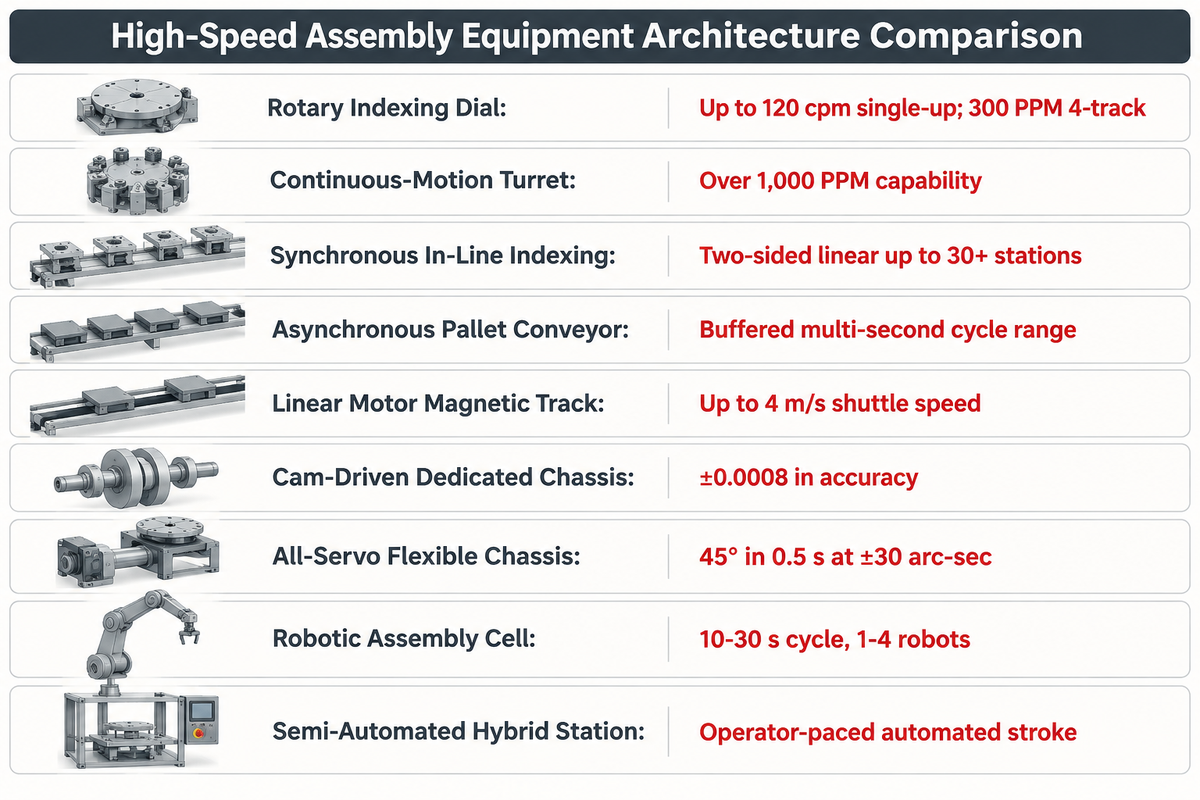
Choose rotary dials for compact balanced stations, linear motor tracks for uneven dwell times, and continuous-motion turrets for ultra-high volumes above 1,000 PPM. Conflicting vendor speed claims happen when brochures mix single-cavity cycles with multi-track tooling. Distilling motion types from multi cavity counts clarifies the statements.
Published OEM data from ASSEMBLY Magazine and SuperTrak Conveyance anchor real machine ceilings. A Weiss TO1300 direct-drive rotary table completes a 45-degree index in 0.21 seconds with a 0.29-second dwell. That 0.50-second cycle delivers 120 cycles per minute inside a 1,300 mm footprint rated at 26,600 N·m torque.
Multi-track tooling scales rotary output without pushing acceleration past mechanical limits. At Netafim, a Weiss TO750 four-track rotary table runs 75 cycles per minute to build 300 irrigation components per minute across 16 stations. Mechanical CDS ITP75–ITP450 cam indexers hold ±0.0008 inch accuracy across fixed layouts. For variable jobs, Foerster Systems runs a Centricity EZ servo indexer moving 45 degrees in 0.5 seconds at ±30 arc-seconds. On magnetic tracks, ATS SuperTrak VERTICAL10 shuttles travel up to 4 m/s.
| Type | Motion Profile | Published Speed Anchor | Station Layout | Dwell Flexibility | Best Fit | Limitations / Not Suitable For |
|---|---|---|---|---|---|---|
| Rotary Indexing Dial | Intermittent circular index-and-dwell | Up to 120 cpm single-up (Weiss TO1300); 300 PPM 4-track (Netafim) | Compact circular (e.g., 16 stations) | Low (shared slowest dwell) | Compact parts with balanced short operations | Large parts, unequal long cure times, high station counts |
| Continuous-Motion Turret | Non-stop rotary cam tracking | Over 1,000 PPM capability (JR Automation) | High-density rotating turret | None (fixed cam profile) | Ultra-high-volume medical disposables and caps | Frequent SKU swaps, low volumes, tight capex budgets |
| Synchronous In-Line Indexing | Precision-link or walking beam | Part-dependent intermittent indexing | Two-sided linear (up to 30+ stations) | Low (linked global index) | Multi-step linear assembly needing two-sided access | Single 30-station unbuffered lines lose OEE on jams |
| Asynchronous Pallet Conveyor | Free-flowing belts with stops | Buffered multi-second cycle range | Modular open linear loop | High (queues buffer dwell gaps) | Larger subassemblies with long test or cure cycles | Sub-1-second cycles or ultra-compact floor footprints |
| Linear Motor Magnetic Track | Independent electromagnetic shuttles | Up to 4 m/s shuttle speed (SuperTrak VERTICAL10) | Modular scalable oval | Very high (per-mover profiles) | Multi-SKU precision assembly with uneven dwell times | Low capital budgets or heavy press loads on movers |
| Cam-Driven Dedicated Chassis | Master camshaft mechanical sync | ±0.0008 in accuracy (CDS ITP series) | Fixed-angle rotary or linear | None (hardened cam curve) | 24/7 single-product lines requiring zero backlash | Variable index angles or evolving part families |
| All-Servo Flexible Chassis | Programmable electronic cams | 45° in 0.5 s at ±30 arc-sec (Centricity EZ) | Programmable rotary or linear | High (HMI stroke and dwell recipes) | Multi-variant component assembly with frequent recipe changes | Eliminating physical bowl and nest changeover hardware |
| Robotic Assembly Cell | Vision-guided pick-and-place paths | 10–30 s cycle (ZEUEE 6-axis cell benchmark) | 1–4 robots per cell | Very high (path programmable) | Flexible assembly, mixed SKUs, delicate orientations | High-force pressing or continuous ultra-high PPM |
| Semi-Automated Hybrid Station | Manual load with automated join/test | Operator-paced automated stroke | Compact bench or 1–4 stations | Operator-paced | Pilot launches, tangled cables, complex final assembly | Multi-million annual runs or high labor-cost markets |
Synchronous lines carry a steep downtime penalty as station counts climb. On one linked machine, a single feeder jam halts every other station immediately because all nests move in lockstep. Per ASSEMBLY Magazine contributor Bill Budde, two small indexing dials joined by a buffer conveyor often outperform one 30-station precision-link system. The buffer lets one dial keep running while technicians clear the other. For mixed product families, pairing compact chassis with robotic assembly integration isolates flexible loading from rigid high-speed joining.
What Are the Four Main Types of Assembly Lines?
The four main types of assembly lines in modern manufacturing are intermittent synchronous lines, continuous-motion lines, asynchronous pallet transfer lines, and manual or semi-automated cellular lines. High-speed assembly systems fall into the first three groups depending on whether parts pause during work strokes or move without stopping.
Intermittent lines feature rotary dials and walking beams which index, stop, operate during dwell, and repeat the cycle. Continuous lines consist of rotating turrets where tooling continuously follows the parts, thereby recovering lost acceleration time. Asynchronous lines use independent pallet conveyors or linear magnetic tracks to buffer slower inspection and curing stations until their queues fill.
Semi-automated cells engage the operator with more versatile tasks while automating the press operation or automated vision checks.
Key Factors When Choosing High-Speed Assembly Equipment
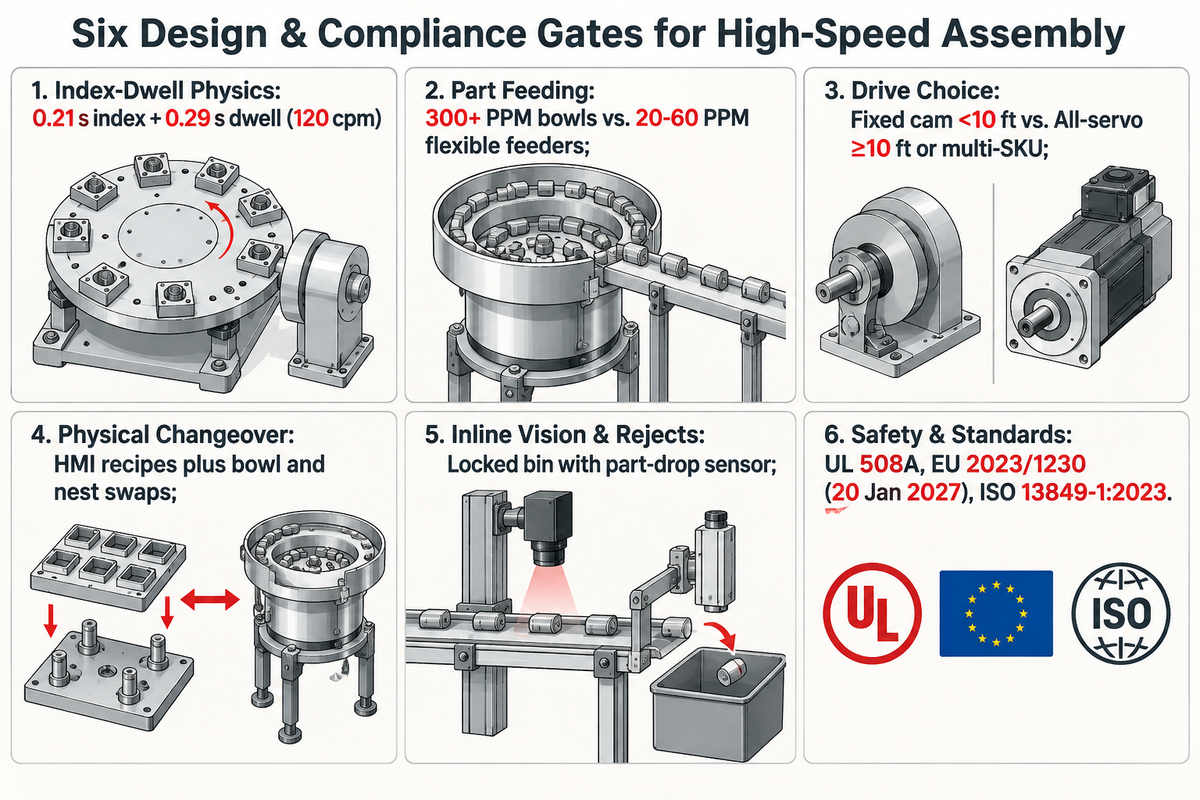
At 60 cycles per minute on a 120-degree index and 240-degree dwell cam, only 0.67 seconds remain for stationary work per cycle. Auditing six equipment design gates—index-to-dwell physics, part feeding, drive mechanics, physical changeover, inline verification, and compliance—prevents buyers from ordering fast dry-cycle machines that stall on shift.
Cycle Rate, Index-to-Dwell Ratio, and OEE vs. Dry-Cycle Speed
On a synchronous intermittent-motion chassis, total cycle time equals index transfer time plus stationary dwell time. Take the Weiss TO1300 running 120 cycles per minute (0.50 seconds total): its 0.21-second index leaves just 0.29 seconds of stationary dwell. That 0.29s of dwell time must provide for all the cylinders, all the ultrasonic horns and all the screwdrivers going in, performing their work and coming back out.
Dry-cycle ratings measured without parts hide feeding and quality losses. In ASSEMBLY Magazine, Bill Budde sets acceptable production efficiency for automated assembly equipment at 80% to 95%. In the same guide, he notes that acceptable first-pass yield is typically greater than 99% when incoming part defects are excluded. In a separate ASSEMBLY Magazine OEE analysis, Corey Vodvarka shows how brief micro-stoppages and jams quietly drain performance far more than major breakdowns.
Part Feeding, Escapement Mechanics, and Design for Assembly (DFA)
Part feeding is the main reliability bottleneck across the manufacturing industry on high-speed assembly lines. Per Huben Automation, dedicated vibratory bowl feeders deliver up to 300+ parts per minute on one stable geometry. Flexible, camera guided feeders will supply at 20 – 60 ppm and accommodate several geometries.
For symmetrical caps and light plastic parts, centrifugal rotary feeders supply parts at high speed with no vibratory bounce.
The shape of the part influences the feeders’ uptime. Clean molding parting lines, chamfered lead-ins, and anti-nesting ribs keep components from shingling inside tracks and escapements. On threaded fasteners, specifying a tuned automatic screw feeding system with blow-feed verification confirms fastener delivery before the driver starts. Torque-angle monitoring then catches cross-threading during insertion.
Cam-Driven vs. Servo-Driven and Hybrid Drive Architectures
According to Motion Index Drives, fixed preloaded cam-driven rotary indexers provide zero backlash and lower integration costs than servo dials under 10 feet in diameter when station positions remain constant. At 10 feet or larger, or if the unit requires varying index angles and dwell profiles, the cost of a cam driven mechanism tends to escalate and the servo driven alternative often becomes the more economical choice because a fixed cam output angle is set for life.
| Drive Type | Positioning & Rigidity | Profile Flexibility | Best Operating Envelope |
|---|---|---|---|
| Fixed Mechanical Cam | Preloaded zero backlash; locked timing | Fixed index angle after manufacture | Fixed-station dials <10 ft diameter (lower integration cost per Motion Index Drives) |
| All-Servo Electric | Closed-loop encoder; gearhead backlash check | Programmable index angle, speed, and dwell | Dials ≥10 ft (where cam costs rise) or multi-SKU lines needing variable index profiles |
| Hybrid Cam + Servo | Mechanical base sync with servo work heads | Fixed transfer pitch; programmable station strokes | High-speed chassis needing variable press depths or pin heights |
Changeover Time: Software Recipes vs. Physical Tooling Swaps
Servo motors switch motion profiles via HMI recipes in seconds, yet physical tooling still dominates real changeover time on multi-variant assembly machines. Even on an all-servo chassis, changes to outer part geometry may require technicians to swap or adjust affected bowl tracks, escapements, pallet nests, or gripper fingers. Hybrid cam-plus-servo lines often beat pure servo systems on shift output by pairing rigid cam bases with quick-release dowel nests, cartridge feeders, and modular end-of-arm tooling design.
In-Line Vision Inspection, Force Monitoring, and Reject Verification
High-speed assembly and testing require tight synchronization across optics, press load cells, and reject gates. On a 120 PPM rotary chassis with a 0.29-second stationary dwell (such as the Weiss TO1300), the camera must act inside that narrow dwell window. It strobes lighting, captures the frame, runs edge checks, and passes the result to the PLC before indexing resumes. Mounting in-line vision inspection systems on isolated frames with lighting shrouds prevents plant vibration from causing false rejects.
“Successfully implementing machine vision for high-speed assembly is not just a matter of installing vision components, and should be considered in terms of the whole system integration.”
Whole-system vision integration requires coordinating lighting strobes, camera triggers, image evaluation, PLC pass/fail signals, and mechanical reject gates within a single cycle budget. A servo press head adds force-displacement curves to verify press-fit interference without requiring additional stations. Every rejected part must drop into a locked bin verified by a part-drop sensor so unconfirmed rejects immediately halt the line.
Do High-Speed Assembly Machines Need Certification?
Before operation in North America or Europe, high-speed assembly machines must meet applicable electrical and machine-safety requirements. Regulated products such as medical devices add industry-specific quality and validation obligations. Panel electrical listing, machine safety assessment with CE conformity, and regulated process validation are distinct activities with different scopes.
- North America electrical panels (ANSI/UL 508A): Per UL Solutions (category NITW), UL 508A covers only the enclosed industrial control panel and door-mounted devices, excluding external motors, heaters, and the controlled machine. Whole-machine electrical acceptance follows applicable local electrical inspection codes.
- European Union machinery compliance: Per EUR-Lex and TÜV SÜD, EU Machinery Regulation (EU) 2023/1230 becomes fully applicable on 20 January 2027. Until that date, Directive 2006/42/EC remains in force; the new regulation adds software safety and cybersecurity rules for connected machinery.
- Functional safety (ISO 13849-1:2023): Per Pilz, EN ISO 13849-1:2023 defines Performance Levels PL a through PL e for safety-related control functions, including functions using interlocks or light curtains. The 2023 edition entered the EU Official Journal in May 2024, and the 2015 edition withdraws on 15 May 2027.
- Robot cell safety (ISO 10218:2025): Per ANSI, ISO 10218-1:2025 and Part 2 cover industrial robots and integrated cells, incorporating former ISO/TS 15066 collaborative safety rules and cybersecurity requirements.
- Medical device manufacturing (FDA QMSR & ISO 13485): Per the U.S. FDA Quality Management System Regulation (QMSR), effective February 2, 2026, 21 CFR Part 820 incorporates ISO 13485:2016 by reference. Regulated projects may also apply GAMP 5 validation (IQ/OQ/PQ), which serves a different purpose than generic ISO 9001 certification.
Which High-Speed Assembly Equipment Fits Your Application?
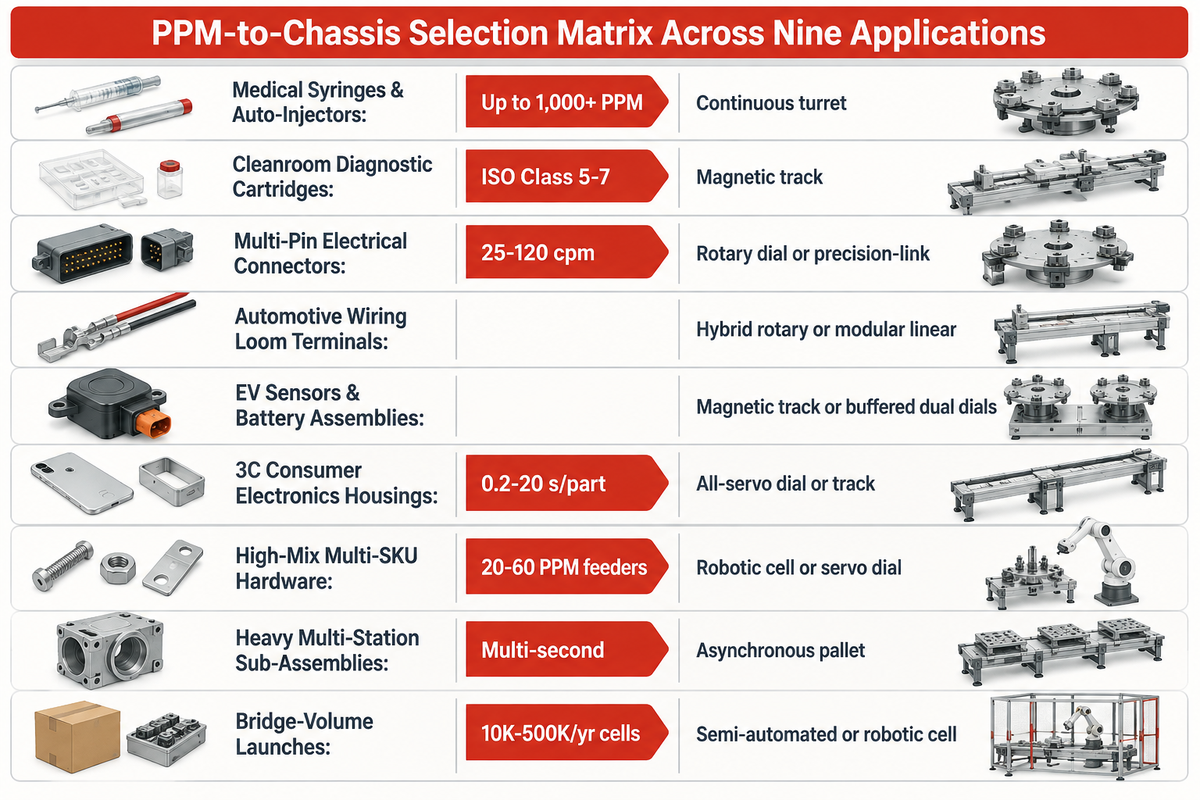
Choose continuous turrets or magnetic tracks for ultra-high-volume medical disposables, rotary dials or hybrid linear chassis with vision verification for multi-pin electrical connectors, and asynchronous pallet lines for heavy multi-station subassemblies.
| Application Scenario | Speed Band Class | Recommended Chassis | Part Feeding Method | In-Line Inspection & Testing | Compliance & Key Limitation |
|---|---|---|---|---|---|
| Medical Syringes & Auto-Injectors | Ultra-high (up to 1,000+ PPM) | Continuous turret or multi-up cam dial | Centrifugal / stainless cleanroom bowls | Inline vision, silicone coat, leak/pressure test | ISO 13485 may apply to QMS; GAMP 5 can guide project IQ/OQ/PQ validation and extend schedules |
| Cleanroom Diagnostic Cartridges | High-speed modular | Linear motor magnetic track | Tray denesters and low-particulate bowls | Micro-dispense vision, barcode serialization | ISO Class 5–7 cleanroom particulate limits |
| Multi-Pin Electrical Connectors | Medium-to-high (25–120 cpm) | Rotary indexing dial or linear precision-link | Reel-fed stamped pin strips + bowl housings | Pin coplanarity CCD vision, insertion force, hi-pot | Pin pitch tolerance (≤0.1 mm) limits feed speed |
| Automotive Wiring Loom Terminals | Medium-speed precision | Hybrid rotary or modular linear station | Cut-strip-crimp feeders + housing bowls | Crimp force monitor, pull test, vision lock check | Flexible wire routing resists full automation |
| EV Sensors & Battery Assemblies | High-speed buffered | Linear magnetic track or buffered dual dials | Pallet trays + vibratory small-part feeders | Servo press force-stroke, laser weld, EOL test | Full serial traceability; long laser or cure dwell |
| 3C Consumer Electronics Housings | Fast modular (0.2–20 s/part) | All-servo rotary dial or linear track | Tray feeders and vision pick-and-place | Cosmetic surface vision, gap verification | Short product lifecycles require reusable bases |
| High-Mix Multi-SKU Industrial Hardware | Flexible (20–60 PPM feeders) | SCARA/Delta robotic systems or servo dial | Vision-guided flexible feeders | 2D camera verification + torque monitoring | Lower peak PPM than dedicated cam bowls |
| Heavy Multi-Station Sub-Assemblies | Multi-second buffered | Asynchronous pallet conveyor | Automated tray lifts or robotic load | Leak decay, functional electrical test, vision | Large floor footprint; higher pallet tooling cost |
| Bridge-Volume Product Launches | Pilot (10K–500K/yr cells) | Semi-automated hybrid or robotic cell | Operator load + auto screw/press feeds | Pokayoke sensors, press force curve, barcode | Higher labor cost per unit at mature volume |
For your project, it would be best to select the right level of system builder so you don’t pay an enterprise premium on a specialized job or risk under resourcing a highly regulated production line. For medical devices and pharmaceutical production, JR Automation brings over 40 years in life sciences with published specs of ±2 μm position accuracy, 0.15 μm repeatability, 2 nl dosing, ISO Class 5 cleanroom experience, and speeds above 1,000 PPM.
For precision automotive parts and EV manufacturing, modular EV battery lines achieving over 90% OEE in under 1,200 sq ft, alongside laser busbar welding and thermal-interface dispensing, are built by ATS Industrial Automation. Through virtual commissioning, ATS saves over six weeks on automotive ramps and supplies automation solutions for consumer goods with cycle times of 0.2 to 20 seconds per part.
Specialized builders deliver focused custom solutions for precision automotive subassemblies, consumer products, and electrical component assembly. AMD Machines has built over 800 custom machines across 30+ years for automotive and industrial production. Published AMD benchmarks include progressive-die coil terminal insertion on 4-position index tables ($250K–$320K), servo bearing press stations ($720K–$900K), and automated leak or vision cells. For electrical connectors, plugs, and wiring terminals, ZEUEE builds custom assembly machines engineered since 2005 with 25–45 pcs/min verified throughput (including 35 pcs/min on the ZEUEE-MY0728 plug machine). Those systems achieve 0.1 mm pin-insertion accuracy and ISO 9283 repeatability mapping, shipping with PLC control, pneumatics, linear rails, CCD vision, and a documented factory acceptance test for complex assembly.
How to Size High-Speed Assembly Equipment
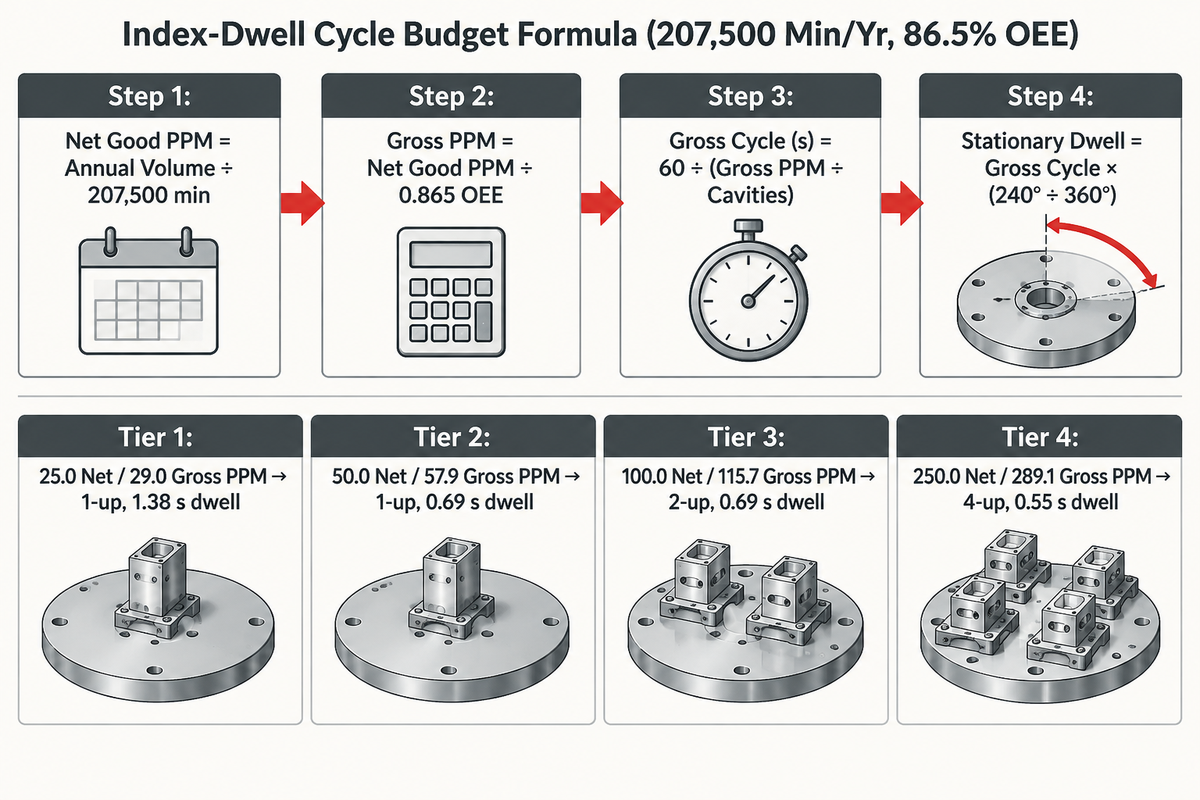
Prior to changeover deductions in steady state scheduling, required gross output rate (PPM) is equal to required net good PPM divided by OEE (Availability × Performance × Quality). Using this required gross output rate formula at Bill Budde’s published 86.5% OEE benchmark, a plant targeting 50.0 net good PPM requires at least 57.9 gross PPM.
Before issuing a purchase order, the manufacturing engineer can verify supplier capacity proposals through four simple steps:
- Net Good PPM = Annual Volume Target divided by Scheduled Production Minutes per Year.
- Gross Output Rate (PPM) equals Net Good PPM divided by OEE (OEE = Availability × Performance × Quality).
- Gross Cycle Time (seconds) = 60 ÷ (Gross Output Rate ÷ Cavity Count).
- Available Stationary Dwell (seconds) = Gross Cycle Time × (Dwell Angle ÷ 360°), valid for synchronous intermittent rotary cams.
Example worked (Index-Dwell Cycle Budget Formula): Use the example of a published shift by Bill Budde in ASSEMBLY Magazine: A shift of 480 minutes less time for lunch, breaks and cleaning (65 minutes) gives 415 planned minutes per shift. Across 2 shifts per day and 250 days per year, scheduled runtime equals 207,500 minutes per year. Bill Budde’s worked OEE is 0.952 availability x 0.909 performance x 0.999 quality = 86.5% (0.865).
Suppose a plant needs 10,375,000 finished connectors per year. Dividing 10,375,000 by 207,500 minutes yields 50.0 net good PPM. Dividing 50.0 by 0.865 requires 57.803 gross PPM, rounded up to at least 57.9 gross PPM (1.036 seconds per single-up cycle).
On a 120-degree index / 240-degree dwell cam (240 ÷ 360 = 0.667 dwell fraction), stationary dwell equals 0.69 seconds and index time equals 0.35 seconds. This algebraic sizing model determines the chassis class and cavity count; live feeder and bottleneck station tests confirm achievable dwell.
When single-cavity dwell drops below the slowest joining head, adding parallel tracks preserves stationary work time without exceeding mechanical acceleration limits. This was applied on Netafim’s Weiss TO750 four track machine running 75 cycles per minute with 4 tracks to achieve 300 PPM.
| Annual Volume | Net Good PPM | Minimum Gross PPM | Suggested Cavity & Cycle Rate | Stationary Dwell (240° Cam) |
|---|---|---|---|---|
| 5,187,500 units | 25.0 PPM | 29.0 PPM | 1-up rotary dial or servo cell at 29.0 cpm | 1.38 s stationary dwell |
| 10,375,000 units | 50.0 PPM | 57.9 PPM | 1-up rotary dial or linear track at 57.9 cpm | 0.69 s stationary dwell |
| 20,750,000 units | 100.0 PPM | 115.7 PPM | 2-up rotary dial at 57.9 cpm | 0.69 s stationary dwell |
| 51,875,000 units | 250.0 PPM | 289.1 PPM | 4-up rotary at 72.3 cpm or continuous turret | 0.55 s (4-up) / Not applicable (continuous) |
How Much Does High-Speed Assembly Equipment Cost?
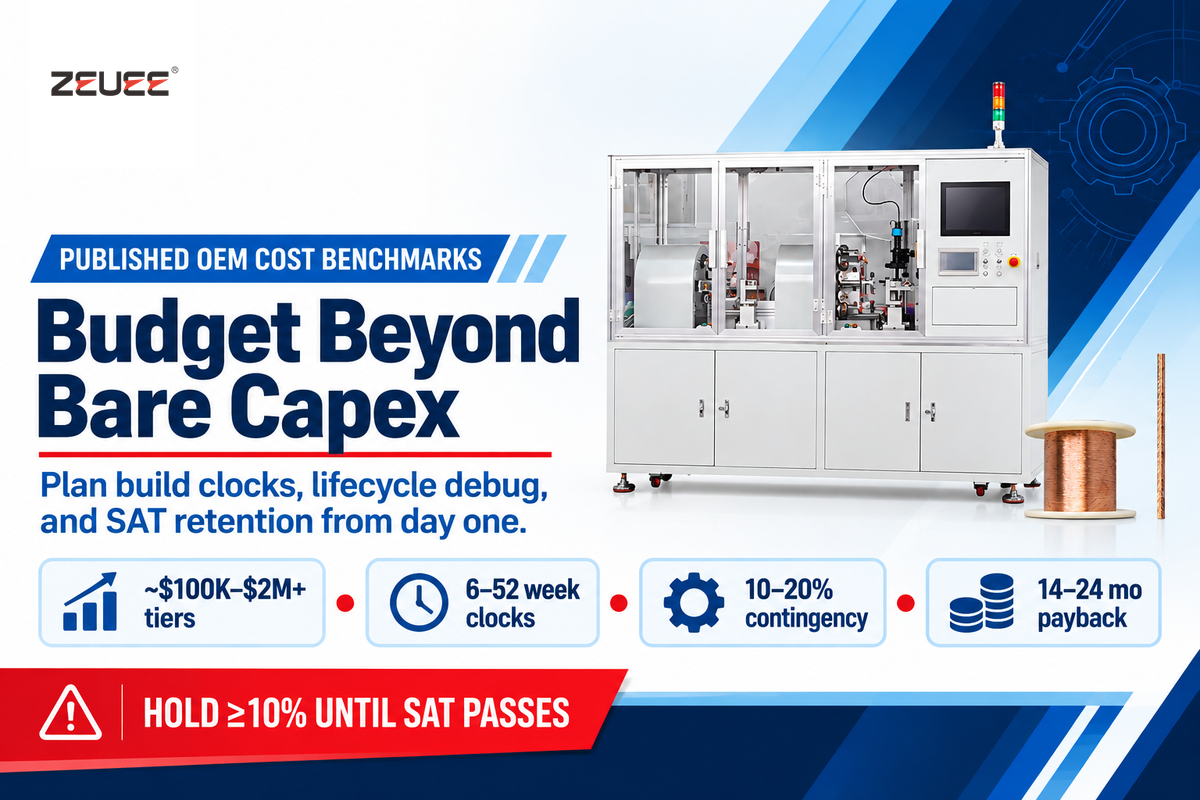
Published U.S. custom builder guides from AMD Machines and SDC Automation span ~$100K for simple single-station cells to $500,000–$1.5 million+ for multi-station assembly systems and $2M+ for fully inspected high-volume lines. Across 800+ builds over 30+ years, AMD Machines reports an installed-base average near ~$500K. Published build clocks run from approved specification or purchase order to FAT, excluding upfront RFQ concepting and buyer approval.
Lead times scale with custom design and development scope and long-lead drive orders. Per LanPDT, published delivery spans from approved specification run 6–10 weeks for manual fixtures, 12–20 weeks for semi-automated stations, 20–32 weeks for single-process automated machines, and 30–52 weeks for multi-station lines (with separate stage breakdowns listing 2–4 weeks for requirements and concepting). Regulated or hygienic equipment adds 20–40% cost and 6–12 weeks for validation. AMD Machines cites 6 weeks for simple cells and 24–26 weeks for complex U.S. builds versus 40–42 weeks for overseas builders. Total RFQ-to-FAT calendar duration also includes internal quotation review and PO approval, and exact pricing requires a formal RFQ.
| System Tier | Published Budgetary Range | Published Build Clock | Scope & Cited Source |
|---|---|---|---|
| Semi-Automated Station | $60k–$180k (LanPDT) / $150,000+ (SDC) | 12–20 weeks (LanPDT); 6 wks simple (AMD) | Operator load + auto press, test, or screw station |
| Single-Process / Focused Machine | $180k–$500k (LanPDT) / $200,000+ (SDC) | 20–32 weeks (LanPDT) | Focused automated assembly with feeders and inspection |
| Multi-Station Assembly System | $500,000–$1.5 million+ (SDC) / $500k–$2m+ (LanPDT) | 24–26 wks US vs 40–42 wks overseas (AMD); 30–52 wks (LanPDT) | Multi-station indexing or linear lines with vision and force testing |
| Large Turnkey High-Volume Line | $1.5 million+ (SDC) to $2M+ (AMD) | 30–52 weeks + 6–12 weeks if regulated (LanPDT) | Fully inspected high-volume lines; cleanroom/MES scoped per RFQ |
Five-Year Lifecycle Cost Drivers Beyond Bare Machine Capex
Published build breakdowns from LanPDT and SDC Automation show how design, controls, components, and post-delivery readiness shape total lifecycle spend on advanced assembly machines.
| Lifecycle Cost Bucket | Published Cost Driver | Budget Control Action |
|---|---|---|
| Design, Controls & Purchased Parts | Mechanical design 12–18%, controls/software 15–25%, purchased components 25–35% (LanPDT) | Freeze part CAD before mechanical design review |
| Fabrication, Assembly & Debug | Fabrication 15–22% and assembly/debug 12–20% (LanPDT) | Reject low bids that slash debug hours |
| Installation, Utilities & Contingency | Install/training 5–10% (LanPDT); 10–20% contingency recommended (SDC) | Budget facility drops and rigging alongside machine PO |
| Critical Spare Parts & PM | Cam followers, pneumatic seals, vacuum cups, sensors, vision optics | Order wear kit with machine shipment |
| Scrap & Downtime Risk | False rejects, micro-stoppages, unrecovered feeder jams | Hold at least 10% payment until SAT passes (LanPDT) |
Payback & Schedule Scenario: AMD Machines reports an installed-base project average near ~$500K and typical two-shift payback in a 14–24 month band (under one year on three shifts). In a labor-cost illustration, SDC Automation notes that displacing one $60,000 operator per shift across two shifts saves $120,000 annually in labor costs; any specific machine’s payback also depends on scrap reduction, maintenance spend, and realized OEE. Schedule risk starts before build: LanPDT breaks delivery into 2–4 weeks for requirements and concepting, 4–8 weeks for detailed design, 4–10 weeks for long-lead procurement, and 1–3 weeks for FAT, while late production-intent samples slip FAT week-for-week.
Buyers uncertain of demand can reduce their capital risk through a phased advanced automation implementation. Commence with a semi-automatic, modular cell to automate the most difficult high-defect joining and vision inspection steps first; subsequently, after demand becomes more predictable, add an automatic bowl feeder and rotary or linear transfer module.
Common Mistakes When Buying High-Speed Assembly Equipment
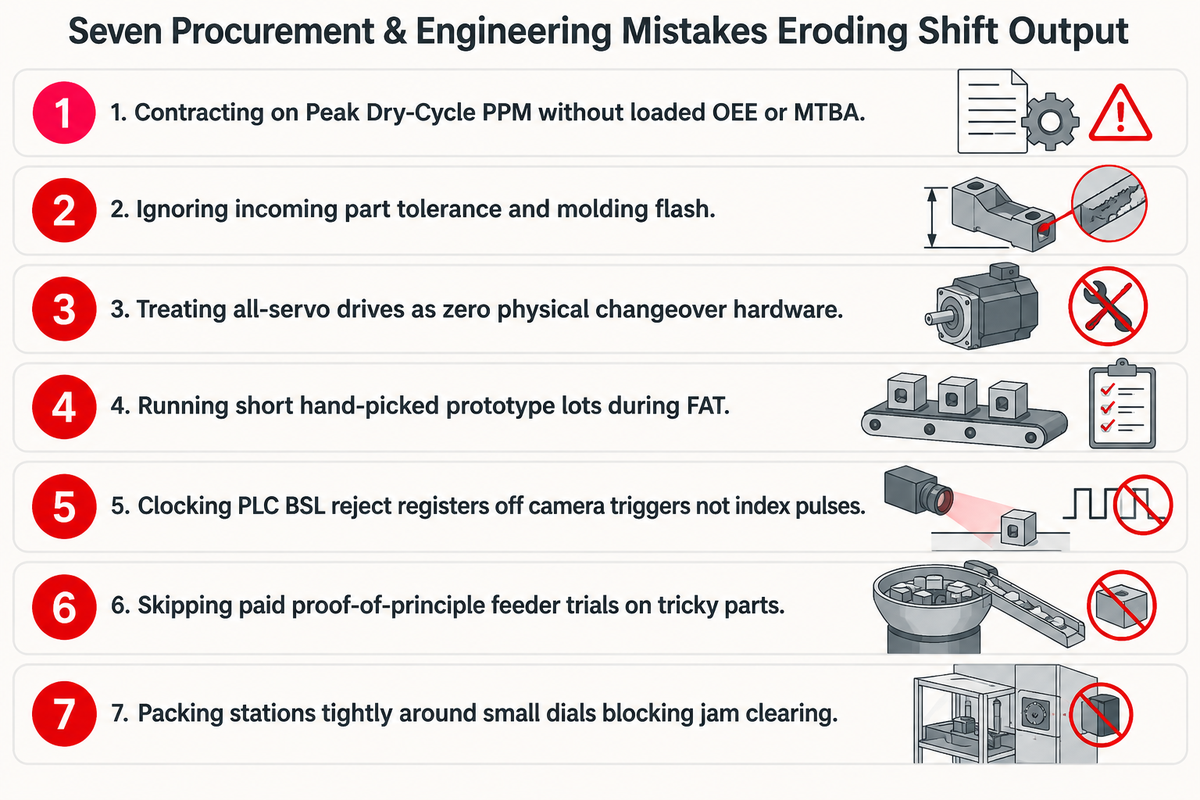
Seven procurement and engineering mistakes quietly erode sustained shift output on newly delivered high-speed assembly lines.
Common Mistake — Contracting on Peak Dry-Cycle PPM: Writing a contract around empty-cycle speed without loaded OEE or mean time between assists (MTBA) lets a machine pass dry trials while stalling repeatedly on real parts.
- Ignoring incoming part tolerance and molding flash turns minor molding drift into chronic jamming. Bill Budde cites a press fit reject in the ASSEMBLY Magazine, due to a 0.002 inch oversize hole, not a ram problem. Acceptance agreements must separate incoming part defects from machine faults.
- Seeing all servo drives as zero changeover hardware overlooks manual tool changes. Software recipes update motion strokes quickly, but technicians still have to change or adjust affected bowls, escapements, and nests. Quick release cartridges or location pins can make these manual changeovers quicker.
- Running short demo lots during Factory Acceptance Tests hides thermal drift and pressure sag. Supply multi-lot production-intent molded and stamped parts for multi-hour endurance runs instead of hand-picked prototypes.
- Clocking PLC reject shift registers off camera triggers instead of physical index pulses corrupts sorting. A controls engineer on PLCtalk documented a six-part-per-index machine with two cameras and a five-index Bit Shift Left (BSL) register on an Allen-Bradley SLC-5/04. Whenever a nest arrived empty, the camera trigger never fired and the BSL failed to shift. Always clock shift registers off physical index motion and confirm physical ejection with a chute sensor.
- Avoid skipping paid, proof-of-principle feeder tests on springs, elastomers, or thin, stamped pins, or you risk a late redesign. By testing feedability before design freeze you expose jamming modes whilst tooling changes are cheap.
- Packing stations tightly around a small rotary dial blocks jam clearing and lens cleaning, turning short operator assists into prolonged downtime.
Integration, Utility Requirements, and What to Ask Suppliers Before You Order
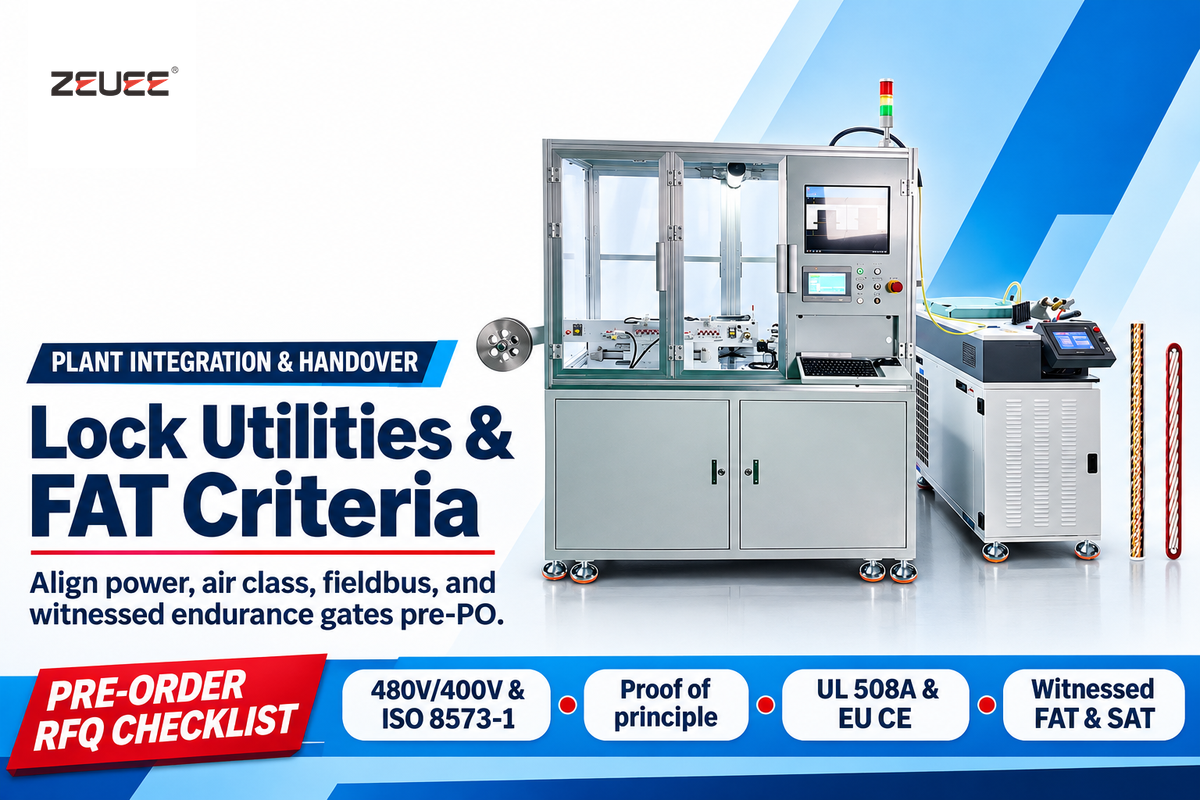
Lock down electrical drops, ISO 8573-1 compressed-air classes, real-time fieldbus interfaces, buffer conveyors, and written factory acceptance test checklist criteria before issuing a purchase order. Early facility preparation and clear acceptance gates prevent commissioning delays once high-speed machinery reaches your plant floor.
Size the three-phase electrical supply (480V/400V) for the builder’s specified peak input demand and account for servo regeneration inside the drive design. Specify compressed-air particle, water, and oil classes under ISO 8573-1 so pneumatic valves and blow-offs stay clean. Align fieldbus protocols, EtherCAT, PROFINET, or EtherNet/IP, with plant maintenance skills and define OPC-UA or MES data tags early. Adding modular bases and accumulation buffers protects automated assembly line architecture scalability for future SKUs.
Why Is Preventive Maintenance Important for High-Speed Assembly Equipment?
Preventive maintenance protects OEE by replacing high-cycle wear items—cam followers, pneumatic seals, bowl track coatings, vacuum cups, and vision optics—before wear triggers chronic micro-stoppages and unplanned downtime. At a fixed 100 PPM output, annual cycle counts rise with operating hours and scale inversely with cavities per cycle, while cumulative mechanical wear can lead to missed escapements and false vision rejections.
Rather than relying on calendar dates, the best plants trigger their preventative maintenance off of cycle counters. Daily checks include air pressure, vision camera lens cleaning, and reject chute verification using master bad parts. Monthly and quarterly routines inspect cam follower preload, linear rail lubrication, belt tension, and sensor alignment while keeping critical wear spares on hand.
Pre-Order RFQ & Factory Acceptance Test (FAT) Checklist
Lock these four project milestones in writing before releasing a purchase order so machine design, compliance files, and rigorous testing match plant requirements.
| Stage | Buyer RFQ Package Inputs | Supplier Written Commitments |
|---|---|---|
| 1. RFQ Specification | 3D CAD, 2D tolerances, annual volume, shift calendar, SKU family | Chassis type, single-up vs. multi-up cycle budget, bottleneck dwell |
| 2. Proof of Principle | Production-tool sample lots across cavity variation | Feed-rate video log, press force curve, vision lighting test |
| 3. Safety & Utilities | Plant voltage, ISO 8573-1 air class, floor load, PLC/MES standards, target market | Applicable UL 508A panel docs; EU conformity under 2006/42/EC through 19 Jan 2027 and (EU) 2023/1230 from 20 Jan 2027; ISO 13849-1:2023 PL rating; exact utility loads |
| 4. FAT & SAT Handover | Multi-lot production parts + deliberate known-bad defect samples | Witnessed run (e.g., 95% avail / 40 hr, Cpk 1.33, <0.5% scrap per LanPDT), verified rejection of all supplied defect samples, unlocked PLC code, wear-parts list |
Whether you’re considering a rotary, linear or a vision integrated assembly solutions for connector, plug or any other electromechanical component automation, submit your 3D CAD files and cycle times to ZEUEE. We review feedability, cycle budget and inline inspection strategy to create a practical machine proposal.
Frequently Asked Questions
What is considered high-speed assembly in manufacturing?
High-speed assembly generally starts with modular automated lines running down to 0.2 seconds per part (ATS Industrial Automation) and rotary multi-track dials reaching 300 PPM (ASSEMBLY Magazine). Continuous-motion turrets exceed 1,000 PPM (JR Automation). The achievable speed tier on the electrical, automotive and medical lines is dictated by part size, station count and join dwell.
How do rotary indexing machines differ from linear transfer assembly lines?
Rotary indexing machines move smaller parts around a circular dial across balanced stations in a compact floor space with a low moving mass. Larger components, higher station counts, unequal dwell cycles, and open access on two sides for feeders, inspection cameras, and maintenance technicians can be accommodated on linear transfer lines, including precision-link conveyors, asynchronous pallets, and linear motor magnetic tracks.
What is a component assembly machine?
A component assembly machine is a dedicated automated feeding, assembly and inspection system. A sub-system comprises a vibratory bowl, pick-and-place machines, a pneumatic or servo press, ultrasonic welding, and a vision camera under a single PLC control, and is standardised for multi-shift operation to improve efficiency. In steady production, ASSEMBLY Magazine cites 80% to 95% as an acceptable efficiency range depending on product complexity.
Is high-speed assembly equipment worth the investment for small batches?
Generally, the answer is no. Dedicated high-speed assembly machines have significant custom bowl and tooling expenses which infrequently repay their costs at modest yearly volumes. Small lots belong on semi-automated benches or robotic cells unless proven repeatability validates the use of dedicated automation.
How can plants reduce micro-stoppages and jams on high-speed assembly lines?
Tighten incoming part tolerances and remove molding flash or stamping burrs before parts ever enter vibratory bowls. Run paid proof-of-principle feeder trials across multiple production mold lots, add part-presence sensors at every escapement, and clock PLC reject shift registers off physical index motion with chute confirmation. Track mean time between assists by station and replace worn cam followers, pneumatic seals, and track coatings on cycle counters to protect long-term manufacturing efficiency and operational efficiency across manufacturing operations.
How does an automated assembly machine differ from a robotic assembly cell?
An automated assembly device, unlike flexible automated systems, incorporates cam wheels, rotary dials, or linear tracks in sync to optimise continuous flow on parts that are inherently stable. A robotic assembly cell is comprised of SCARA, Delta or six-axis arms exchanging top-end speed for multi-SKU versatility.
What should buyers verify during a Factory Acceptance Test (FAT) before shipping?
Run a witnessed multi-hour endurance test at contracted net good PPM using production-intent parts drawn from multiple mold cavities. Measure sustained availability, first-pass yield, and cycle stability while feeding deliberate known-bad samples to test detection of the agreed defects and physical reject-chute sorting. Time a full SKU changeover with your own technicians and audit electrical schematics, UL 508A panel files where required, applicable EU CE machine conformity documents, unlocked PLC code, and critical spare-parts lists.
References & Sources
- EUR-Lex, Regulation (EU) 2023/1230 on Machinery Safety Requirements
- U.S. FDA, Quality Management System Regulation (QMSR, 21 CFR Part 820 / ISO 13485:2016)
- ISO, ISO 13849-1:2023 Safety of Machinery: Safety-Related Parts of Control Systems
- UL Solutions, Industrial Control Panel Certification Scope (NITW / UL 508A)
- ANSI, ISO 10218-1:2025 Industrial Robots and Robotic Devices Safety
- TÜV SÜD, New EU Machinery Regulation (EU) 2023/1230 Overview
- Pilz, Functional Safety Standard EN ISO 13849-1:2023 Transition
- ASSEMBLY Magazine, Rotary vs. Linear Indexing (Weiss, Netafim, CDS, Foerster Benchmarks)
- ASSEMBLY Magazine (Bill Budde), Defining Throughput in Automated Assembly Systems
- ASSEMBLY Magazine (Corey Vodvarka), Uncovering Hidden Capacity Using OEE
- Automation World, Cameras See Greater Role in High-Speed Assembly (FANUC America Quote)
- Motion Index Drives, Cam-Driven vs. Servo-Driven Rotary Indexers
- AMD Machines, What Custom Automation Costs
- SDC Automation, Realistic Cost Breakdown for Automated Assembly Machines
- LanPDT, Custom Machine Lead Times, Cost Breakdown, and Acceptance Milestones
- JR Automation, High-Speed Assembly Automation Solutions
- ATS Industrial Automation, High-Speed Assembly Systems
- SuperTrak Conveyance, SuperTrak VERTICAL10 Linear Motor Specifications
- Huben Automation, Flexible Vibratory Feeder vs. Standard Bowl Feeder Comparison
Reviewed by the Shenzhen Zeyu Intelligent Industrial Science Technology Co., Ltd technical team.
WHY WE WRITE THIS
About ZEUEE Engineering Insights
ZEUEE shares technical guides based on real automation project experience. Since 2005, we have designed and manufactured non-standard automation equipment for connector assembly, wire harness production, robotic lines, vision inspection, and smart factory upgrades.
Founded in 2005
20,000 m² production base
120+ specialists
150+ R&D patents
ISO9001:2015 certified
Related Posts
Trending now