Get in touch with Zeyu lntelligent Industrial Company

Small Batch Wire Manufacturing: Process Routes, Low-Volume Wire Harness Production, and Automation Trade-Offs

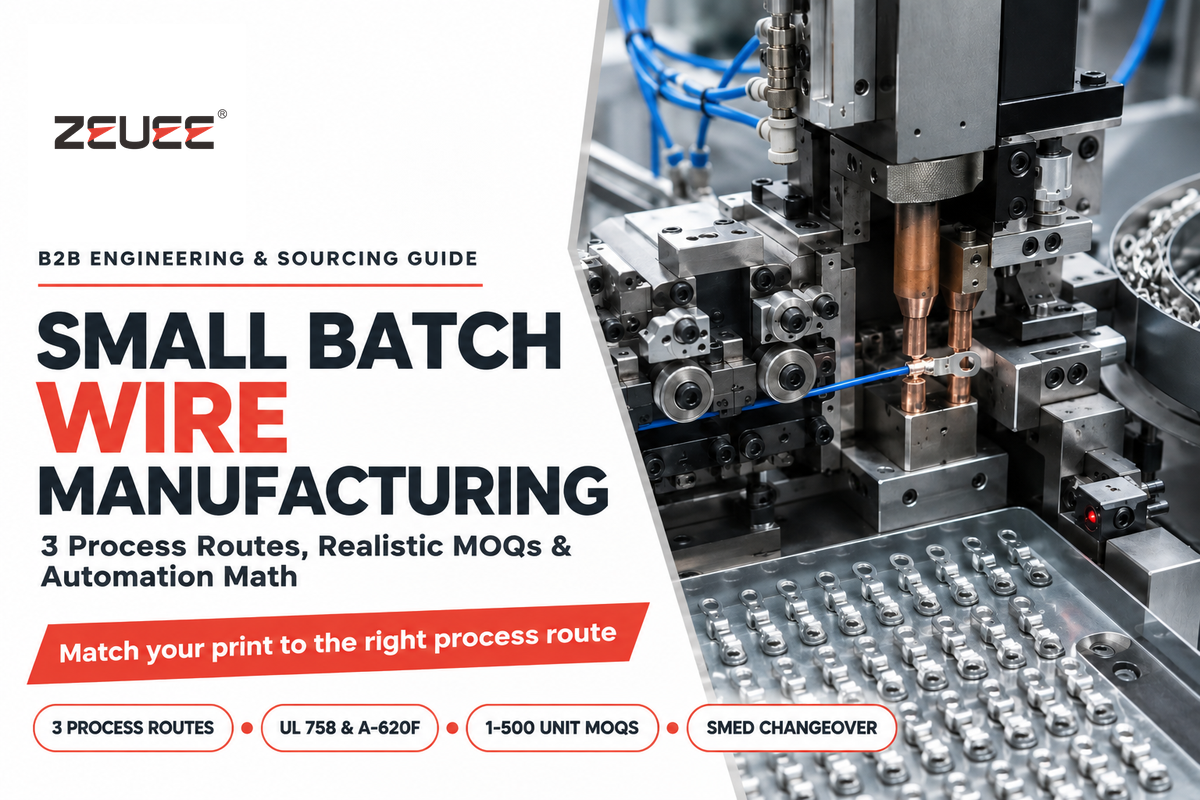
Small batch wire manufacturing splits into three distinct production routes. Custom bulk cable extrusion starts around 1,000 ft at specialty mills. Modified off-the-shelf UL wire bridges mid-sized lots, while cut-strip-crimp wire harness assembly starts at 1 unit. Each route quotes by a different unit and carries different setup waste.
This guide covers electrical wire, custom cable, and terminated wire harness builds for industrial, automotive, and aerospace buyers.
What Small Batch Wire Manufacturing Covers: 3 Core Process Routes and MOQ Mechanics
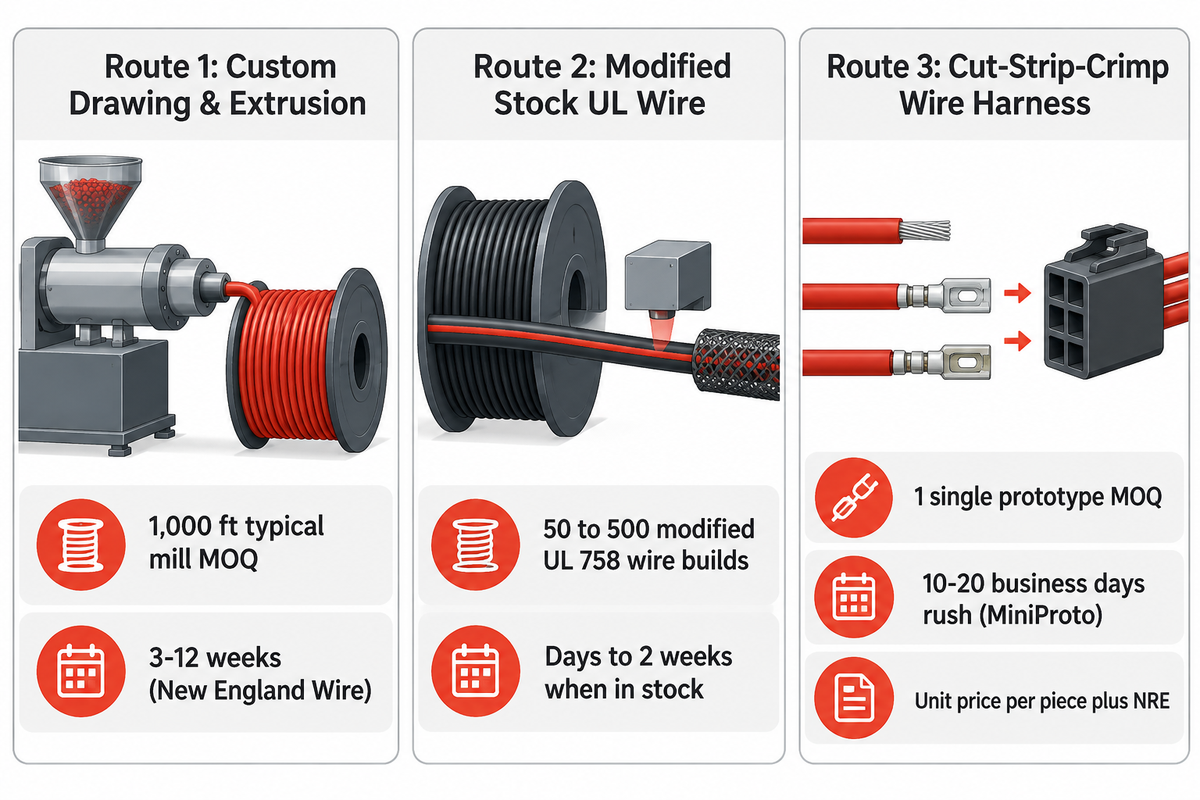
Upstream continuous wire drawing and extrusion have startup purge scrap and line stabilization waste, which bring typical custom bulk cable minimums to 1,000 ft at specialty mills such as New England Wire and General Wire Products. Downstream cut-strip-crimp wire harness assembly begins at 1 single prototype with no polymer purging.
Quoting delays typically happen when buyers mistakenly send a 25-piece cable assembly drawing to a wire mill or ask a contract shop to draw a custom copper alloy. Neither request goes past the first step – the physical manufacturing process isn’t the same. Extrusion barrels must heat up, purge prior colorants, and stabilize wall thickness over hundreds of feet before good cable exits the die.
Discrete wire harness production avoids that continuous scrap during short production runs. Short production runs: operators add spooled wire from the stock to cut and strip machines, crimp terminals, and insert connector housings one by one. That structural difference explains why bulk custom wire quotes by length in feet or meters, while wire harness builds quote per finished assembly plus setup charges.
3-Route Wire-vs-Harness Selector
Route custom extruded bulk cable orders to a specialty wire mill, 50 to 500 modified UL 758 wire builds to a value-add processor, and 1 to 500 cut-strip-crimp wire harnesses to a contract shop before requesting quotes. Choosing the wrong tier creates unnecessary minimum order quantity (MOQ) barriers or forces a shop to subcontract half the complete process.
| Evaluation Dimension | Route 1: Custom Drawing & Extrusion | Route 2: Modified Stock UL Wire | Route 3: Cut-Strip-Crimp Wire Harness Assembly |
|---|---|---|---|
| Primary Output | Bulk spooled custom wire or multi-conductor cable | Striped, cut, or re-sleeved UL-recognized stock wire | Terminated custom wire harness or cable assembly |
| Quoting Unit | Length (feet or meters) or conductor weight (kg) | Footage plus per-cut or striping setup fee | Unit price per piece plus NRE tooling charges |
| Published MOQ Floor | 1,000 ft typical (prototype runs negotiable at specialty mills) | Stock reel or cut-to-length lot from value-add distributor | 1 single prototype at dedicated HMLV assembly shops |
| Scrap Physics | Continuous extruder barrel purge and concentricity startup loss | Minimal leader waste during ink striping or respooling | First-piece strip and crimp setup leads (5–20 wires) |
| Typical Lead Time | 3–12 weeks (New England Wire published range) | Days to 2 weeks when base UL wire is in stock | 10–20 business days rush (MiniProto published range) |
| UL / Standard Scope | Covered under UL 758 AWM Component Recognition at the wire mill | Requires UL traceability handling if re-marked or jacketed | Built to IPC/WHMA A-620F-2025 workmanship classes |
| Tooling Driver | Extrusion crosshead tips, dies, and custom color masterbatch | Ink-striping wheels, hot-stamp dies, or sleeving fixtures | Crimp applicators, formboards, and continuity test adapters |
| Primary Supplier Tier | Specialty wire mill or short-run cable extruder | Value-add wire distributor or authorized processor | HMLV contract assembly shop or in-house assembly cell |
| When to Select | Non-stock conductor count, special shield, or custom jacket wall | 50–500 assemblies needing custom colors without mill MOQs | Any terminated assembly needing connectors, seals, and routing |
How does small batch wire manufacturing work when ordering under 500 units?
Orders under 500 units normally run through Route 3 using stocked UL hook-up wire, pre-cut leads, and modular benchtop or automatic crimping stations. Engineers release a bill of materials (BOM), a From-To wire list, and a 2D assembly drawing. The shop then sources standard reels and assembles small quantities without custom cable extrusion.
First, assembly confirms wire sizes in AWG or mm² versus terminal barrel ranges. Second, technicians cut each lead to length, strip insulation to print tolerance, and crimp onto bare strands. Third, operators put terminals in connector housings, route branches on a nailboard, apply heat shrink or braid, and perform end-to-end electrical continuity tests prior to shipment.
Neither mechanical CNC wire forming nor wire EDM produces insulated electrical cable assemblies or follows IPC/WHMA-A-620 acceptance rules.
Custom Extruded Cable vs. Modified Off-the-Shelf UL Wire for 50–500 Assemblies
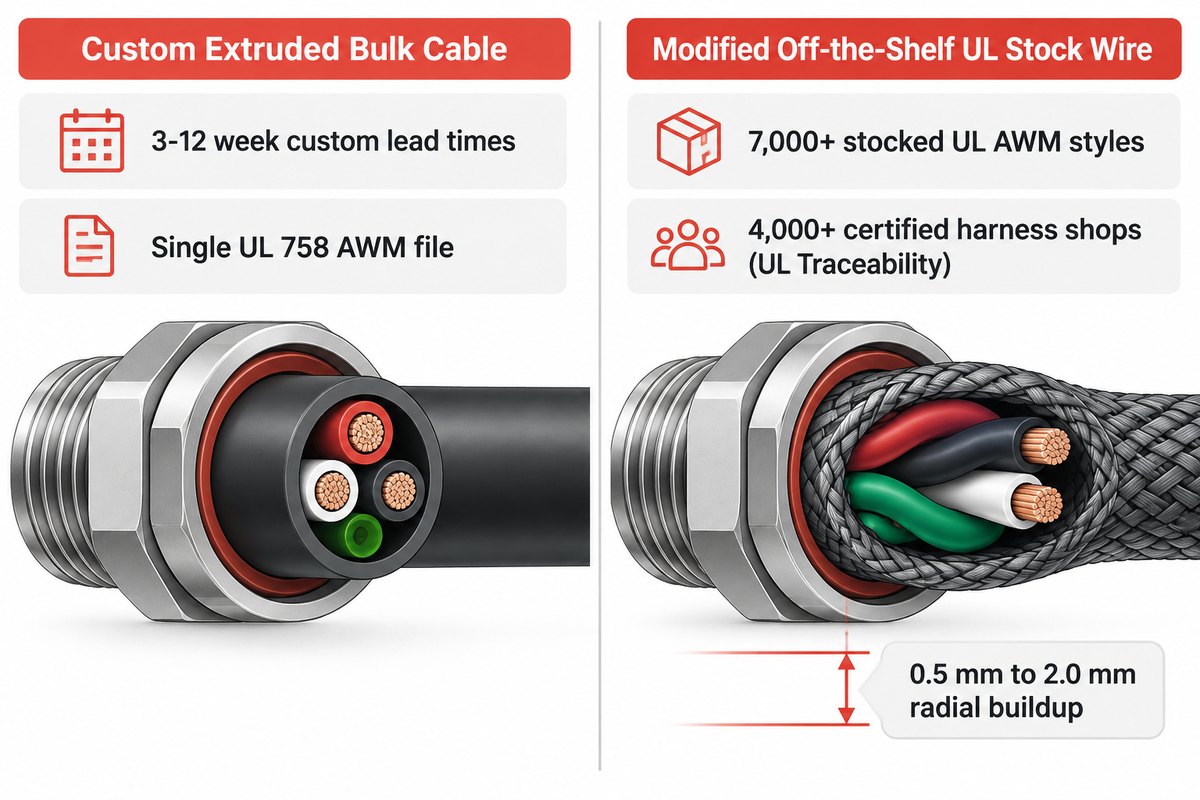
For 50 to 500 assemblies, modifying stocked UL 758 wire via ink striping or sleeving avoids the mill extrusion floor. It also avoids New England Wire’s 3–12 week custom turnaround. Choose full custom extrusion only when conductor geometry, shielding coverage, or outer diameter can’t be met with 7,000+ stocked UL AWM styles.
UL Solutions certifies Appliance Wiring Material under UL 758 AWM across more than 7,000 styles defined by polymer, voltage, temperature, and flame class. ANSI/UL 758 remains actively maintained through its November 18, 2026 revision. Purchasing a certified reel is only the first step when an outside shop alters that wire.
When a shop respools, re-marks, or jackets bulk AWM wire, chain-of-custody rules apply. Through the UL Wiring Harness Traceability Program, UL tracks AWM cable from the wire mill through more than 4,000 certified wire harness manufacturers using tamper-evident holographic labels. Adding an aftermarket outer jacket or overmold over recognized internal wire may also require end-product evaluation instead of simply taking the internal wire AWM mark.
Custom Extruded Bulk Cable
- Mill minimum extrusion run with 3-12 week custom lead times (New England Wire).
- Exact OD (outer diameter), wall concentricity, and factory extruded color stripes.
- Required for non-standard conductor counts, foil-braid shields, or bonded jackets.
- Factory-certified directly under a single UL 758 AWM Component Recognition file.
Modified Off-the-Shelf UL Stock Wire
- No mill purge minimum; uses standard distributor reels for low-volume lots.
- Color coding with ink striping, laser marking, or printed heat shrink markers.
- Bundle protection using expandable nylon sleeving, spiral wrap or tubing.
- Preserves traceability only when processed inside UL-recognized traceability controls.
Two practical shop-floor constraints catch engineering teams off guard during stock-wire modification. First, ink striping adheres well to PVC and XLPE jackets, but low-surface-energy PTFE, FEP, and silicone jackets resist standard solvent inks without chemical surface etching or thermal transfer heat shrink labels. Without chemical surface etching or thermal transfer heat shrink labels, color stripes rub off when wire is routed and pulled.
Second, adding secondary covering changes the mechanical fit at enclosures. Braided nylon sleeving or dual-wall heat shrink tubing adds 0.5 mm to 2.0 mm of radial buildup and creates an oval cross-section around twisted leads. Many standard circular cable gland configurations and single-wire rubber seals don’t seal ingress on sleeved bundles, but a round, custom-extruded jacket squeezes uniformly against the seal elastomer.
Conductors, Insulation, and Connector Specifications for Prototype Wire Runs
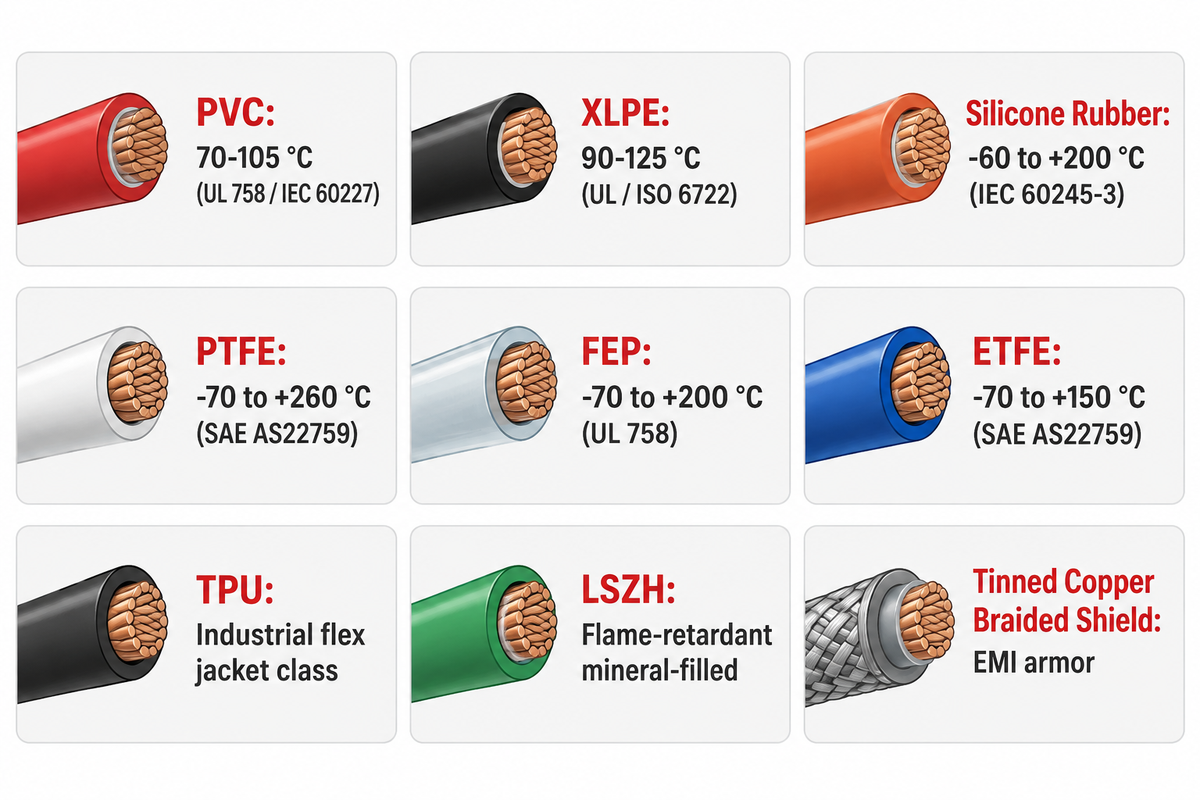
Standardize prototype wire runs on ASTM B33 tinned copper conductors and ASTM B286 flexible stranding. Pair them with stocked UL 758 insulation classes spanning PVC (70–105 °C) up to PTFE (-70 to +260 °C). Non-standard strand counts or custom alloys push a prototype out of stock inventory into high-MOQ mill runs.
Conductor metallurgy influences electrical conductivity, solderability and flex fatigue life. Annealed bare copper provides best electrical conductivity for power feeds, while ASTM B33 tin plating reduces oxidation and enhances solder wetting on field-serviceable joints. Anneal heat treatment modulates copper hardness and springback to determine how consistently tiny strands retain inside a crimp barrel under mechanical stress.
Insulation choice determines both thermal survival and automatic strip quality. Soft silicone rubber rated -60 to +200 °C delivers >=5.0 N/mm² tensile strength per IEC 60245-1 and >=150% elongation per IEC 60811-501 after thermal ageing, yet tears when strip blades dull. Fluoropolymers like PTFE (-70 to +260 °C) and FEP (-70 to +200 °C) reach >=10.0 N/mm² tensile strength and >=200% elongation. Both demand sharp V-blades or laser stripping to avoid nicking fine strands.
| Insulation / Covering | Continuous Temp Class | Mechanical & Tensile Profile | Auto-Stripper Behavior | Stock Availability | Primary Engineering Limit |
|---|---|---|---|---|---|
| PVC (Polyvinyl Chloride) | 70–105 °C (UL 758 / IEC 60227) | Moderate abrasion resistance; stiffens below -20 °C | Clean mechanical blade strip; low slug cling | High across 10–30 AWG stock reels | Softens near soldering heat; emits halogens in fire |
| XLPE (Cross-Linked PE) | 90–125 °C (UL / ISO 6722) | Higher cut-through and melt resistance than PVC | Crisp mechanical strip; requires tuned blade depth | High in automotive and appliance gauges | Higher flexural stiffness on tight bend radii |
| Silicone Rubber (SiR) | -60 to +200 °C (IEC 60245-3) | >=5.0 N/mm² tensile strength; >=150% elongation | Soft wall smears or tears if blades are worn | Good in UL 3512 / SRML standard colors | Low cut-through resistance; poor solvent ink adhesion |
| PTFE (Polytetrafluoroethylene) | -70 to +260 °C (SAE AS22759) | >=10.0 N/mm² tensile strength; >=200% elongation | Tough fluoropolymer; needs precision V-blade or laser | Good in silver/nickel-plated aerospace gauges | Cold flow under sharp clamp loads; high material cost |
| FEP (Fluorinated Ethylene Propylene) | -70 to +200 °C (UL 758) | >=10.0 N/mm² tensile strength; >=200% elongation | Melt-extruded wall strips cleaner than taped PTFE | Moderate across common sensor gauges | Lower max temperature than PTFE; slick jacket surface |
| ETFE (Ethylene Tetrafluoroethylene) | -70 to +150 °C (SAE AS22759) | High abrasion and mechanical cut-through strength | Thin wall demands tight strip-depth tolerance | Good in aerospace hook-up wire sizes | Lower thermal ceiling than PTFE or FEP |
| TPU (Thermoplastic Polyurethane) | Industrial flex jacket class | Strong flex-fatigue, oil, and tear resistance | Elastic jacket requires sharp blades to prevent pull-out | Common in multi-conductor robotics cable | Custom multi-core TPU jackets trigger mill MOQs |
| LSZH (Low-Smoke Zero-Halogen) | Industrial transit & building class | Flame-retardant mineral-filled compound | Abrasive filler accelerates strip-blade wear | Moderate in standard power and control sizes | Higher jacket stiffness and lower wet-abrasion toughness |
| Tinned Copper Braided Shield | Matches inner insulation class | Mechanical EMI armor plus flex durability | Requires rotary shield cut or manual comb-out | Widely stocked as flat/tubular sleeving | Adds manual labor minutes per termination in small lots |
Connector choices impact small-batch sourcing nearly as much as wire protection. Standard off-the-shelf connector housings with matching single-wire seals and stocked stamped terminals keep assembly costs predictable. For circular or barrel power interfaces, review DC connector and adapter cable specifications to align gauge, jacket OD, and strain-relief geometry before freezing the BOM.
If a housing is going to employ cavity seals, keep the outer diameter tolerance close. A thin-wall XLPE wire fits loose in a seal meant for thick PVC, so water can flow into the contact cavity. Refer directly to the connector seal table on wire OD in mm rather than AWG gauge.
Realistic MOQs, Tooling NRE Charges, and Lead Times Across Order Stages
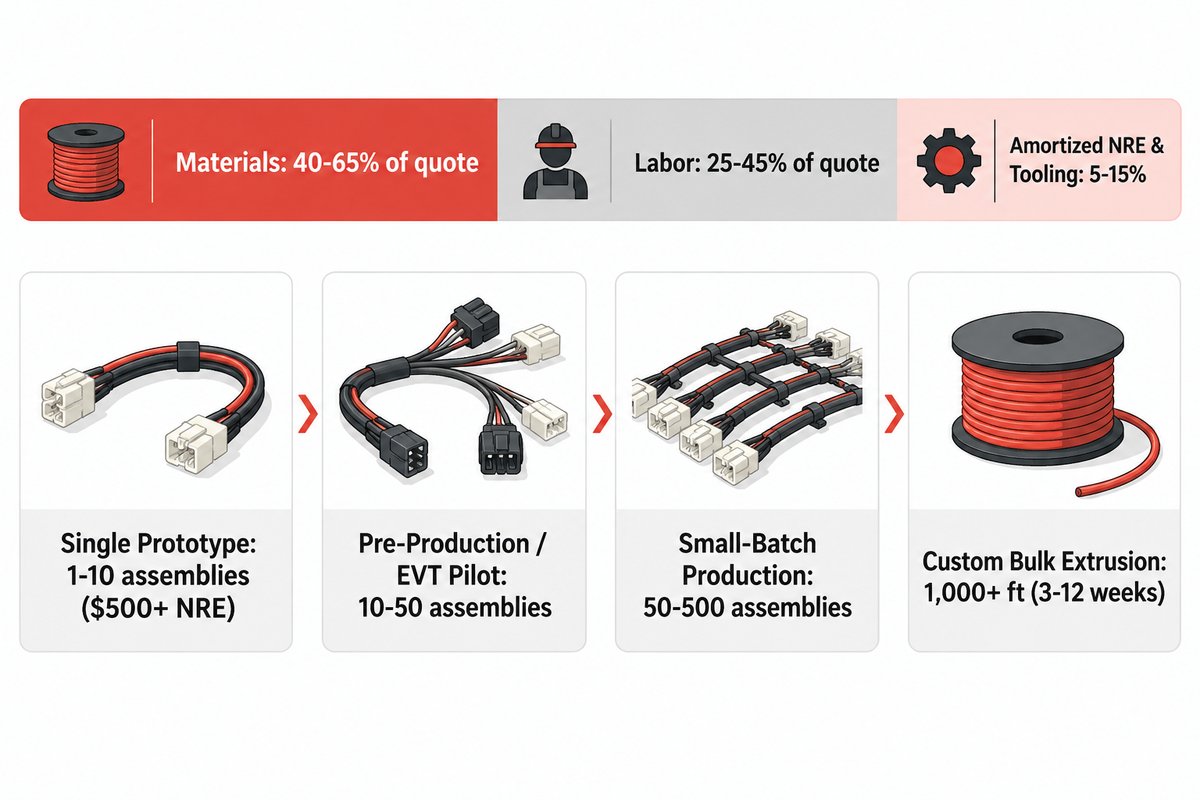
Small-batch wire harness quotes break into 40–65% materials, 25–45% labor, and 5–15% amortized NRE and tooling, according to PCBInsider’s April 2026 wire harness cost breakdown. MiniProto accepts 1-unit prototype orders in 10–20 business days rush, whereas New England Wire publishes 3–12 week turnarounds on custom extruded bulk cables starting at its mill floor.
Analysis of unit prices by order stages without disaggregating NRE upsets supplier quotes. PCBInsider lists baseline NRE starting at $500 for simple builds up to $15,000+ for complex assemblies, including assembly board fabrication ($300–$3,000) and test fixture development ($500–$5,000). Custom crimp applicators and aluminum soft overmolding molds add separate one-time tooling line items when not stocked.
| Order Stage | Typical Quantity | Published MOQ / Source Basis | Primary NRE & Tooling Drivers | Published Lead Time |
|---|---|---|---|---|
| Single Prototype | 1–10 assemblies | 1 unit MOQ (MiniProto; RFA Engineering single prototype) | Hand-crimp tooling or stocked mini-applicators; simple NRE from $500 (PCBInsider) | 10–20 business days rush (MiniProto published scope) |
| Pre-Production / EVT Pilot | 10–50 assemblies | Low-volume contract shop lot; no custom cable extrusion | Dedicated pegboard/formboard, mate-test cable adapter, first-article setup | Depends on connector stock; expedited builds use stocked UL wire |
| Small-Batch Production | 50–500 assemblies | Discrete assembly lot; component reel minimums apply | Assembly board ($300–$3,000) and test fixture ($500–$5,000) per PCBInsider; custom applicators or soft molds quoted separately | Scheduled around terminal reel delivery and test-fixture build |
| Custom Bulk Extrusion | 1,000+ ft cable | 1,000 ft typical (New England Wire; General Wire Products) | Extrusion die/tip setup, compound purge scrap, custom colorant | 3–12 weeks typical turnaround (New England Wire) |
What counts as a low MOQ for custom wire and prototype wire harness builds?
A low MOQ means 1 to 50 assemblies for a contract wire harness shop, or the specialty mill extrusion minimum (with smaller prototype runs negotiable) for a custom cable extruder. Shops hit 1-unit minimums only when your BOM uses standard stocked UL wire, loose-piece or in-house strip terminals, and off-the-shelf connector housings.
Hand-building 1 or 2 prototypes in an engineering lab stays manageable, as practitioners note on r/AskElectronics. Once an engineering team needs 10 to 50 identical assemblies taking an hour each, manual work creates a schedule bottleneck. That volume increase presses forward the switch to a low-volume contract manufacturer.
Common Mistake: Ignoring Component-Reel MOQ Pass-Throughs
A contract shop advertising a 1-unit MOQ still buys specialty crimp terminals on full carrier reels and sealed connectors in factory pack bags. If your print calls out a non-stock automotive terminal, the shop bills the entire unused reel into a 25-piece quotation. Flagging distributor-reel minimums during DFM review lets engineers substitute stocked equivalent terminals with matching mechanical and electrical ratings.
Semi-Automatic Benchtop Setups vs. Modular Automated Wire Production Lines
Automatic wire cutting and stripping machines produce from 3,000 to 8,000 wires per hour with 5 to 15 minute wire-type changeovers, according to Bobo Machine’s posted comparison. Double-end units such as the Wiromac WM-3202 are from 3,800 to 4,000 pcs/h on short leads. However, max press speed is worse whenever short lots are in setup longer than run.
Assembly Magazine reports that semiautomatic benchtop stripping and crimping stations remain a staple for high-mix, low-volume production. A fully automatic high-volume line requires consistent lots of the same leads to recover changeover time. Industry experts stress a semi-automatic cell isn’t just a bridge.
“Semi-automatic solutions are not just a steppingstone. They are often the best long-term solution for certain products.”
2-Variable Changeover Crossover Formula
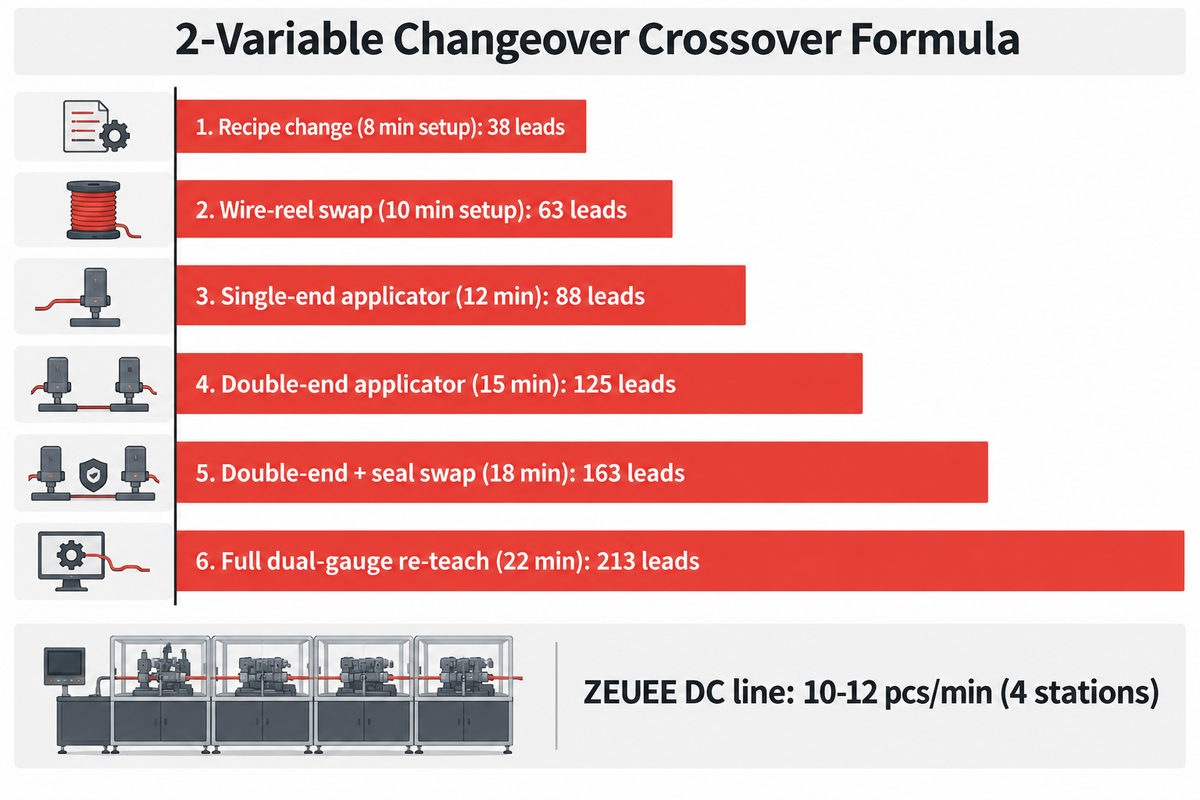
The break-even batch size between a semi-automatic benchtop cell and an automated line is Nbreakeven = (Tauto − Tsemi) ÷ (tsemi − tauto), where Tauto and Tsemi are changeover plus first-piece check minutes. Terms tsemi and tauto are cycle minutes per good lead (60 ÷ hourly good rate).
Using modeled benchtop versus 3,000 leads/hr automated line assumptions (verify against your own floor rates), the table compares six changeover tiers from an 8-minute recipe switch up to a 22-minute full dual-end swap.
| Changeover Scenario | Automated Setup Tauto (min) | Net Setup Penalty vs. 5-min Bench (min) | Cycle Saving per Lead (min) | Break-Even Batch Nbreakeven | Faster Route Below Break-Even |
|---|---|---|---|---|---|
| 1. Recipe / length change only + first-piece check | 8 min | 3 min | 0.08 min | 38 leads | Semi-automatic benchtop |
| 2. Wire-reel swap (same gauge & terminal) | 10 min | 5 min | 0.08 min | 63 leads | Semi-automatic benchtop |
| 3. Single-end applicator + wire swap | 12 min | 7 min | 0.08 min | 88 leads | Semi-automatic benchtop |
| 4. Double-end applicator + wire + crimp-height check | 15 min | 10 min | 0.08 min | 125 leads | Semi-automatic benchtop |
| 5. Double-end + seal loader swap + pull check | 18 min | 13 min | 0.08 min | 163 leads | Semi-automatic benchtop |
| 6. Full dual-gauge + dual-applicator + seal + vision re-teach | 22 min | 17 min | 0.08 min | 213 leads | Semi-automatic benchtop |
Say a manufacturing facility needs 150 identical DC power leads, double-end applicator, wire swap (Scenario 4, Tauto = 15 min). On the semi-automatic bench, total run time is 5 + (150 × 0.10) = 20.0 minutes. On the automated line, total run time is 15 + (150 × 0.02) = 18.0 minutes, saving 2.0 minutes with inline crimp-force checks. Drop that order to 80 leads and the winner flips. Semi-automatic bench: total run time = 5 + (80 × 0.10) = 13.0 min.
The semi-automatic bench finishes in 5 + (80 × 0.10) = 13.0 minutes, beating the automated line at 15 + (80 × 0.02) = 16.6 minutes by 3.6 minutes.
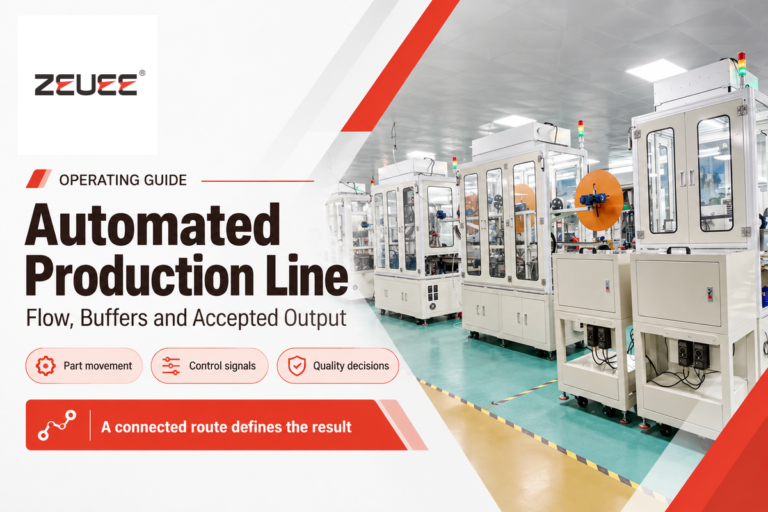
Modern modular cells narrow that setup penalty in two ways. First, Assembly Magazine reports fully automatic stripping and crimping platforms that stage up to 24 cables and 7 ferrule sizes without manual changeover. Second, integrated lines collapse hand-offs into one repeatable flow. ZEUEE builds an automated DC wire production line with 4 stations for feeding, cutting, stripping, 0.8 s spot welding, CCD vision, conduction checks, overmolding, and bundling. That line runs 10–12 finished pcs/min (600–720 pcs/hr) inside a 28 kW, 8.4 m footprint. Factories scaling terminated leads can also evaluate a modular wire harness assembly machine to keep crimp repeatability high across recurring batches.
What is the total cost of ownership when moving from manual benches to automated wire equipment?
TCO = machine price + interchangeable mini-applicators, spare strip blades, calibration, training, changeover downtime – labour and scrap savings. On DigiKey’s engineering forum, some of the engineers commented that hand crimpers have a lower upfront cost for low crimp counts. Automatic presses can recover their cost after the recurring volume has covered the tooling and setup costs.
Evaluate TCO per accepted electromechanical assembly rather than comparing machine sticker prices. A faster press with slow manual applicator swaps can cost more per good wire than a slower modular unit equipped with quick-release cassettes and inline force monitoring. Model annual SKU changeover hours alongside direct operator wage hours before approving capital equipment.
High-Mix Changeover Control: SMED, Kitting, and Lot-Size-One Wire Flow
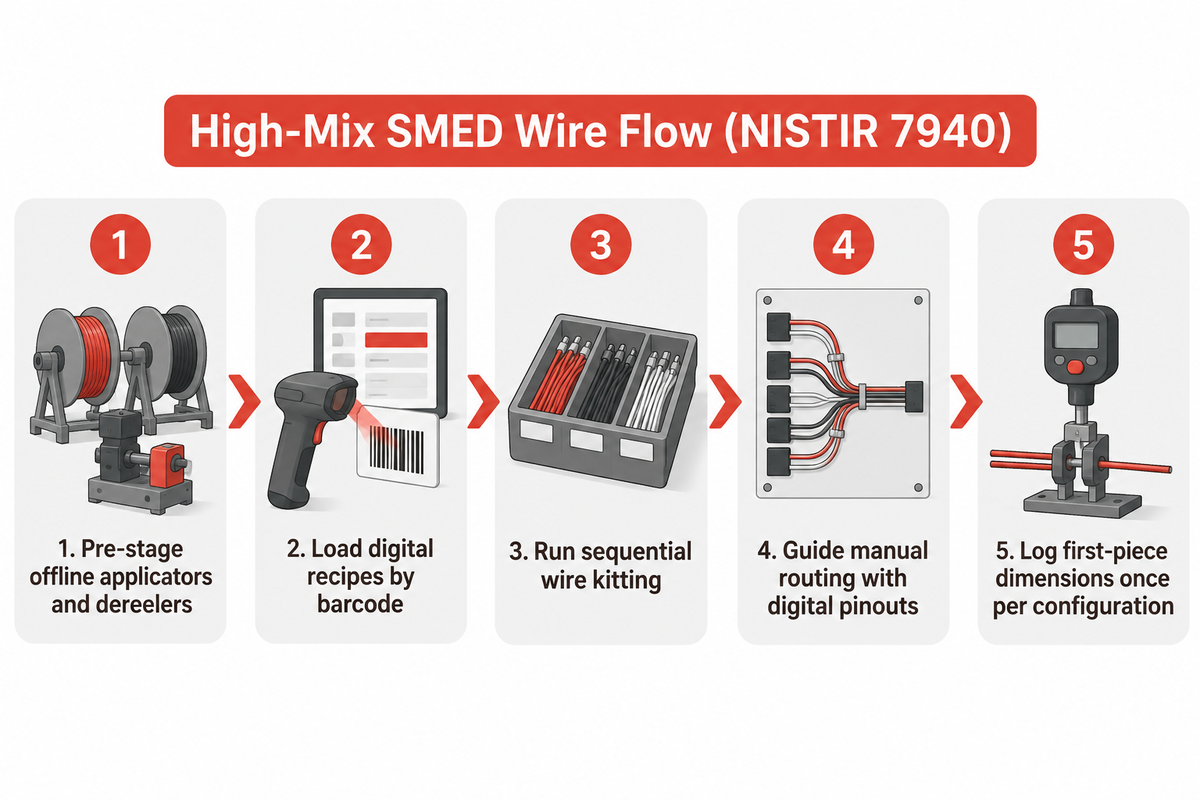
For high-mix, low-volume manufacturing facilities, short changeover time-not maximum press stroke speed-is the key to daily throughput of multiple small lots. NISTIR 7940 shows that low-volume plants with high part variety require quick “flip” and re-programming at the process level to ensure setup time doesn’t eat into cycle-time improvements.
Interchangeable strip-fed tooling is the mechanical chassis for fast changeovers. As detailed in USPTO Patent US8347496B2, automated presses crimp carrier-strip terminals using removable applicator modules. Tooling mechanics change terminal geometry without rebuilding the press frame.
Combine high-speed indexing tools with Single-Minute Exchange of Die (SMED) to shift setup tasks off the press while the production run continues.
- Pre-stage offline applicators and dereelers — Mount the next terminal reel onto a spare quick-change applicator. Position the next wire spool on an offline dereeler before the active batch ends.
- Load digital recipes by barcode – Scan the work-order barcode to push cut length, strip length, and crimp-force limits from CAD wire harness design data into the press controller.
- Run sequential wire kitting – Cut and crimp all wire for one assembly in sequential order into a numbered tray. This removes manual sorting of 500 loose pieces of one wire.
- Guide manual routing with digital pinouts – Show visual routing and each step of pinouts at the assembly board. Operators seat each contact into the right housing cavity on the first pass.
- Log first-piece dimensions once per configuration — Measure strip length, crimp height, and pull force on the initial sample, record the values, and release the cell.
Electrification and industrial automation are accelerating this flexible-cell shift across 2025 and 2026. The International Wire & Machinery Association (IWMA) reports rising global wire and cable demand driven by grid expansion and electrification. North American wire harness outlooks likewise show rapid digital quoting and automated high-mix cells replacing purely manual board work. Teams evaluating upgrades can review wire harness assembly machine architecture and selection to see how modular stations link without blocking rapid batch turnover.
Quality Standards, Crimp Verification, and FAI for Automotive and Aerospace Harnesses
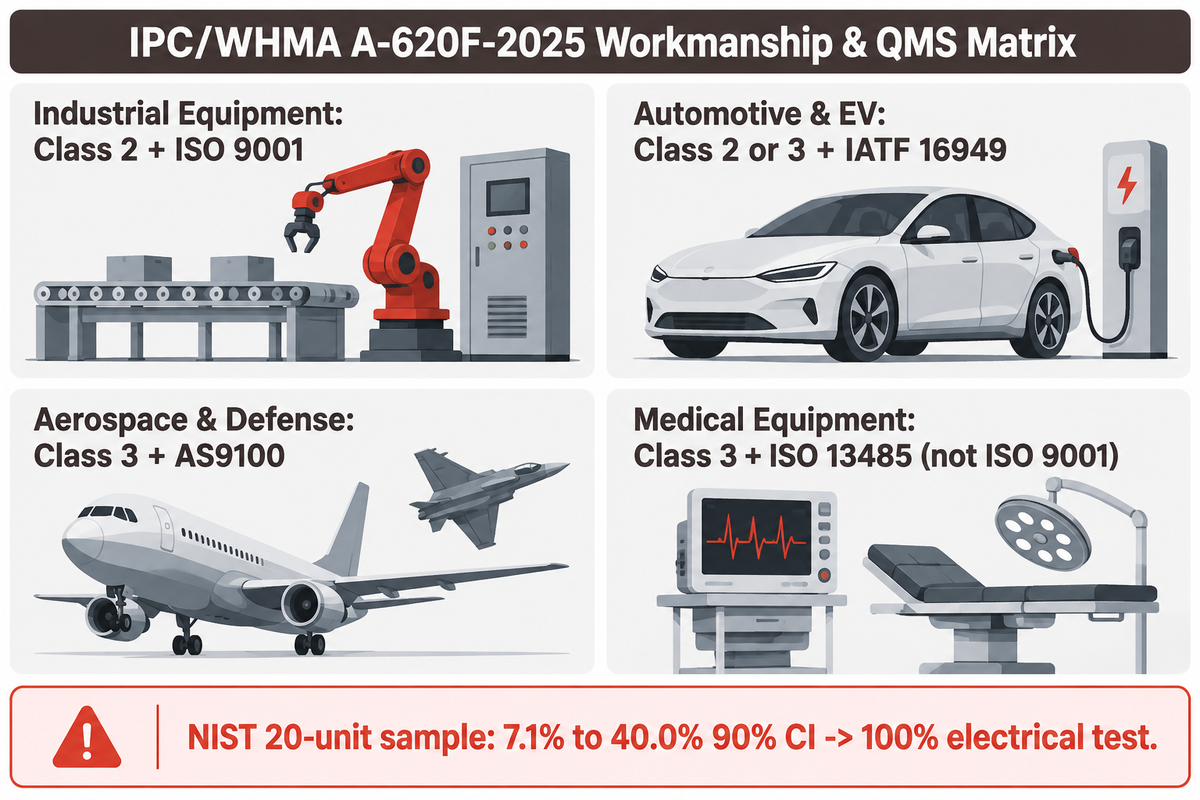
Small-batch wire harnesses comply with IPC/WHMA A-620F-2025 (Revision F, 2025). Per WHMA, the standard sets Class 1, Class 2, and Class 3 workmanship acceptance across 40+ countries and 12 languages. Since small lot sizes can’t pay for a lot of destructive scrap, combine the setup pull tests with non-destructive electrical and inline crimp tests.
Small-sample quality control statistics explain why sampling alone can’t protect a 20-piece or 50-piece assembly run. Section 7.2.4.1 of the NIST Engineering Statistics Handbook notes that normal-approximation binomial limits lose accuracy on small sample sizes. In NIST’s worked example of 4 defects in 20 sampled units (20% observed), the exact 90% binomial confidence interval spans 7.1% to 40.0% (0.071 to 0.400). That uncertainty spread is too wide to replace full electrical verification.
Scope of quality management system (QMS) likewise varies by industry. Pair IPC/WHMA A-620F-2025 Class 2 with ISO 9001 for industrial equipment, Class 2 or Class 3 with IATF 16949 for automotive, and Class 3 with AS9100 for aerospace or ISO 13485 for medical builds (ISO 9001 alone is not medical certification).
| Target Industry | Workmanship Standard | Facility QMS Scope | Required Crimp & Mechanical Checks | Electrical & Traceability Scope |
|---|---|---|---|---|
| Industrial Equipment | IPC/WHMA A-620F-2025 Class 2 | ISO 9001 | First-piece crimp height, pull-force test, visual wire-brush & insulation grip check | 100% continuity, shorts, and mis-wire check; UL 758 wire traceability if required |
| Automotive & EV | IPC/WHMA A-620F-2025 Class 2 or 3 (plus OEM specs) | IATF 16949 | Inline crimp-force monitoring (CFM), pull force, cross-section micro-etch on setup | 100% electrical continuity & seal integrity; lot-level PPAP / FAI documentation |
| Aerospace & Defense | IPC/WHMA A-620F-2025 Class 3 (plus AS22759 / MIL specs) | AS9100 | Strict zero-nicked-strand stripping, calibrated crimp pull-force logs, solder-sleeve inspection | 100% continuity, insulation resistance, hipot; full AS9102 FAI & heat-lot traceability |
| Medical Equipment | IPC/WHMA A-620F-2025 Class 3 | ISO 13485 (not ISO 9001 alone) | Validated process parameters, pull-force retention, clean-jacket inspection | 100% continuity & dielectric withstand testing; Device History Record (DHR) lot tracking |
To keep destructive testing economical on 25-piece pilot runs, shops pull-test dedicated setup leads at every wire gauge change. Production crimps then run non-destructively under crimp force monitoring for inline terminal verification. Finished harnesses move to automated test benches; specialists like RFA Engineering publish up to 1,024-point testing for continuity, shorts, mis-wires, and resistance. Regulated programs pair a factory acceptance test checklist with aerospace and defense traceability controls to keep lot records audit-ready.
How are prototype wire harness dimensions documented and repeated across batches?
Prototype wire dimensions are locked using a 1:1 CAD assembly drawing, a revision-controlled From-To wire list, a signed First Article Inspection (FAI) packet, and a physical golden sample. All branch lengths, breakout tolerances, strip lengths, crimp heights, and connector pinouts are recorded to that baseline. The follow-on batch matches the approved prototype exactly.
Without a From-To wire list and golden sample, a second 50-piece run built six months later will deviate in branch length or breakout angle. Have the shop return redlined drawing updates from the first prototype build before releasing pre-production orders. That helps your CAD master stay connected to shop-floor reality.
Common Mistake: Equating Electrical Continuity with Mechanical Crimp Retention
A wire with a loose crimp barrel or unlatched terminal lock still passes a low-voltage continuity test on a stationary bench. But as soon as the assembly passes into field vibration, the loose contact works its way out and results in the intermittent power failure. Always request electrical testing and mechanical validation (crimp height, setup pull-force tests, and connector tug tests) in your IPC/WHMA A-620F-2025 PO notes.
Specialty Wire Mills, Contract Harness Shops, and Equipment OEMs: Choosing the Right Partner
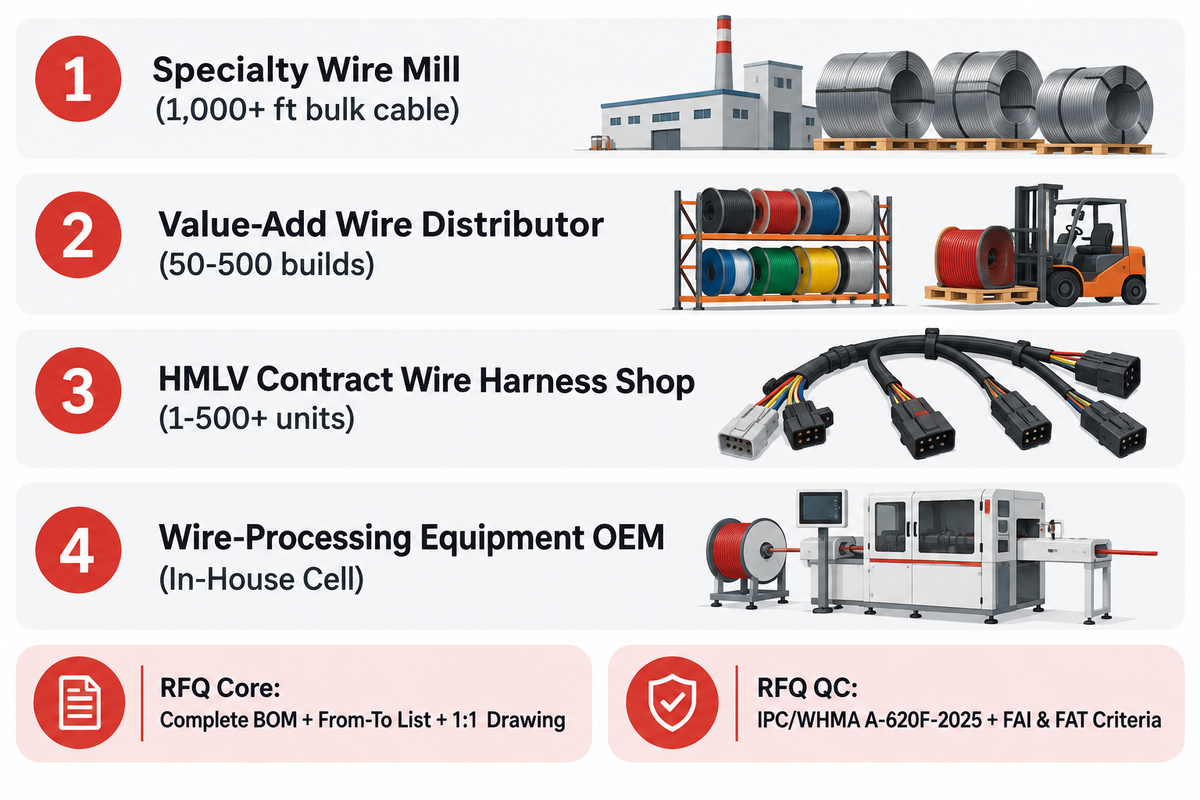
Route custom bulk cable extrusion runs to a specialty wire mill. Send 1 to 500 terminated assemblies to a high-mix contract wire harness shop, and send recurring internal capacity plans to an equipment OEM.
Routing an RFQ to the incorrect tier results in MOQ rejection or layered subcontract markups.
Most sourcing guides combine end-product OEMs with machinery OEMs, obfuscating one of the key “make vs. buy” decisions. Contract wire harness shops offer finished cable assemblies by the piece. Wire-processing equipment OEMs provide modular cut-strip-crimp cells and integrated DC wire lines for repeatable in-house small-batch production.
Buyers reviewing line builders can consult our guide to DC wire production line manufacturers for small batch wire manufacturing.
| Supplier Tier | Core Deliverable | Quoting Unit & Typical Threshold | Best-Fit Buyer Scenario |
|---|---|---|---|
| 1. Specialty Wire Mill | Custom drawn/stranded conductors & extruded multi-core cable | Footage (1,000+ ft typical; prototype runs negotiable) | Non-stock conductor count, custom impedance, or proprietary jacket compound |
| 2. Value-Add Wire Distributor | Cut-to-length, ink-striped, twisted, or respooled UL stock wire | Stock reel or cut-length lot plus processing fee | 50–500 wire harness builds needing custom wire colors fast without mill MOQs |
| 3. HMLV Contract Wire Harness Shop | Finished, tested wire harnesses & cable assemblies | Per piece (1–500+ units) plus itemized NRE/applicators | Prototype, EVT pilot, and low-volume builds with zero equipment overhead |
| 4. Wire-Processing Equipment OEM | Benchtop crimpers, modular cut-strip-crimp cells, integrated DC lines | Capital machine + applicators + FAT acceptance | Factories internalizing recurring small-batch wire production for schedule control |
Small-Batch Wire Harness RFQ Engineering Checklist
Include the following items in the initial RFQ package so suppliers can send firm quotations without a week of engineering clarifications or risk margin padding:
- Complete BOM with Manufacturer Part Numbers: Specify exact wire UL 758 style, AWG, insulation polymer, connector housings, terminals, seals, and approved alternates.
- From-To Wire List & 1:1 Wire Harness Drawing: Define every circuit ID, wire color, cut length, strip length, breakout tolerance in mm, and cavity pinout view.
- Order Stage & Release Schedule: State prototype quantity, anticipated pilot lot, and yearly production requirements so the vendor can tailor tooling and reel orders.
- Component-Reel MOQ Policy: Confirm upfront how unused terminal reels, special cable spools, and applicator tooling costs are billed, owned, or stored.
- Workmanship & Traceability Class: Call out IPC/WHMA A-620F-2025 Class 2 or Class 3, UL Wiring Harness Traceability labeling if required, and required QMS (ISO 9001, IATF 16949, AS9100, or ISO 13485).
- Inspection & FAT Acceptance Criteria: Specify electrical test scope (continuity, shorts, hipot), setup pull-force logging, FAI packet format, and machine FAT sample criteria if purchasing equipment.
About This Analysis
This guide draws on NISTIR 7940, NIST Handbook Section 7.2.4.1, UL 758 AWM, and the UL Wiring Harness Traceability Program. It also cites IPC/WHMA A-620F-2025, USPTO Patent US8347496B2, Assembly Magazine, Wiring Harness News, PCBInsider, and published supplier benchmarks. Reviewed by the Shenzhen Zeyu Intelligent Industrial Science Technology Co., Ltd technical team.
Frequently Asked Questions on Small Batch Wire Manufacturing
Q: What is the minimum release quantity for small batch wire harness orders?
Dedicated low-volume wire harness shops accept a minimum release of 1 single prototype when builds use stocked UL wire and standard connector housings. For custom-extruded bulk cable, specialty mills like New England Wire and General Wire Products typically set a 1,000 ft minimum. Review terminal-reel and sealed-connector pack minimums separately, because non-stock distributor reels raise unit costs on 10 to 50 piece releases.
Q: How long do custom extruded cables take compared to small batch wire harnesses?
Custom extruded cables take 3 to 12 weeks at specialty mills like New England Wire, while stocked-wire assemblies ship in 10 to 20 business days rush at prototype shops like MiniProto. Mill lead time depends on complexity and raw compound stock of conductors. Most wire harness schedules stretch when specialty sealed connectors or custom overmolding molds with factory allocation are required.
Q: Does ink striping or post-extrusion jacketing void UL 758 wire recognition?
Yes, if performed outside certified traceability controls: modifying recognized UL 758 AWM wire via ink striping or post-extrusion jacketing breaks the UL chain of custody. The UL Wiring Harness Traceability Program uses holographic labels across 4,000+ certified wire harness shops to maintain recognition. A new outer jacket or overmold encapsulating recognized wire can also trigger end-product UL evaluation.
Q: What is the difference between a wire harness and a cable assembly in low-volume builds?
A wire harness bundles discrete insulated wires inside open sleeving, tape, or ties for protected internal routing. A cable assembly encloses conductors inside a continuous extruded outer jacket or overmold for moisture, abrasion, and environmental sealing.
Q: Is small batch wire manufacturing profitable for in-house assembly lines?
Yes, when recurring SKU families keep changeover downtime below the break-even threshold in the 2-Variable Changeover Crossover Formula. Modular quick-change applicators, sequential wire kitting and inline crimp monitoring eliminate first-piece scrap and sorting labor to safeguard margins.
Q: Which quality certifications matter most when sourcing small batch wire harnesses for automotive, aerospace, or medical equipment?
IPC/WHMA A-620F-2025 defines Class 2 acceptance for dedicated industrial service, Class 2 or Class 3 for automotive harnesses depending on OEM and safety criticality, and Class 3 for high-reliability aerospace and medical assemblies. On regulated programs, require the supplier’s sector QMS audit (automotive IATF 16949, aerospace AS9100, or medical ISO 13485) rather than general ISO 9001. For UL-recognized end equipment, check that the contract builder participates in the UL Wiring Harness Traceability Program before releasing purchase orders.
Q: What documents should engineers include in a small batch wire harness RFQ?
Include six core documents: a complete BOM, a From-To wire list, a 1:1 CAD wire harness drawing, IPC/WHMA A-620F-2025 workmanship and QMS specs, electrical and pull-force test criteria, and staged order quantities. State expected prototype, pre-production, and small-batch release volumes upfront. Clear engineering packages let suppliers flag component-reel MOQs and custom applicator NRE immediately instead of adding risk padding to the quote.
Plan your small-batch wire processing workflow
Share your wire list, connector drawings, target batch quantities, and test specifications with the ZEUEE engineering team to compare modular benchtop and automated DC wire line options.
References & Sources
- Appliance Wiring Material (AWM) Testing and Certification (UL 758) UL Solutions
- IPC/WHMA A-620F-2025: Requirements and Acceptance for Cable and Wire Harness Assemblies American National Standards Institute (ANSI) / IPC / WHMA
- IPC/WHMA-A-620 Standard Overview for OEMs and EMS Providers Wiring Harness Manufacturer’s Association (WHMA)
- ANSI/UL 758 Standard for Safety: Appliance Wiring Material (Nov 18, 2026 Revision) UL Standards & Engagement
- Wiring Harness Traceability Program UL Solutions
- Wire Harness Cost Breakdown: Material, Labor & NRE Guide (April 2026) PCBInsider
- Should You Invest in Fully Automatic Stripping and Crimping Machines? Assembly Magazine
- Finding the Sweet Spot: Semi-Automation vs. Full Automation in Wire Processing Wiring Harness News
- Fully Automatic Stripping and Crimping Multi-Cable Staging Assembly Magazine
- NIST Workshop Gets a Grip on Robotics Challenge (NISTIR 7940) National Institute of Standards and Technology (NIST)
- Terminal Applicator Method (USPTO Patent US8347496B2) United States Patent and Trademark Office
- The Wire and Cable Boom Has Arrived: How Manufacturers Can Maximise the Opportunity International Wire & Machinery Association (IWMA)
- NIST/SEMATECH e-Handbook of Statistical Methods, Section 7.2.4.1: Exact Binomial Confidence Limits National Institute of Standards and Technology (NIST)
WHY WE WRITE THIS
About ZEUEE Engineering Insights
ZEUEE shares technical guides based on real automation project experience. Since 2005, we have designed and manufactured non-standard automation equipment for connector assembly, wire harness production, robotic lines, vision inspection, and smart factory upgrades.
Founded in 2005
20,000 m² production base
120+ specialists
150+ R&D patents
ISO9001:2015 certified
Trending now