Get in touch with Zeyu lntelligent Industrial Company
Factory acceptance test checklist: turn machine trials into shipment evidence


A factory acceptance test checklist links each machine requirement to an agreed test, recorded result, and disposition. Set the configuration, counting rules, and decision authority prior to the test to ensure a checked box has supporting evidence.
The difficult discussion often starts after a convincing demonstration: Which parts counted? What settings were loaded? What does the signature authorize? Use this factory acceptance test guide to prepare an evidence package for custom assembly equipment. The worksheet fields below are buyer recommendations to adapt with the integrator; they are not a universal acceptance standard.
- Define the test before the visit: freeze requirements, samples, methods and responsibilities.
- Retain the denominator: separate elapsed time, first-pass output and challenge pieces.
- Record four decisions: test outcome, shipment permission, payment milestone and final acceptance.
- Plan the site work: identify installation checks and tests that the factory can’t complete.
Build the factory acceptance test checklist around evidence
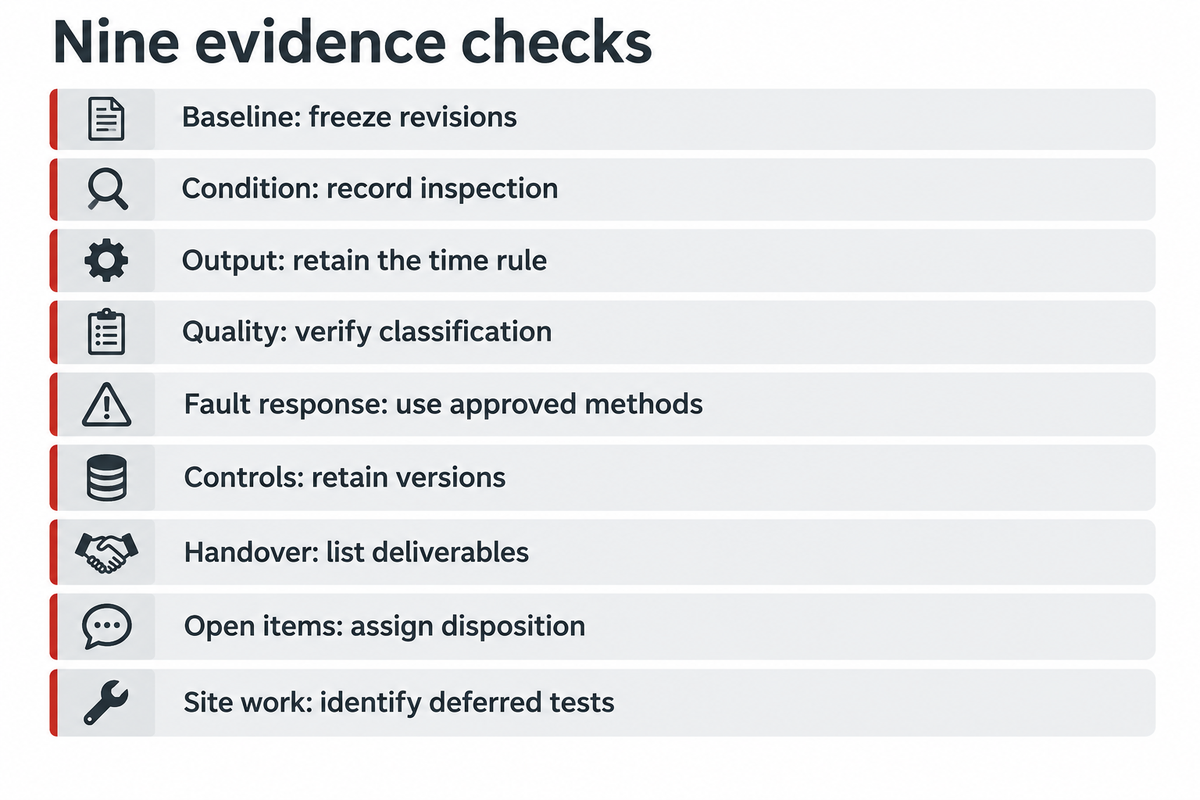
A FAT checklist follows the machine requirement through to its evidence. Identify each test with a requirement identifier, configuration, method, acceptance criteria, result, and reviewer. An unexplained pass mark can’t tell a later reader which revision was tested or whether a deviation was accepted by authority.
What should a factory acceptance test checklist cover?
A checklist should cover preparation, physical condition, measured output, product quality, fault response, controls, documentation, unresolved issues, and the transition to site testing. For each of these, provide an evidence file and disposition. Instead of leaving a cell blank, enter the reason for exclusion and where it would be tested in the future.
For each row, ask whether another engineer could reconstruct the result without relying on the witness’s memory. NASA’s Product Verification guidance, section 5.3.1.2.4, records requirements and product versions, test data, tools and discrepancies. The engineering record structure is useful in this case and it doesn’t set the commercial terms of your machine order.
| Check | What to agree | Evidence to retain | Decision when incomplete |
|---|---|---|---|
| Baseline | Requirement and configuration revisions | Approved protocol and identification record | Resolve revision conflict before testing |
| Physical condition | Inspection scope and drawing references | Visual inspection record and photographs | Log damage or missing assemblies |
| Output | Elapsed-time and counting rules | Start/stop log; example: 285 first-pass units in 60 min | Recalculate against the agreed denominator |
| Product quality | Defect classes and measurement method | Traceable results and measurement-system evidence | Investigate unreliable classification |
| Fault response | Approved safe challenge procedure | Expected versus observed response | Resolve failed functions before release review |
| Controls | Recipe, software and hardware baseline | Version list, backup and restore record | Assess changes and affected retests |
| Handover | Document, training and spare-parts scope | Deliverable register and receipt | Name the missing item and owner |
| Open items | Disposition authority and closure evidence | Punch list linked to test identifiers | Record the authorized next action |
| Site work | Installation checks and deferred interfaces | Factory/site test responsibility matrix | Keep untested requirements visible |
If procurement requests a free checklist template, add columns for requirement ID, expected value, observed value, evidence filename, owner, and date to the example rows copied and pasted here. A PDF is useful as a frozen witness copy; keep an editable master for controlled revisions. The downloaded form shouldn’t be treated as the machine specification.
Evidence checkpoint: the example’s 285 units in 60 min belong to one identified configuration. Include that configuration and the original log with the result. NASA’s record fields make the test traceable; the buyer and supplier still need to agree what that result permits.
Freeze the FAT planning baseline before testing

FAT planning begins with the same baseline for the agreed tests: the technical specification, test procedure, samples, equipment, and personnel. Resolve disagreements before witnesses visit the factory. Otherwise the session can become a demonstration of whichever functions are ready, with missing requirements discovered only when travel time has already been spent.
For custom automation equipment, establish the machine boundary against customer-supplied tooling, materials, and upstream services. Match the purchase order to the approved FAT protocol. If several POs divide the project, identify which order owns each interface, rather than assuming the machine builder supplies everything.
PMMI’s 2021 factory acceptance test roadmap stresses that early planning is key and advises that production materials be used during the FAT, and that operators be included. Its packaging context supplies useful preparation lessons, not universal run durations for every assembly machine.
- Reconcile drawings, requirement identifiers and the current FAT procedure.
- Confirm sample quantities, material revisions and known defect specimens.
- Check instrument suitability and calibration certificates.
- Assign witnesses, data owners and people authorized to resolve deviations.
- Agree stop conditions and how a changed configuration affects completed tests.
Example: A buyer sends just one variant of connector for a planned 60 min trial, while production also needs a second housing. The first variant runs, but the second needs a different nest and an altered inspection recipe. Calling the whole machine accepted would conceal that untested condition. Before the visit, the buyer should list both the variants, identify the samples which are available and assign the absent configuration to another test. If only one can be witnessed, the report should state exactly which variant and recipe were covered. The commercial team should be the one to decide how the remaining work influences the agreed milestone, instead of seeking an engineer’s signature to resolve a contractual dispute.
Planning checkpoint: reserve the 60 min trial for a defined variant and revision. PMMI suggests representative samples and participation by the operator. An absent variant should be made an explicit test responsibility, rather than disappearing in a general statement that FAT testing is complete.
Set measurable performance and defect-detection criteria
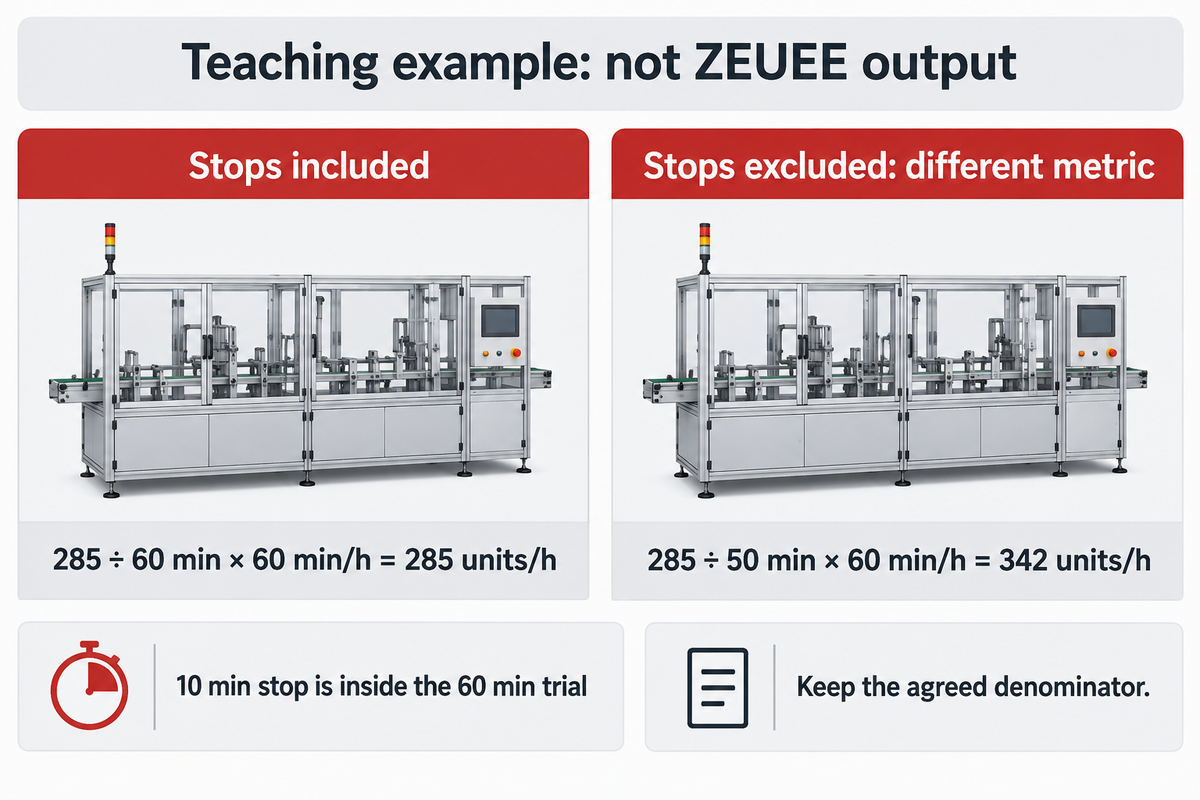
Machine performance requires both a dependable count and defined time base. Concur on how stops, rejected parts, rework and changeover impact the result. Verify that the measurement system is able to classify the required features consistently. A correct hourly calculation remains weak evidence if the underlying good-part decisions are unreliable.
The NIST gauge study guide separates repeatability, reproducibility, stability and bias-related errors. Requests for the applicable measurement system analysis study or other justified method should be made for critical features. Calibration isn’t sufficient to explain all potential errors influencing a production decision for connector inspection automation. Identify the defect and the reference method and the challenge-piece prior to testing detection and rejection.
Worked example: an assembly cell processes 300 production units during 60 min of elapsed time. Inspection classifies 285 as first-pass good, 10 as rework, and 5 as scrap. The period includes 10 min of downtime. If the agreed metric is first-pass good units per elapsed hour, calculate 285 ÷ 60 min × 60 min/h = 285 units/h. Removing the stop time produces 285 ÷ 50 min × 60 min/h = 342 units/h, which answers a different question. Keep the 10 rework units out of the first-pass count even if they’re repaired later. Challenge pieces need their own record so they do not alter the production tally. Compare the results to the threshold agreed prior to the trial.
60 minElapsed test period
285 units/hFirst-pass good output
10 minStops included
NIST’s process stability guidance places stability before process capability. A short, repeatable total doesn’t mean stable performance for the different shifts, lots of raw material or process warm-up conditions.
Ask separately for sustained process evidence when that is part of acceptance.
Performance checkpoint: 285 units/h over 60 min and 342 units/h over 50 min are different metrics derived from the same example. Preserve the 10 min stop record, measurement basis and counting rules. Those provide a reviewer a basis for judging the agreed-to trial and prevent the trial from turning into an unsubstantiated long-term capacity determination.
Verify safety functions and controlled fault recovery
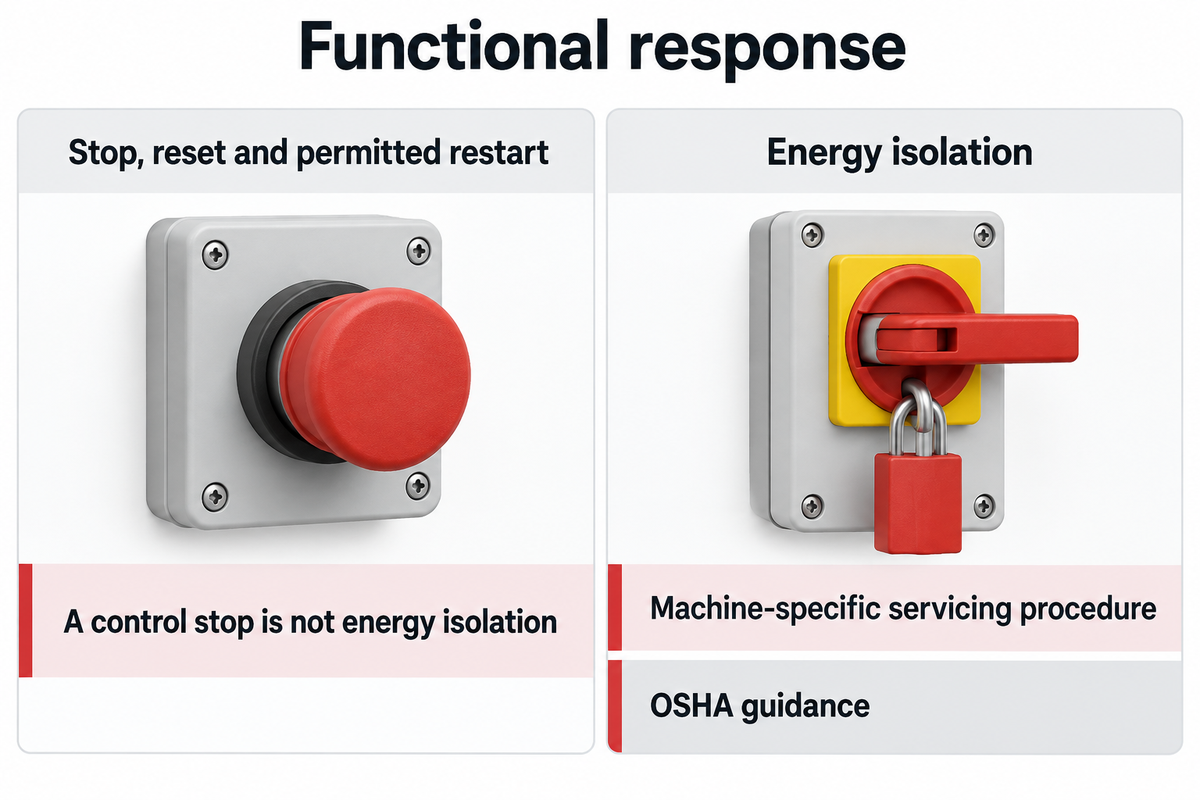
Safety-related functional testing needs an approved machine-specific procedure, expected responses and competent authorized personnel. Review normal operation, faults and recovery within that procedure. Do not improvise a hazardous challenge to obtain a pass mark. An emergency stop demonstration doesn’t, in itself, verify safety compliance for a complete installation.
Do the safety interlocks work?
Verify each applicable interlock against its documented safety function, including the initiating condition, expected response, reset and permitted restart. Retain the observed result and configuration. The machine safety specialist should define the validation method and other evidence required; pressing a button by a witness doesn’t validate safety.
Keep isolation of energy separate. OSHA states that control circuitry and interlocked gates are not energy-isolating devices. Where servicing exposes people to hazardous energy, apply the relevant machine-specific isolation procedure. An e-stop and emergency stops belong in the functional test plan; neither should be presented as permission to enter a hazardous area.
Do
- Use approved fault simulations.
- Record expected stop and recovery behavior.
- Keep the safety validation record linked to the configuration.
Don’t
- Bypass a safeguard for a demonstration.
- Treat a control stop as energy isolation.
- Approve an untested restart sequence.
Recovery checkpoint: the teaching trial’s 10 min stop record should identify why the machine stopped and how operation resumed. An output recovered and counted doesn’t prove a safe recovery. Keep the authorized fault-response evidence separate from the production total and from the isolation procedure used for servicing.
Complete the controls and documentation handover

Handover readiness relies on retention of configuration for recorded results and associated info required for operation and maintenance. Before the machine leaves, reconcile software versions, drawings, backups and the deliverable register. Missing access rights or an untested restore method can make a complete looking package unusable.
Walk the operating sequence with production and maintenance personnel covering the roles of alarm messages, recipe selection and recovery. Test software and hardware where permitted by the approved scope. The HMI should let the machine state be understood by the intended user. For automated assembly machines, couple each product recipe to the tooling and inspection limits.
“A stated confirmation and a demonstrated one are not the same thing.”
Bedre describes integrated test problems as disconnected cables and software changes. The key question for the handover team is whether the connected configuration has demonstrated the required sequences with changes and their impacts logged.
- Reconcile as-built electrical drawings, bill of materials (BOM) and version records.
- Confirm operation and maintenance manual revisions, language and access rights.
- Check spare parts lists against supplied spare parts and agreed consumables.
- Record backup contents, restore responsibilities and demonstrated recovery where included.
- Link training completion, outstanding documents and corrective actions to owners.
Full documentation signifies the agreed deliverables are accounted for, with deficiencies obvious. Proper documentation means we have usable filenames and a controlled revision history. The manufacturer’s recommendations and the buyer’s maintenance arrangements should inform which instructional documentation must be available at the point of use.
Handover checkpoint: pair the example’s 60 min log with its recipe, program and drawing revisions. If a parameter changes afterward, record the change and assess affected tests. A folder of random files without configuration identity can’t help identify which machine produced the 285 first-pass units.
Decide shipment release from the open-item register
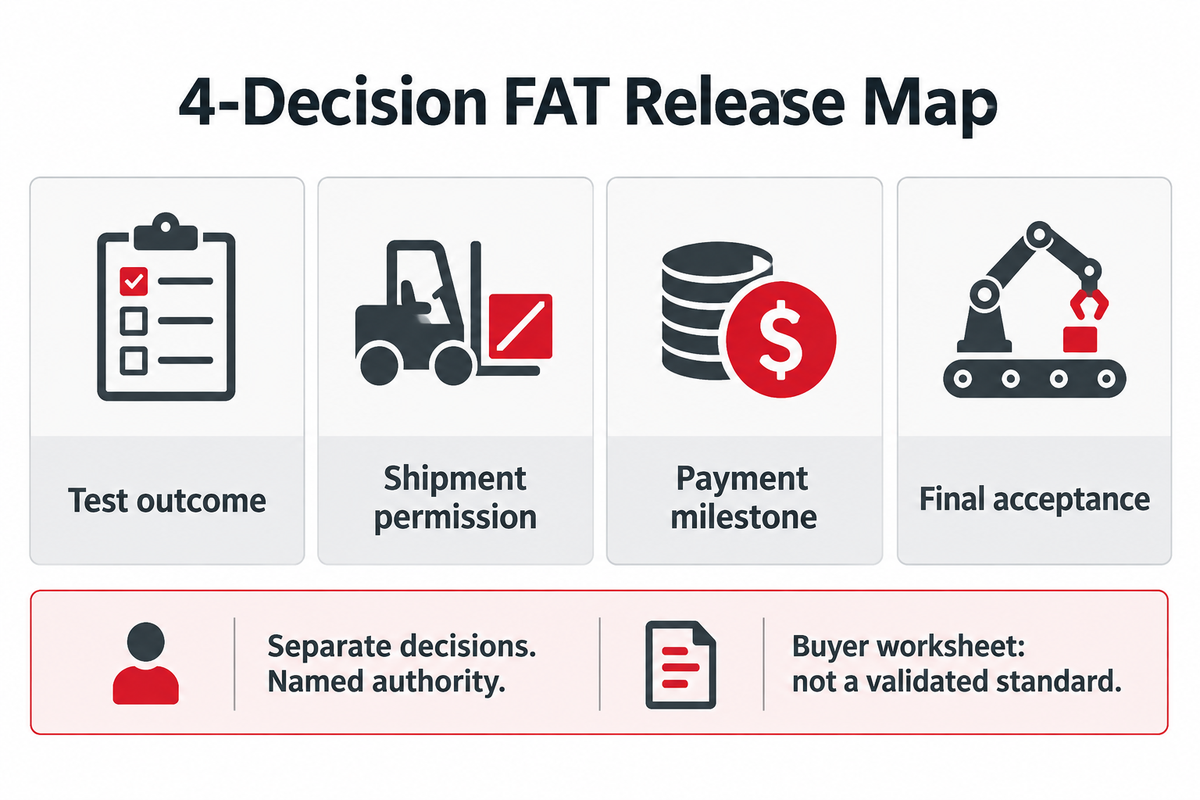
A punch list should lead to a clear disposition, with an owner, evidence and authority for each unresolved requirement. Keep the test result separate from permission to ship, payment milestone and final acceptance. The contract and applicable obligations should govern those decisions; a general FAT signature shouldn’t stand in for all of those.
4-Decision FAT Release Map
The 4-Decision FAT Release Map records the test result, shipment permission, payment milestone and final acceptance separately, with evidence and authorized owners.
This is a buyer worksheet suggested in this guide. It’s neither a validated standard nor an automatic release rule. NASA’s Product Transition guidance distinguishes delivery preparation and documentation from transit and installation. Your contract provides the commercial release authority.
| Decision | Question to answer | Record to retain |
|---|---|---|
| Test outcome | Which requirements passed, failed or remain untested? | Results linked to evidence and deviations |
| Shipment permission | Is dispatch authorized with the stated condition and protections? | Authorized disposition and transport preparation |
| Payment milestone | What does the agreed contract require? | Commercial determination by the authorized party |
| Final acceptance | Are the applicable factory and site obligations satisfied? | Acceptance record identifying remaining obligations |
Example: Procurement asks whether dispatch can proceed. The quality engineer can reconstruct the 285 units/h result. However, the final maintenance manual is missing, and a site interface remains untested. The engineer records the result of the completed trial and both the outstanding items, rather than issuing a pass. The responsible parties check the contract, any applicable obligations and the risk of moving the equipment. If dispatch is authorized, the record should identify the authorized condition, responsible owner and the closure evidence. If a failed safety function isn’t resolved, a business decision to keep the shipping date doesn’t resolve the failure. A payment decision is documented through its own contractual authority.
Release checkpoint: 285 units/h is a recorded test result, not shipment permission. An open-item register helps expose the remaining work, but registration alone doesn’t close the work. NASA’s verification guidance requires objective compliance or an accepted waiver and closure of discrepancies within its own engineering process.
Factory acceptance test vs site acceptance test: assign the retests
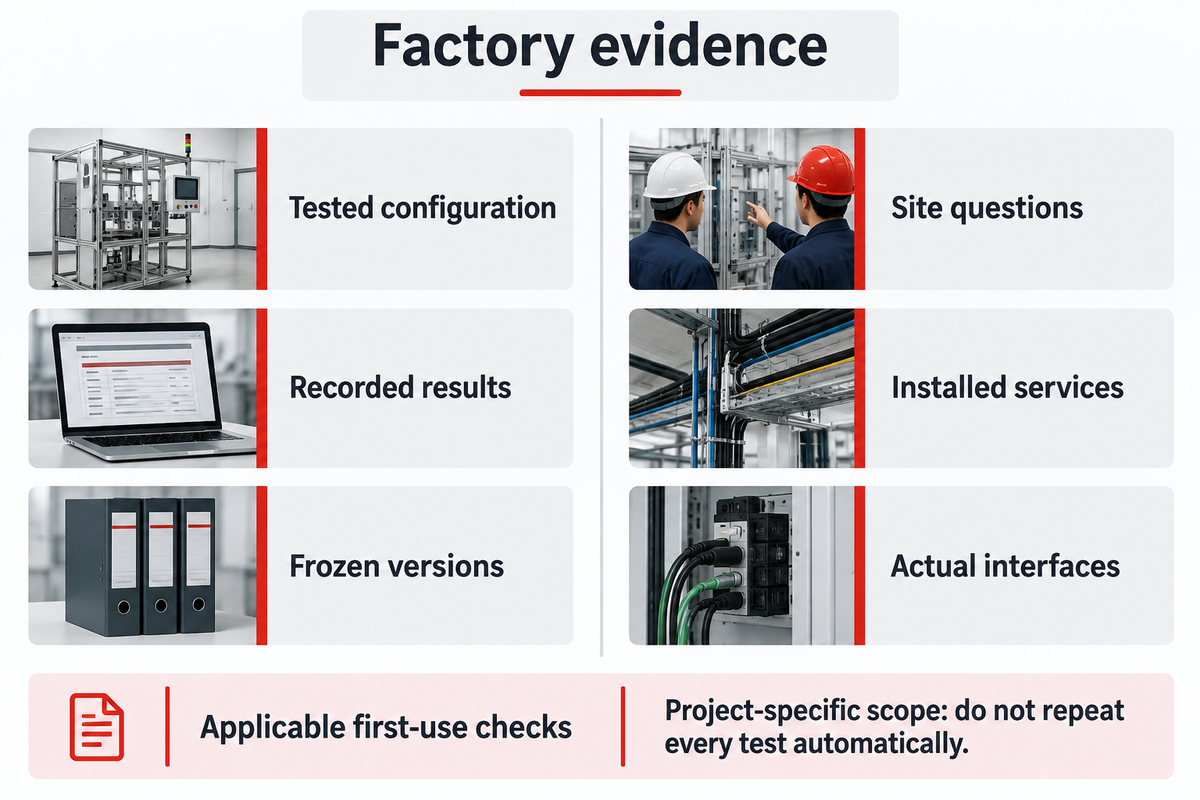
The difference between a factory acceptance test and site acceptance testing is the environment and scope of evidence available. Factory trials can verify the assembled configuration under agreed conditions. Installation introduces transport, utilities and real interfaces. Plan the first-use inspections and the risk-based retests before the machine arrives, with an owner for each.
For production line automation, site performance can depend on upstream supply and downstream handling that were simulated at the supplier’s works. NASA’s transition guidance includes functional and acceptance testing after installation to check for shipping or handling damage. The following FAT vs SAT matrix distinguishes those dependencies from functions that were already demonstrated. It’s a planning worksheet, not a requirement to repeat every test.
| Item | Factory evidence | Site trigger or condition | Owner to name |
|---|---|---|---|
| Physical condition | Pre-dispatch inspection | Transport damage or movement | Receiving and supplier |
| Installation safety | Machine validation records | Safety depends on installed conditions | Competent site specialist |
| Electrical supply | Test supply and settings | Final supply connection and site protection | Electrical specialist |
| Air and other services | Factory service conditions | Actual utility availability and variation | Facilities and integrator |
| Upstream material | Agreed factory samples | Actual feed condition and line interaction | Production and supplier |
| Downstream interface | Simulation or connected equipment record | Actual handshake and blocked-line behavior | Line integrator |
| Safeguard integration | Factory configuration and response | Reassembly, changed wiring or access layout | Machine-safety specialist |
| Software and recipes | Frozen version and backup | Changed version, limits or connected systems | Controls owner |
| Production output | Example: 285 units/h over 60 min | Required performance under actual site conditions | Production and quality |
First-use inspection is a separate question from a configuration change. In Great Britain, HSE’s explanation of PUWER regulation 6 says equipment whose safety depends on installation conditions should be inspected after installation and before first use, and after reassembly at a new location. Define the checks and the equipment for the jurisdiction in question. Don’t conclude that an unchanged program eliminates the obligation due to an installation-dependent condition.
Site checkpoint: preserve the factory’s 60 min evidence, then identify which installed conditions it didn’t cover. A site acceptance test should resolve its assigned requirements with actual conditions and traceable results. Changing the heading of a form from FAT to SAT doesn’t supply evidence.
Compare suppliers by reconstructing one test result
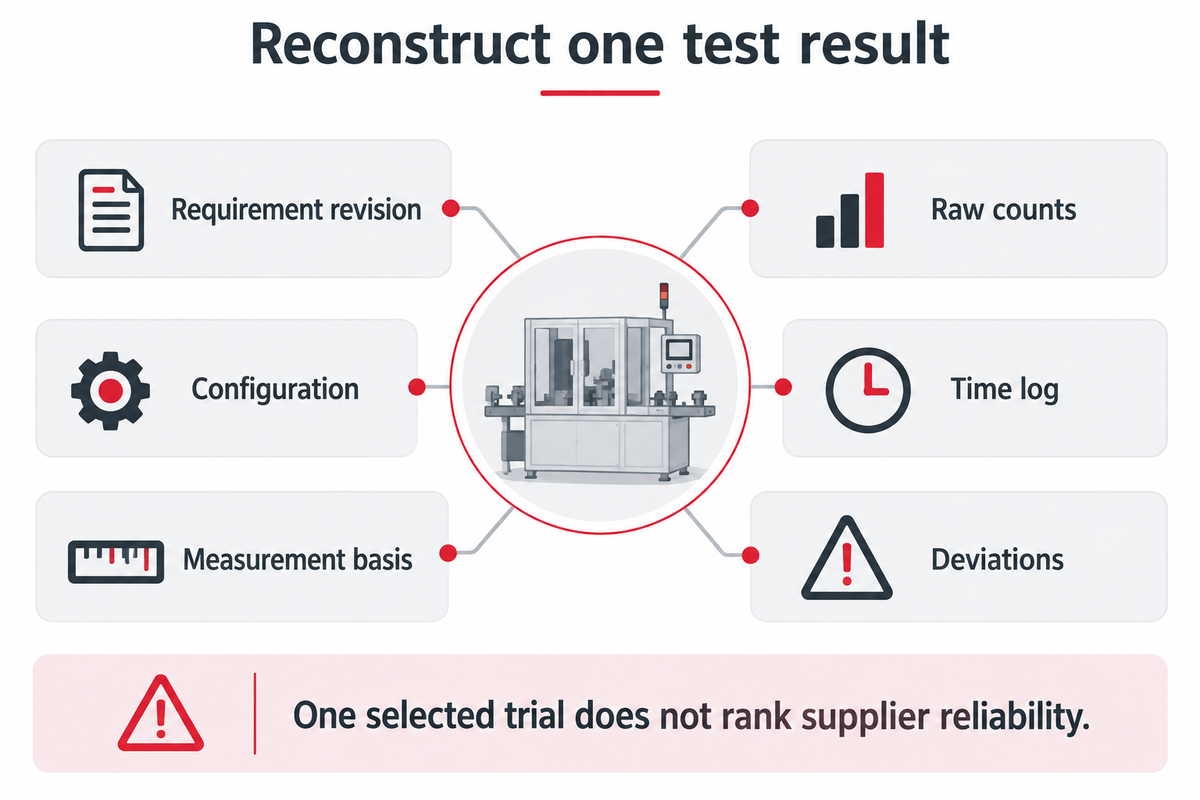
The same applies for a supplier’s test record. Ask each supplier for the evidence needed to reconstruct one relevant result: the requirement revision, configuration, measurement basis, raw counts, time log and deviations. This is a reasonable screen for completeness and quality of records. It does not establish that one supplier is more reliable from a single selected trial or unmatched operating conditions.
It’s important to send the same data requests to each bidder and check the conditions to see if they actually align. NIST’s reliability comparison guidance describes random samples tested under the same conditions. A sample like a vendor’s best demonstration video isn’t of the same sampling basis. Wider purchase related queries can be addressed using the custom automation equipment guide, along with this request focused on acceptance.
- Can the reviewer reproduce the numerator and denominator from raw records?
- Are product variants, material lots, settings and measurement methods identified?
- Does the quality control checklist explain non-conformities and rework?
- Can procurement specialists see what remains untested or contractually unresolved?
For remote witnessing, agree on camera coverage, timestamps, and file access and witness identity. Video verification can support the record, but an edited highlight of the test doesn’t necessarily show that every required function was tested. Inspect whether functions operate in the required order and retain the underlying results when using digital FAT.
Comparison checkpoint: How did the supplier obtain 285 units/h including the 60 min denominator and 10 min stops? Before comparing a large headline number, record reconstruction exposes the missing evidence. A reliable supplier ranking requires a justified comparison design beyond this single example.
Industry Outlook: keep the acceptance baseline current
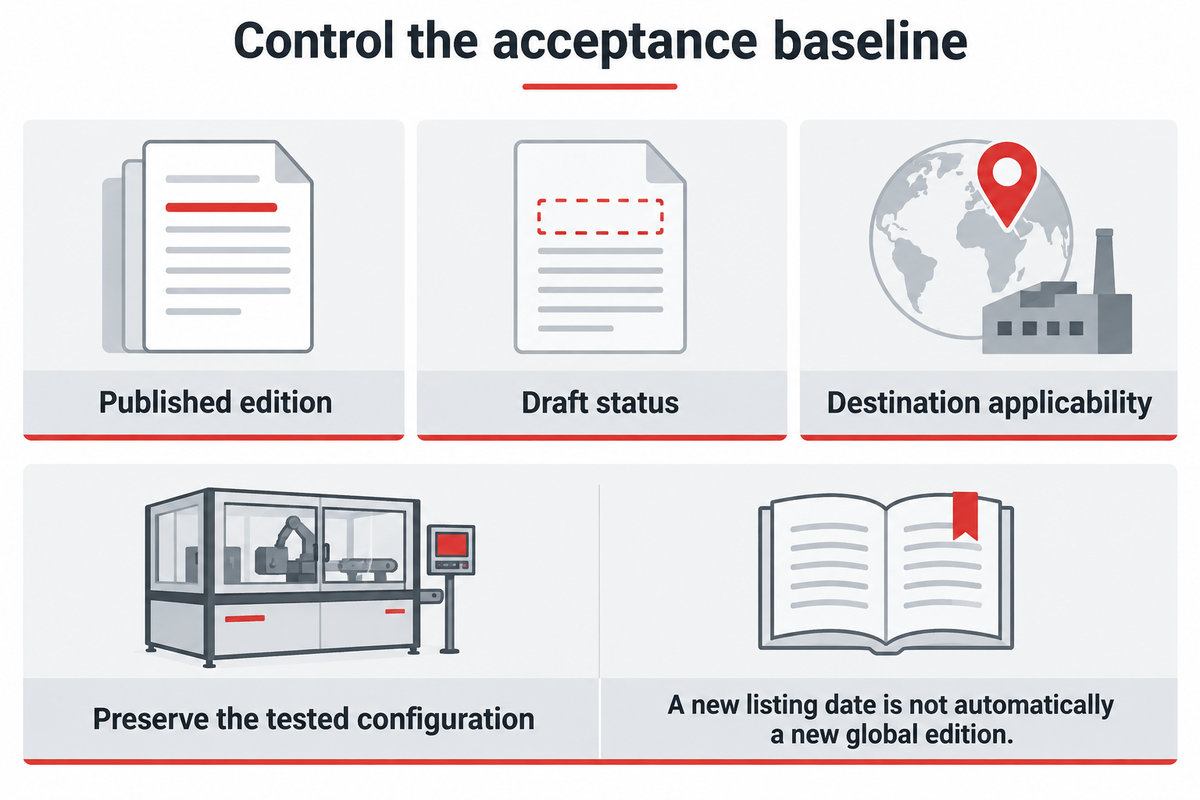
In October 2026, a useful action is to control the edition and applicability of technical references. Check the published standard, destination requirements and agreed revision before endorsing the protocol. Drafts in development and dates in a certification page don’t necessarily change the requirements of an order.
The official ISO 12100:2010 page identifies the published machinery risk-assessment standard and its 2022 confirmation. It provides a link to the work on a later draft. Record the publication status when selecting the reference; do not describe an unpublished revision as a current requirement. The responsible specialist should establish which edition and applicable machinery requirements govern the project.
Electrical references require the same treatment. IECEE’s IEC 60204-1:2016 entry indicates the scope of electrical equipment starts at the machine supply connection. National variations and their dates require their own applicability assessment. A recent listing date does not by itself indicate a recently issued global edition.
Integrate that review into the equipment lifecycle. Before a new equipment order, identify the references, editions and destination. Prior to a factory test, compare the approved requirements with the machine revision. Prior to a shipment, assess the changes introduced while closing a punch list. Post-installation, evaluate the actual supply and integrated safeguards. These checkpoints give the acceptance team a reason to revisit a test without reopening unrelated work.
Digital records are helpful only if their revision history is available. Keep the results of the supplier, the buyer’s disposition and subsequent corrective actions distinguishable. If the manufacturer’s software changes after the witness session, keep both configurations and describe the impacted requirements. A newer file must not silently replace the evidence behind an earlier signature.
Version checkpoint: a 60 min result remains evidence for the configuration tested, even when a later standard draft appears. Assess the changes with the responsible specialists and adjust the protocol as required. Update the protocol where required, preserve the prior record and authorize any necessary retests before claiming that the changed machine is accepted.
Key takeaway
A complete FAT record should let a reviewer trace the requirement, tested configuration, result and authorized disposition. Keep the four release decisions separate and carry untested site requirements forward.
Frequently asked questions
Is a Factory Acceptance Test the same as a pre-shipment inspection?
Factory acceptance tests differ from pre-shipment inspections. Their scopes can overlap, but the agreed tasks determine what each inspection proves.
A pre-shipment inspection may focus on identification, condition, quantities or packing. A factory acceptance test normally follows an agreed protocol for the equipment’s specified functions and performance. Ask for the actual scope and evidence rather than relying on the service name. If both activities are required, identify shared checks and keep any untested functional requirements visible in the report.
Is a factory witness test the same as a Factory Acceptance Test?
A witness test describes observation; the FAT protocol defines the acceptance scope.
A buyer, representative or remote observer may witness selected factory trials without witnessing every requirement. Agree which tests are observed, which records are reviewed later and who can approve deviations. Attendance alone does not establish that the complete FAT process was covered. The report should identify the witness, configuration, procedures and results, including any tests deferred to another session or location.
Who is this Factory Acceptance Test checklist template for?
This factory acceptance test checklist is for buyers, quality engineers, production teams and integrators defining machine acceptance evidence.
Adapt the fields to the machine, contract and destination requirements with the responsible specialists. Industrial automation projects share recordkeeping needs, but their technical tests differ. A packaging line, CNC machine and connector assembly cell need different performance criteria and safety validation plans. Use the worksheet to organize those requirements; it cannot supply technical limits or regulatory approval for equipment it has not assessed.
Why use a factory acceptance test checklist?
A factory acceptance test checklist helps expose missing evidence before shipment.
Linking requirements, results and unresolved items lets the team identify omitted tests and assign closure work. Its value depends on accurate records and authorized decisions.
Must maintenance manuals be in a specific language?
Maintenance manual language depends on destination requirements, intended users and the agreed documentation scope.
Do not assume an English manual satisfies every market. Specify the required language and revision in the deliverable register, and obtain the responsible specialist’s applicability decision.
What is a Factory Acceptance Test needed for?
A factory acceptance test verifies agreed equipment requirements before dispatch under the defined factory conditions.
The purpose of the FAT is to identify evidence of conformity and expose defects or unfinished work while the equipment is accessible at the supplier. Performance testing, functional trials and document review may all contribute. Completing a generic template does not certify the machine or remove installation obligations. To verify the machine against your order, agree the protocol, acceptance limits and evidence first, then record the observed result and disposition for each applicable requirement.
Prepare an acceptance brief for your assembly project
Send the part drawing revision, production variants, required output definition, inspection method and site interfaces to the ZEUEE project team. Use those inputs to define the test scope and the evidence your team needs.
References & Sources
- NASA Systems Engineering Handbook: Product Verification, sections 5.3.1.2.3–4 and 5.3.1.3
- NASA Systems Engineering Handbook: Product Transition, section 5.5
- PMMI ProSource: Roadmap for a Successful Factory Acceptance Test, 2021
- NIST/SEMATECH e-Handbook: Gauge R&R Studies, section 2.4
- NIST Technical Note 2045: Confirming a Performance Threshold with a Binary Experimental Response, 2019
- NIST/SEMATECH e-Handbook: Assessing Process Stability, section 3.4.5
- OSHA: Energy Control Circuitry Prohibition
- Madhur Bedre in Automation World: Before an Integrated Factory Acceptance Test, September 2026
- HSE: Inspection of Work Equipment, updated October 2024
- NIST/SEMATECH e-Handbook: Comparing Reliability Between Populations, section 8.4.4
- ISO: ISO 12100:2010 publication status
- IECEE: IEC 60204-1:2016 scope and standard entry
WHY WE WRITE THIS
About ZEUEE Engineering Insights
ZEUEE shares technical guides based on real automation project experience. Since 2005, we have designed and manufactured non-standard automation equipment for connector assembly, wire harness production, robotic lines, vision inspection, and smart factory upgrades.
Founded in 2005
20,000 m² production base
120+ specialists
150+ R&D patents
ISO9001:2015 certified