Get in touch with Zeyu lntelligent Industrial Company
Top 20 Handle Assembly Machine Manufacturers in the World

List note
The following list is presented in no particular order. ZEUEE is presented as No.1. Numbers 2 through 20 are reference numbers, not a performance ranking.
Updated August 2026. Buyers researching handle assembly machine manufacturers quickly discover that this is not one uniform equipment category. A door lever, broom shaft, knife grip, paint-brush handle, and bucket bail all require different feeding, joining, inspection, and changeover methods.
This guide reviews 20 companies using current, publicly available information from official manufacturer websites and recent Google results. It gives priority to companies with a published handle-specific machine or production line. Those final five entries are established custom assembly integrators that can engineer a handle project but do not advertise a standard handle machine.
How These Manufacturers Were Selected
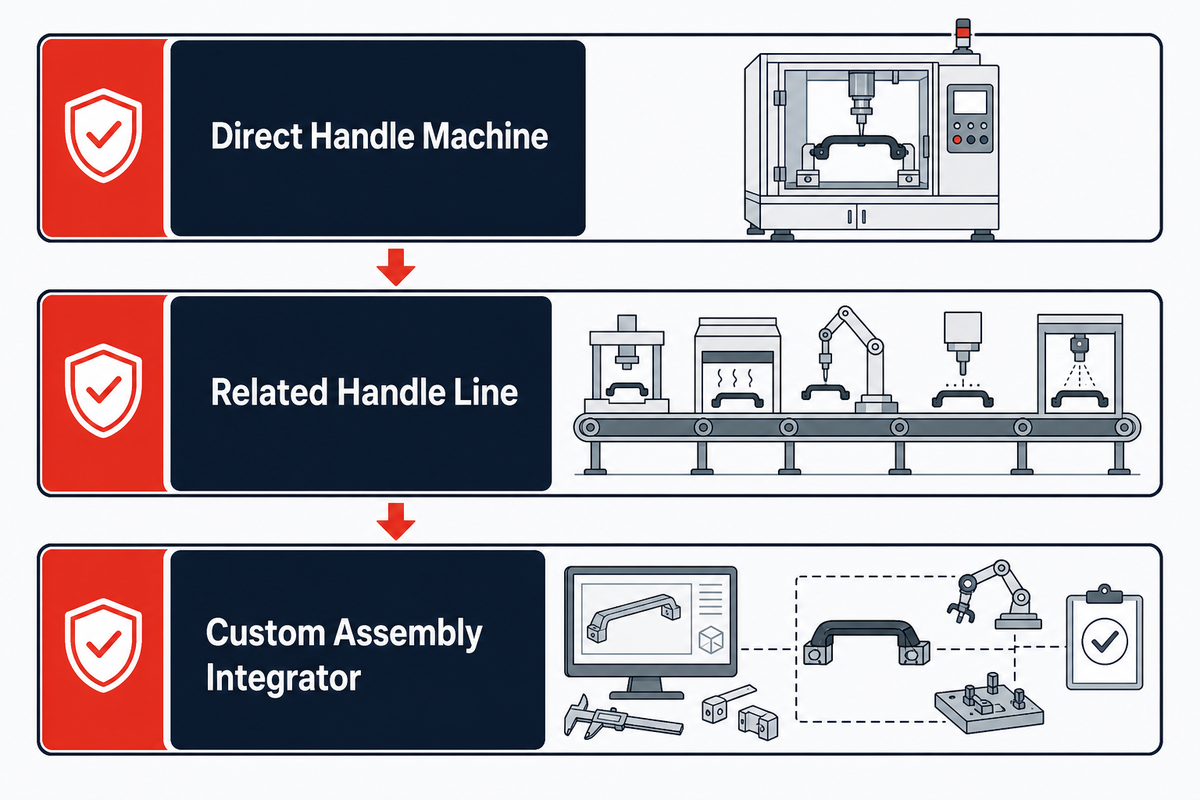
The shortlist was built around purchasing relevance, not general brand recognition. A manufacturer qualified in one of three ways:
- Its official website documents a machine that assembles a handle or fits a handle to another product.
- It produces a closely related line that forms, processes, inserts, nails, or finishes handles.
- It is a genuine custom-automation builder with published component-assembly capability that could support a properly scoped handle project.
Company history and product claims were checked against official public pages. If an exact founding year could not be verified, the field says Not publicly disclosed. A statement such as “more than 30 years” was not converted into a guessed calendar year.
The “Key disadvantages” field records a public-scope or application limitation. It is not a claim that a machine is poor quality. In this market, a narrow application can be a strength when it closely matches the buyer’s component and joining process.
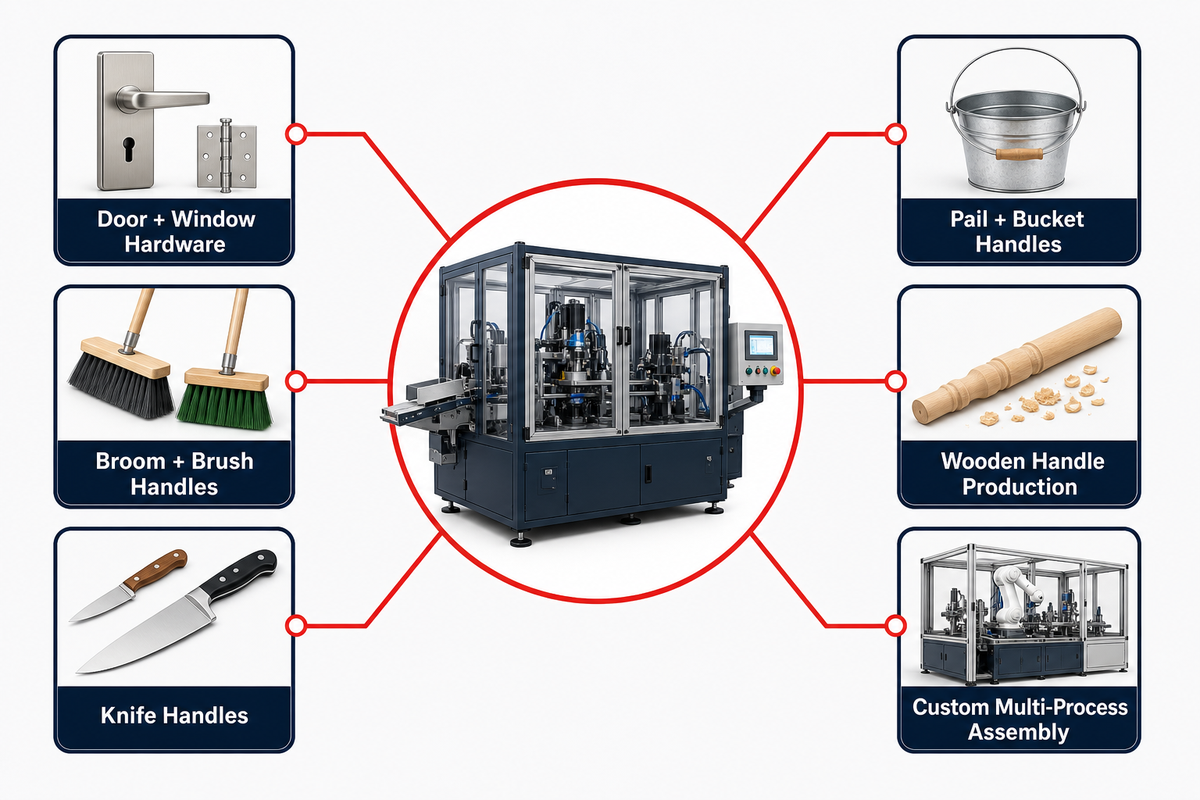
Handle application map
This nine-part map prevents a common sourcing error: comparing machines that share the word “handle” but perform unrelated operations.
| Application family | Typical operation | Relevant manufacturers in this guide |
|---|---|---|
| Door and window hardware | Feed and join levers, spindles, springs, screws, and trim parts | ZEUEE; Hensen |
| Broom and brush handles | Insert plastic parts, tighten ends, or build complete shafts | Borghi; Bizzotto; Azone; PENGLAI |
| Paint-brush handles | Insert a handle into the brush head and nail the joint | Hengyu |
| Knife handles | Orient grip components, heat them, and assemble them around a blade | CDS Manufacturing |
| Pail and bucket handles | Form or feed a bail and fit it to molded or formed container features | Romiter; Yixin; PHJ; Beck; Moving |
| Metal-container handles | Fit a plastic handle to a can or metallic body | Welding Machine; Moving |
| Tool and sporting-goods handles | Form, cap, thread, or process hammer, pickaxe, and racket handles | Romiter |
| Wooden handle production | Machine, drill, thread, sand, and label the handle itself | SIBO |
| Custom multi-process assembly | Engineer feeding, joining, inspection, and controls around supplied parts | JR Automation; Intec; PAR Systems; RNA; PrimeTest |
Quick Comparison of 20 Handle Assembly Machine Manufacturers
Use this table to identify the relevant application group before comparing production rate, cycle design, inspection, or price.
| No. | Company | Founded | Handle-equipment evidence | Best-fit application | Main public-scope limitation |
|---|---|---|---|---|---|
| 1 | ZEUEE | 2005 | Door and window handle assembly machine | Multi-component architectural hardware | Project fit depends on actual parts and process validation |
| 2 | Borghi S.p.A. | Not publicly disclosed | Metal-handle production and assembly lines | Broom and brush handles | Highly application-specific product family |
| 3 | Bizzotto Giovanni Automation S.r.l. | 1957 | B111 metal broom-handle assembly machine | Plastic inserts in metal broom handles | Published machine has a narrow handle format |
| 4 | CDS Manufacturing | 1983 | Knife-handle assembly machine | Knife and cutlery assemblies | Dedicated tooling and some manual loading in the shown cell |
| 5 | Welding Machine S.r.l. | Not publicly disclosed | MMP flat plastic handle assembly machine | Metal cans and containers | Limited public corporate and application detail |
| 6 | Zhangzhou Hengyu Automation Technology Co., Ltd. | Not publicly disclosed | Handle-inserting and nailing machines | Paint brushes | Brush-production focus |
| 7 | Shenzhen Azone Machinery Co., Ltd. | 2015 | AZ-MHAM15 handle assembly machine | Mops and brooms | Published scope centers on cleaning-product handles |
| 8 | Ruian Hensen Automatic Machinery Co., Ltd. | Not publicly disclosed | Door, knob, and broom-handle machines | Multiple handle categories | Limited detailed public specifications and cases |
| 9 | Romiter Machinery | Not publicly disclosed | Multiple handle-processing solutions | Bucket, mop, tool, and racket handles | Some products form or process handles rather than assemble a final product |
| 10 | Zhuhai Yixin Technology Co., Ltd. | Not publicly disclosed | Plastic-bucket handle assembly solution | Injection-molded buckets | Bucket and plastics-line specialization |
| 11 | PHJ Automation B.V. | 2014 | EAM steel and plastic handle fitting machines | Pails and buckets | Container-focused range |
| 12 | Beck Automation AG | 1934 | Bailer handle forming and fitting system | Plastic buckets | Best suited to plastics and in-mold-labeling environments |
| 13 | Moving Srl | Not publicly disclosed | Custom handle fitting machines | Buckets and cans | Project-specific engineering with limited standard specifications |
| 14 | Guangdong PENGLAI Intelligent Equipment Co., Ltd. | 1992 | Customized broom-handle assembly line | Brooms and mops | Configuration must be revalidated for the buyer’s product |
| 15 | SIBO Engineering | 1830 | LBE/2000 broom-handle production line | Wooden broom-handle manufacturing | Produces handles rather than fitting them to a finished assembly |
| 16 | JR Automation | 1980 | Custom assembly and joining systems | Large custom automation projects | No standard handle-machine model is publicly listed |
| 17 | Intec Automation | Not publicly disclosed | Custom automated assembly systems | Precision multi-process cells | No handle-specific catalog system is published |
| 18 | PAR Systems | 1961 | Engineered automated assembly | Complex or regulated automation | May be more engineering than a simple handle project requires |
| 19 | RNA Automation | 1898; automation focus since 1972 | Bespoke component assembly machines | Feeding-intensive assembly | Handle application would be a custom project |
| 20 | PrimeTest Automation | 2001 | Custom assembly, test, and vision systems | Assembly with integrated verification | No standard handle-machine model is publicly listed |
The 20 Manufacturers
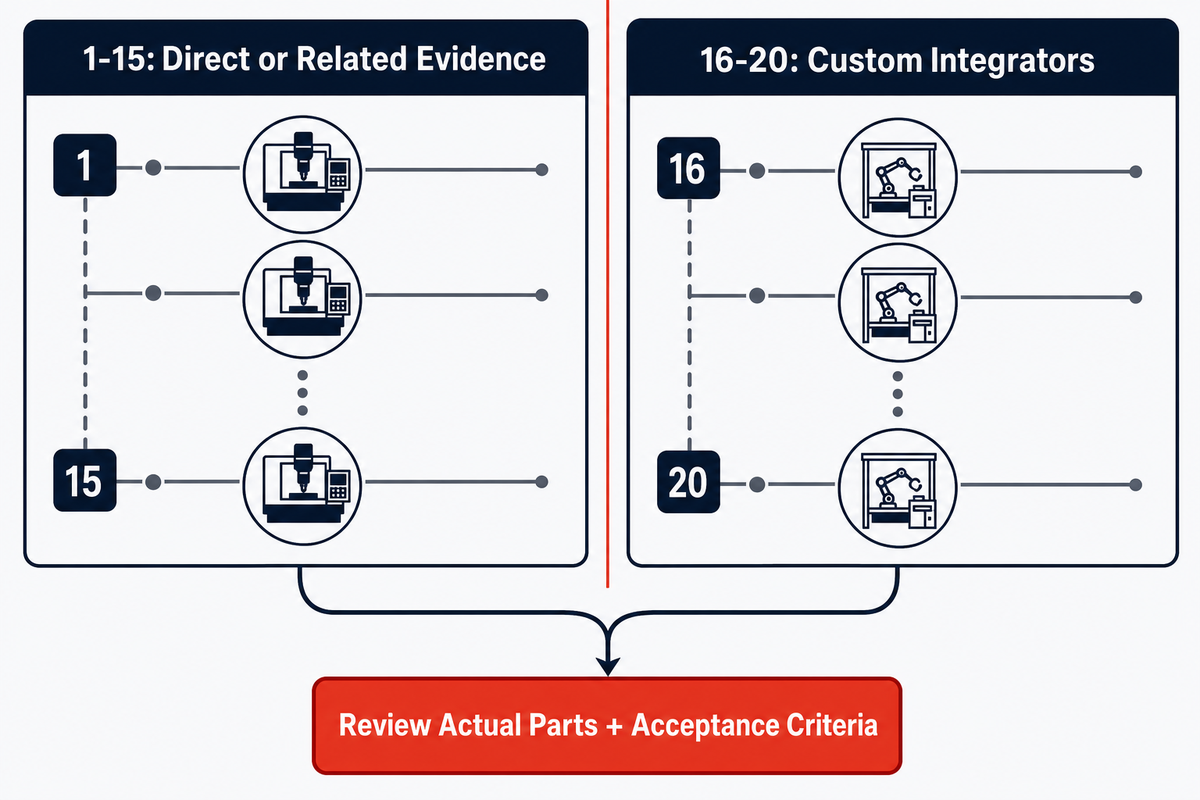
The first 15 companies have direct handle-machine or closely related handle-line evidence. Entries 16 through 20 are custom integrators. Buyers should ask every shortlisted supplier to review actual components and acceptance criteria before treating a public catalog page as a confirmed technical match.
No.1 ZEUEE
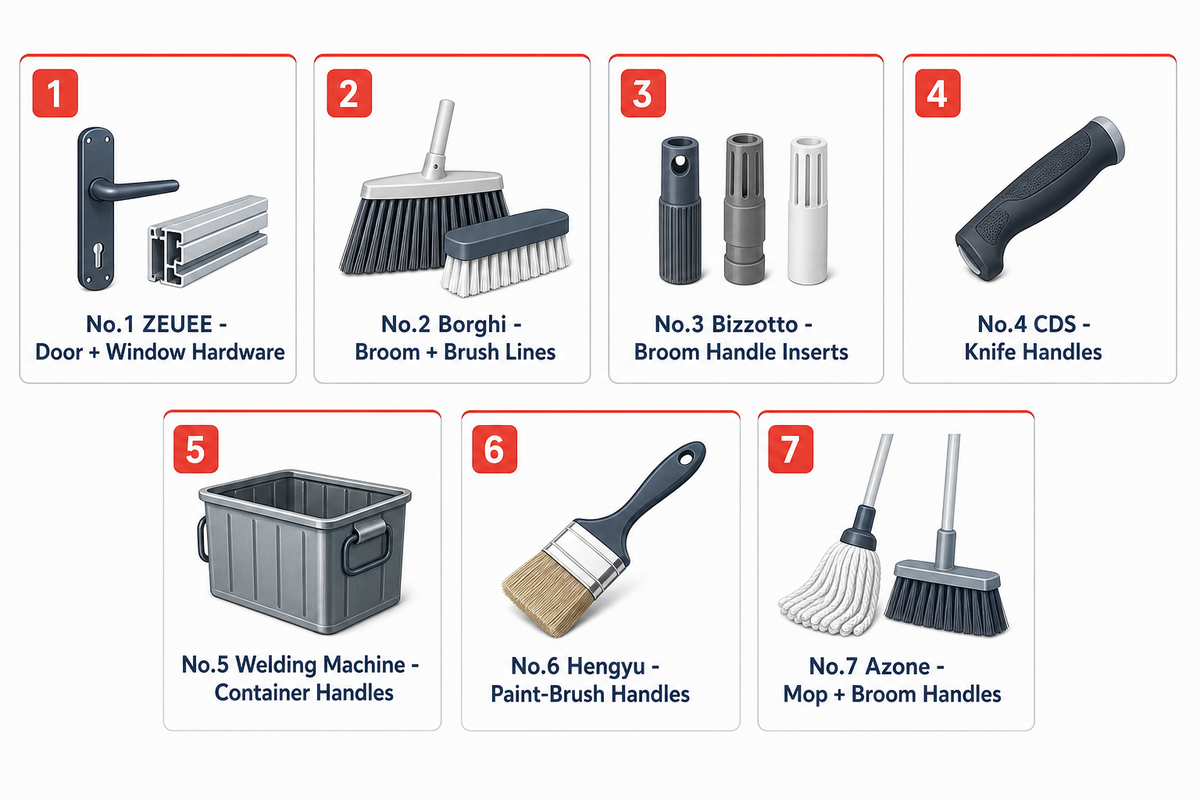
Company name: Shenzhen Zeyu Intelligent Industrial Science Technology Co., Ltd. (ZEUEE)
Year founded: 2005
Brief company introduction: ZEUEE is a Shenzhen-based non-standard automation manufacturer. Its published C22-ZY05-01 machine is designed for door and window handle hardware and coordinates multiple component-feeding and assembly operations in one system.
ZEUEE’s main products include Door and window handle assembly machines, automated assembly machines, inspection equipment, production lines, and custom automation equipment.
ZEUEE’s key advantages include Direct evidence for complex architectural-hardware assembly; custom design around the buyer’s components; published attention to feeding, hydraulic crimping, variant handling, and changeover.
ZEUEE’s key disadvantages: The showcased model is application-specific, so suitability for a different handle family cannot be assumed. Buyers need to provide parts, drawings, joining requirements, and acceptance samples. Public rate wording on the reviewed page is inconsistent, so cycle-time confirmation should be part of the quotation and factory acceptance test.
ZEUEE official website: https://zeueeauto.com/
No.2 Borghi S.p.A.
Company name: Borghi S.p.A.
Year founded: Not publicly disclosed
Brief company introduction: Borghi is an Italian manufacturer of broom, brush, and mop-production machinery. Its official materials state more than 75 years of experience, but the reviewed company page does not give an exact founding year.
Borghi’s main products include Fully automatic plastic-coated metal-handle production lines, H2/H3/H4 assembly configurations, broom and brush machines, and related packaging systems.
Borghi’s key advantages include Direct handle-line specialization; multiple published assembly configurations; integration across handle forming, processing, assembly, and finishing; international service presence.
Borghi’s key disadvantages: The public handle range is centered on broom and brush production. A buyer assembling door hardware, knives, tools, or container handles would need a different machine concept. Full lines may also exceed the scope of a low-volume, single-operation project.
Borghi official website: https://www.borghi.com/
No.3 Bizzotto Giovanni Automation S.r.l.
Company name: Bizzotto Giovanni Automation S.r.l.
Year founded: 1957
Brief company introduction: Bizzotto Giovanni Automation is an Italian custom-machine builder with a long history in handle manufacturing and industrial automation. Its B111 is a dedicated machine for fitting plastic inserts into metal broom handles.
Bizzotto’s main products include B111 metal broom-handle assembly machines, machines for metal and wooden handle production, brush and broom equipment, packaging systems, and custom industrial automation.
Bizzotto’s key advantages include Published application-specific engineering; experience with upstream handle manufacturing as well as assembly; custom-machine capability for line integration.
Bizzotto’s key disadvantages: The B111’s documented task is narrow. Buyers need separate confirmation for a different insert geometry, joining method, substrate, or finished product. A broader line can also require more floor space and upstream coordination than a standalone assembly station.
Bizzotto official website: https://bizzottoautomation.com/
No.4 CDS Manufacturing
Company name: CDS Manufacturing
Year founded: 1983
Brief company introduction: CDS Manufacturing is a US custom-automation company. Its knife-handle machine combines bowl feeding, vision orientation, pick-and-place, heating, and dedicated tooling to assemble handle components around a blade.
CDS’s main products include Knife-handle assembly machines, custom assembly systems, bowl feeders, robotic cells, inspection, packaging, and material-handling equipment.
CDS’s key advantages include A clear, documented knife-handle application; experience combining part feeding, vision, thermal processing, and assembly; custom tooling capability.
CDS’s key disadvantages: The published system uses dedicated tooling and manually loaded blades in the shown configuration. A different knife family, safety concept, material, or desired automation level would require engineering review rather than a direct catalog purchase.
CDS official website: https://www.cdsmanufacturing.com/
No.5 Welding Machine S.r.l.
Company name: Welding Machine S.r.l.
Year founded: Not publicly disclosed
Brief company introduction: Welding Machine S.r.l. is an Italian special-machine supplier whose MMP system assembles flat plastic handles onto metallic containers. This is a direct handle-fitting application rather than a general automation claim.
Welding Machine’s main products include Flat plastic handle assembly machines for metal containers and other special welding or container-production equipment.
Welding Machine’s key advantages include Direct fit for a defined can and container operation; specialized handling of a plastic handle and metallic body; potentially useful to paint, chemical, or packaging-container producers.
Welding Machine’s key disadvantages: The published application is narrow, and the official website provides limited current corporate history, configuration detail, and case documentation. Buyers should verify the present machine specification, safety standard, support coverage, and compatible container range.
Welding Machine official website: http://www.weldingmachinecambiago.com/
No.6 Zhangzhou Hengyu Automation Technology Co., Ltd.
Company name: Zhangzhou Hengyu Automation Technology Co., Ltd.
Year founded: Not publicly disclosed
Brief company introduction: Hengyu focuses on paint-brush manufacturing equipment. Its official catalog includes machines that insert handles into brush heads and secure the joint by nailing, making it a direct supplier for a specific handle-assembly process.
Hengyu’s main products include Paint-brush handle inserting and nailing machines, ferrule machines, bristle processing equipment, and complete brush-production lines.
Hengyu’s key advantages include Strong alignment with paint-brush process flow; combines insertion and mechanical fastening; broader brush-line knowledge can simplify upstream and downstream integration.
Hengyu’s key disadvantages: The application is limited to brush manufacturing. An architectural, tool, knife, or bucket handle needs different fixturing and joining technology. The exact founding year and some detailed performance data are not publicly disclosed.
Hengyu official website: https://www.hengyubrush.com/
No.7 Shenzhen Azone Machinery Co., Ltd.
Company name: Shenzhen Azone Machinery Co., Ltd.
Year founded: 2015
Brief company introduction: Azone designs packaging, printing, and assembly machinery. Model AZ-MHAM15 is presented as an automatic mop and broom handle assembly machine, giving buyers a specific product reference rather than only a general custom-automation service.
Azone’s main products include Mop and broom handle assembly machines, packaging machinery, printing equipment, and customized automatic machines.
Azone’s key advantages include Direct published machine for cleaning-product handles; defined electrical and pneumatic requirements; useful overlap between assembly and downstream packaging expertise.
Azone’s key disadvantages: The public machine is intended for mop and broom handles. Buyers with different tube diameters, locking parts, joining methods, or cosmetic standards need a sample trial and written confirmation. The company has a shorter public operating history than several long-established European suppliers in this list.
Azone official website: https://www.azonemachinery.com/
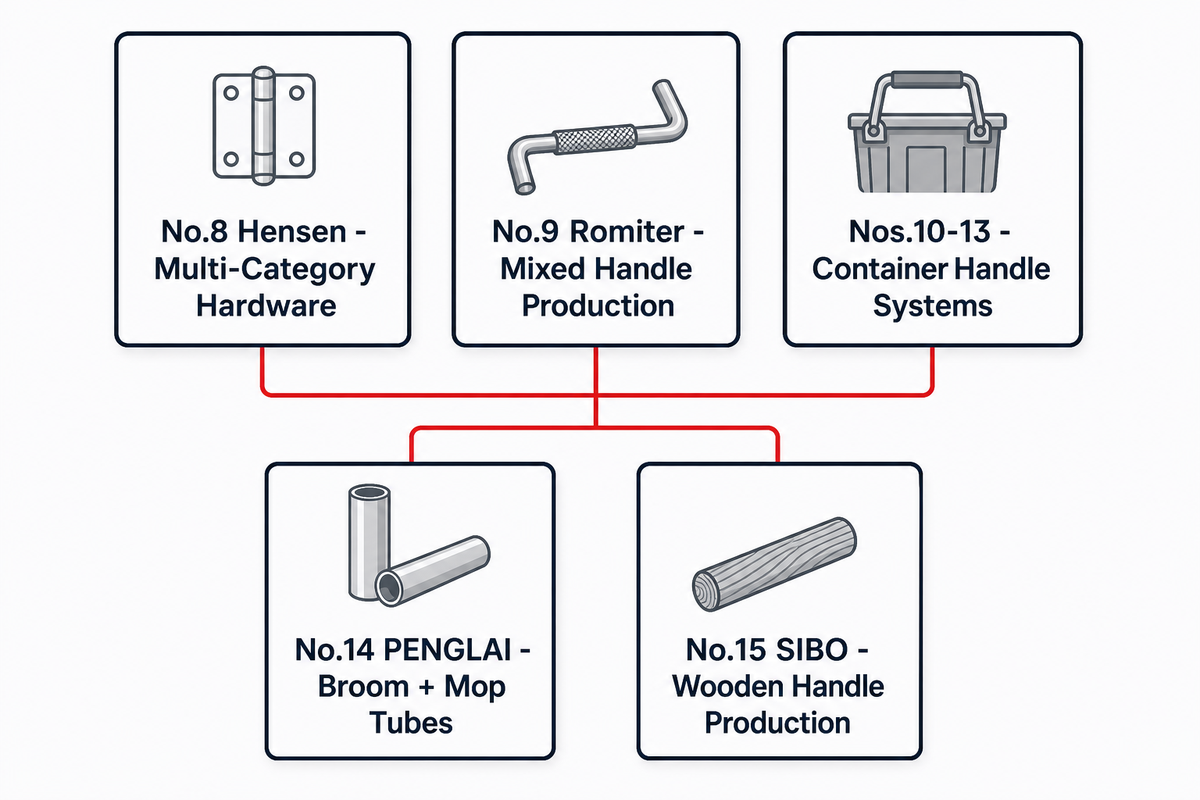
No.8 Ruian Hensen Automatic Machinery Co., Ltd.
Company name: Ruian Hensen Automatic Machinery Co., Ltd.
Year founded: Not publicly disclosed
Brief company introduction: Hensen publishes a broad automatic-assembly catalog that includes doorknob, door-handle, broom-handle, faucet, valve, and other hardware systems. That range makes it relevant to buyers comparing more than one handle category.
Hensen’s main products include Door-handle and doorknob assembly machines, broom-handle assembly equipment, faucet and valve assembly machines, automatic screwdriving, and custom assembly lines.
Hensen’s key advantages include Multiple handle applications are visible in the official catalog; adjacent hardware-assembly experience; potential to combine feeding, fastening, testing, and line handling.
Hensen’s key disadvantages: Public pages provide less detailed technical and corporate evidence than the strongest documented entries in this list. The exact founding year is not disclosed, and buyers should request recent reference projects, machine videos, acceptance criteria, and component-specific cycle data.
Hensen official website: https://www.hensen-machinery.com/
No.9 Romiter Machinery
Company name: Romiter Machinery
Year founded: Not publicly disclosed
Brief company introduction: Romiter operates a handle-machinery product site covering several household, packaging, and tool applications. Its scope includes bucket handles, mop handles, hammer handles, racket handles, and pickaxe handles.
Romiter’s main products include Bucket-handle making machines, mop-handle machines, tool-handle processing machines, cap or thread installing equipment, and related handle-production lines.
Romiter’s key advantages include Broad handle-family coverage; useful for buyers that also need tube forming, threading, capping, or other upstream processing; multiple material and end-use categories.
Romiter’s key disadvantages: Some catalog items make or process a handle instead of assembling the handle to a final product. Public corporate-history and inspection-system detail is limited. Buyers should define where the requested line starts and ends and verify that the legal supplier and service organization match the quotation.
Romiter official website: https://www.handlemachine.com/
No.10 Zhuhai Yixin Technology Co., Ltd.
Company name: Zhuhai Yixin Technology Co., Ltd.
Year founded: Not publicly disclosed
Brief company introduction: Yixin publishes a plastic-bucket handle solution that can link component feeding, handle assembly, conveyors, and injection-molding production. The application is aimed at automated bucket manufacturing rather than a standalone generic handle cell.
Yixin’s main products include Plastic-bucket handle assembly solutions, auxiliary automation for injection molding, conveying, feeding, and customized factory automation.
Yixin’s key advantages include Direct bucket-handle application; integration with injection-molding flow; emphasis on feeding and material transfer reduces isolated-machine handoffs.
Yixin’s key disadvantages: The public solution is specialized for plastic buckets. An independent container plant or a different handle material may require a redesigned interface. An exact founding year is not publicly disclosed, and the 2026 solution should be validated with a current reference configuration.
Yixin official website: https://www.yixinautomation.com/
No.11 PHJ Automation B.V.
Company name: PHJ Automation B.V.
Year founded: 2014
Brief company introduction: PHJ Automation is a Dutch automation company formed from the merger of several businesses. Its EAM range fits steel or plastic handles to pails and buckets and sits within a wider portfolio for plastics production.
PHJ’s main products include EAM handle-fitting machines, bucket and pail automation, in-mold labeling systems, leak testing, vision inspection, and downstream handling.
PHJ’s key advantages include Dedicated handle-fitting range; both steel and plastic handle options; knowledge of container automation around molding, testing, and handling.
PHJ’s key disadvantages: Public applications concentrate on buckets and pails. Buyers must confirm handle geometry, container size, hole or lug condition, line interface, and whether handle forming is included. It is not a general-purpose solution for door, knife, or tool handles.
PHJ official website: https://www.phjbv.com/
No.12 Beck Automation AG
Company name: Beck Automation AG
Year founded: 1934
Brief company introduction: Beck Automation is a Swiss automation company with a strong plastics and in-mold-labeling background. Its Bailer system forms metal wire handles and fits them to plastic buckets in an automatic production environment.
Beck’s main products include Bailer handle forming and assembly systems, in-mold labeling automation, lid handling, downstream plastics automation, and quality-control systems.
Beck’s key advantages include Combines metal-handle forming with bucket assembly; experience working around injection molding and fast production cycles; established plastics automation capability.
Beck’s key disadvantages: The Bailer is a specialized bucket solution, not a general handle platform. Its integration value is greatest in an automated plastics line, while a simple retrofit or low-volume station may need a smaller concept. Exact compatibility still depends on bucket and wire samples.
Beck official website: https://www.beck-automation.com/
No.13 Moving Srl
Company name: Moving Srl
Year founded: Not publicly disclosed
Brief company introduction: Moving is an Italian custom-automation company that states more than 30 years of experience. It designs machines that fit metal or plastic handles to buckets and cans, including configurations that form and install a metal handle.
Moving’s main products include Handle fitting machines, form-and-fit systems, bucket and can automation, leak testers, stacking equipment, and custom special machines.
Moving’s key advantages include Direct container-handle expertise; options for metal or plastic handles; custom engineering can combine forming, fitting, testing, and downstream handling.
Moving’s key disadvantages: The exact founding year is not publicly disclosed. The public range is project-oriented, so buyers cannot rely on one standard specification or price. Container geometry, handle supply format, target output, and line communication must be defined during engineering.
Moving official website: https://www.movingsrl.it/
No.14 Guangdong PENGLAI Intelligent Equipment Co., Ltd.
Company name: Guangdong PENGLAI Intelligent Equipment Co., Ltd.
Year founded: 1992
Brief company introduction: PENGLAI is a Chinese packaging and customized-machinery manufacturer. Its official catalog includes a bespoke automatic line that loads broom or mop tubes and tightens insert components into the handle.
PENGLAI’s main products include Broom and mop handle assembly lines, filling and packaging machines, labeling systems, capping equipment, and customized automation.
PENGLAI’s key advantages include Published handle-specific project; ability to combine tube loading and insert tightening; broad packaging knowledge for a production line that continues beyond assembly.
PENGLAI’s key disadvantages: The handle system is presented as a customized configuration, not a universal stock machine. Online configuration or price information may describe one historical project. Buyers should reconfirm the current specification, safety package, electrical standard, component trial, documentation, and service terms.
PENGLAI official website: https://www.penglaipacking.com/
No.15 SIBO Engineering
Company name: SIBO Engineering
Year founded: 1830
Brief company introduction: SIBO is an Italian woodworking and special-machinery company whose history traces to 1830. The LBE/2000 is an automatic line for producing broom handles through machining, drilling, threading, and labeling operations.
SIBO’s main products include LBE/2000 broom-handle lines, wooden-handle machinery, sanding and profiling equipment, special woodworking machines, and automation for roundwood products.
SIBO’s key advantages include Deep specialization in wooden and round handle production; multiple sequential operations in one line; suitable when the buyer needs to manufacture the handle itself.
SIBO’s key disadvantages: This is a related handle-production line rather than a machine that fits a handle to a brush head or other final product. Buyers whose parts arrive as finished handles need a different assembly process. The 1830 date reflects company heritage, not the age of the current automation model.
SIBO official website: https://www.sibo.it/
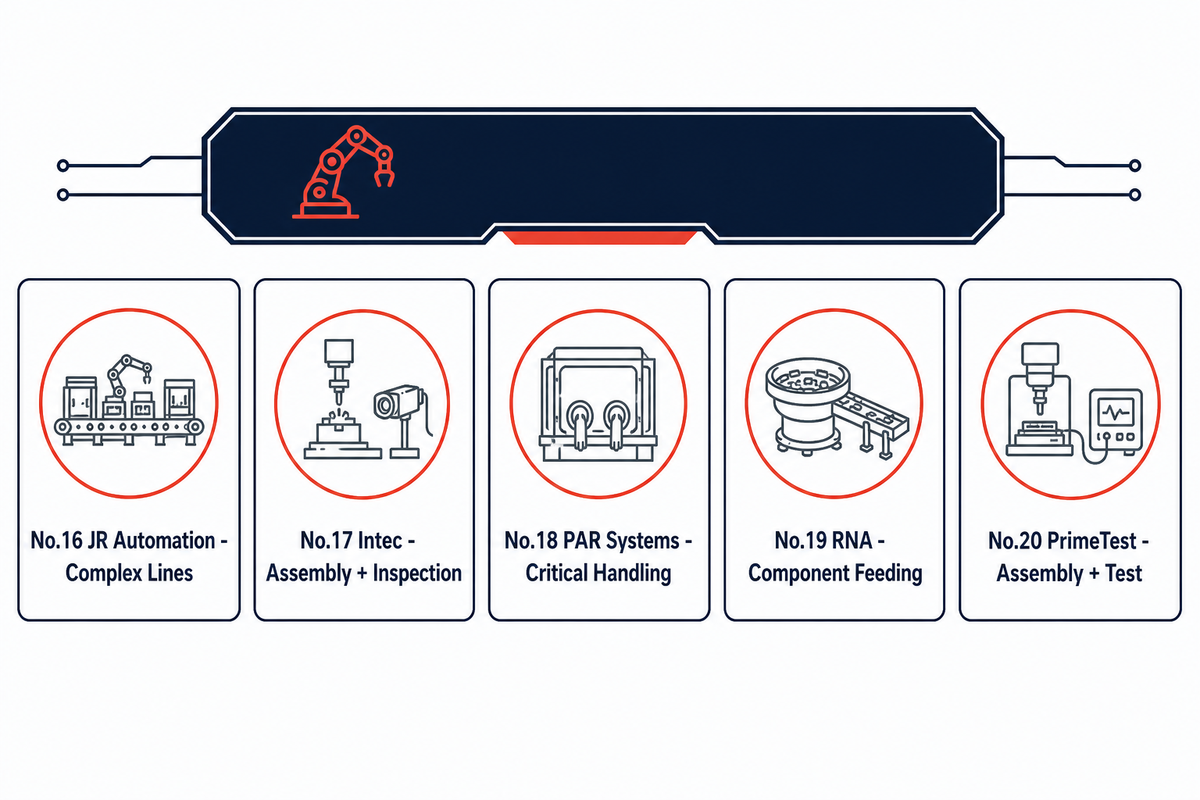
No.16 JR Automation
Company name: JR Automation
Year founded: 1980
Brief company introduction: JR Automation is a large custom manufacturing-systems integrator. It designs assembly, robotics, material handling, joining, test, and inspection systems across multiple industries.
JR Automation’s main products include Custom assembly lines, robotic systems, joining equipment, test and inspection, controls, and intelligent manufacturing solutions.
JR Automation’s key advantages include Broad multidisciplinary engineering; capability to manage complex line integration; global resources and experience with high-specification manufacturing programs.
JR Automation’s key disadvantages: No standard handle-assembly model was found in the public catalog. A handle line would be a custom engineering engagement, with scope, schedule, and capital requirements that may be too large for a simple standalone operation.
JR Automation official website: https://www.jrautomation.com/
No.17 Intec Automation
Company name: Intec Automation
Year founded: Not publicly disclosed
Brief company introduction: Intec Automation is a US custom-equipment company with more than 25 years of publicly stated experience. Its systems combine assembly, inspection, dispensing, packaging, and material handling for precision products.
Intec’s main products include Custom automated assembly, vision inspection, dispensing, robotic handling, packaging, and manufacturing software integration.
Intec’s key advantages include Useful process mix for a handle that needs adhesive, fastening, inspection, or traceability; custom cell and line integration; precision-automation orientation.
Intec’s key disadvantages: No handle-specific catalog machine or exact founding year was verified on the reviewed official page. Buyers need to establish technical fit through a formal concept study and should not treat general assembly capability as proof of prior experience with their handle type.
Intec official website: https://www.intecautomation.com/
No.18 PAR Systems
Company name: PAR Systems
Year founded: 1961
Brief company introduction: PAR Systems is a US engineered-systems company serving complex manufacturing and critical-handling applications. Its stated capabilities include automated assembly and advanced manufacturing.
PAR Systems’s main products include Engineered automated assembly, robotic and remote handling, advanced manufacturing systems, control systems, and specialized test equipment.
PAR Systems’s key advantages include Strong engineering resources for unusual, safety-critical, or tightly controlled processes; integration of handling, assembly, controls, and verification.
PAR Systems’s key disadvantages: PAR does not advertise a standard handle machine. Its engineered-system model may be disproportionate for a conventional broom, bucket, or door-handle task. Buyers should first determine whether the process complexity justifies a high-customization integrator.
PAR Systems official website: https://www.par.com/
No.19 RNA Automation
Company name: RNA Automation
Year founded: 1898 (automation focus since 1972)
Brief company introduction: RNA’s corporate history traces to 1898, while its dedicated feeding and automation development dates from 1972. The company designs bespoke component-assembly machines supported by feeding, joining, inspection, and control technology.
RNA’s main products include Custom component assembly machines, vibratory and centrifugal feeders, robotic handling, vision inspection, joining, and PLC-controlled production systems.
RNA’s key advantages include Particular strength in orienting and feeding small components; useful for handles with springs, screws, pins, caps, or mixed hardware; custom assembly and inspection in one platform.
RNA’s key disadvantages: No standard handle-machine model was found on the official site. The buyer must fund and validate a custom project. The 1898 date represents the broader company lineage and should not be interpreted as 128 years of handle-assembly machine production.
RNA official website: https://www.rnaautomation.com/
No.20 PrimeTest Automation
Company name: PrimeTest Automation
Year founded: 2001
Brief company introduction: PrimeTest Automation is a North American custom-automation builder that combines assembly engineering with test and measurement. It develops production systems with robotics, vision, verification, and packaging where needed.
PrimeTest’s main products include Custom assembly lines, robotic automation, functional test systems, machine vision, traceability, and packaging equipment.
PrimeTest’s key advantages include Assembly and verification can be engineered together; suitable for a safety- or quality-sensitive handle product; custom robotics and test expertise.
PrimeTest’s key disadvantages: No standard handle-assembly model is publicly listed, so buyers need a custom feasibility and quotation process. Public project support is oriented mainly toward North American custom automation, and global installation coverage should be confirmed for each location.
PrimeTest official website: https://www.primetest.com/
A 7-Point RFQ Screen for Handle Assembly Equipment
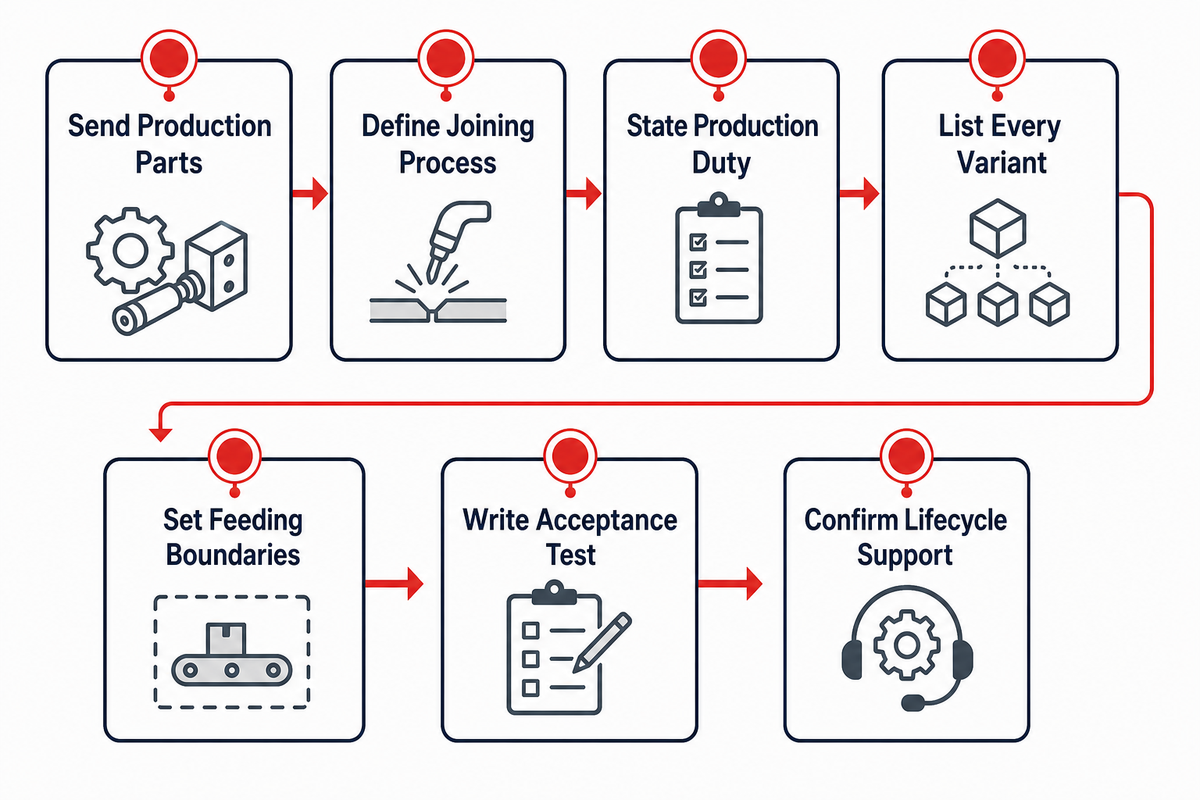
A supplier list becomes useful only after the request for quotation describes the real process. An efficient comparison starts with the same input package for every candidate. Copy these seven points into an RFQ and require written responses.
- Send production parts: provide all components, dimensioned drawings, material specifications, cosmetic surfaces, tolerances, and acceptable defect samples.
- Define the joining process: state whether the handle is crimped, screwed, pressed, nailed, heated, welded, bonded, snapped, or fitted into molded features.
- State the production duty: give the required good-parts rate, shift pattern, utilization assumption, and upstream or downstream line constraints.
- List every variant: identify handle sizes, colors, left and right parts, fastener options, recipes, and the maximum acceptable changeover time.
- Set feeding boundaries: specify which parts must be automatically fed, which may be manually loaded, and how bulk parts arrive at the cell.
- Write the acceptance test: require a factory acceptance test with production-intent parts and measurable checks for rate, reject handling, joint strength, surface damage, and changeover.
- Confirm lifecycle support: document installation, training, spare parts, remote support, software backups, manuals, warranty boundaries, and service response for the destination country.
The most important comparison is not “Which company is largest?” It is “Which supplier can prove the required joint, quality, and output with our parts?” That is why an official handle-machine reference is valuable but still does not replace a sample trial.
Frequently Asked Questions
What is a handle assembly machine?
Answer
A handle assembly machine feeds, positions, joins, and often inspects the components that form a handle or attach it to another product. Depending on the application, joining may involve crimping, pressing, screwdriving, nailing, heating, welding, snapping, adhesive dispensing, or wire forming. Some lines also make the handle itself, while others start with finished handles and install them on doors, brushes, knives, tools, cans, pails, or buckets.
Which supplier type is best for door and window handles?
Answer
Start with a manufacturer that publishes architectural-hardware experience, because door and window handles often combine several precision parts and cosmetic surfaces. ZEUEE and Hensen show direct public evidence in this category. Ask how the cell controls left and right variants, spindle orientation, spring placement, screw torque, crimp force, and visible-surface damage. A broad custom integrator can also be suitable when the process requires unusual testing, traceability, or integration with machining, coating, or packaging equipment.
Can one machine assemble different handle variants?
Answer
Often yes, but only within an engineered variant envelope. Ask the supplier to list shared tooling, change parts, recipe control, feeder changes, changeover time, and the rate available for each variant. The supplier should run representative high-risk variants during the acceptance test, including the smallest, largest, and most cosmetically sensitive parts. A general claim of flexibility without a written variant matrix is not enough for purchasing approval.
What should be included in an RFQ?
Answer
Begin with revision-controlled component drawings, production samples, material specifications, and cosmetic requirements. Add the intended joining method, target good-parts rate, shift pattern, utilization assumption, variant list, feeder boundaries, inspection points, reject logic, traceability needs, and upstream or downstream interfaces. State the destination electrical and safety standards. For each part, identify the supply format, replenishment interval, allowable orientation, contamination risk, and whether contact with a visible surface is permitted. Define who supplies fixtures, gauges, safety samples, utilities, network access, and production material for commissioning. Ask the vendor to separate base scope, options, exclusions, assumptions, and customer responsibilities in the quotation. Finally, define the factory acceptance test, installation responsibilities, operator and maintenance training, critical spare parts, software backups, documentation language, warranty boundaries, and expected service response. Acceptance testing should name the sample quantity, trial duration, allowable micro-stops, rate calculation, defect limits, joint-strength method, and sign-off authority. This detail lets suppliers quote the same process instead of making incompatible assumptions.
Why do some manufacturers publish no price or founding year?
Answer
Custom assembly machines are quoted around the buyer’s parts, rate, inspection, safety, and line-interface requirements, so a universal price can be misleading. Company-history pages also vary in detail. Where an exact founding year could not be verified from reliable public information, this article uses “Not publicly disclosed” instead of converting a phrase such as “more than 25 years” into an estimated date. Buyers can request legal company records during supplier qualification if corporate age matters to the purchasing policy.
Final Selection Advice
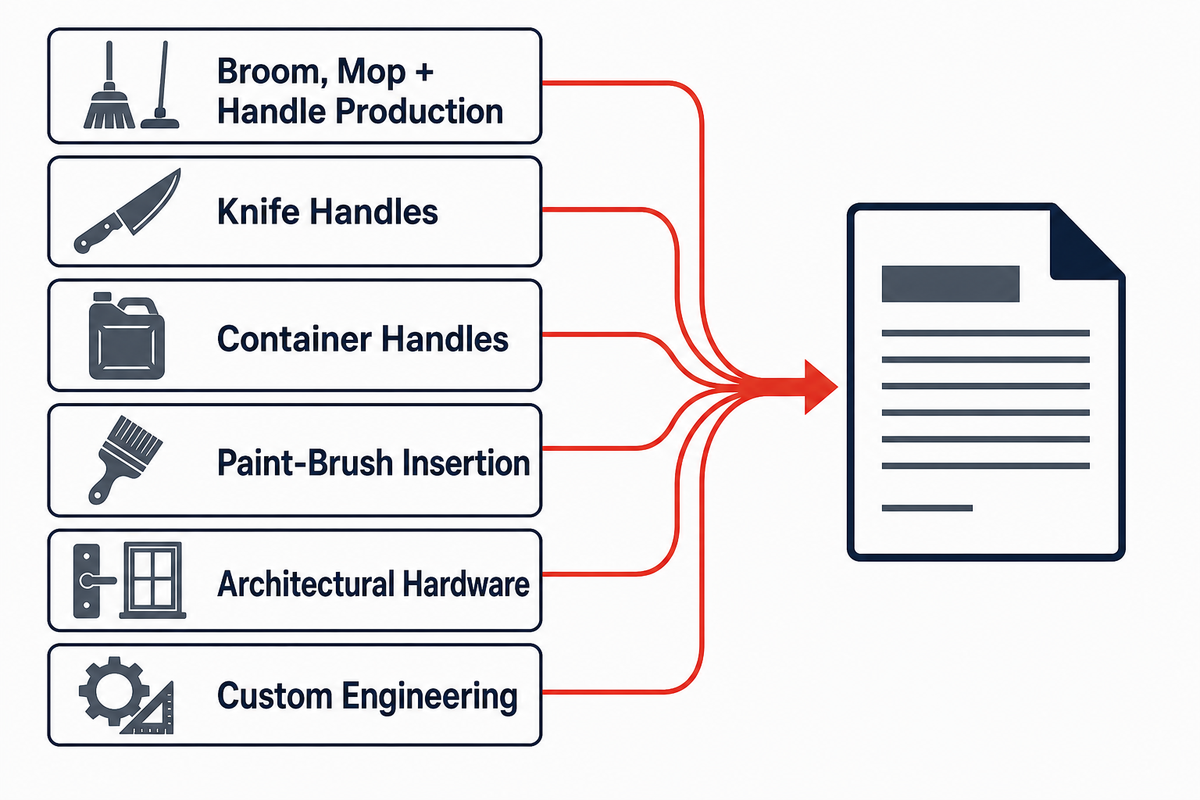
Begin with the application category. Borghi, Bizzotto, Azone, PENGLAI, and SIBO are relevant to broom, mop, or handle-production work. CDS targets knife handles. Welding Machine, Yixin, PHJ, Beck, and Moving focus on container handles. Hengyu addresses paint-brush handle insertion. ZEUEE and Hensen publish architectural-hardware applications. The final five companies are better treated as custom-engineering candidates.
Shortlist two or three suppliers, send the same RFQ package to each, and compare the proposed process boundary rather than headline claims alone. A credible quotation should explain how parts are presented, joined, inspected, rejected, changed over, and supported after installation.
Discuss a handle assembly project with ZEUEE
Share your component drawings, production samples, joining requirements, target output, and variant list. ZEUEE can review whether an existing machine concept or a custom automation design is the appropriate starting point.
WHY WE WRITE THIS
About ZEUEE Engineering Insights
ZEUEE shares technical guides based on real automation project experience. Since 2005, we have designed and manufactured non-standard automation equipment for connector assembly, wire harness production, robotic lines, vision inspection, and smart factory upgrades.
Founded in 2005
20,000 m² production base
120+ specialists
150+ R&D patents
ISO9001:2015 certified