Get in touch with Zeyu lntelligent Industrial Company

How to Choose a Twist Pin & Insulator Insertion Machine Manufacturer

Updated September 2026
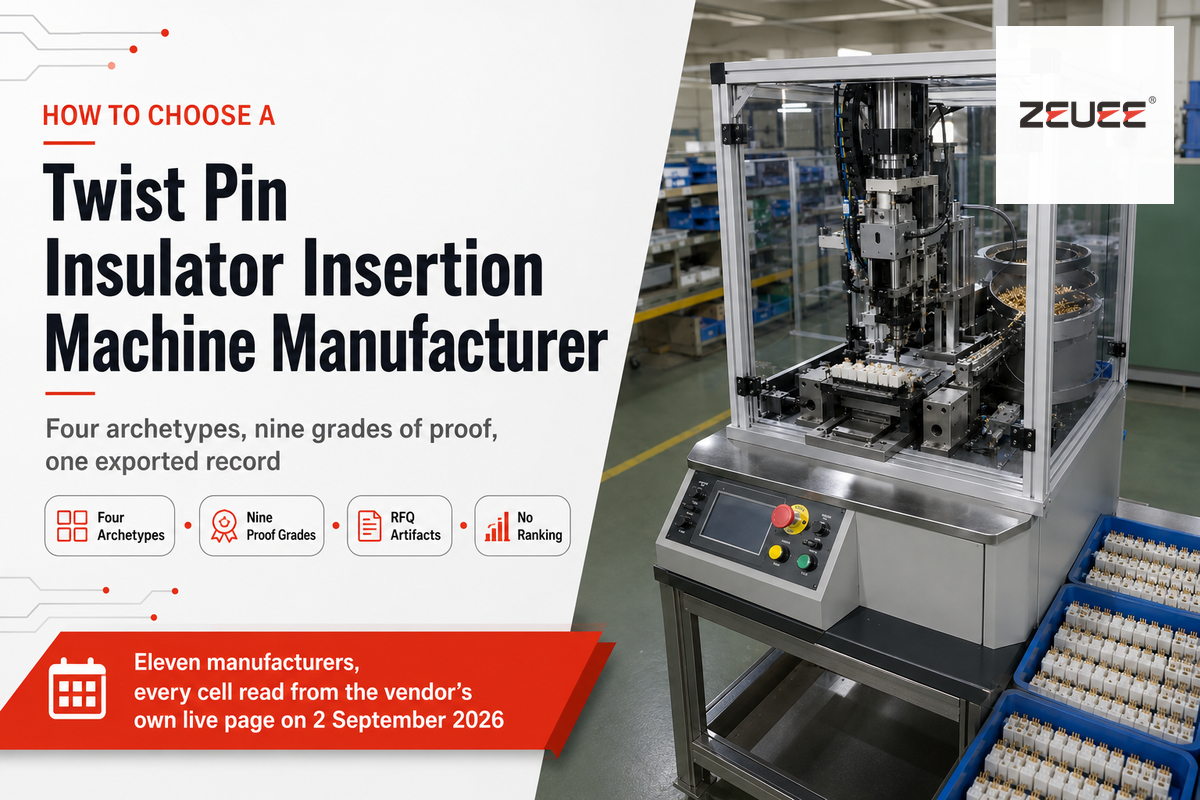
Twist pin insulator insertion machine manufacturers are the companies that build the capital equipment which presses hyperboloid twist pins into connector housings and seats insulators into their cavities. They aren’t one industry. Four different kinds of company will answer the same request for quotation, and the differences show up in the paperwork long before they show up in the machine. Full disclosure first: this article is published by ZEUEE, a builder of this equipment, so the list below includes its own publisher and says so in every place it matters. What follows is a selection method, not a ranking. Every vendor cell was read from that vendor’s own live page on 2 September 2026, and where a page says nothing, the cell says not stated.
How This List Was Built, and Who Built It
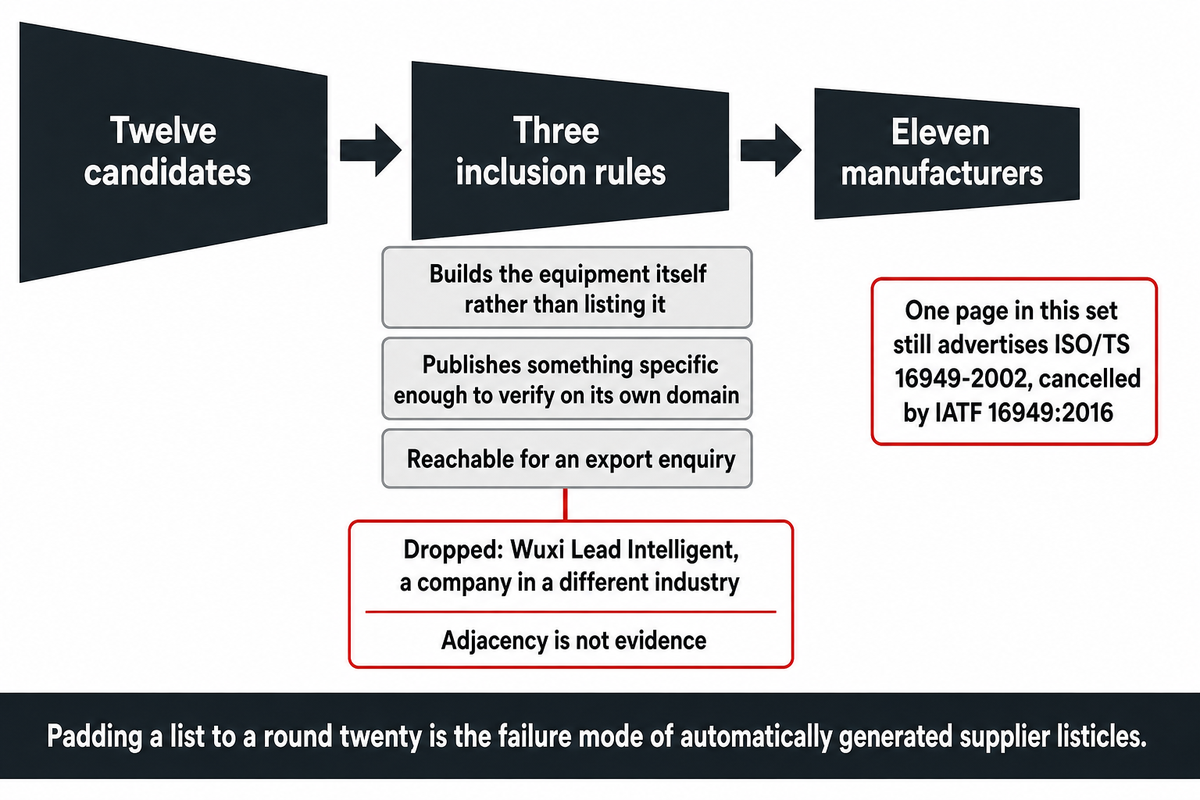
Eleven manufacturers appear in this article, screened from twelve candidates against three inclusion rules: the company must build insertion and assembly equipment itself rather than list it, it must publish something specific enough to verify on its own domain, and it must be reachable for an export enquiry. Twelve were planned. One was dropped.
Candidate twelve was Wuxi Lead Intelligent. It reached the shortlist because it appears beside a genuine competitor as a suggested similar company on a professional network. Reading its actual output (lithium-battery winding devices, roll-change patents, and a 16,000 cell per hour photovoltaic stringer line announced in 2026) showed a company in a different industry. Adjacency isn’t evidence, so the list stops at eleven rather than being padded to a round twenty. Padding to twenty is the exact failure mode of the automatically generated supplier listicles this page competes with. Standards citations go unchecked in the same way: one manufacturer page in this set still advertises conformity to ISO/TS 16949-2002, an edition superseded in 2009 and cancelled outright by IATF 16949:2016.
What this article does and does not claim
- No vendor was ranked, scored or ordered by quality. Sequence follows archetype.
- No pricing appears anywhere, because not one of the eleven publishes a price on the product pages reviewed here.
- Scope is capital equipment. A hand-held pin insertion tool, or an extraction kit for rework, is a different purchase and is not covered here. So is a pick-and-place machine for surface-mount or through-hole technology: it populates a printed circuit board, not a connector cavity, and the acceptance evidence differs accordingly.
- Every specification is quoted from the manufacturer’s own page, with the URL in the table.
- ZEUEE is held to the same standard as the other ten: its own product page is self-description, and it’s labelled as such.
The Archetype Sort: Four Very Different Companies Will Answer Your RFQ
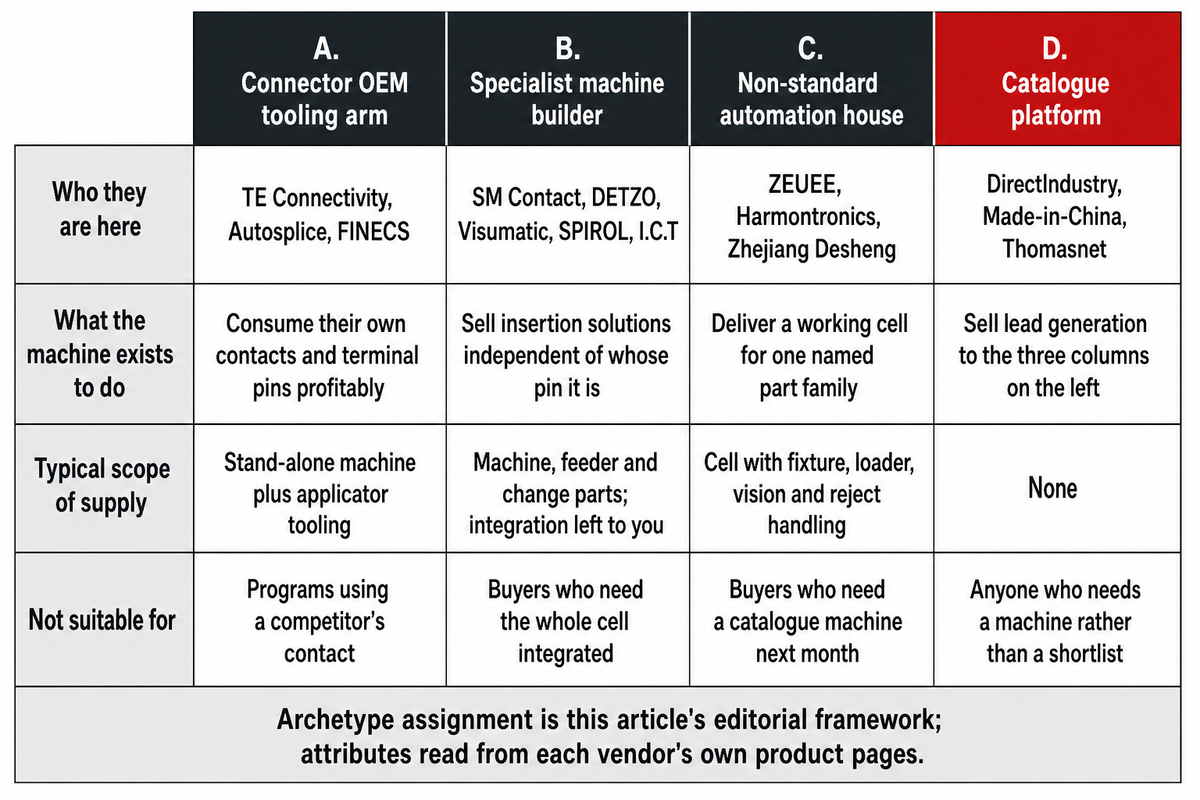
The Archetype Sort separates insertion equipment vendors into four business models: connector makers who build tooling to place their own contacts, specialist machine builders who are contact-agnostic, non-standard automation houses who build a cell around your part, and catalogue platforms that manufacture nothing. Quotations that look four times apart on price are usually four different products. The same standard set out above governs every page cited from here on, ZEUEE’s own included.
Sorting an inbox this way before comparing numbers is worth more than any spreadsheet of specifications, because each archetype is answering a different question. A connector maker is quoting the cost of applying its contacts. A specialist is quoting an insertion head, a feeder, and the various pin sizes the tooling will accommodate. An automation house is quoting a whole assembly line segment with your fixture, your loader and your reject chute in it, built to synchronize with the stations either side. Automation here’s bought to minimize scrap and positional variation as much as to cut the cost of manual placement, and reducing manual labor is the easy half of the business case while proving each joint is the hard half. Adjacent equipment follows the same logic, as the handle assembly machine manufacturers comparison shows, and machine-class background sits in the general pin insertion machine guide.
| Decision dimension | A. Connector OEM tooling arm | B. Specialist machine builder | C. Non-standard automation house | D. Catalogue platform |
|---|---|---|---|---|
| Who they are here | TE Connectivity, Autosplice, FINECS | SM Contact, DETZO, Visumatic, SPIROL, I.C.T | ZEUEE, Harmontronics, Zhejiang Desheng | DirectIndustry, Made-in-China, Thomasnet |
| What the machine really exists to do | Consume their own contacts and terminal pins profitably | Sell insertion solutions independent of whose pin it is | Deliver a working cell for one named part family | Sell lead generation to the three columns on the left |
| Typical scope of supply | Stand-alone machine plus applicator tooling; modular head range | Machine, feeder and change parts; integration left to you | Cell with fixture, loader, vision and reject handling | None |
| Board-level soldered pins (PCB assembly, SMT lines) | Core competence; press-fit and solder tails both covered | Usually yes; I.C.T and SM Contact are PCB-primary | Possible but not the reason to hire them | Not applicable |
| Connector-housing and insulator seating | Supported, framed as a non-PCB application | Mixed; DETZO covers bobbins and connectors, while nothing in SPIROL’s published catalogue is an electrical contact | The reason this archetype exists | Not applicable |
| Contact compatibility across suppliers | Narrowest; compatible parts are largely their own catalogue | Broadest; contact-agnostic by design | Whatever you specify, engineered per project | Not applicable |
| Changeover and high-mix versatility | Tooling-kit driven; quick within their own pin size range | Good, and usually the sales argument | Designed to your mix, so it depends on what you declared | Not applicable |
| Spares and service reality | Global manufacturing and spares network, usually the widest of the four | Regional; check the subsidiary that will actually travel | Varies widely; overseas travel cost is often the buyer’s | None |
| Evidence they will produce without a fight | Datasheets and quality-management language; force logs are an option | Sample runs and video; published rates are inconsistent | Trial-run parts on your drawings — the one vendor here that publishes a figure states 3,000 to 5,000 pieces | Marketing copy only |
| Not suitable for | Programs using a competitor’s contact, or a housing outside their catalogue | Buyers who need the whole cell integrated and have no internal engineering | Buyers who need a catalogue machine next month with published spares pricing | Anyone who needs a machine rather than a shortlist |
Source: attributes read from each vendor’s own product pages, 2 September 2026. Archetype assignment is this article’s editorial framework.
Pin Insertion and Insulator Seating: What Each Manufacturer Actually Covers
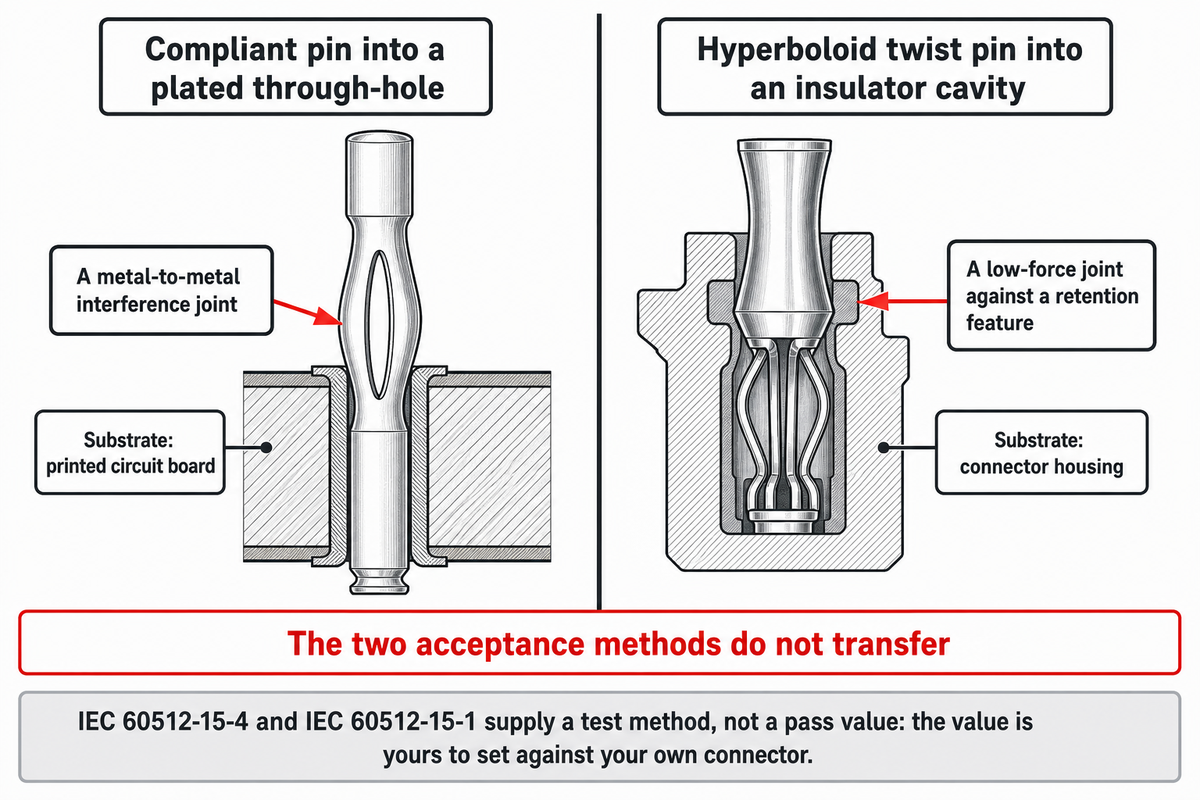
A connector-housing insertion machine differs from a PCB machine in what it inserts into, not in how fast it moves. Pressing a compliant pin into a plated through-hole on printed circuit boards is a metal-to-metal interference joint. Seating a hyperboloid twist pin into an insulator cavity is a low-force joint against a retention feature, and the two acceptance methods don’t transfer. Archetype told you who is answering your RFQ; this section is about what the product does to your part, read the same way, from each vendor’s own pages.
That distinction decides your shortlist whether the end product is an automotive wiring assembly, an aerospace connector or consumer electronics, so the table below records it per vendor from the vendor’s own words. Empty specifications are reported as not stated rather than filled in by inference. Exactly one of the eleven, a mechanical-fastener builder, publishes an insertion force figure at all; six pages don’t mention force in any form, and eight publish no rate.
| Manufacturer | Archetype / HQ | Inserts into | Published rate | Verification the page names | Limitation for a twist-pin buyer |
|---|---|---|---|---|---|
| TE Connectivity | A · US/IE | Both. PCB processing plus connector stitching into housings | P4 up to 3.3 (4) cycles per second; P550 5+ strokes/second on 30 mm pitch | Insertion force monitoring, optional; changeover traceability on P8 | Force monitoring is an add-on, and the fastest figure counts strokes, not verified parts |
| Autosplice | A · US/DE | PCB-primary; tooling also for plastic, ceramic and metal substrates | MicroSert up to 3 per second; MiniSert 12,000 per hour on 5.08 mm pitch; AIS 6000 up to 0.2 sec/insertion | Vision for PCB error correction; end-of-reel sensors; continuity sensing optional | Vision checks board skew, not joint integrity; insertion force measurement is an optional feature |
| SM Contact | B · France, est. 1986 | PCB on PININSERT 2100 and 3200; PCB or plastic parts on 2100 XL | Not stated on any of the three machines | Inline quality control and defect tracking; laser control of components and pins | No rate and no force published anywhere, so every number must come from a quotation |
| DETZO | B · Taiwan | Connectors and coil bobbins | Not stated; capacity given as 1, 4, 8 or 12 stations (DSW-IP01 to IP12) | Servo motor control of insertion depth and position; active pressure monitoring, optional | Cites unnamed industrial standards for verticality and pitch, which cannot be audited |
| Harmontronics | C · China, SH 688022 | Both, as separate lines: PCB pin assembly and header connector assembly | Not stated on the profile page; named machine PA800-PCB | ISO 9001; FMEA; end-to-end quality control system | Public specifications are thin; the evidence is customer references rather than data |
| Zhejiang Desheng | C · China, since 2009 | Automobile connector housings; feeding, bending, assembling and detection | 20 to 30 pcs/min | Automatic detecting, which its own next clause defines as material presence | Detection is a hopper sensor, not joint verification; pneumatic supply 0.5 ±0.1 MPa is not insertion force |
| FINECS | A · Japan, Toyama | Terminal pins into workpieces, unspecified, for its own terminal pin customers | Not stated; the FINESERT Pro spec sheet is gated behind a download | Not stated | Nothing is verifiable without contact, and the machine exists to serve its own pin business |
| I.C.T | B · China | PCB holes; model I.C.T-S4020, with a radial sibling for capacitors and resistors | Not stated on this page | Alignment accuracy across model changes; reduced operator variation | PCB-only scope; no insulator or housing capability is claimed |
| SPIROL | B · US | Mechanical fasteners: coiled and slotted spring pins, dowels, bushings, inserts | Not stated; this industry quotes force instead of rate | Optional force monitoring, pin sensing, laser part presence, feed-tube pin level | Nothing in its published catalogue is an electrical contact — wrong industry despite the identical phrase |
| Visumatic | B · US | Barbed darts, steel pins, push-pins, automotive christmas-tree fasteners | Not stated | Punch position sensors qualify the insertion stroke and depth; separate feed-confirmation sensor | Mechanical fastening scope, but the position-based verification method is the one to copy |
| ZEUEE | C · China, Shenzhen, est. 2005 | Twist pin into the connector insulator cavity — the named category | Not published; quoted per part family | Closed-loop force monitoring with seating-depth verification before release, described on its own page as standard on all machines rather than optional | Publisher of this article; the page is self-description and is not independent evidence |
Every cell read from the linked page on 2 September 2026. Not stated means the page is silent, never that the capability is absent.
The Manufacturers, Reviewed
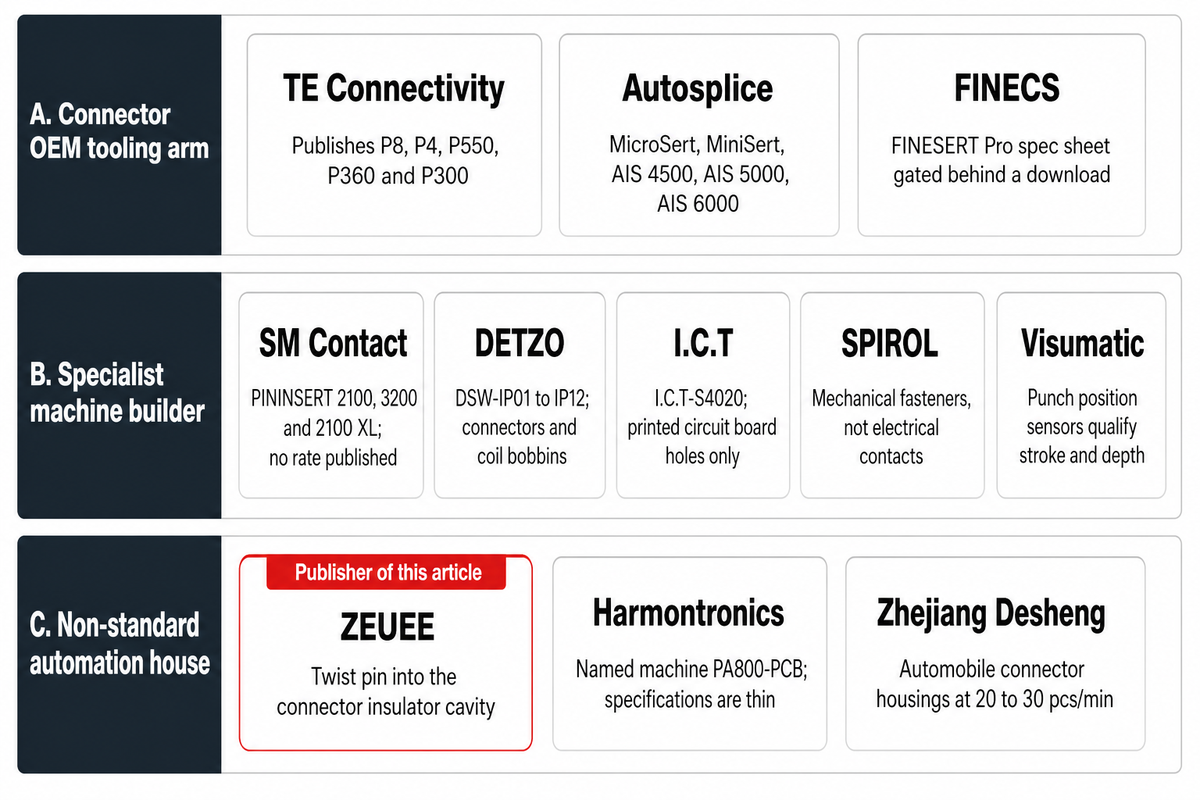
Each entry below gives one verifiable specific, the archetype it belongs to, and the limitation a buyer should price in. No entry claims a capability the vendor doesn’t publish, and the review order follows the archetype map rather than any judgement of quality. Where a page is silent, the entry says so, on the same rule the table above uses.
TE Connectivity
Connector OEM tooling arm with the widest published portfolio here, covering the wide range of applications this category spans, from board processing to connector stitching: P8, P4, P550, P360 and P300. Throughput is published two ways, the P4 at up to 3.3 (4) cycles per second, and the P550 at 5+ strokes per second on a 30 mm pitch. Limitation: insertion force monitoring is offered as an option, fitted, in TE’s own words, as requested in many automotive applications.
Autosplice
Also a component maker, and explicit about it: a global manufacturer of flexible PCB pin insertion machines whose tooling extends to plastic, ceramic and metal substrates. Its most specific published figure is the MiniSert at 12,000 per hour on 0.2 inch (5.08 mm) pitch, with the AIS 4500 and 5000 quoted at 0.7 sec per pin and 1.0 sec per tab, and the AIS 6000 at up to 0.2 sec per insertion and ±0.03 mm accuracy. The MicroSert publishes repeatability of 0.001 inch (0.0254 mm), which is a different measurement from the ±0.001 inch accuracy stated for the MiniSert, so the two figures shouldn’t be read against each other. Limitation: pitch-dependent figures don’t compare directly with anyone else’s.
SM Contact
French specialist since 1986 with subsidiaries in China, Estonia and Spain, covering customized connector, PCB, coil frame, transformer and lead frame work. What’s verifiable here is process rather than a number: the company states that it starts each project with a pin design. Limitation: no rate and no force appear on any of the PININSERT 2100, 2100 XL or 3200 pages, so comparison requires a quotation.
DETZO
Taiwanese builder positioned around winding expertise, covering connectors and coil bobbins across the servo-driven DSW-IP01 to DSW-IP12 range. Active pressure monitoring, offered as an option, detects insertion force in real time to prevent bobbin damage or pin deformation. Limitation: capacity is expressed as station configuration rather than rate, and the standards it cites for verticality and pitch are unnamed.
Harmontronics
Chinese automation house founded in 2007, the year it developed its first high-speed pin insertion machine, and listed on the STAR Market in 2019. Its published customer list is the verifiable specific: the company states it serves TE, Aptiv, Bosch, Continental and Yazaki, and the part a third party can corroborate is the run of supplier awards from TE across 2017 and 2021 to 2025. Limitation: the public pages carry almost no machine data, so due diligence has to run through references.
Zhejiang Desheng
Yueqing-based house building since 2009, specifically for the automobile connector industry, with feeding, bending, assembling and detection in one machine. Published rate is 20 to 30 pcs per minute at a working pressure of 0.5 ±0.1 MPa. Limitation: what the page calls detection is material presence at the feeder, which tells you nothing about the joint.
FINECS
Japanese terminal pin maker in Toyama selling the FINESERT Pro to insert terminal pins into workpieces automatically and continuously; explicitly, in its own words, for our terminal pin customers. That statement of purpose is unusually honest about the archetype, and it’s the only thing on the page a buyer can verify unaided. Limitation: the specification sheet is gated behind a download, so nothing is verifiable before contact.
I.C.T
Chinese SMT equipment builder whose I.C.T-S4020 handles terminal insertion, placing terminal components into PCB holes, with a radial sibling handling capacitors, resistors, LEDs, transistors and mini switches. Alignment accuracy maintained even when product models change is the claim on offer. Limitation: the scope is printed circuit boards only, with no insulator or connector-housing capability claimed anywhere.
SPIROL
US specialist in mechanical pin installation whose catalogue publishes what nobody in the electrical category does: machine force ratings from 0.9 kN on the PM through 1.3 kN, 6.7 kN and 8 kN to 22.2 kN on the PMX. That force ladder is the one published force range in this set, transcribed from its catalogue page. Its sensing options are grouped as performance-enhancing accessories rather than standard equipment. Limitation, and it’s decisive: coiled spring pins and bushings aren’t electrical contacts, so this company belongs on a different shortlist.
Visumatic
US builder of automatic fastening systems for barbed darts, steel pins, push-pins and automotive christmas-tree fasteners, catalogued on its own site as an automatic pin insertion machine. Verification architecture is the specific worth copying: punch position sensors qualify the insertion stroke and depth, with a separate fastener transfer sensor confirming feed. Limitation: mechanical fasteners again rather than contacts, though the two-sensor split is the model every buyer in this category should demand.
ZEUEE
The publisher of this article, and an automation house of the third archetype: founded 2005 in Shenzhen with a 20,000 m² base in Taihe, Jiangxi added in 2020, 120+ staff, and an ISO 9001:2015 quality-management certificate, whose certifying body and certificate number we will supply on request; that is exactly what the top grade of the scale above tells you to ask us for. Its twist pin insulator insertion machine page describes feeding the hyperboloid contact into the insulator cavity, applying force under closed-loop monitoring, and verifying seating depth before release. Limitation, applied to ourselves: that page is self-description, and a buyer should demand the same artifacts from us as from anyone in the table.
Are there US-based twist pin insulator insertion machine manufacturers?
Three of the eleven are US-domiciled: Autosplice, SPIROL and Visumatic, with TE Connectivity running US engineering under an Ireland-domiciled parent. Only Autosplice and TE work on electrical contacts. SPIROL and Visumatic build mechanical fastener equipment that shares the search phrase and none of the application. Buyers needing domestic support for connector-housing work have a short list, and should ask any US supplier to state which of the two joint types its equipment was designed around before discussing lead time.
What does a small insertion machine manufacturer do better than a large one?
Two things: changeover responsiveness and direct engineering access. A specialist or automation house usually redesigns a fixture for one part family inside a build cycle, and the engineer who designed your tooling often takes the call. Large connector OEMs return the opposite: spares depth across a global network, documented quality systems, and audit paperwork that survives inspection. Regulated-sector programs usually need the paperwork more. High-mix programs with frequent new connectors tend to need the reverse, and pay in service geography.
The 9-Grade Proof Scale: What to Demand Instead of Believing the Datasheet
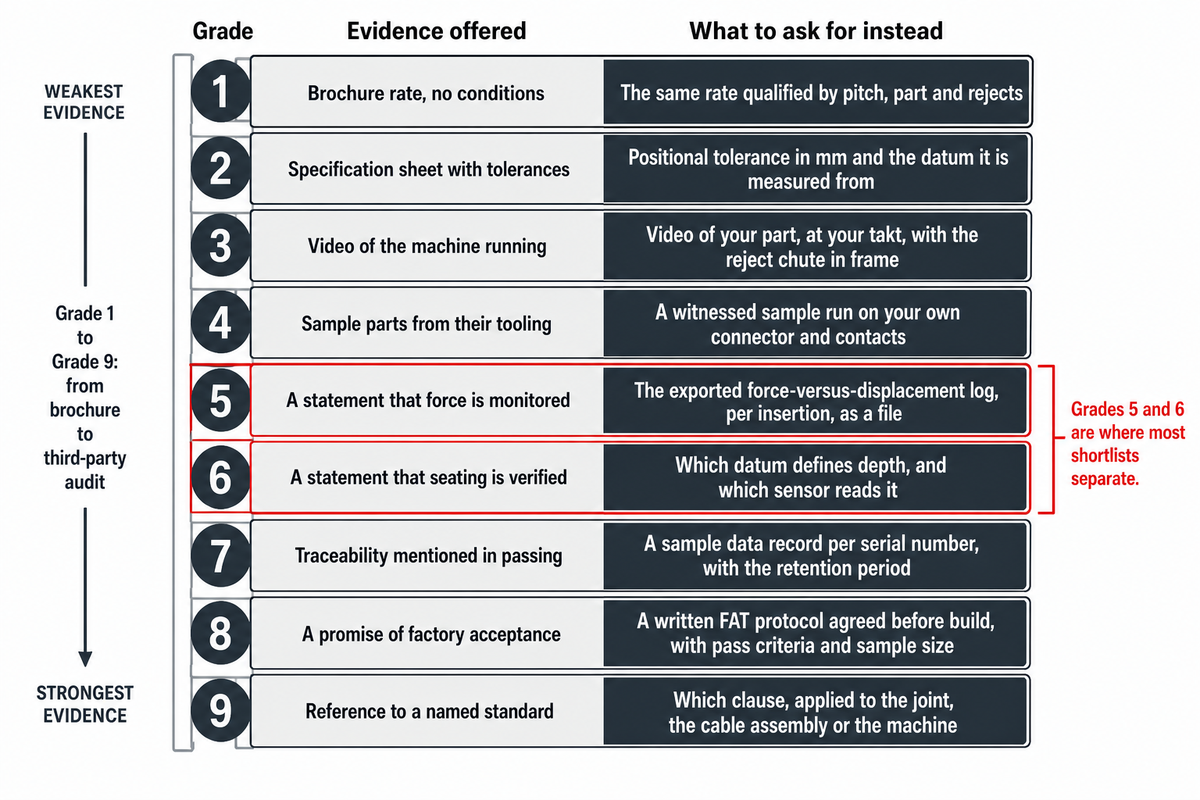
No machine-level qualification standard exists for this equipment. Searching the standards bodies returns acceptance criteria for the finished cable assembly and for the crimping process, but nothing that qualifies an insertion machine itself, which is why buyers must build acceptance from joint-level tests and a written protocol instead.
That absence is the single most useful fact in this article, and it’s worth stating precisely. IPC/WHMA-A-620 is the acceptance standard for Cable and Wire Harness Assemblies, the product, not the equipment. NASA-STD-8739.4 governs crimping, interconnecting cables and wiring workmanship; the process, not the machine. Pointing an insertion machine supplier at either one asks it to certify against a document that doesn’t describe it. Artifacts replace that gesture, and the ladder below sets them in order.
“Upper level machines can be equipped with insertion force monitoring … as requested in many automotive applications.”
— TE Connectivity, discrete pin insertion machines product page
Read that sentence as a procurement fact rather than marketing copy. Force monitoring produces per-unit evidence of a good joint, and it’s sold by the piece, when a customer asks. All four of the independent vendors that mention force monitoring, TE, Autosplice, DETZO and SPIROL, sell it as an option. If you don’t specify it, the machine delivers parts and no proof.
| Grade | Evidence offered | What to ask for instead | What a refusal tells you |
|---|---|---|---|
| 1 | Brochure rate, no conditions | The same rate qualified by pitch, part and whether rejects are included | The number is a stroke count, not a cycle time |
| 2 | Specification sheet with tolerances | Positional tolerance in mm and the datum it is measured from | Accuracy was measured on the head, not on the seated contact |
| 3 | Video of the machine running | Video of your part, at your takt, with the reject chute in frame | The demonstrated part is easier than yours |
| 4 | Sample parts from their tooling | A witnessed sample run on your own connector and contacts | Compatibility with your components has not been proven |
| 5 | A statement that force is monitored | The exported force-versus-displacement log, per insertion, as a file | Monitoring exists as a lamp, not as a record |
| 6 | A statement that seating is verified | Which datum defines depth, and which sensor reads it | Verification is feed presence upstream of the joint |
| 7 | Traceability mentioned in passing | A sample data record per serial number, with the retention period | Records exist on the machine and nowhere else |
| 8 | A promise of factory acceptance | A written FAT protocol agreed before build, with pass criteria and sample size | Acceptance will be negotiated after your money is spent |
| 9 | Reference to a named standard | Which clause, applied to what — the joint, the cable assembly, or the machine | The standard governs something else, and nobody had checked |
Grades 5 and 6 are where most shortlists separate. Engineering behind how insertion force is monitored sits in the machine guide rather than here.
Joint-level testing is where a buyer should anchor acceptance, because tests for the output do exist even though tests for the machine do not. IEC 60512-15-4 (contact insertion, release and extraction force) and IEC 60512-15-1 (contact retention in an insert) supply a test method rather than a pass value: the value is yours to set against your own connector. That is the honest version of what most supplier pages compress into the word compliant. Precise insertion is a property of the joint and of the manufacturing process around it rather than of the head alone, which is why process optimization after installation often returns more than a faster machine would.
Question-to-Artifact Pairing: How to Write the RFQ
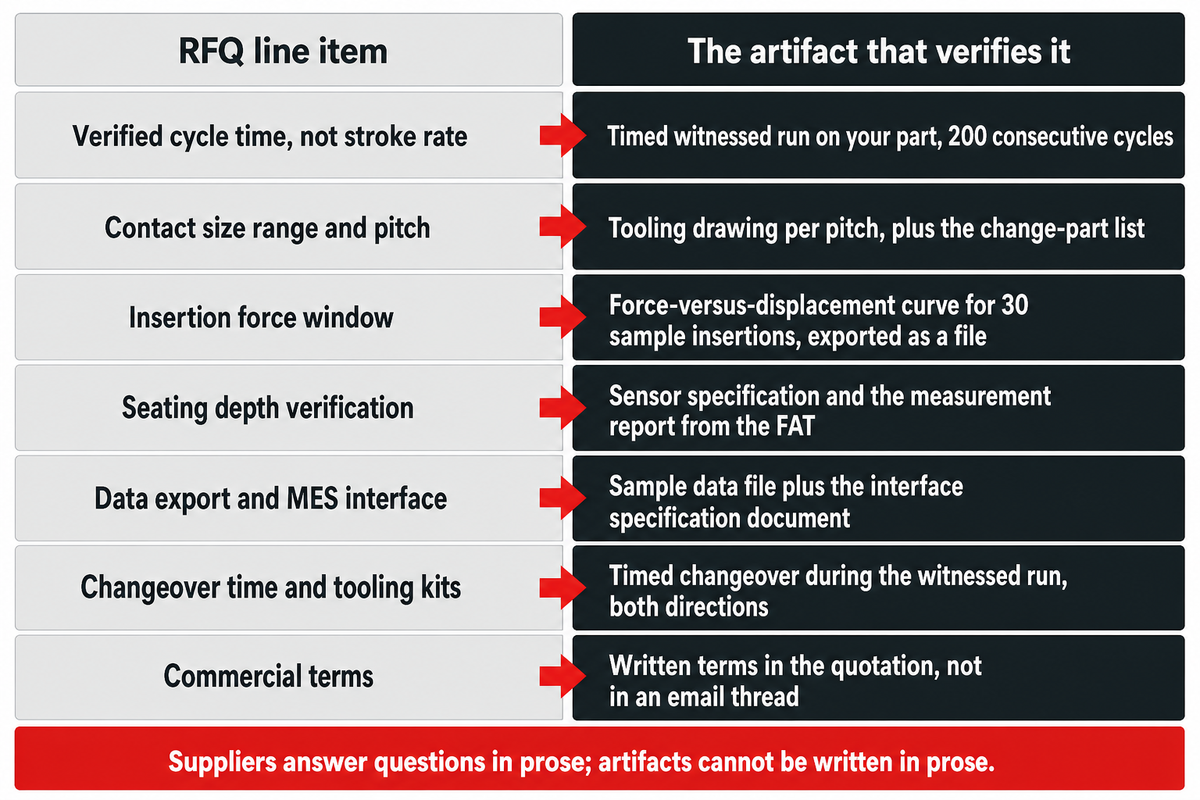
Question-to-Artifact Pairing sets every question beside the artifact that answers it, which is what separates it from an ordinary questionnaire. Suppliers answer questions in prose. Artifacts can’t be written in prose, so a request for one either produces a file or produces a reason, and both are informative.
State your production needs in the request itself and send the table below with them, rather than following up later. Buyers who want a broader vendor screen before the technical round can start from the general vendor screening checklist and then layer these rows on top for insertion equipment specifically. Copy the four columns into your quote request unchanged.
RFQ checklist — copy these into your quote request:
| Parameter | Recommended range | Why it matters | How to verify |
|---|---|---|---|
| Verified cycle time, not stroke rate | State your target in seconds per verified part, typically 0.2 to 3.0 s | Published rates range from 0.2 sec/insertion to 30 pcs/min and exclude rejects | Timed witnessed run on your part, 200 consecutive cycles |
| Contact size range and pitch | Declare every pitch you run, down to 5.08 mm or finer | Two of the fastest published figures are valid only at one stated pitch | Tooling drawing per pitch, plus the change-part list |
| Insertion force window | Upper and lower limit in newtons, set from your own connector data | Hyperboloid twist pin contacts are defined by low insertion force, so an upper limit protects the insulator | Force-versus-displacement curve for 30 sample insertions, exported as a file |
| Seating depth verification | Positional tolerance in mm against a named datum | Depth is established by a datum stop, and force alone does not prove it | Sensor specification and the measurement report from the FAT |
| Data export and MES interface | Per-insertion record, retained 12 months minimum | Force monitoring without export is a lamp, not traceability | Sample data file plus the interface specification document |
| Changeover time and tooling kits | Target under 15 minutes for a same-family change | High-mix production loses more to changeover than to cycle time | Timed changeover during the witnessed run, both directions |
| Commercial terms | Build time, warranty scope, and who pays overseas service travel | One vendor of eleven publishes terms; the rest reveal them only on request | Written terms in the quotation, not in an email thread |
One published example makes the last row concrete. Zhejiang Desheng states a build time of 60 to 90 working days, asks for physical samples plus 2D and 3D drawings before quoting, supplies 3,000 to 5,000 trial components, and offers a one year warranty that excludes spare parts while placing all overseas after-sales costs on the customer. Those terms may or may not suit you, but they’re stated. Ten of the eleven manufacturers state nothing comparable, which means the comparison you actually make is between one disclosed set of terms and ten unknowns.
Integration and Utility Requirements Buyers Forget Until Install Week
For a machine that will run inline rather than stand-alone, the site constraints belong in the RFQ, not in the commissioning report. Supply voltage and phase, compressed air quality, floor footprint, conveyor height, the SMEMA handshake and the PLC or MES protocol all change the quotation, and all of them are cheaper to declare than to retrofit.
| Requirement | What to state in the RFQ | What goes wrong if you do not |
|---|---|---|
| Electrical supply | Voltage, phase and frequency at the intended location — Autosplice publishes 400 V / 50 Hz / 16 A and 6 bar of air for the AIS 4500 | A transformer appears on the commissioning invoice |
| Compressed air | Pressure and dryness at the drop, for example 0.5 ±0.1 MPa as Desheng specifies | Pneumatic actuators run out of tolerance and seating varies |
| Footprint and access | Available length, width and maintenance clearance in mm, against published cabinet footprints, which in Autosplice’s own AIS range run from 1170 × 1010 mm on the single-head AIS 4500 to 3025 × 1650 mm on the conveyorised AIS 5000 inline | A machine 2.0 m long arrives for a 1.6 m gap in the layout |
| Conveyor interface | Transport height in mm, direction of travel, and whether SMEMA compatible signalling is required | The cell cannot be placed in the production line without a lift table |
| Control and data | PLC brand, network protocol, and the MES record you need per part | Traceability has to be bolted on later, usually by you |
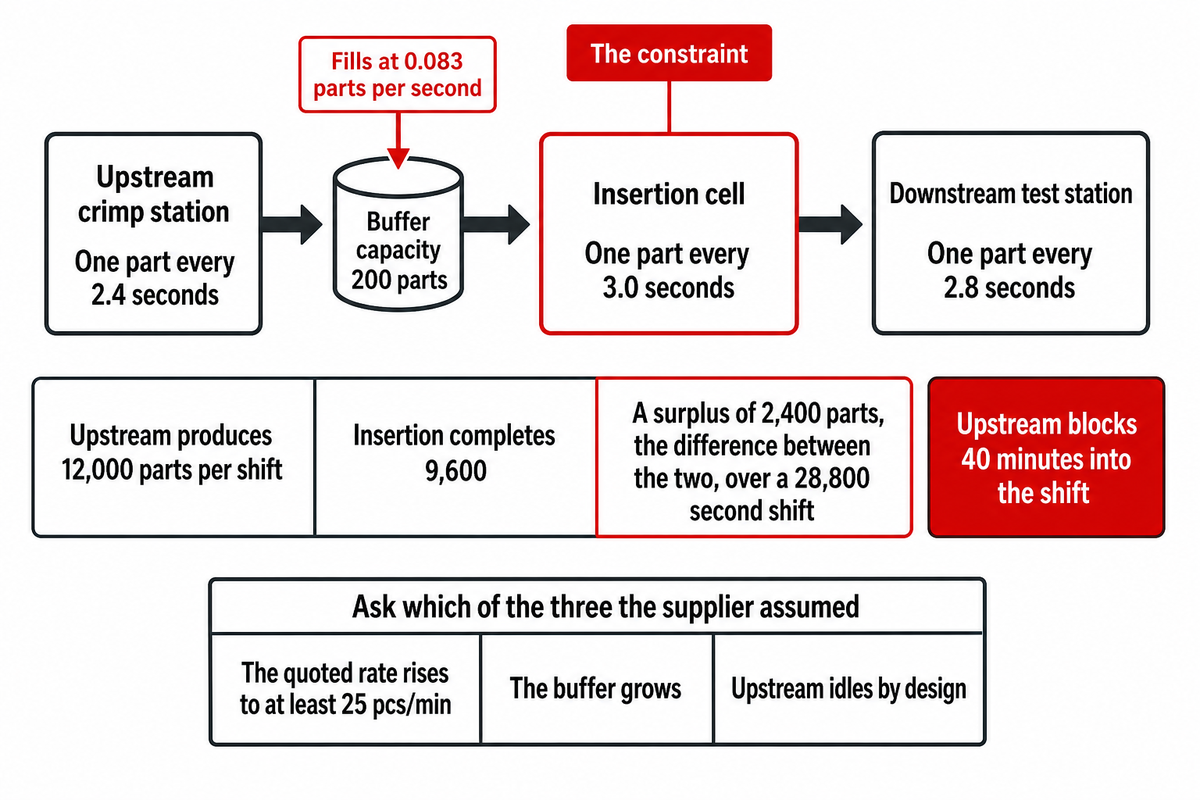
| Upstream and downstream rate | Takt of the stations either side, and available buffer | The fastest machine in the plant starves or blocks — see the calculation below |
Worked example, rate matching. Take a supplier quoting 20 to 30 pcs/min, and use the conservative end: 20 pcs/min is one part every 3.0 seconds. Suppose the upstream crimp station delivers a part every 2.4 seconds and the downstream test station accepts one every 2.8 seconds. Insertion is now the constraint at 3.0 s, so upstream runs 0.6 s per part ahead of it. Over an eight-hour shift of 28,800 seconds, upstream produces 12,000 parts while the insertion cell completes 9,600; a surplus of 2,400 parts that has to go somewhere. The buffer fills at 1 ÷ 2.4 − 1 ÷ 3.0 = 0.083 parts per second, so a capacity of 200 parts is used up after 2,400 seconds and the upstream station blocks 40 minutes into the shift. Either the quoted rate rises to at least 25 pcs/min (2.4 s), or the buffer grows, or upstream idles by design. Ask which of the three the supplier assumed, because the quotation assumed one of them.
Spares held in your own region reduce downtime far more dependably than any promise of reliable performance in a brochure. Interface work of this kind is the part of the project that transfers badly between vendors, which is one reason the archetype matters: an automation house prices it in, a component maker frequently doesn’t. Where a whole line is in scope rather than one station, the same questions extend across the connector assembly equipment range and into wire and cable assembly machines downstream.
Where Supplier Selection Actually Goes Wrong
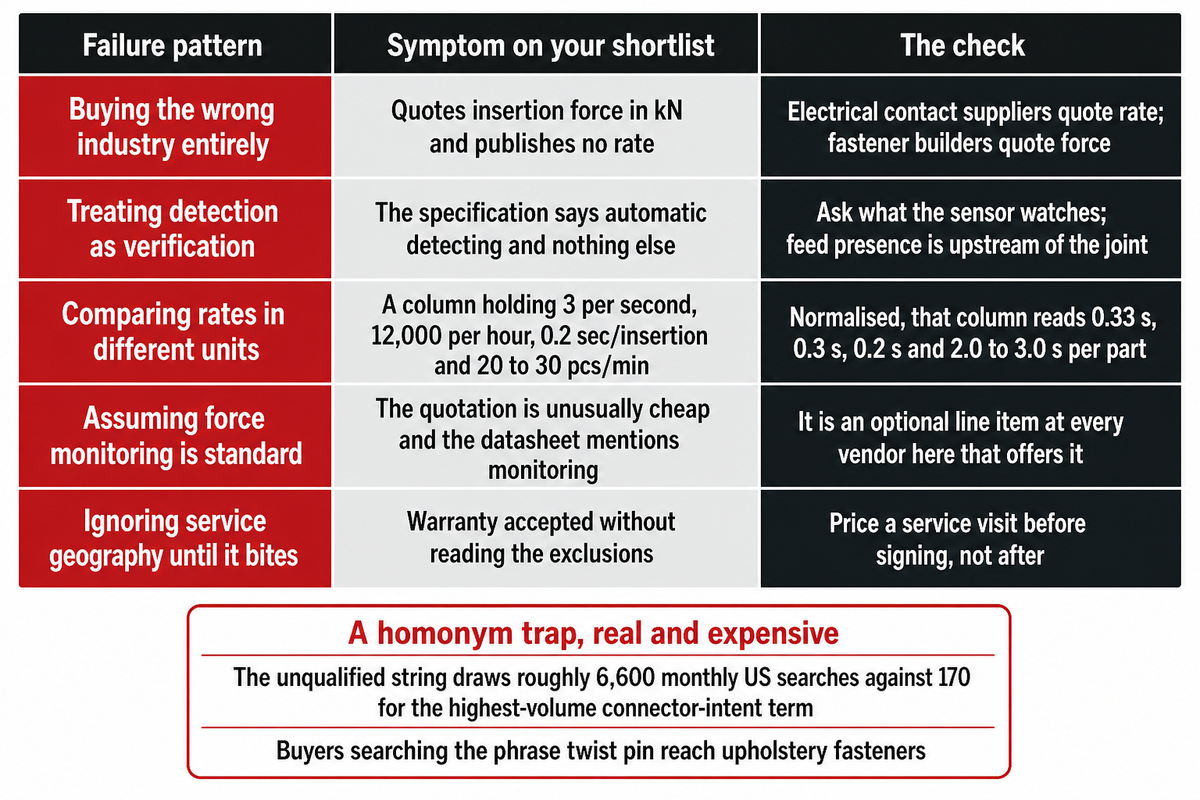
Five failure patterns account for most of the damage in this category, and four of them are visible before a purchase order is issued. Recognising them costs an hour of shortlist review; missing them costs a build cycle. Each one is caught in the places the previous section sent you: the vendor’s published page, the interface scope, and the spares region.
Five failure patterns, and the check that catches each one
- Failure pattern 1 — buying the wrong industry entirely. Symptom: your shortlist quotes insertion force in kN and publishes no rate. Check: mechanical fastener builders such as SPIROL and Visumatic quote force because a spring pin is pressed into a metal interference. Electrical contact suppliers quote rate. A shortlist mixing both is comparing incomparable machines.
- Failure pattern 2 — treating detection as verification. Symptom: the specification says automatic detecting and nothing else. Check: ask what the sensor watches. Feed-presence monitoring at the hopper is upstream of the joint and proves only that material was available.
- Failure pattern 3 — comparing rates in different units. Symptom: a spreadsheet column containing 3 per second, 12,000 per hour, 0.2 sec/insertion and 20 to 30 pcs/min. Check: normalise to seconds per verified part at your pitch — that column reads 0.33 s, 0.3 s, 0.2 s and 2.0 to 3.0 s per part, a 15x spread the raw units hide — and ask each supplier whether rejects and changeover are inside the number.
- Failure pattern 4 — assuming force monitoring is standard. Symptom: the quotation is unusually cheap and the datasheet mentions monitoring. Check: it’s an optional line item at every vendor here that offers it. Specify it explicitly, with export, or you won’t receive it.
- Failure pattern 5 — ignoring service geography until it bites. Symptom: warranty accepted without reading the exclusions. Check: at least one supplier states plainly that overseas after-sales costs are borne by the customer and that spare parts sit outside the one year warranty. Price a service visit before signing, not after.
A homonym trap, real and expensive. Buyers searching the phrase twist pin reach upholstery fasteners. Third-party keyword data pulled for this article puts the unqualified string at roughly 6,600 monthly US searches, against 170 for the highest-volume connector-intent term in the same set. Across the whole pull, dated 2026-09-02, the split is starker: 27 homonym-trap terms carry 59,960 monthly searches between them, while the 10 core machine-category terms carry 500. Search volume attaches to the string, not to the meaning, so that figure isn’t evidence of demand for upholstery pins; it’s evidence that the phrase resolves to soft furnishings before it resolves to connectors. Contact insertion, searched alone, returns contact lens tooling. Sourcing consequences are concrete: a request for quotation sent through a generic directory form will reach suppliers who make a completely different object and will answer politely, consuming two weeks. State hyperboloid contact, connector insulator and the connector series in the first line of any enquiry, and the mismatch resolves itself immediately.
What’s Changing in How These Machines Are Sourced (2026)
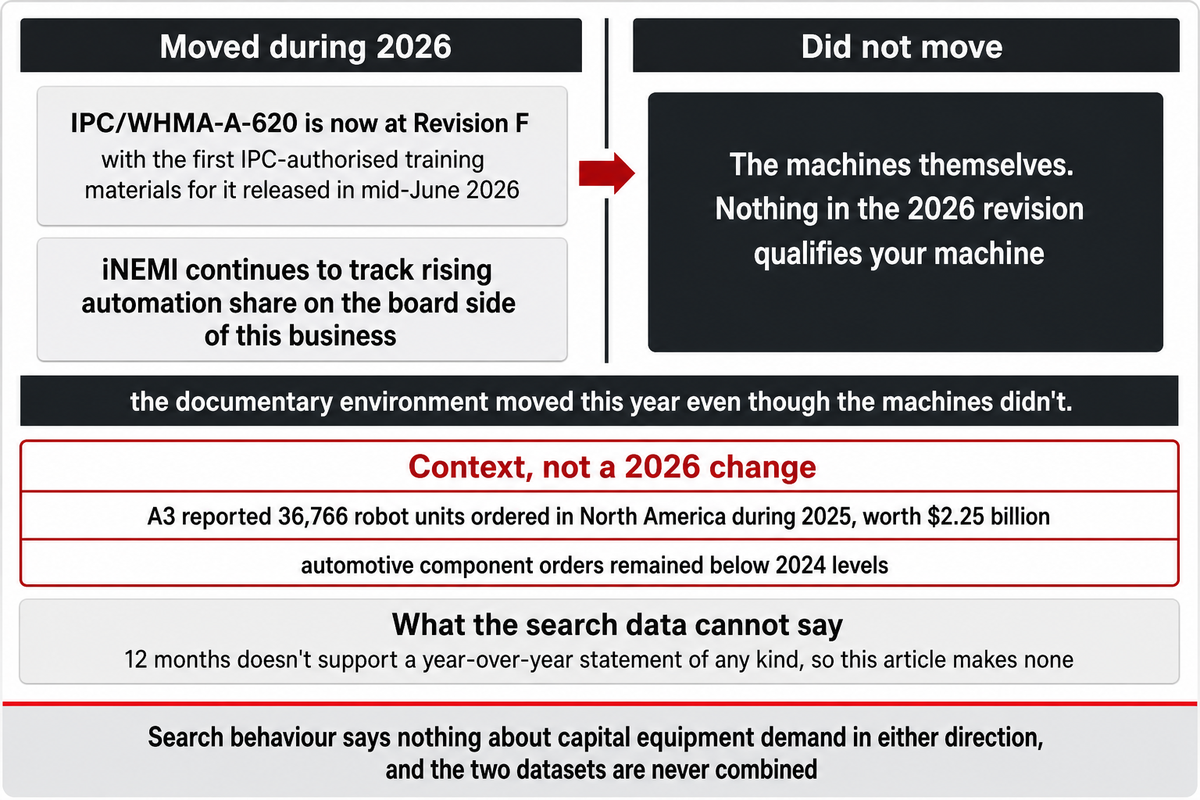
Buyers should now require the per-insertion data record as a line item rather than an option, because the documentary environment moved this year even though the machines didn’t. That’s the single change worth acting on before your next renewal, and it costs nothing to add to an RFQ you’re sending anyway.
Two things moved. IPC/WHMA-A-620 is now at Revision F, with the first IPC-authorised training materials for it released in mid-June 2026, relevant because your customer’s incoming inspection will cite the current revision for the finished assembly even though nothing in it qualifies your machine. Meanwhile the iNEMI press-fit roadmap continues to track rising automation share on the board side of this business, which is where the compliant-pin work sits.
On capital equipment demand, the association that collects the data is the one to cite. A3 reported 36,766 robot units ordered in North America during 2025, worth $2.25 billion; up 6.6% in units and 10.1% in revenue year over year on a consistent reporting cohort. Segment cut matters more than the headline: automotive component orders remained below 2024 levels while automotive OEM activity improved, which places connector and contact assembly behind the recovery rather than inside it.
One honesty note about search data, since supplier articles routinely abuse it. This project holds 12 months of keyword history for 35 related terms, and 12 months doesn’t support a year-over-year statement of any kind, so this article makes none. Available directional reading is narrower: across the most recent 9 months all four analysable machine terms read lower, but at 20 to 170 monthly searches the volume buckets round heavily enough that the movement carries no meaning. Search behaviour says nothing about capital equipment demand in either direction, and the two datasets in this section are never combined.
One measurement from the assistants themselves, since buyers increasingly start there. Asked on 2 September 2026, ChatGPT (GPT-4o mini) returned 6 cited sources for the best-manufacturers question, 3 for the price question and none at all for how to choose one; Perplexity returned 19 for each of the three. Read a thin answer as thin published evidence on the open web, not as a short supplier list, and go back to the vendor pages.
Frequently Asked Questions
Q: Who manufactures twist pin and insulator insertion machines?
Eleven manufacturers qualified for this article, across three groups: connector makers including TE Connectivity, Autosplice and FINECS; specialist machine builders including SM Contact, DETZO and I.C.T; and non-standard automation houses including ZEUEE, Harmontronics and Zhejiang Desheng.
Connector makers on the list are TE Connectivity, Autosplice and FINECS. Specialist builders are SM Contact, DETZO, I.C.T, SPIROL and Visumatic, though the last two work on mechanical fasteners rather than electrical contacts. Automation houses are ZEUEE, Harmontronics and Zhejiang Desheng. Only a subset handles insulator seating specifically, which the comparison table above marks per vendor from each company’s own published page.
Q: How much does a twist pin insulator insertion machine cost?
None of the eleven manufacturers publishes a price on the product pages reviewed here. Marketplace and directory listings sometimes carry a figure, but that is an asking price for one configuration rather than a comparable list price. Scope sets the cost here, not machine class, and a stand-alone head with one tooling kit is a different purchase from a fully automated cell.
Price in this category is set by scope rather than by machine class: a stand-alone head with one tooling kit and a fully automated cell for high volume production, with vision, fixture, loader and reject handling, are different purchases. What can be pinned down before quotation is the scope itself; station count, pitches to be covered, whether force monitoring and data export are included, and who pays for commissioning travel. Fix those, and the quotations become comparable even without a published list price.
Q: Is a connector twist pin the same as an upholstery twist pin?
No. A connector twist pin is a hyperboloid wire-cage contact; an upholstery twist pin is a furniture fastener, and they share only the phrase. The unqualified search term sits in soft furnishings, which is why directory enquiries so often reach the wrong industry.
The unqualified string carries roughly 6,600 monthly US searches at low competition, which is why generic supplier directories return soft-furnishing suppliers so readily. Consequences for sourcing are practical rather than academic: enquiries sent through directory forms reach the wrong industry and get answered anyway. Naming the contact type, the connector series and the insulator material in your first line removes the ambiguity before it costs you two weeks.
Q: Do I need a PCB pin insertion machine or a connector-housing machine?
Decide by the joint, not the machine: press-fit pins into printed circuit boards and contacts into an insulator cavity are different processes with different acceptance evidence.
PCB assembly machines from Autosplice, I.C.T and SM Contact target plated through-holes, where interference and board support govern the result. Connector-housing work seats a contact against a retention feature at low force, where the risk is damage to the insulator rather than insufficient force. Several suppliers cover both as separate product lines, so the question to ask is which line your quotation was written against.
Q: Are Eberhard and TE the only established pin insertion machine brands?
No, the search results overweight two names, while at least eleven manufacturers publish verifiable insertion equipment across three continents. Builders in Japan, Taiwan, France and China often publish more specific detail than the better-known brands do.
Brand recall in this category tracks marketing budget rather than capability, and the AI answer panels for these queries lean heavily on a handful of pages; ChatGPT’s answer to the best-manufacturers query cites six domains. Builders in Japan, Taiwan, France and China appear in the comparison table above, and their published detail is often more specific than the better-known names, including Autosplice’s pitch-qualified rates and DETZO’s optional real-time pressure monitoring. Evaluate on artifacts produced, not on recognition.
Q: What should a factory acceptance test cover for an insertion cell?
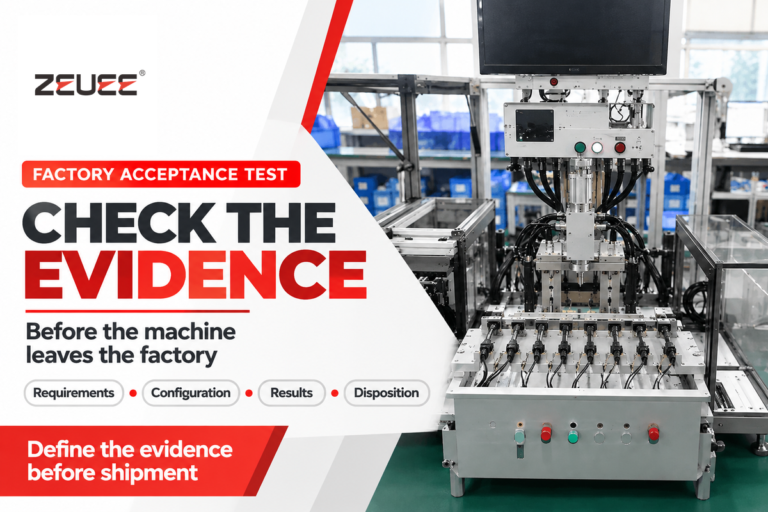
A written protocol agreed before build, covering sample size, verified cycle time, seating depth against a datum, and exported force records. Agree the protocol at order stage rather than at delivery, since a test written after the machine exists tends to describe what the machine already does.
Add a timed changeover in both directions, and state the pass criteria as numbers rather than adjectives.
Q: How long does a custom insertion machine take to build?
One of the eleven publishes a figure: 60 to 90 working days, which is roughly three to four months of calendar time once weekends are counted in.
That published window covers the build itself and not the work before it. That same supplier requires physical samples plus 2D and 3D drawings before it will quote, and supplies 3,000 to 5,000 trial components during proving; both of which add weeks that sit outside the stated build time. Sequence your own schedule accordingly: sample dispatch and drawing release usually determine the delivery date more than the factory does. For a cell with vision, a custom fixture and an MES interface, add validation time on your side after the factory acceptance test, since the machine cannot enter the production line until your quality function has signed the data records it produces. Ask every supplier to quote build time and proving time as two separate numbers, because a single combined figure hides which half is at risk.
Final Selection Advice
Match the archetype to your situation first, then apply the proof scale to whoever is left. Below is the shortest form of that advice.
| Your situation | Start with | Verify first |
|---|---|---|
| High-volume production on one connector family, contacts from a single supplier | Connector OEM tooling arm | That force monitoring and export are quoted, not assumed |
| High-mix work across several contact suppliers | Specialist machine builder | A timed changeover on two of your own part numbers |
| Non-standard housing, or a cell rather than a machine | Non-standard automation house | Trial parts run on your drawings before release to build |
| Regulated sector with customer audits | Whichever archetype exports per-insertion records | A sample data file and its retention period |
| Thin internal engineering, remote site | Supplier with local service, whatever the archetype | Written travel and spares terms, in the quotation |
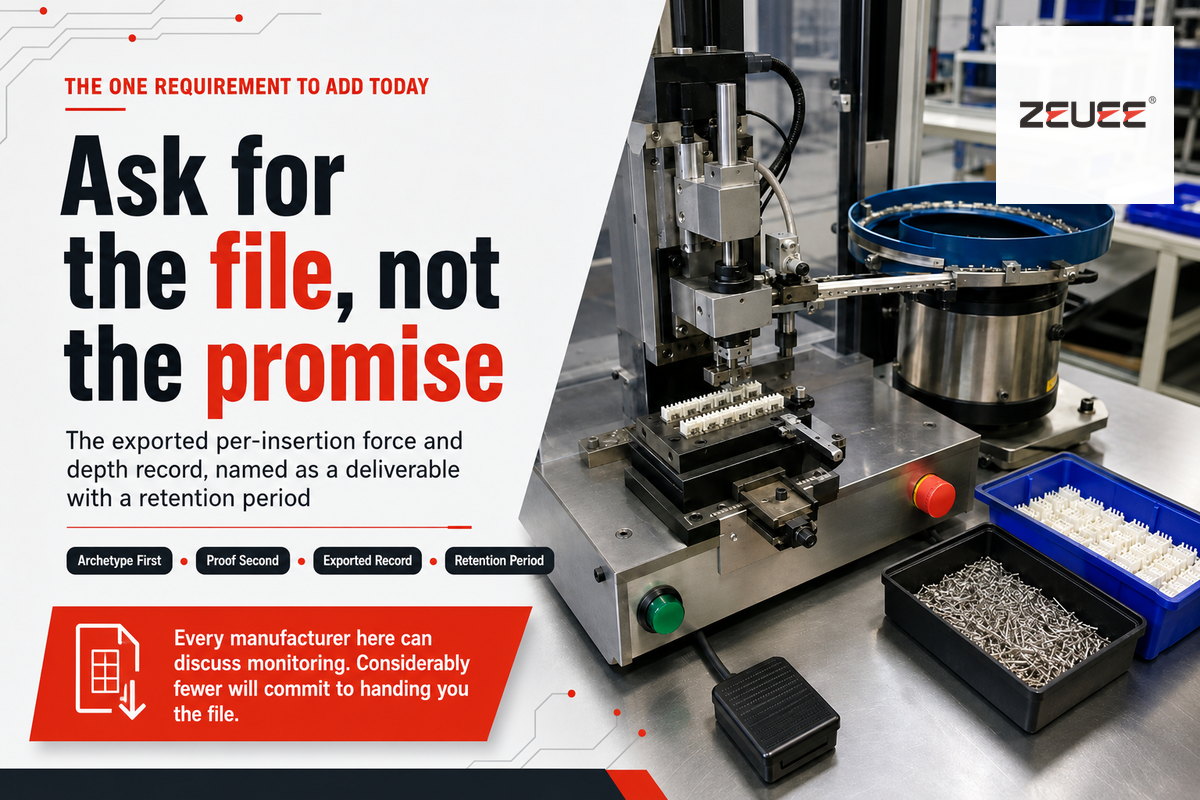
The one requirement to add today, regardless of which column you land in: the exported per-insertion force and depth record, named as a deliverable with a retention period. Every manufacturer here can discuss monitoring. Considerably fewer will commit to handing you the file.
About This Analysis
ZEUEE builds twist pin and insulator insertion equipment, so this comparison includes its own publisher and applies the same evidence test to itself. Every vendor figure here was read from that manufacturer’s live page on 2 September 2026 and is quoted rather than summarised; where a page is silent the entry reads not stated. Figures that depend on your own connector (insertion force windows, seating tolerance, cycle time) are given as method rather than value, because no supplier can set them for you.
References & Sources
- IPC/WHMA-A-620, Requirements and Acceptance for Cable and Wire Harness Assemblies — IPC (Revision F current, 2026)
- NASA-STD-8739.4, Crimping, Interconnecting Cables, Harnesses, and Wiring — NASA Technical Standards
- US3955414A, Contact insertion apparatus — positioning stop and retention flange datum
- US7775841B2, Hyperboloid electrical contact — low insertion force characteristic
- iNEMI Press-Fit Technology Roadmap — International Electronics Manufacturing Initiative
- 2025 North American robot order statistics — A3, Association for Advancing Automation
- Discrete pin insertion machines — TE Connectivity
- Insertion systems — Autosplice
- Pin insertion equipment — SM Contact
- Pin installation technology — SPIROL
- Automatic pin insertion — Visumatic
- Automatic connector pin inserting assembly machine — Zhejiang Desheng
Ask for the file, not the promise
Founded in 2005, ZEUEE builds connector assembly and insertion equipment, and is one of the eleven manufacturers reviewed above under the same evidence test as the other ten. Bring the connector drawing, the pin schedule and the takt target, and name the exported force-and-depth record as a deliverable.
Send us your connector drawing and pin schedule →
Request an insertion process review
WHY WE WRITE THIS
About ZEUEE Engineering Insights
ZEUEE shares technical guides based on real automation project experience. Since 2005, we have designed and manufactured non-standard automation equipment for connector assembly, wire harness production, robotic lines, vision inspection, and smart factory upgrades.
Founded in 2005
20,000 m² production base
120+ specialists
150+ R&D patents
ISO9001:2015 certified