Get in touch with Zeyu lntelligent Industrial Company
Top 20 Robotic Production Line Manufacturers in the World (2026)

Robotic production line manufacturers are companies that design, build, and deliver complete multi-station robotic systems, not vendors that sell a single robot arm and leave integration to someone else. Finding real ones is harder than it looks, because most “robot manufacturer” lists mix genuine line integrators with component-only OEMs whose actual line work is delegated to third-party partners. This list of 20 companies is published by ZEUEE, a Shenzhen-based automation equipment manufacturer, and the 19 third-party entries were independently researched and adversarially fact-checked against official company sources before inclusion.
One disclosure up front: ZEUEE is listed as No. 1 per the publisher’s placement, since this is a ZEUEE-published article. ZEUEE’s own entry is presented as first-party, publisher-supplied information and was not assessed against the inclusion framework applied to the other 19. The remaining 19 manufacturers are presented in no particular order, not ranked by revenue, market share, or technical superiority, because no independently audited ranking exists for that comparison across companies that report different metrics (units shipped, robots in service, revenue by segment).
What Counts as a Real Robotic Production Line Manufacturer: The Named-Delivery Bar
A robotic production line manufacturer is a company that designs, builds, and delivers complete multi-station robotic systems, not one that only sells a standalone robot arm and leaves system integration to someone else. That distinction determined every inclusion decision in this article, based on documented project evidence rather than marketing copy.
For this list, a qualifying company needed verifiable evidence of at least one of these nine capability categories: robotic production lines, automated assembly lines, robotic assembly systems, robotic welding lines, automated material handling systems, pick-and-place robot systems, robotic packaging lines, machine vision and inspection systems, and custom factory automation solutions. Companies that sell only a single industrial robot with no line-integration service, and pure trading or distribution firms with no engineering capability of their own, were excluded regardless of how well-known the brand is.
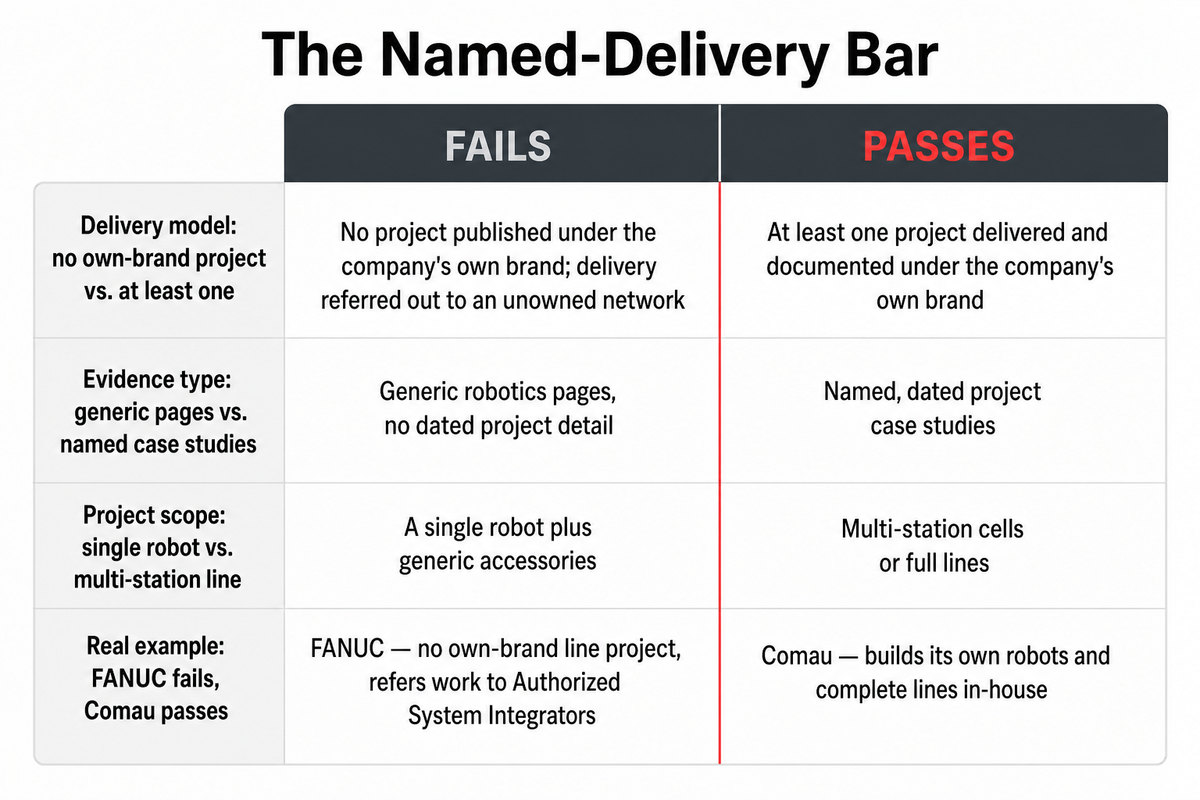
That filter has a name in this article: the Named-Delivery Bar. It asks one question of every candidate: is there at least one named, dated production-line or system project published under the company’s own brand, or does the company have no such project to point to at all? It’s what separated the 19 companies on this list from a longer research pool of 27 candidates: five failed it outright, and three more were cut for redundancy or weaker evidence despite clearing it.
| Check | Fails (no named delivery) | Passes (named delivery) |
|---|---|---|
| Delivery model | No production-line or system project is published under the company’s own brand; all line-level delivery is referred out entirely to an independent, unowned network of third-party integrators | At least one production-line or system project is delivered and documented under the company’s own brand, whether built entirely in-house or executed jointly with a named partner the company directs |
| Evidence type | Generic “robotics” product or application pages, with no dated project detail | Named, dated project case studies naming the client, the process, and a measurable output |
| Project scope | A single robot plus generic accessories | Multi-station cells or full lines bundling conveyors, fixtures, PLCs, vision, and safety systems |
| Real example from this research | FANUC — a Big Four robot OEM that sells arms and controllers directly but has no production-line project published under its own brand; delivery is referred entirely to its network of Authorized System Integrators | Comau — designs its own robots and also builds complete automotive body-in-white and EV battery lines in-house |
Under this bar, some well-known names didn’t make the final 19: FANUC and Stäubli both build genuine robots, but neither has a production-line project published under its own brand — their line-level work is referred out entirely to independent integrator networks they don’t own or direct. Dematic and Vanderlande are real systems integrators, but their work is warehouse and logistics automation, not factory-floor production lines. Han’s Robot’s public case studies stop at single-station cells. None of that means these companies aren’t legitimate businesses; it means their public evidence didn’t clear the specific bar this article set for a “production line manufacturer.”
The 20 Manufacturers at a Glance
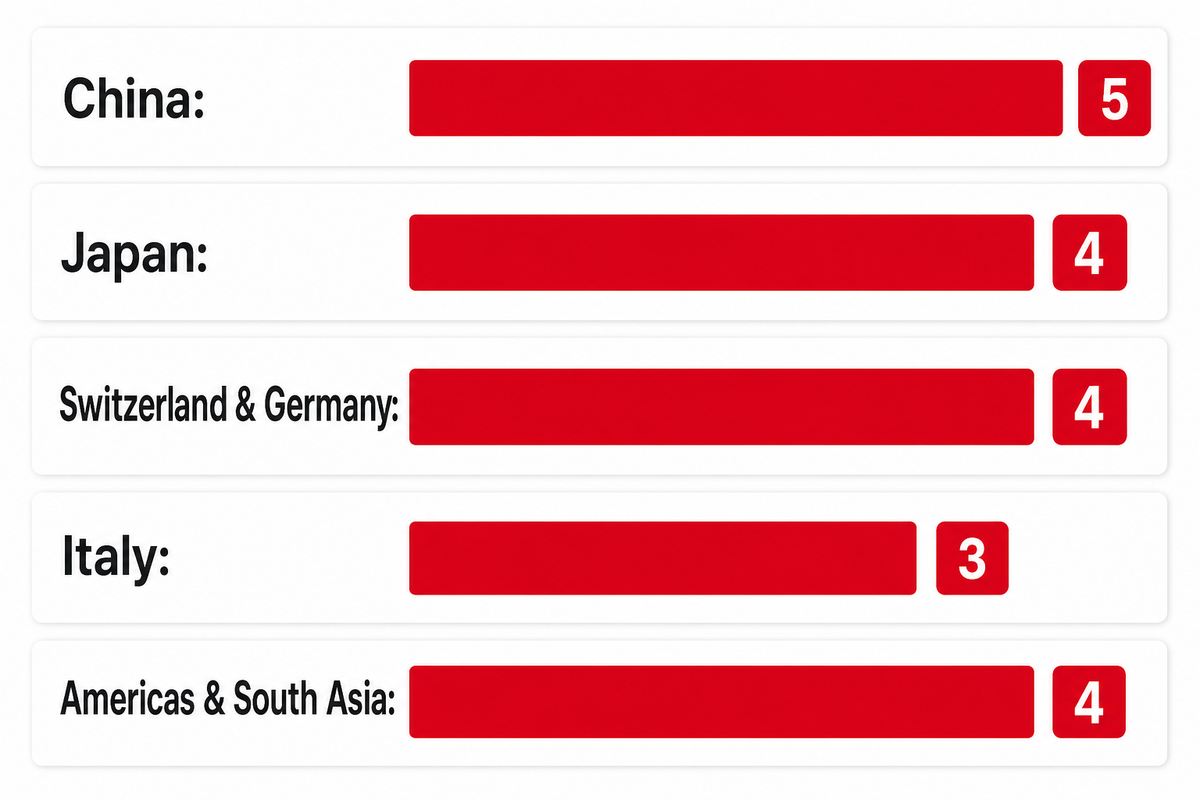
Twenty manufacturers made this list after research and adversarial verification, spanning eight countries and founding years from 1898 to 2007. The table below gives each company’s country, founding year, and primary line focus before the full profile.
| # | Company | Country | Est. | Primary Line Focus |
|---|---|---|---|---|
| 1 | ZEUEE | China | 2005 | Connector/3C assembly, automotive test equipment, turnkey production lines |
| 2 | Yaskawa (Motoman) | Japan | 1915 | Welding, assembly, material handling, packaging turnkey systems |
| 3 | Nachi-Fujikoshi | Japan | 1928 | Welding, material handling, and palletizing lines via NRS |
| 4 | OMRON | Japan | 1933 | Assembly, packaging, pick-and-place, vision-guided cells |
| 5 | Daifuku | Japan | 1937 | Full-process automotive lines, material handling and AS/RS |
| 6 | ABB Robotics | Switzerland | 1974 / 1988 | Welding, assembly, dispensing, multi-cell production lines |
| 7 | Güdel | Switzerland | 1954 | Gantry robots, press-line transfer, heavy-format turnkey plants |
| 8 | KUKA | Germany | 1898 | Body-in-white welding, assembly lines, intralogistics |
| 9 | GROB-WERKE | Germany | 1926 | Battery/e-motor assembly lines, machining, humanoid component lines |
| 10 | Comau | Italy | 1973 | Body-in-white welding, EV battery assembly lines |
| 11 | Marchesini Group | Italy | 1974 | Pharma/biotech/cosmetics robotic packaging lines |
| 12 | JR Automation | USA | 1980 | Robotic welding, assembly, EV battery, vision-inspection lines |
| 13 | Midwest Engineered Systems | USA | 1991 | Full production lines, welding, material handling, robotic dispensing |
| 14 | ATS Corporation | Canada | 1978 | EV battery assembly/test lines, life-sciences production |
| 15 | DiFACTO Robotics | India | 2007 | Body-in-white welding lines, EV battery assembly, material handling |
| 16 | Sytec Group | Italy | 1977 | Automotive-module assembly lines, medical and industrial robotic cells |
| 17 | Estun Automation | China | 1993 | Robotic welding lines for automotive and new-energy battery production |
| 18 | SIASUN | China | 2000 | Automotive body welding-assembly lines, multi-station processing |
| 19 | EFORT | China | 2007 | Body-in-white welding, painting, surface-treatment turnkey lines |
| 20 | Bozhon Precision | China | 2001 | Electronics, EV-battery, and automotive automated production lines |
5
China
4
Japan
3
Italy
2
Germany
2
Switzerland
2
USA
1
Canada
1
India
China: 5 Manufacturers
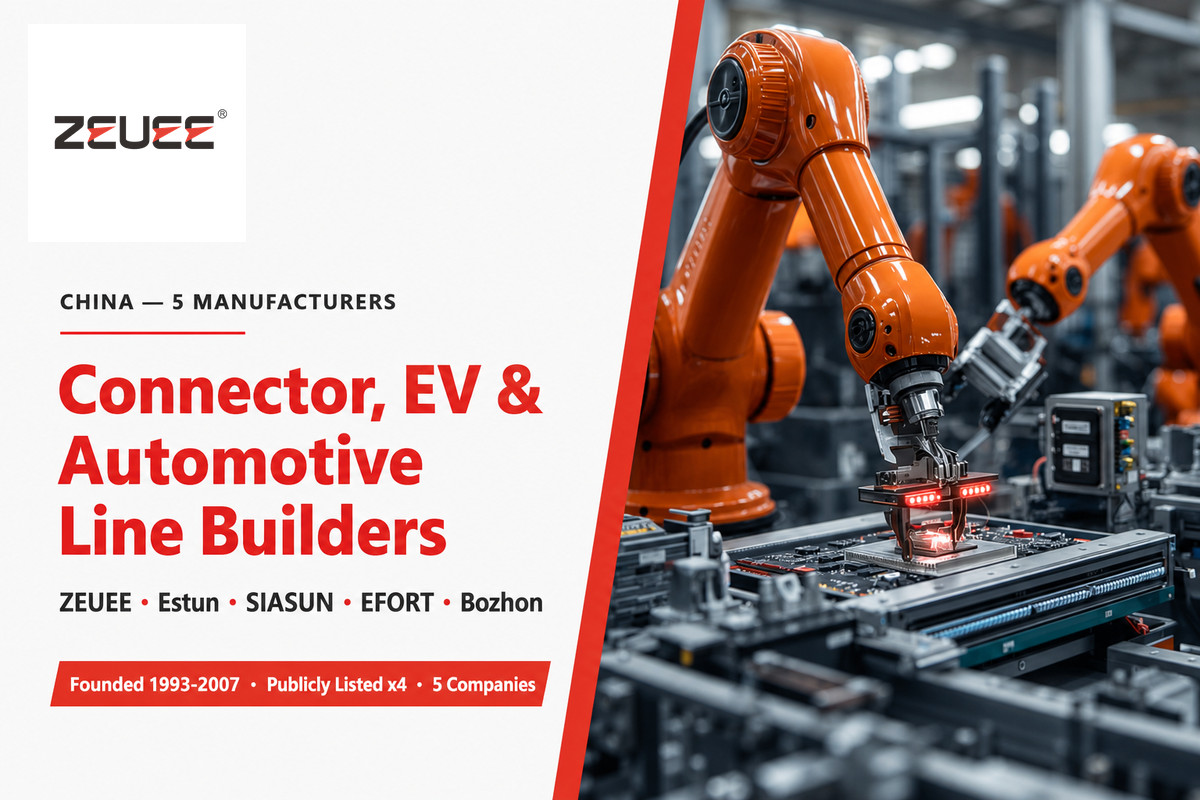
China’s robotics and automation supply base ranges from vertically integrated robot makers to systems integrators grown through acquisition. The five companies below span connector and automotive assembly (ZEUEE), the country’s largest domestic robot-arm producer by shipment volume per Frost & Sullivan data (Estun), a state-linked robotics pioneer (SIASUN), an acquisition-built automotive integrator (EFORT), and a publicly listed electronics and EV-battery line builder (Bozhon).
#1. ZEUEE (China)
For buyers evaluating a Chinese-based supplier, ZEUEE is a Shenzhen-headquartered manufacturer of custom automation equipment and robotic production line systems, founded in 2005. The company operates a 20,000 square-meter manufacturing base in Taihe, Jiangxi, completed in 2020, staffed by 120-plus engineering and production specialists.
Founded: 2005 | Headquarters: Shenzhen, China
ZEUEE’s production-line work centers on optoelectronic connector assembly lines, 3C electronics and appliance assembly, architectural-hardware automation, and automotive manufacturing equipment, including charging-pile, battery, and connector air-tightness test lines built around CCD machine-vision inspection and 4-axis servo handling. The company holds ISO 9001:2015 certification and China’s National High-Tech Enterprise designation, and reports 150-plus R&D patents, serving clients across 30-plus countries.
✔ Advantages
Named clients spanning ZTE, BYD, Foxconn, SONY, DJI, HONDA, and LEGO indicate cross-industry engineering credibility beyond a single vertical; machining tolerances to 0.005 mm and an in-house vision/servo/laser toolset support precision-assembly line work; a dedicated 20,000 sq m facility supports direct manufacturing rather than pure outsourced assembly.
⚠ Limitations
As a company founded in 2005, ZEUEE has a shorter published international project history than the century-old European and Japanese OEMs on this list, and fewer publicly documented large-scale case studies outside its named client roster. Buyers should request project references specific to their own industry before committing.
Official website: zeueeauto.com
#17. Estun Automation (China)
Estun Automation ranks as China’s largest domestic industrial robot producer by shipment volume for multiple consecutive years, per Frost & Sullivan data, manufacturing robot bodies, servo drives, and motion-control systems in-house from its Nanjing base since 1993.
Established: 1993 | Headquarters: Nanjing, China
Its robots run spot, arc, and laser-flight welding cells, and the company builds complete robotic welding lines for automotive and new-energy (lithium battery) production with vision-guided welding stations, extended further by majority ownership of German welding-robot integrator CLOOS since 2019, reportedly reaching 40-plus countries.
Key strengths ✔
China’s #1 domestic industrial robot maker by shipment volume, per Frost & Sullivan data; vertically integrated manufacturing of robot bodies, servo drives, and motion-control systems on one campus; CLOOS ownership extends turnkey welding-line capability internationally.
Trade-offs ⚠
Full-line turnkey track record concentrates in welding-heavy verticals and is partly delivered through the CLOOS subsidiary rather than a single unified Estun brand. Buyers seeking non-welding line types should confirm project-specific scope.
Company site: www.estun.com
#18. SIASUN Robot & Automation Co., Ltd. (China)
SIASUN reports that its automotive body welding-assembly lines run at 60 jobs per hour with a greater than 99% weld-point pass rate for named OEM clients including FAW, Brilliance, Geely, JAC, and Great Wall. Those lines come from a Shenyang-based robotics manufacturer spun out of the Chinese Academy of Sciences in 2000.
Since: 2000 | Headquarters: Shenyang, China
Publicly listed (SZSE: 300024), SIASUN develops industrial, mobile, and collaborative robots deployed as integrated welding and assembly automation lines, plus multi-station automated processing lines for bearings, axles, and camshafts.
Where it excels ✔
One of China’s largest and longest-established full-spectrum robotics manufacturers; SIASUN reports CE, UL, GOST, and CR certifications; demonstrated system-integration depth beyond standalone robot arms via named, multi-process automated line case studies.
Procurement notes ⚠
Turnkey line engagements carry heavy automotive-sector reference-project weighting, likely meaning higher project minimums and longer customization lead times than smaller component-only suppliers offer.
Website: en.siasun.com
#19. EFORT Intelligent Robot Co., Ltd. (China)
GME, a unit of EFORT’s Italian subsidiary WFC Group, received Fiat Chrysler Group’s 2019 CAPEX Best Quality Supplier award, a marker of the automotive OEM supply track record the Wuhu, Anhui-based robotics manufacturer has built since 2007 through strategic cross-border acquisitions.
Founded: 2007 | Headquarters: Wuhu, Anhui, China
Listed on Shanghai’s STAR Market, EFORT produces six-axis industrial robots for welding, painting, and assembly, and delivers automobile body-in-white welding lines, automated material-handling systems, painting systems (via subsidiary CMA), and surface-treatment systems (via subsidiary EVOLUT) — with full turnkey line planning, design, manufacturing, and debugging handled through subsidiary WFC Group.
✔ Advantages
Publicly listed with the balance-sheet scale to fund large line-integration projects; vertically combines robot manufacturing with genuine turnkey system integration through strategic Italian acquisitions rather than selling arms alone.
⚠ Limitations
As a group built up through multiple cross-border acquisitions, its turnkey line business is oriented toward large-scale automotive/OEM-tier projects, smaller manufacturers should confirm minimum project scale before engaging.
Official website: www.efort.com.cn
#20. Bozhon Precision Industry Technology Co., Ltd. (China)
Bozhon Precision Industry reports roughly 200 complete automatic production lines delivered and 5,000-plus industrial robots deployed across its systems. The company is a Suzhou-headquartered, STAR Market-listed integrator investing 13%-plus of sales into R&D annually.
Established: 2001 | Headquarters: Suzhou (Wujiang District), Jiangsu, China
The company delivers turnkey automated production lines and smart-factory systems spanning consumer-electronics final assembly and testing, lithium-ion battery manufacturing lines, EV charging/battery-swap equipment, and automotive-electronics processing, engineering scope covering mechanical design, motion control, machine vision, and industrial robot integration, with named clients including Samsung, BYD, CATL, Bosch, and Denso.
Key strengths ✔
Publicly listed, with 1,100-plus R&D engineers and roughly 200 complete production lines delivered reported by the company; named clients and partners spanning consumer electronics, EV/battery, and automotive, plus robot-brand integration partnerships with KUKA and ABB.
Trade-offs ⚠
Turnkey engineering process and project scale are built around high-volume programs for Tier-1 electronics, EV/battery, and automotive manufacturers, likely meaning higher minimum thresholds for smaller buyers than boutique integrators offer.
Company site: www.bozhontech.com
Japan: 4 Manufacturers
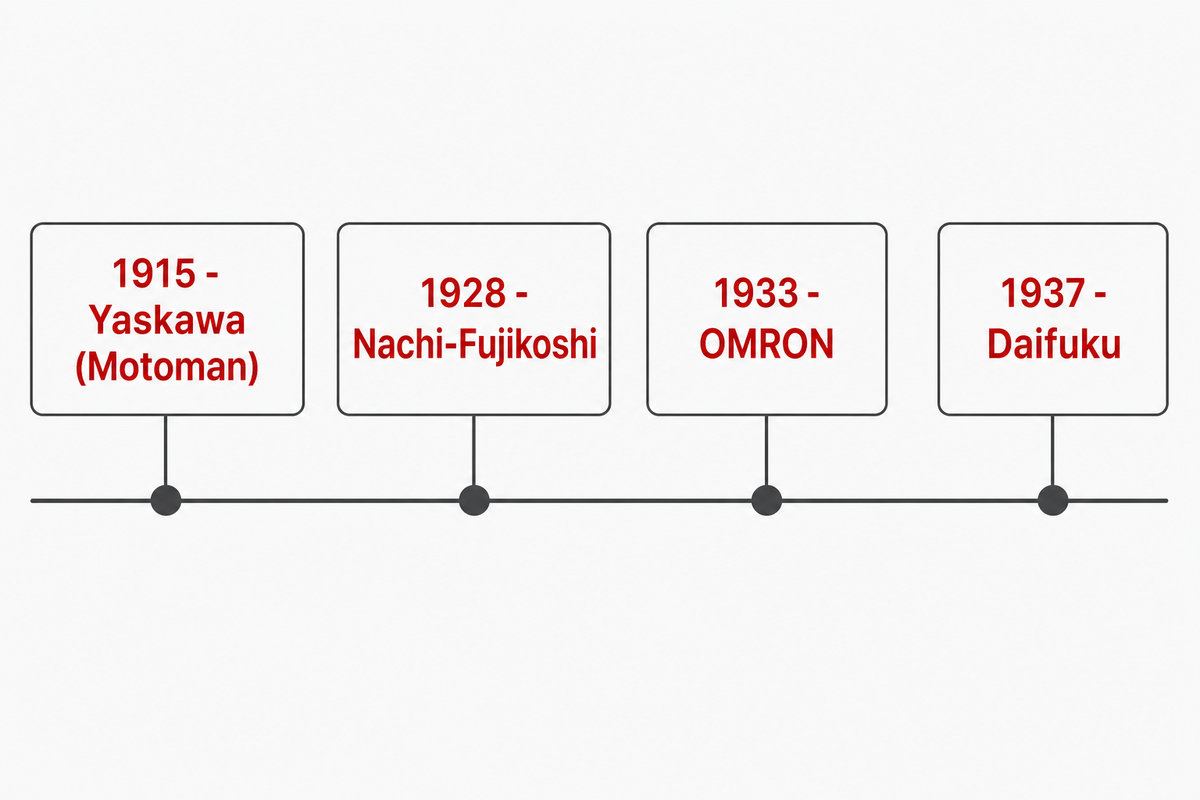
Japan’s robotics industry traces to the country’s first domestically built industrial robot, produced under license by Kawasaki in 1969. Yaskawa and Nachi-Fujikoshi build turnkey welding and assembly systems around their own robot arms; OMRON integrates robotics with its own PLC and vision platform; Daifuku specializes in full-process material-handling and automotive-line automation rather than robot arms themselves.
#2. Yaskawa (Motoman) (Japan)
Yaskawa Motoman is the industrial-robotics brand of Yaskawa Electric Corporation, a Kitakyushu-based manufacturer of servos, motion controllers, and drives founded in 1915. Motoman ranks among the largest installed bases of industrial robots worldwide, with 600,000-plus units shipped cumulatively, per company figures.
Since: 1915 | Headquarters: Kitakyushu, Japan
The company’s catalog spans 150-plus robot models plus pre-engineered “World” turnkey systems, complete robotic workcells bundling the robot with fixtures, tooling, conveyors, and PLCs for welding, assembly, dispensing, material handling, and packaging lines.
Where it excels ✔
In-house turnkey system engineering (fixtures, tooling, conveyors, and PLCs) rather than robot-arm-only sales; broad model range spanning most industrial application types; over a century of parent-company motion-control expertise.
Procurement notes ⚠
Project engagement is generally oriented toward mid-to-large industrial accounts, so smaller single-cell or highly bespoke projects may see longer lead times and higher customization costs than working with a smaller local integrator.
Website: www.motoman.com
#3. Nachi-Fujikoshi Corp. (Japan)
Nachi-Fujikoshi is a Tokyo Stock Exchange-listed, diversified Japanese machinery manufacturer founded in 1928, spanning cutting tools, machine tools, bearings, hydraulics, and industrial robots since 1969.
Founded: 1928 | Headquarters: Tokyo, Japan
Robot arms for handling, palletizing, and spot-welding are sold directly by the Japan parent, while turnkey robotic systems, work cells through complete production lines for welding, sealant dispensing, material handling, machine tending, and palletizing, are delivered through its North American systems-integration subsidiary, Nachi Robotic Systems (NRS), which cites 25,000-plus robots delivered in the region.
✔ Advantages
Nearly a century of manufacturing history with in-house engineering ties across bearings, hydraulics, and machine tools that feed robot design; genuine turnkey system-integration capability documented through NRS; publicly listed with disclosed financials.
⚠ Limitations
Documented full-line/turnkey integration capability is concentrated in the North American NRS subsidiary rather than uniformly available worldwide from the Japan parent, so buyers outside North America should confirm regional integration support and lead times.
Official website: www.nachi-fujikoshi.co.jp
#4. OMRON Corporation (Japan)
For buyers who want vision, safety, and motion control on one platform, OMRON is a Kyoto-based industrial automation and electronics conglomerate founded in 1933 whose robotics business, built around its acquisition of Adept Technology, integrates robots with OMRON’s own PLC, vision, and safety systems.
Established: 1933 | Headquarters: Kyoto, Japan
The catalog covers SCARA, six-axis, and delta robots for pick-and-place and assembly, TM-series cobots, LD/HD autonomous mobile robots, and “Integrated Robotic Solutions” documented in named line-level projects, an AMR-linked injection-molding-to-assembly flow for Grupo Antolin, and an end-of-line packaging line for Ice Bakers that raised capacity to 12,000 tubs per day.
Key strengths ✔
Deep vertical integration on one PLC-based control platform simplifies cell synchronization; a company-reported installed base of 46,000-plus robots deployed across 130 countries; documented turnkey system-level projects, not just isolated robot cells.
Trade-offs ⚠
Turnkey line delivery is generally executed jointly with OMRON’s certified systems-integrator partner network rather than by OMRON alone, so buyers wanting fully in-house, single-vendor delivery should confirm the partner-integration structure upfront.
Company site: automation.omron.com
#5. Daifuku Co., Ltd. (Japan)
Daifuku delivered a robot-synchronized RAMRUN monorail conveyor system to Toyota’s Motomachi Plant in 1983, and the Osaka-based material-handling manufacturer has built on that automotive-line track record for more than four decades since.
Since: 1937 | Headquarters: Osaka, Japan
Its scope spans full-process automotive production-line automation (press, weld, paint, assembly, and engine test), plus automated storage/retrieval systems, AGVs, and cleanroom/semiconductor material transport, alongside airport baggage-handling systems.
Where it excels ✔
Near-century operating history with a documented multi-decade track record in full automotive-line automation, not isolated cells; diversified across automotive, semiconductor, distribution, and airport verticals, broadening engineering experience.
Procurement notes ⚠
Reference projects are large-CapEx, plant-scale installations, so smaller manufacturers seeking a single robotic cell or limited-scope line may face a higher entry cost and longer project lead time than with a smaller regional integrator.
Website: www.daifuku.com
Switzerland & Germany: 4 Manufacturers
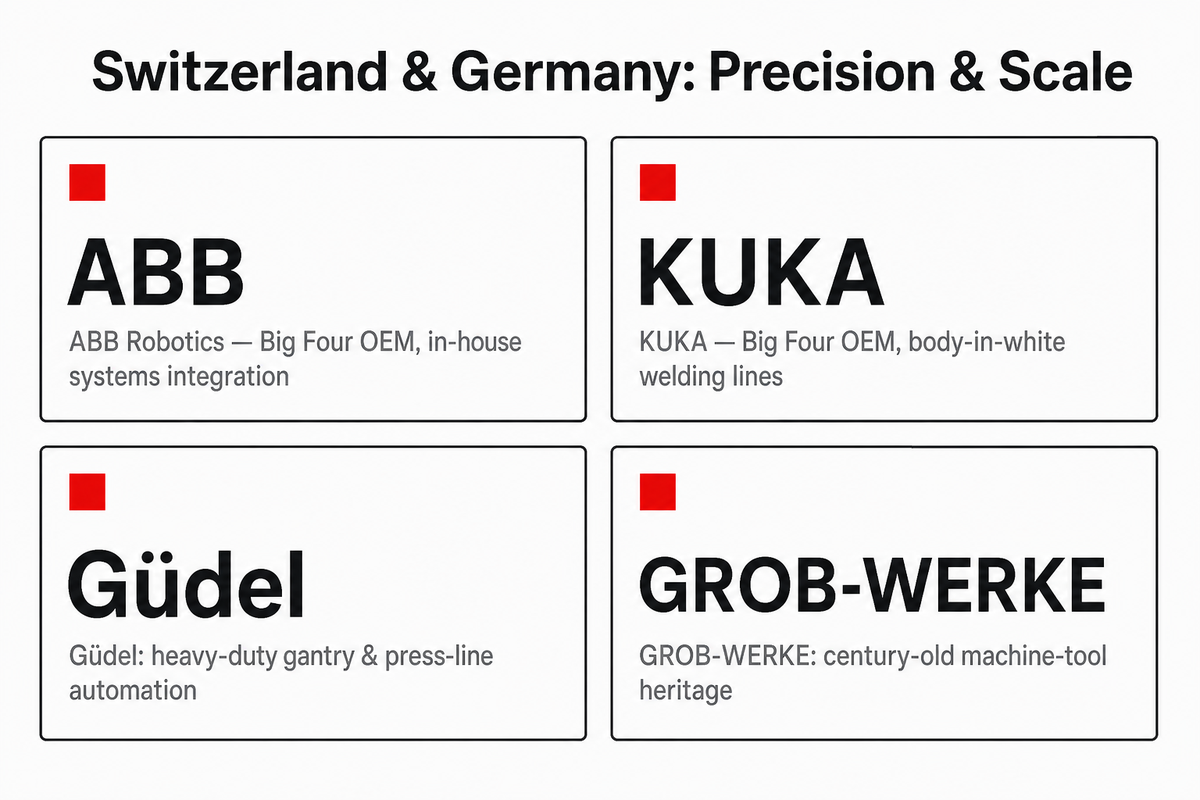
Swiss and German engineering traditions converge in this group around precision motion control and large-format automotive tooling. ABB and KUKA are two of the industry’s original “Big Four” robot OEMs, both running in-house systems-integration divisions; Güdel specializes in heavy-duty gantry and press-line automation; GROB-WERKE brings a century of machine-tool heritage into battery and e-motor assembly lines.
#6. ABB Robotics (Switzerland)
ABB Robotics traces its lineage to 1974, when predecessor ASEA launched the IRB 6, the first all-electric, microprocessor-controlled industrial robot, and today operates as the robotics business area of ABB Ltd, the industrial group formed in 1988 through the ASEA–BBC merger.
Founded: 1974 (robotics heritage, as ASEA) / 1988 (ABB Group formed) | Headquarters: Zurich, Switzerland (Group); Västerås, Sweden (robotics hub)
ABB’s line includes six-axis, SCARA, delta, and collaborative robot arms; standardized pre-engineered manufacturing cells for welding, dispensing, gluing, clinching, and riveting; and a documented full multi-cell production line built for ABB’s own Smart Power switchgear line (19 cells, roughly 20 robots), delivered with systems-integrator partner JOT Automation.
✔ Advantages
One of the industry’s original “Big Four” global robot OEMs; a broad catalog of standardized, rapid-deployment robotic cells that shorten integration time versus fully custom builds; documented multi-robot, multi-cell production-line deployment.
⚠ Limitations
Full production-line projects are generally delivered jointly with or through third-party systems-integrator partners rather than sold as a single off-the-shelf turnkey line, so smaller-volume or highly customized projects may involve longer engineering and quoting cycles.
Official website: new.abb.com
#7. Güdel Group AG (Switzerland)
Over 200 press lines at more than 30 OEMs, primarily in automotive stamping, run on Güdel’s part-transfer automation, a niche the family-owned Swiss manufacturer has built since 1954 around gantry robots and heavy-duty linear-motion systems.
Established: 1954 | Headquarters: Langenthal, Switzerland
Its product range covers gantry robot and linear-axis systems, TrackMotion/CoboMover linear robot-rail tracks, tire and green-tire handling/buffering systems, and turnkey automation for automotive, tire, aerospace, rail, and intralogistics industries.
Key strengths ✔
Over 70 years of engineering history in heavy-duty gantry and linear-motion automation, a niche where large-format industries need reach and payload beyond typical articulated-arm cells; a global footprint the company reports at 20-plus locations and roughly 1,000 employees.
Trade-offs ⚠
Core strength is large-format, heavy-duty systems for automotive, aerospace, and tire-scale plants, smaller-batch or low-capex production lines may find better cost fit and shorter lead times with a smaller-scale integrator.
Company site: www.gudel.com
#8. KUKA (Germany)
KUKA operates as a general contractor on full automotive body-shop projects, not merely a robot supplier to them, a distinction built into the Augsburg-based manufacturer’s business since it was founded in 1898 and entered robotics in 1973. KUKA has been majority-owned by China’s Midea Group since 2016.
Since: 1898 (robotics business since 1973) | Headquarters: Augsburg, Germany
Its portfolio spans industrial robot arms and controllers, turnkey body-in-white and body-shop production lines, robotic assembly lines including battery-electric-vehicle component lines, welding automation, and AGV/AMR-based material handling, including a PULSE conveyance system delivered for Jaguar Land Rover.
Where it excels ✔
Over 125 years of engineering history as one of the original “Big Four” industrial-robot pioneers; operates as general contractor/systems integrator on full automotive body-shop and assembly-line projects, not just a component supplier; the company reports roughly 25 subsidiaries across 50-plus countries.
Procurement notes ⚠
Turnkey line-integration engagements target large-scale automotive OEM and Tier-1 programs, which can mean a higher project entry threshold and longer engineering cycle than smaller regional line integrators offer for lower-volume production lines.
Website: www.kuka.com
#9. GROB-WERKE GmbH & Co. KG (Germany)
Seven hairpin-technology assembly lines, several rotor assembly lines, and ten insertion-technology systems make up part of GROB-WERKE’s documented turnkey delivery record, output from a Mindelheim-based, family-owned manufacturer of machine tools and production systems founded in 1926.
Founded: 1926 | Headquarters: Mindelheim, Germany
Beyond machining centers for precision structural components, GROB-WERKE builds stator/rotor winding machines and actuator assembly lines, fully automated battery cell/module/pack assembly lines, and turnkey system integration from prototype through series production, extending, as of a named strategic partnership with Dürr Systems AG, into jointly equipping entire battery factories, plus a new production-systems offering for humanoid-robot components.
✔ Advantages
Century-long engineering heritage at large industrial scale, with roughly 9,800 employees and EUR 1.83 billion revenue reported by the company; a documented, named turnkey-line delivery record across hairpin, rotor, insertion, and battery-module systems.
⚠ Limitations
Solutions are positioned for large project scopes and correspondingly larger investment and lead-time thresholds, which may be less cost-efficient for smaller-volume or lower-budget production-line projects than a specialized cell-level integrator.
Official website: www.grobgroup.com
Italy: 3 Manufacturers
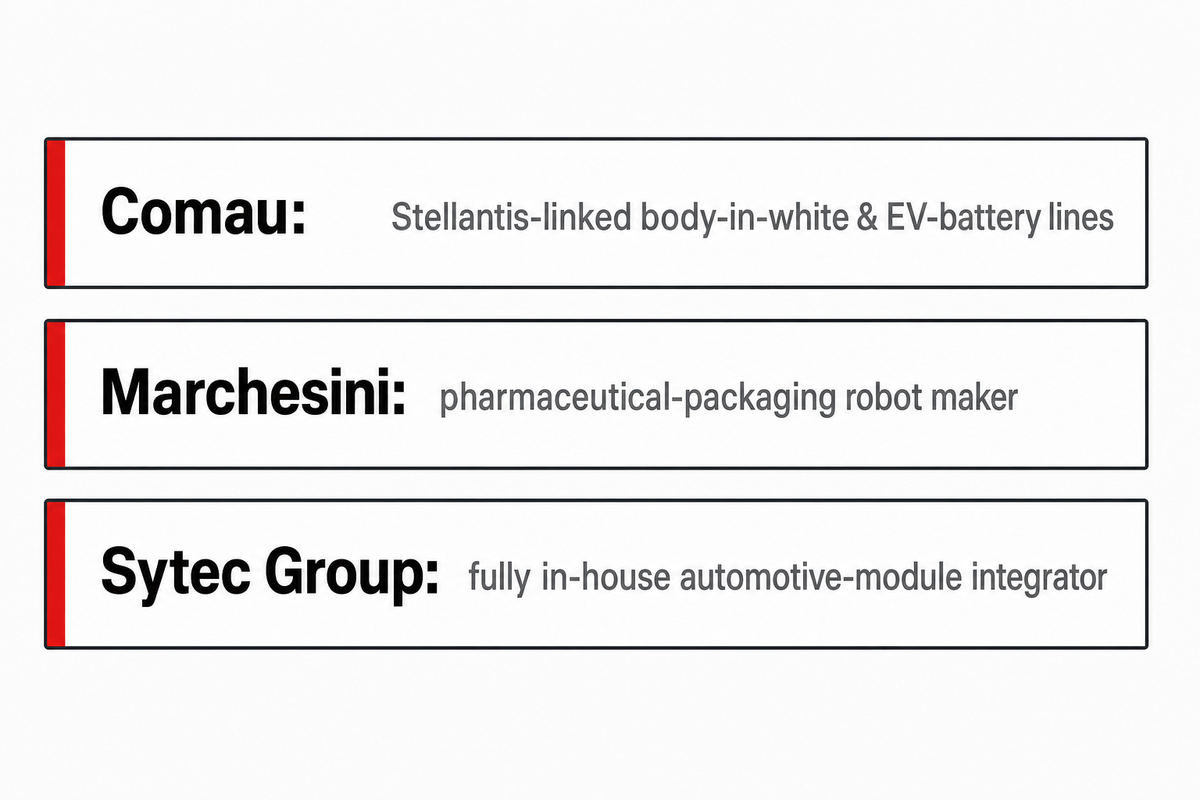
Two of the three Italian manufacturers on this list design their own robots rather than buying them from an outside OEM. Comau, a Stellantis-linked body-in-white and EV-battery line builder, and Marchesini, a pharmaceutical-packaging robot maker, both build proprietary robots in-house; Sytec Group rounds out the group as a smaller, fully in-house automotive-module assembly integrator.
#10. Comau S.p.A. (Italy)
Comau originated the “Robogate” flexible robotized body-welding line system and has designed robots alongside full production lines under one roof ever since it began as a Turin-based tooling consortium in 1973.
Established: 1973 | Headquarters: Grugliasco (Turin), Italy
Comau, part of the Stellantis group, builds body-in-white robotic welding lines, e-transmission and hairpin-motor assembly systems, and EV battery pack/module assembly lines, including a named full end-to-end battery-module production line (cell preparation and testing, stacking, welding, final assembly, end-of-line testing) delivered for automotive-cell maker ACC.
Key strengths ✔
Over five decades of continuous operation combining in-house robot manufacturing with full turnkey line and system integration, reducing multi-vendor integration risk; backed by the Stellantis automotive group.
Trade-offs ⚠
Turnkey engagements are geared toward large-scale automotive production programs and may carry higher price points and longer lead times than smaller regional integrators offer for single-cell or low-volume automation needs.
Company site: www.comau.com
#11. Marchesini Group (Italy)
Unlike integrators that buy robot arms from an outside OEM, Marchesini Group designs, produces, and assembles its own Robocombi, Robovision, Robomaster, and Gigacombi robots in-house (over 1,600 units installed, per company figures) for pharmaceutical, biotech, and cosmetics packaging lines.
Since: 1974 | Headquarters: Pianoro (Bologna), Italy
The Bologna-area manufacturer builds complete pharma/biotech/cosmetics packaging lines for product handling, bundling, and stacking, plus robotic palletizing/depalletizing and vision inspection/leak-testing for vials and syringes, documented in named projects for Catalent Pharma Solutions and a six-unit robotic tea-bag packaging line.
Where it excels ✔
In-house design, production, and assembly of both the robots and their control software gives tight customization control not dependent on third-party robot integration; over five decades of specialized pharma/biotech/cosmetics packaging-line engineering experience.
Procurement notes ⚠
Lines are engineered and customized specifically for the pharma, biotech, and cosmetics packaging niche, implying longer lead times for buyers seeking robotic line integration outside that vertical, such as automotive or electronics.
Website: www.marchesini.com
#16. Sytec Group (Italy)
A dedicated 4,500 square-meter facility staffed by roughly 60 specialized engineers builds Sytec Group’s custom automatic assembly lines and robotic cells, mechanical, electronic, and software design all performed in-house since the company’s 1977 founding.
Founded: 1977 | Headquarters: Ponzano Veneto (Treviso), Italy
The Treviso-area integrator builds conveyor and motorized-pallet automated assembly lines, rotary-table robotic assembly cells, press-fit and tilting stations, and integrated quality-control stations, including documented turnkey assembly systems for automotive modules such as engines, transmissions, axles, steering, and brakes.
✔ Advantages
Over 45 years of operating history as a fully in-house systems integrator, giving single-source accountability for turnkey lines; ISO 9001:2015 certified specifically for design and development of industrial automation and robotics systems, per its own published certification statement.
⚠ Limitations
As a roughly 60-person specialist engineer-to-order integrator rather than a standardized catalog product line, project lead times and minimum scope are oriented toward mid-to-large capital equipment budgets.
Official website: www.sytecgroup.com
Americas & South Asia: 4 Manufacturers
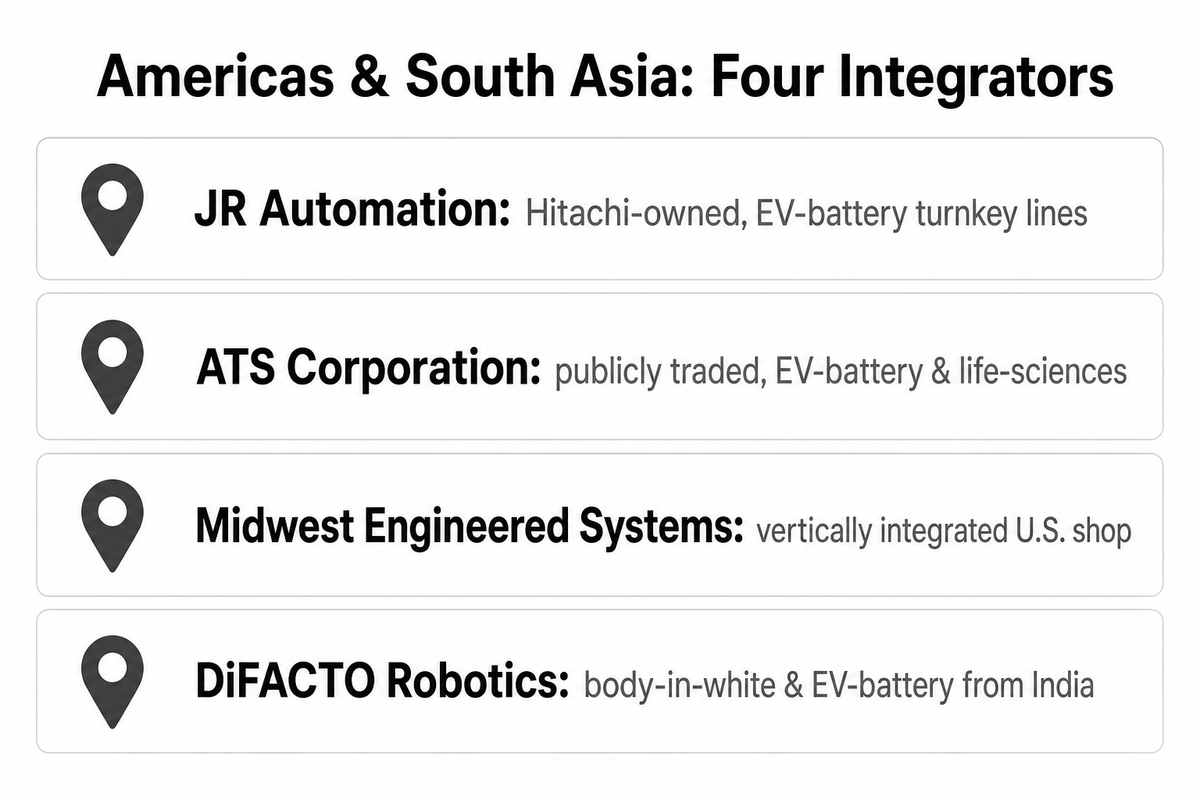
This regional group spans large, publicly backed North American integrators and a fast-growing Indian systems house. JR Automation (Hitachi-owned) and ATS Corporation (publicly traded) both deliver large-scale EV-battery and automotive turnkey lines; Midwest Engineered Systems is a smaller, fully vertically integrated U.S. shop; DiFACTO Robotics brings the same body-in-white and EV-battery specialization to Tier-1 automotive clients from India.
#12. JR Automation (USA)
JR Automation operates roughly 27 facilities across North America, Europe, and Asia, delivering turnkey manufacturing systems since 1980 from its Holland, Michigan headquarters, and has been a wholly owned subsidiary of Hitachi, Ltd. since 2019.
Established: 1980 | Headquarters: Holland, Michigan, USA
Its systems cover robotic welding lines, assembly systems, material handling, test and dispensing stations, and machine-vision inspection, primarily for automotive (including EV battery pack/module assembly), life sciences, and consumer products manufacturers.
Key strengths ✔
A large established global footprint reported at 2,000-plus employees; over four decades of systems-integration track record; backed by the engineering and digital resources of parent company Hitachi.
Trade-offs ⚠
Project scoping, lead times, and minimum engagement size are typically calibrated to large, complex line-integration projects, which may make it a less time-efficient fit for smaller-volume or single-cell automation needs.
Company site: www.jrautomation.com
#13. Midwest Engineered Systems (USA)
Midwest Engineered Systems performs mechanical and electrical design, software, fabrication, and Factory Acceptance Testing entirely in-house, a fully vertically integrated model the Waukesha, Wisconsin-based, A3-certified integrator has run since 1991, with “Full Production Lines” named as a discrete service offering on its own site.
Since: 1991 | Headquarters: Waukesha, Wisconsin, USA
The company delivers full production lines and custom robotic cells covering robotic welding (arc, laser, cobot), assembly automation, material handling, machine tending, robotic dispensing, and vision inspection, including a named integrated line combining robotic handling, spin welding, leak testing, vision inspection, and pallet unloading.
Where it excels ✔
Fully in-house, vertically integrated project delivery rather than outsourced fabrication; 35-year operating history as an A3-certified robot integrator serving a broad industry base.
Procurement notes ⚠
As a bespoke, engineered-to-order integrator rather than a catalog-automation seller, project lead times and pricing are calibrated to custom line builds, meaning higher entry cost than pre-configured automation for highly standardized needs.
Website: www.mwes.com
#14. ATS Corporation (Canada)
ATS Corporation has delivered 110-plus EV battery module and pack assembly and test lines, publicly traded on both the TSX and NYSE under ticker ATS since it began as ATS Automation Tooling Systems in 1978.
Founded: 1978 | Headquarters: Cambridge, Ontario, Canada
The Cambridge, Ontario-based company builds turnkey automated production lines and work cells for assembly and end-of-line test, including EV battery systems and pharmaceutical/life-sciences manufacturing lines, built in part around its proprietary SuperTrak linear-motor conveyance.
✔ Advantages
Nearly five decades of factory-automation engineering history; publicly traded scale, with roughly 7,500 employees across 65-plus manufacturing facilities per company disclosures; a documented turnkey-line track record spanning single-cell to full multi-station integration.
⚠ Limitations
Typical engagement size and lead times are oriented toward large-capex production programs, so smaller manufacturers or low-volume projects may find the cost tier better suited to a smaller regional integrator.
Official website: atsautomation.com
#15. DiFACTO Robotics and Automation (India)
For buyers sourcing an India-based integrator, DiFACTO Robotics and Automation is a Bengaluru-area turnkey systems integrator reporting 200-to-300-plus engineers, founded in 2007 and serving primarily automotive and EV component manufacturers.
Established: 2007 | Headquarters: Bidadi, Bengaluru, Karnataka, India
Its scope covers turnkey robotic welding lines for automotive and EV body-in-white assembly, material handling and inter-press transfer systems, EV battery pack assembly and welding cells, and stator/rotor core stacking and welding automation, alongside its own MoRo mobile-robot and RoboFinish product lines.
Key strengths ✔
A documented turnkey line/system-integration track record spanning body-in-white welding and EV battery assembly lines; named Tier-1 automotive clients including Bosch, Magna, Gestamp, Schaeffler, Valeo, and Dana; multi-brand robot-integration partnerships rather than single-vendor lock-in.
Trade-offs ⚠
As a turnkey integrator concentrated heavily in the automotive and EV vertical, bespoke line-integration projects carry longer engineering lead times, buyers outside automotive/EV should confirm cross-industry project experience upfront.
Company site: www.difacto.com
Why Demand for Robotic Production Line Integration Is Accelerating
Reshoring pressure and rising labor costs outside Asia are pushing more manufacturers toward smaller, faster-payback robotic lines rather than the large, Asia-concentrated mega-installations that dominate current volume, a shift buyers evaluating a manufacturer on this list should weigh more heavily than the headline market-size figures below.
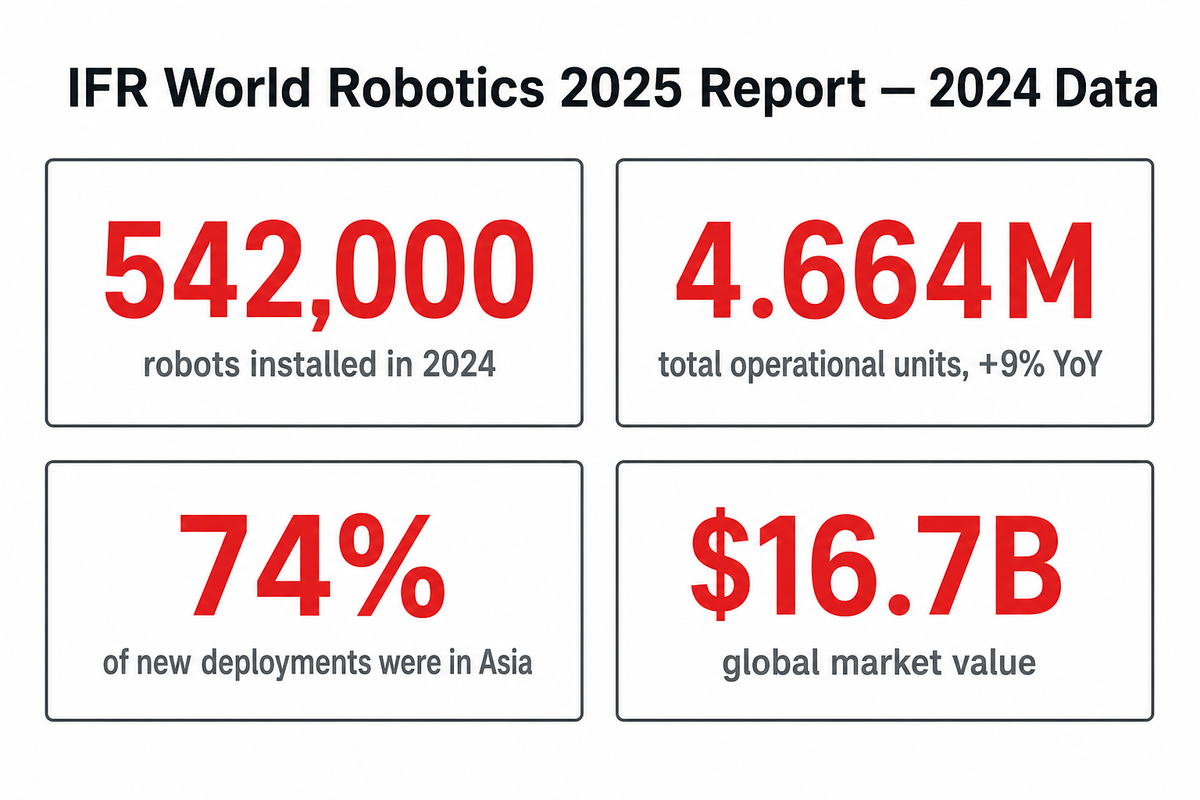
Those figures still matter as context: according to the International Federation of Robotics’ World Robotics 2025 report, 542,000 industrial robots were installed globally in 2024, pushing the total operational stock to 4.664 million units, a 9% year-over-year increase, with a market value of US$16.7 billion. Asia accounted for 74% of new deployments in 2024, and China alone represented 54% of the global total with 295,000 units installed. The IFR’s World Robotics 2026 report is scheduled for release on September 24, 2026 and hadn’t yet published as of this writing, so the 2024 figures above, the most recent complete-year data available, are what this article cites.
For buyers outside China and the rest of Asia, that concentration is itself the signal: with the bulk of new capacity going into large-scale Asian manufacturing expansion, companies on this list that specialize in smaller-footprint or faster-changeover lines, rather than only mega-scale automotive programs, are worth weighting more heavily if your own production volume doesn’t match a Tier-1 automotive OEM’s scale.
How to Choose a Robotic Production Line Manufacturer
Choosing among robotic production line manufacturers comes down to matching a supplier’s documented project scope to your own line’s payload, cycle-time, and changeover requirements, not to brand recognition alone, since several of the best-known robot brands on this list delegate line integration to third parties rather than delivering it themselves.
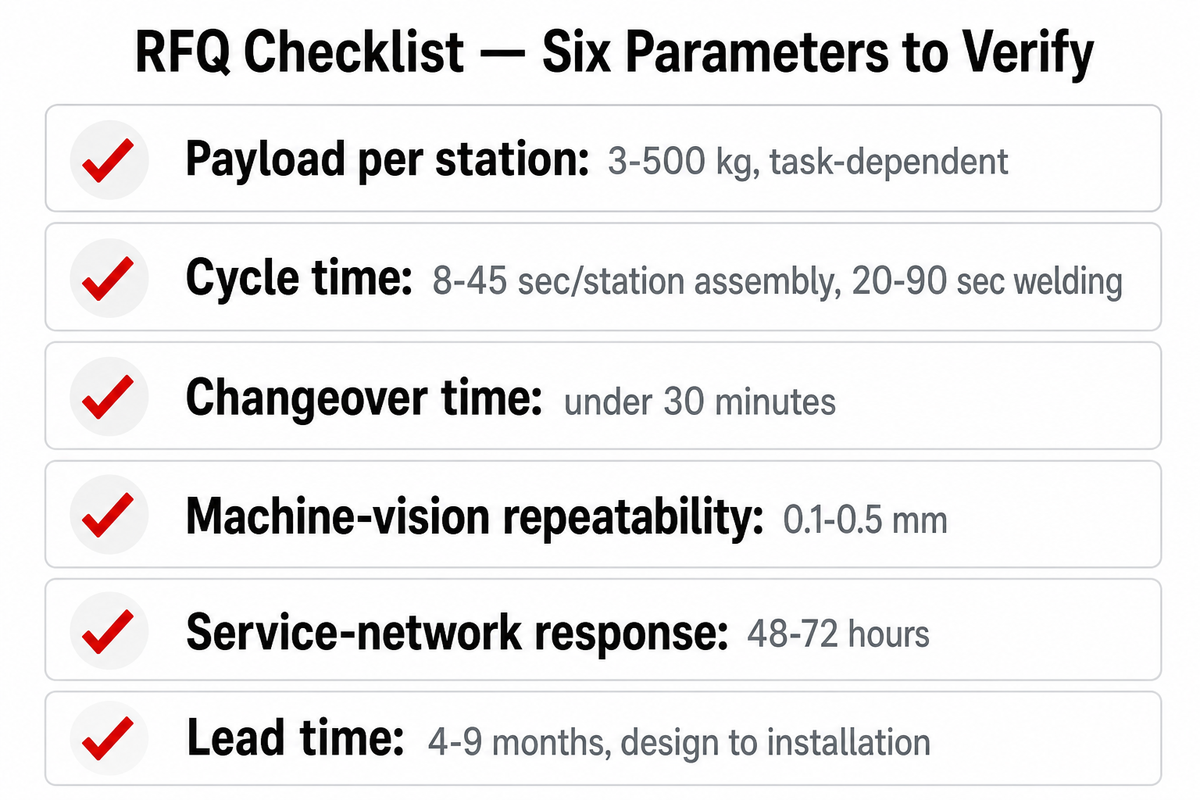
Buyers evaluating custom robot integration services should request the same core information from every manufacturer on this list before comparing quotes: a named project reference in your own industry, a Factory Acceptance Test schedule, and a written changeover-time commitment for your specific part mix. The checklist below sets realistic ranges to copy directly into an RFQ.
RFQ checklist — copy these into your quote request:
| Parameter | Recommended range | Why it matters | How to verify |
|---|---|---|---|
| Payload per station | 3-500 kg, task-dependent | An undersized robot bottlenecks cycle time; an oversized one adds unneeded capital cost | Request the rated cycle-time curve against your part’s actual weight and reach |
| Cycle time | 8-45 sec/station (assembly); 20-90 sec (welding) | Directly sets daily output and payback period | Ask for a Factory Acceptance Test video run on your actual part or a close analog |
| Changeover time | Under 30 minutes for tooling swap on flexible lines | High-mix production loses money to changeover downtime, not just cycle time | Have the integrator demonstrate a live tooling change during the plant visit or FAT |
| Machine-vision requirement | 0.1-0.5 mm repeatability for inspection-critical stations | Vision-guided stations can fail silently if optics aren’t matched to your part’s finish | Request sample inspection data run on parts from your actual supplier, not a demo part |
| Service-network reach | Under 48-72 hours response time for your plant’s region | A week of line downtime over a controller fault erases months of throughput gains | Ask for the name and location of the nearest certified service technician to your facility |
| Lead time | 4-9 months, design-to-installation for a multi-station line | Longer than a single robot cell — budget it into your production ramp plan | Get a milestone-based project schedule, not just a single ship date, in the quote |
ZEUEE’s own supplier vetting checklist covers the same ground in a form a purchasing team can run through directly, useful whether or not ZEUEE ends up on your shortlist.
Integration & Utility Requirements to Verify Before You Sign
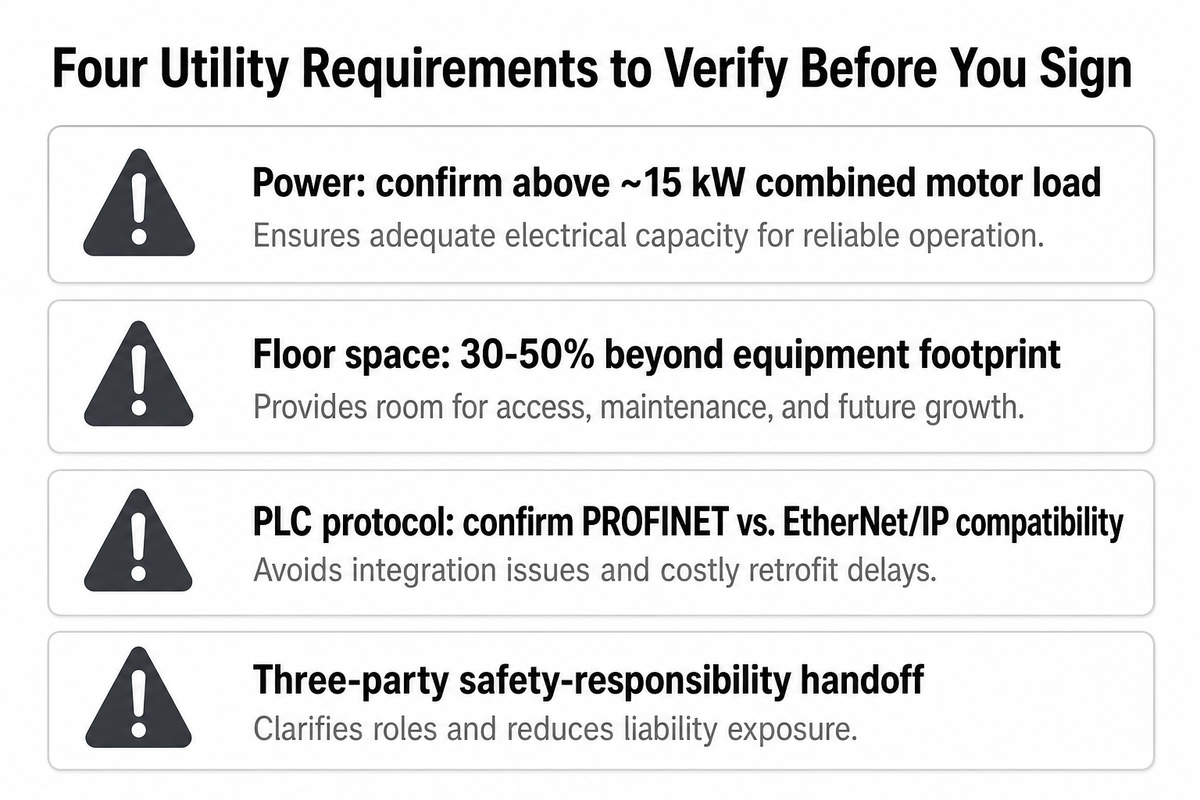
For a line rated above roughly 15 kW combined motor load, confirm your facility’s available three-phase power and panel capacity before signing. Undersized electrical service is one of the most common causes of installation-date slippage on multi-station robotic lines.
Floor space needs to account for more than the footprint of the robots themselves: safety fencing, conveyor runs, control cabinets, and maintenance-access clearance typically add 30-50% beyond the equipment’s own footprint. Confirm PLC protocol compatibility early. A line built around Siemens PROFINET won’t integrate cleanly into a plant standardized on Allen-Bradley EtherNet/IP without a gateway, and gateways add both cost and an additional point of failure. If vision inspection systems are part of the line, lighting consistency at your plant (not the integrator’s demo cell) determines whether the vendor’s quoted defect-detection rate will actually hold on your floor.
Worker safety around the finished line is a separate verification step from the equipment specification itself. The U.S. Occupational Safety and Health Administration’s robotics hazard-recognition guidance places safety responsibility on three parties jointly: the robot’s designer/manufacturer, the systems integrator, and the employer operating the line. A written safety-responsibility handoff at commissioning, not just a CE mark on the equipment, should be part of your sign-off — ask the integrator to confirm the finished line was designed against the current ISO 10218 industrial-robot safety series, not an older edition.
When NOT to Buy a Full Robotic Production Line
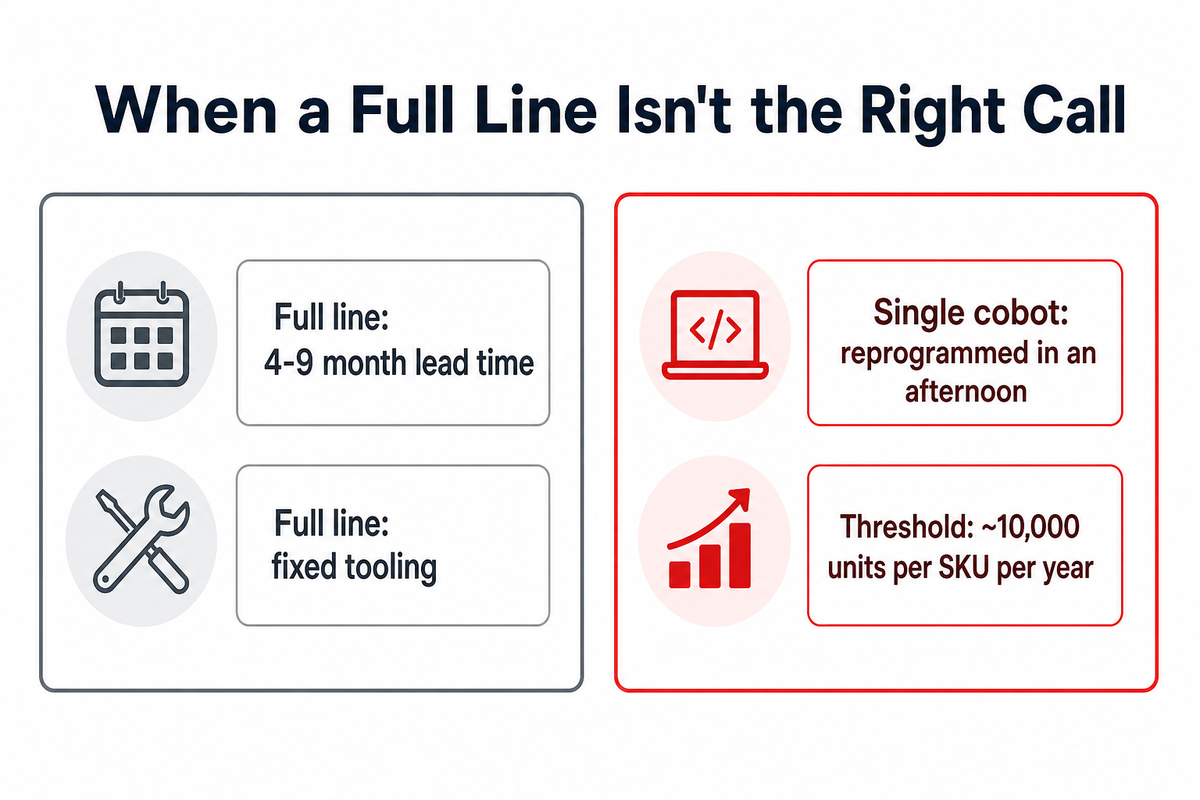
For low-volume, high-mix production runs, a single-station cobot cell often outperforms a full multi-station line on total cost of ownership. The capital and changeover-programming overhead of a full line only pays back once volume and part-mix stability justify it — a distinction worth confirming against your own volume forecast, using a tool such as ZEUEE’s automation payback estimator, before requesting a line quote.
If your production run changes SKUs weekly rather than monthly, the 4-9 month lead time and fixed-tooling investment a full line requires can leave you paying for capacity you reconfigure before it’s amortized. A manual or semi-automated cell, or a single collaborative robot that a line operator can reprogram in an afternoon, is frequently the better economic choice below roughly 10,000 units per SKU per year — a threshold worth calculating with your own labor and defect-rate numbers before assuming bigger automation is always better.
FAQ
Q: Who is the largest robotics manufacturer?
By cumulative installed base, FANUC has historically reported the largest figure among robot-arm OEMs, with over 1 million units shipped worldwide — though that is a company-reported figure, not an independently audited one, and FANUC itself does not appear among the 19 manufacturers profiled in this article.
No independently audited, universally accepted “largest robotics manufacturer” ranking is published, because companies report different metrics, units shipped historically, robots currently in active service, or annual revenue, and none of these figures are cross-verified by a neutral third party. FANUC’s over-1-million-units-shipped figure is the most commonly cited installed-base claim, though it remains company-reported rather than independently audited. Shipment volume alone doesn’t determine a company’s place on this article’s list, either: FANUC does not appear among the 19 line-building manufacturers profiled here, because its own production-line integration work is delegated to a third-party partner network of authorized system integrators rather than performed in-house by FANUC. See the Named-Delivery Bar table earlier in this article for the exact criteria that decided inclusion.
Q: What are the top 10 companies in robotics?
Rankings vary by the metric used, units shipped, revenue, or market capitalization, so no single canonical “top 10” list exists across the industry; this article instead lists 20 manufacturers filtered by one specific criterion: documented evidence of building complete production lines.
Rankings differ by metric, shipment volume, revenue, or market capitalization, so results vary by publisher. This article skips a size-based top 10 entirely and instead lists 20 manufacturers filtered by one criterion: documented evidence of building complete production lines, not just individual robots.
Q: Who are the big 4 in robotics?
The robot makers most commonly called the industry’s “Big Four” are FANUC and Yaskawa (Japan), ABB (Switzerland/Sweden), and KUKA (Germany) — three of which (Yaskawa, ABB, and KUKA) appear among the 19 verified manufacturers on this list, while FANUC does not, for reasons explained in the Named-Delivery Bar section.
These four are the most frequently cited “Big Four” by cumulative robot shipment volume and industry longevity. Three of the four, Yaskawa, ABB, and KUKA, appear among the 19 verified line manufacturers on this list, because each has documented evidence of building full production-line or multi-cell systems. FANUC, the fourth, does not appear on this list’s manufacturer roster for the reason explained in the Named-Delivery Bar section above: its production-line integration work is delegated to independent partner integrators rather than delivered by FANUC itself.
Q: How do I choose the right robot for an assembly application?
Match the robot’s payload and reach to your heaviest part plus its gripper, then verify cycle time against a Factory Acceptance Test run on your actual part, not a generic demo.
Payload and reach specifications on a datasheet describe the robot at its rated maximum, not necessarily at the speed and precision your process needs, a robot can be payload-rated for your part yet still miss your target cycle time. Request the vendor run (or video) a Factory Acceptance Test using your real part or a close geometric analog, and confirm changeover time separately from cycle time if your line will run more than one part variant. The RFQ checklist in the “How to Choose a Robotic Production Line Manufacturer” section above lists the specific parameters to request from any vendor.
Q: Why is ZEUEE listed as No. 1 in this article?
ZEUEE is listed first because this article is published by ZEUEE, not because of an independently verified market-share or revenue ranking or because ZEUEE was assessed against the article’s own Named-Delivery Bar; the remaining 19 manufacturers are presented in no particular order, each individually verified against that same inclusion bar.
This is a publisher-placement disclosure, not an independently verified ranking. ZEUEE’s own entry is first-party information and was not assessed against the Named-Delivery Bar the way the other 19 companies were. Those other 19 manufacturers appear in no particular order; each was individually verified against the Named-Delivery Bar criteria, not ranked against one another.
Q: How long does a typical robotic production line installation take?
Most multi-station robotic production lines take roughly 4 to 9 months from design sign-off to installation, depending on line complexity and how much custom tooling is required.
A single robotic cell can sometimes be delivered in weeks, but a full multi-station line, the category most manufacturers on this list specialize in, typically runs 4 to 9 months across design, fabrication, Factory Acceptance Testing, shipping, and on-site commissioning, per the lead-time patterns disclosed across this article’s 19 verified manufacturer profiles. Projects involving custom tooling, multiple robot brands, or first-of-a-kind process steps (such as a new battery-cell format) tend to sit at the longer end of that range; buyers should request a milestone-based schedule rather than a single ship date, as noted in the RFQ checklist above. Buyers should also confirm whether a quoted timeline starts at design sign-off or at purchase-order issuance, since some vendors quote from design freeze while others count from contract signing, a gap that can add several weeks without changing the underlying engineering schedule, and one worth pinning down in writing before comparing lead times across the manufacturers profiled in this article.
Why We Write This
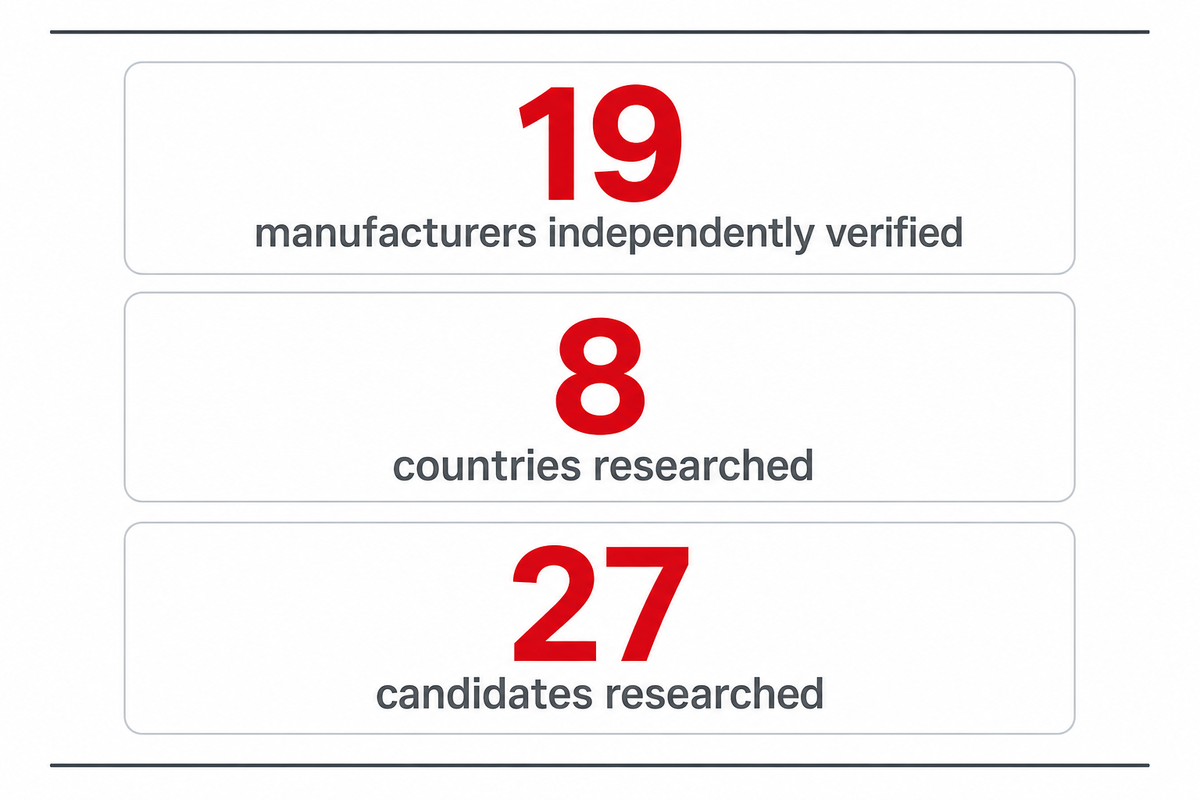
ZEUEE builds robotic production line equipment for connector, 3C, and automotive manufacturers, which means we read competitor and peer manufacturer specifications constantly as part of our own product development. This article started as that internal research, expanded to independently verify 19 other manufacturers across eight countries rather than just listing familiar names. Reviewed by the Shenzhen Zeyu Intelligent Industrial Science Technology Co., Ltd technical team. If you’re evaluating suppliers for your own line, the RFQ checklist above and ZEUEE’s own robotic production line page are reasonable next stops, whether or not ZEUEE ends up on your shortlist.
References & Sources
- ISO 10218-1:2025 — Robotics — Safety requirements — Part 1: Industrial robots — International Organization for Standardization
- ISO 10218-2:2025 — Robotics — Safety requirements — Part 2: Industrial robot applications and robot cells — International Organization for Standardization
- Robotics — Hazard Recognition — Occupational Safety and Health Administration, U.S. Department of Labor
- World Robotics 2025 report — Industrial Robots — International Federation of Robotics
- Top 5 Global Robotics Trends 2026 — International Federation of Robotics
Related Articles
- Robot Integration Guide — how to plan a robot-integration project before requesting quotes from any manufacturer on this list.
- Custom Automation Equipment Guide — a broader look at custom-built vs. catalog automation equipment for manufacturers not ready for a full production line.
- Automated Testing Equipment Guide — end-of-line test-station design, relevant to several EV-battery and automotive lines profiled above.
- Custom Assembly Machine Guide — for buyers whose volume doesn’t yet justify a full robotic line, per the “When Not to Buy” section above.
WHY WE WRITE THIS
About ZEUEE Engineering Insights
ZEUEE shares technical guides based on real automation project experience. Since 2005, we have designed and manufactured non-standard automation equipment for connector assembly, wire harness production, robotic lines, vision inspection, and smart factory upgrades.
Founded in 2005
20,000 m² production base
120+ specialists
150+ R&D patents
ISO9001:2015 certified
Trending now