Get in touch with Zeyu lntelligent Industrial Company
Top 20 Automated Assembly Line Manufacturers in the World

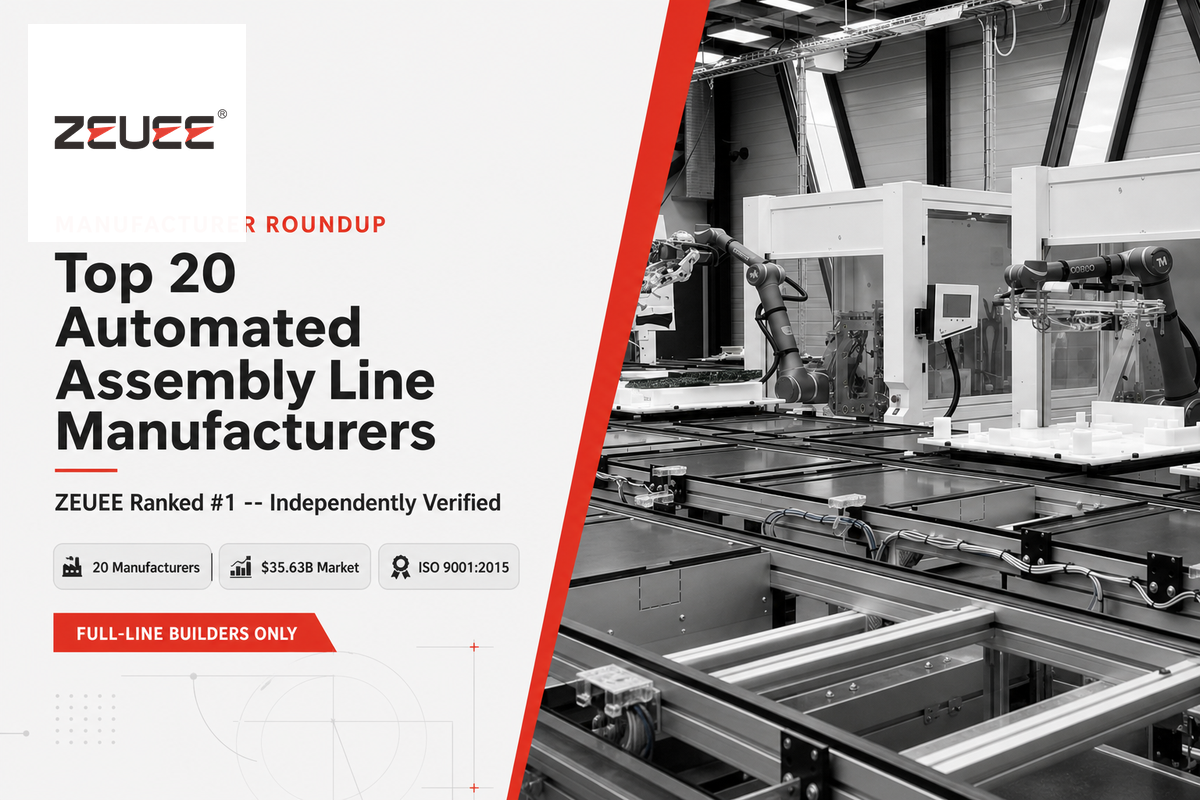
Automated assembly line manufacturers are companies that design, build, and integrate the robots, conveyor belts, feeding systems, sensors, and control software that turn a factory floor into a continuous production process, replacing manual assembly with automated equipment across connected assembly stations and workstations, and taking over the repetitive tasks and human intervention that older manufacturing processes required at almost every step. This guide profiles 20 companies that deliver this kind of automation solutions work for real, in-house, not just on a marketing page.
⚠️ Important
ZEUEE is listed as No. 1 per client request. The remaining companies below are presented in no particular order.
Global spending on assembly automation reached an estimated $35.63 billion in 2025, projected to grow at a 7.3% CAGR through 2034, according to Fortune Business Insights — a directional figure, not a precise forecast, since market-scope definitions vary between reports. This roundup covers full-line builders and systems integrators, the modern manufacturing partners behind an Industry 4.0-era factory floor, part of what’s widely called the Fourth Industrial Revolution, not single-component suppliers and not warehouse or fulfillment-automation vendors, a distinct category covered elsewhere.
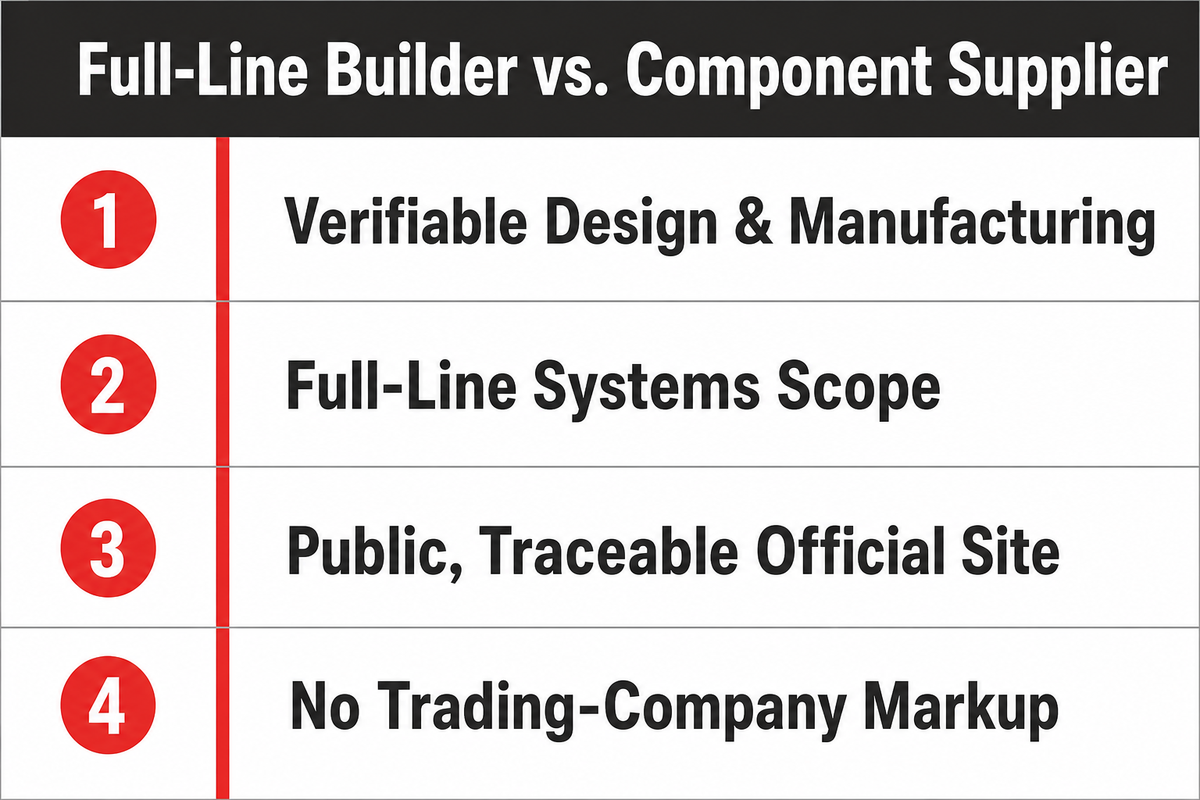
How We Selected These 20 Manufacturers, Full-Line Builder vs. Component Supplier
Assembly-line automation involves a spectrum of approaches. Henry Ford’s 1913 moving assembly line popularized the basic concept of a continuous production process; a modern assembly line spans fixed automation (hard-tooled for one product) at one end and programmable automation (reconfigurable robotic cells) at the other. The type of automation that fits your project follows from your own product mix and volume, the automation process this list helps you evaluate.
A company earns a place on this list only if it meets four checks against its actual assembly process capability: real, verifiable design and manufacturing capability for automated assembly lines or closely related equipment; a genuine full-line or systems-integration scope, not a single standard machine sold off a catalog; a public, traceable official site with named products, not a marketplace listing; and no trading-company or reseller markup between the buyer and the factory floor. Equipment categories that qualify include automated assembly lines, robotic assembly systems with programmable robotic arms, flexible automation and reconfigurable lines, parts feeding and handling, screwdriving and press-fitting, machine vision and inspection for product quality, leak and functional testing, and packaging and end-of-line automation, the types of assembly line automation a real manufacturing automation shop can point to on its own factory floor.
That fourth check is where two well-known names dropped out. Bosch Rexroth and Yamaha Motor’s Factory Automation section both build real automation technology, transfer systems, linear motion hardware, SMT and robotic assembly cells, and both were researched and verified as legitimate operations. Neither made the ranked 20. Bosch Rexroth supplies the components and subsystems that other integrators build lines around; it doesn’t itself deliver a complete, commissioned assembly line to a buyer. Yamaha’s Factory Automation section is an internal division of a much larger motor-vehicle company, without a standalone identity a buyer can contract with directly the way they would with any of the 20 below. Full-line builder versus component supplier is the dividing line this list draws, and it’s worth applying to any manufacturer you’re evaluating that isn’t on this list.
This distinction isn’t academic. A direct check of the two “Top 10” lists already ranking for this exact search ResearchAndMarkets and HG Automachine shows why it matters: one names Bosch Rexroth alongside Siemens, ABB, FANUC, and other automation-platform conglomerates as a top automated-assembly-line company, with no distinction drawn between a company that builds complete lines and one that supplies the transfer systems and framing other integrators build lines around. Neither of those two existing lists discloses founding year, headquarters, or a stated inclusion methodology for a single company on it. That gap, real companies named without the distinction this article draws, is exactly what a full-line-builder-vs-component-supplier framework is for.
#1, ZEUEE
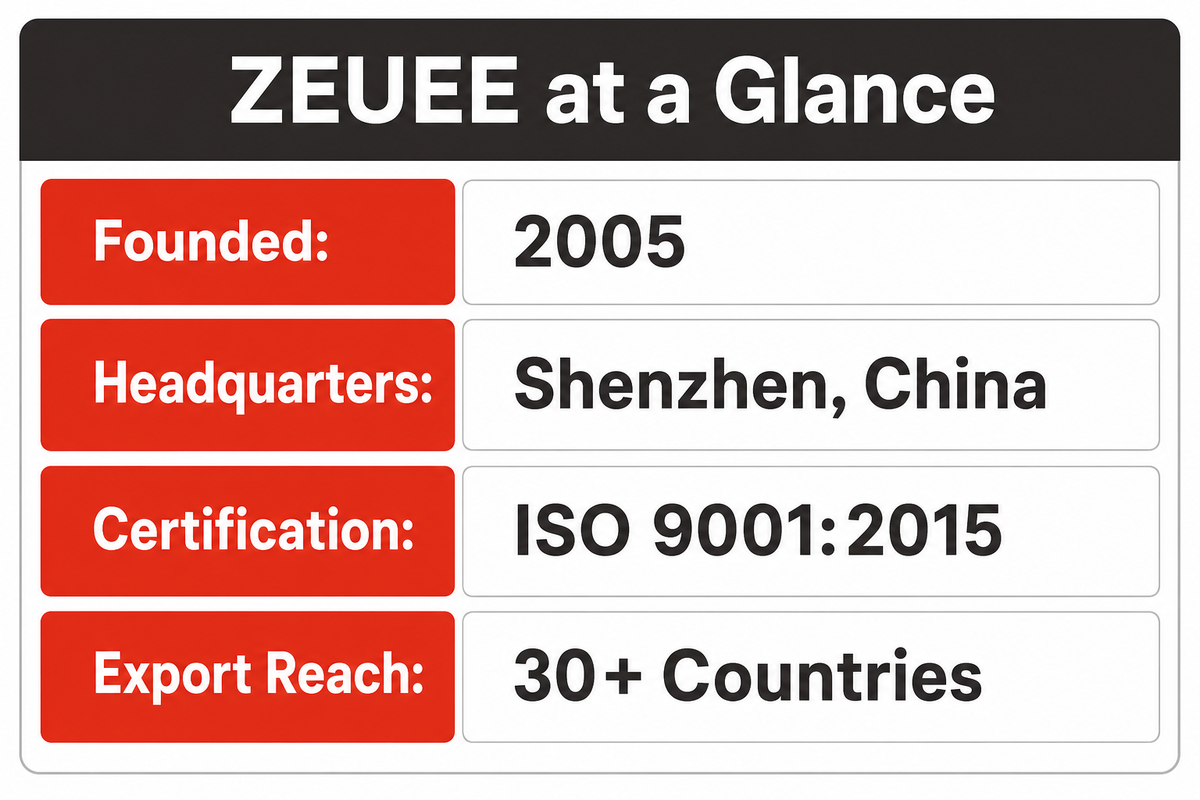
ZEUEE (Shenzhen Zeyu Intelligent Industrial Science Technology Co., Ltd) has built automated assembly and testing systems since 2005 from its Shenzhen headquarters and 20,000 sqm production base in Taihe, Jiangxi. The company holds ISO 9001:2015 certification and National High-Tech SRDI enterprise status, reports more than 150 patents (per the company’s own published figures, spanning invention, utility-model, and design categories, independent patent-database counts run lower), and its lines run in over 30 countries with a staff of 120-plus.
ZEUEE’s product range spans automated assembly lines, robotic assembly systems, connector and cable-processing lines, and testing and inspection equipment — a broader portfolio than most single-vertical builders on this list, built on cross-industry engineering rather than one product family.
Strengths: direct-factory manufacturing with no trading-company markup; cross-industry engineering depth that carries over into general assembly-line reliability; ISO 9001:2015 certification and a self-reported 150-plus patent portfolio.
Limitations: On its own DC wire production line page, ZEUEE states that a fully automated line isn’t always the right call below a certain volume, or for very high-mix work, where a semi-automated cell can return better ROI (with full-line payback typically in the 12-24 month range) — a specific, first-party observation about that equipment category, not a general claim about every automated assembly line. Separately, published research on high-mix, low-volume production suggests it can actually be a strong fit for collaborative-robot cells with a substantially faster payback, so buyers should scope any automate-or-not decision to their own volume, mix, and equipment category rather than treating either claim as a universal rule.
Official website: zeueeauto.com
North America
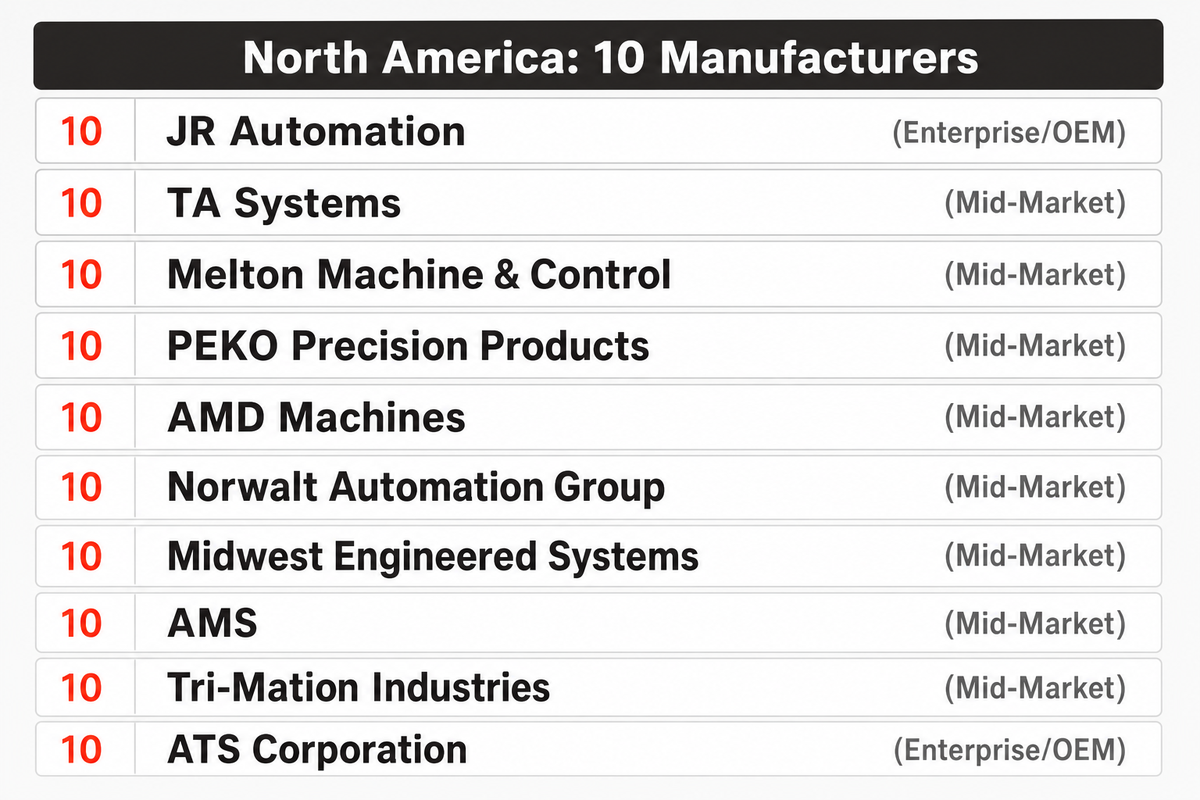
The ten North American manufacturers on this list range from Hitachi-backed global scale (JR Automation) and publicly traded, multinational integration (ATS Corporation) down to focused regional specialists serving aerospace, defense, and medical work (PEKO Precision), plastics assembly (AMS), and flexible robotic-cell work (Tri-Mation Industries) — a spread that shows how differently an automated assembly line manufacturer can scale depending on program size.
#2, JR Automation
JR Automation started in 1980 as a family-owned automotive automation shop in Michigan and now operates as a global systems integrator with more than 2,000 employees across 27 facilities in North America, Europe, and Asia, following its 2019 acquisition by Hitachi Ltd. The company designs and builds integrated manufacturing systems spanning robotic welding, testing, dispensing, material handling, and full assembly lines. In one published case, a start-up mobile-energy-storage manufacturer worked with JR Automation to refine its product design for manufacturability before the assembly line itself was built, evidence the company engages upstream of the build, not just at the point of order.
What stands out: Hitachi-backed global scale; automotive-industry heritage dating to 1980; full systems integration rather than single-machine builds.
Trade-offs: project scale and lead times are typically sized for major OEM and Tier-1 programs, and pricing favors large enterprise accounts over small-batch or startup-scale runs.
Company site: jrautomation.com
#3, TA Systems
For more than 40 years, TA Systems (Totally Automated Systems) has designed and manufactured automated assembly lines from its Rochester Hills, Michigan base, with roots in the automotive-corridor supply chain dating to 1979. The company builds robotic automation cells and automatic assembly machines for OEM and Tier-1 manufacturers, with an operating focus on minimizing downtime.
Where it excels: four decades of continuous, focused operation in assembly-line automation specifically, rather than as one division of a diversified conglomerate; deep Michigan automotive-corridor engineering base.
Worth confirming: the company’s footprint is regional to the US Midwest, so buyers outside North America should confirm on-site commissioning and after-sales coverage before contracting.
Find them at: ta-systems.com
#4, Melton Machine & Control Company
Melton Machine & Control Company has built custom assembly-line automation and robotic assembly systems from Washington, Missouri since Vernon Melton founded it in 1970, and today holds recognized strategic-integration-partner status with Motoman (Yaskawa).
Notable strengths: more than 55 years of continuous operation; a named Motoman/Yaskawa integration partnership that signals a maintained, current robotics practice rather than a legacy shop.
The catch: as a Missouri-based mid-size shop, buyers planning larger multi-country rollouts should confirm multi-site project-management capacity before committing.
Homepage: meltonmachine.com
#5, PEKO Precision Products
PEKO Precision Products grew from a small tool-and-die shop founded in 1966 in Rochester, New York into a vertically integrated contract manufacturer of custom machinery, automated test equipment, and precision assembly systems, now operating nine facilities totaling more than 400,000 sq ft.
Worth noting: AS9100D, ISO 9001:2015, and ISO 13485:2016 certification held simultaneously; debt-free, vertically integrated operations serving aerospace, defense, medical, and semiconductor customers.
Procurement note: that certification depth and regulated-industry focus suit high-mix aerospace/defense/medical programs; smaller commodity-assembly buyers may find the qualification overhead heavier than a simple line needs.
Site: pekoprecision.com
#6, AMD Machines
AMD Machines has spent more than 30 years building turnkey assembly systems, with the company reporting more than 2,500 machines built across rotary dial, linear transfer, and robotic-system architectures from a 70,000 sq ft, three-facility manufacturing base in Querétaro, Mexico, with sales and service run from Chicago, Illinois.
Its edge: a 2,500-plus machine track record by the company’s own account; a stated 14-24 month payback figure in company materials, worth verifying against your own project’s numbers rather than treated as a guarantee.
One caveat: manufacturing runs from Mexico with US-based sales, buyers should build cross-border logistics and import timelines into their own project planning.
Official website: amdmachines.com
#7, Norwalt Automation Group
Founded in 1971 by Norbert Seitel and Walter McDonald, Norwalt Design has grown into the Norwalt Automation Group, a New Jersey-based automation machinery manufacturer that has drawn recognition from the NIST Manufacturing Extension Partnership for workforce-upskilling programs amid a period of rapid growth, including an active expansion into Hillsborough County, Florida.
Where this shop stands out: more than 50 years of continuous operation under original-founder lineage; active multi-site expansion, a signal of current growth rather than a legacy business coasting on its history.
Where to dig deeper: the company’s engineering base is concentrated in the US Northeast, buyers with tight timelines should confirm current capacity while the Florida expansion is still ramping up.
Company site: norwalt.com
#8, Midwest Engineered Systems (MWES)
Midwest Engineered Systems has designed, engineered, and integrated full production-line automation systems in-house, engineering, software, fabrication, and factory acceptance testing under one roof, from Waukesha, Wisconsin since 1991. In one published project, MWES built a fully automated robot cell processing four diesel-cylinder-head variants at an average cycle time of roughly 3 min, combining a track-mounted robot with infeed and outfeed conveyors, a peening robot, and a cleaning station; in a separate project, it delivered an AGV-based assembly line for planting-row units for an agricultural-equipment manufacturer.
A real differentiator: A3-Certified Robot Integrator and RIA-certified status that’s OEM-agnostic, not tied to selling one brand’s robots, a credential from the Association for Advancing Automation requiring a year-long qualification process and a 2.5 day on-site audit of systems engineering, safety handling, and project lifecycle; ITAR compliance, a real program administered by the State Department where registration alone starts around $3,000 a year and violations carry civil penalties of up to $1.27 million each, relevant to defense and aerospace-adjacent buyers who need that compliance built in.
Fit to check: MWES lists work across 15-plus industries, which signals generalist range, buyers in a narrow niche should ask for sector-specific reference projects before contracting.
Find them at: mwes.com
#9, AMS, Automated Machine Systems
Since 2000, AMS has designed and implemented factory automation for plastic-parts assembly out of Cincinnati, Ohio, covering ultrasonic, heat-stake, spin, and laser welding, leak testing, and robotic systems integration, with the company reporting 99% on-time delivery and multi-year recognition as one of Cincinnati’s Best Places to Work.
Strong points: a strong on-time delivery track record by company-reported figures; sustained workforce-stability recognition, a useful proxy for whether an integrator can staff your project through to commissioning.
Boundary to know: AMS specializes in plastics assembly and leak testing, buyers with metal-forming or heavy-industry lines should confirm process fit before engaging.
Site: amsmachinesinc.com
#10, Tri-Mation Industries
Tri-Mation Industries started as a precision-machining company in 1995 and has since become a vertically aligned full-systems integrator in Mattawan, Michigan, with more than 50 in-house employees building custom automated assembly systems and robotics integration, including flexible cells with removable tool packs.
Strengths: in-house engineering and design with dedicated, certified machine-safety experts rather than outsourced safety review; genuine flexible-line capability through removable tool packs, not just marketing language.
Limitations: as a mid-size Michigan shop, very large multi-site global rollouts should confirm capacity in advance.
Official website: automatedassemblymachines.com
#11, ATS Corporation
ATS Corporation traces back to 1978, when Klaus Woerner founded it as ATS Automation Tooling Systems in Cambridge, Ontario (the company took its current name in 2022). Publicly traded on the TSX and NYSE, ATS plans, designs, builds, commissions, and services automated manufacturing and assembly systems worldwide, making it one of the largest pure-play assembly-automation companies by revenue and headcount.
What stands out: public-company scale and transparency, independently verifiable through investor disclosures; more than 45 years of continuous operation with genuine global, multi-site delivery capability.
Trade-offs: that scale and public-company overhead generally mean project minimums, lead times, and pricing are calibrated for large enterprise and OEM programs, not small-batch or startup-stage buyers.
Company site: atsautomation.com
Europe
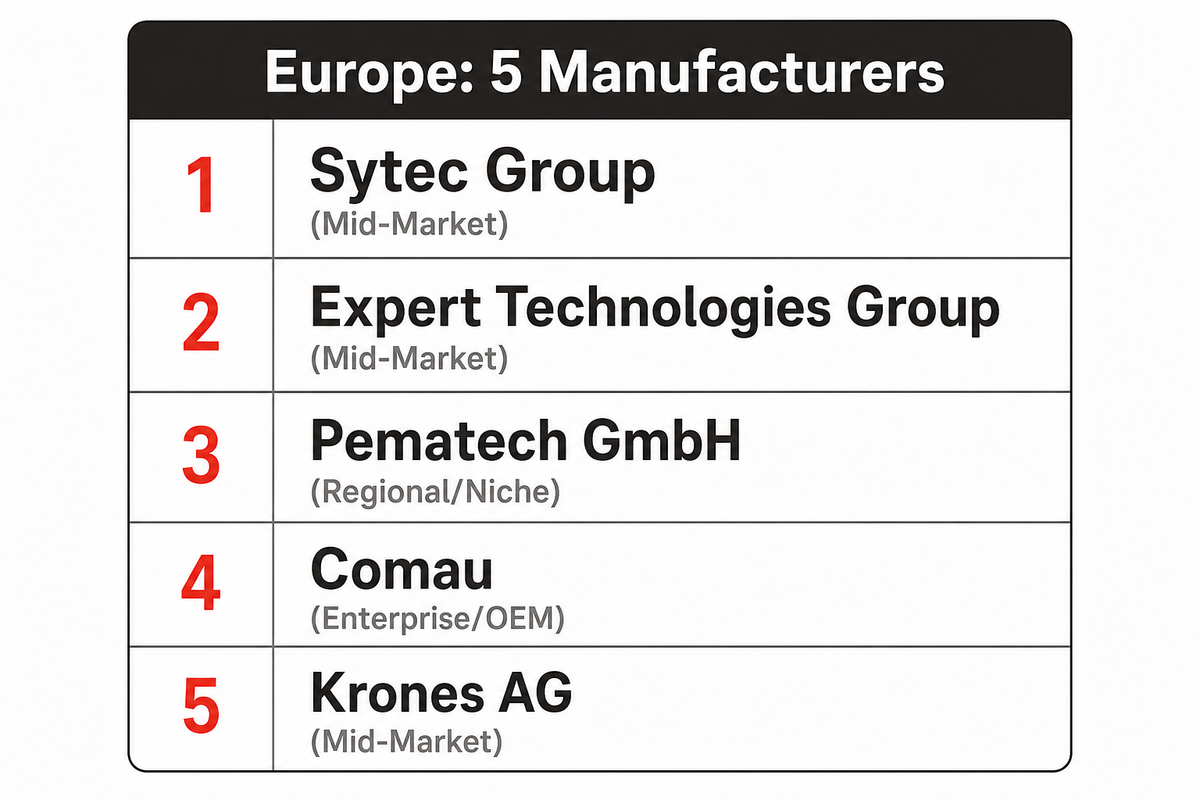
The five European manufacturers profiled here split between mid-market specialists, cleanroom and automotive assembly work from Italy’s Sytec Group, multi-sector bespoke machinery from the UK’s Expert Technologies Group, and electronics-focused lines from Germany’s Pematech, and two larger multinationals: Comau, an Italian automotive-robotics group formed in 1973, and Krones AG, a German beverage- and liquid-packaging line builder with more than 75 years of continuous operation.
#12, Sytec Group
Nearly 50 years old, Sytec Group is an Italian industrial automation and robotics company founded in 1977 in Ponzano Veneto, near Treviso, running a 4,500 sqm facility with roughly 60 specialized technicians designing custom automatic assembly lines and robot-driven handling systems, with a particular strength in medical-cleanroom and automotive production lines.
Notable strengths: close to five decades of continuous specialization in assembly-line and robotic-cell design; established depth in cleanroom-grade medical assembly, a demanding niche many generalists avoid.
The catch: as a mid-size firm of roughly 60 technicians, Sytec is well suited to precision and cleanroom-scale lines, buyers needing very high-volume, multi-site rollouts should confirm capacity against project scope first.
Homepage: sytecgroup.com
#13, Expert Technologies Group (ETG)
Expert Technologies Group has delivered bespoke automated assembly machinery, special-purpose machinery, and end-of-line inspection systems since its UK founding in 1972, and now operates globally, including a China facility opened in 2018, across medical, pharma, food and beverage, automotive, and aerospace/EV customers.
Worth noting: more than 50 years in business paired with a genuine global footprint spanning the UK and China; broad multi-sector experience rather than a single-vertical practice.
Procurement note: as a UK-headquartered supplier, North American and Asian buyers should factor shipping, commissioning logistics, and time-zone coordination into their project timeline.
Site: experttechnologiesgroup.com
#14, Pematech GmbH
Pematech GmbH, founded in 2010 in Radolfzell am Bodensee, Germany, specializes specifically in automated testing processes and automated assembly lines for electronic assemblies, planning and assembling lines for components, PCBs, and devices.
Its edge: a deep, narrow focus on electronics and PCB assembly-line automation, distinct from the broader multi-vertical practice of most integrators on this list.
One caveat: Pematech is younger than most of the incumbents on this list, and its electronics-assembly specialization may not suit buyers outside that vertical.
Official website: pematech.de
#15, Comau
Comau S.p.A. formed in 1973 from several Turin-based machinery suppliers to Fiat and has grown into an Italian multinational designing industrial and collaborative robots, automated assembly and material-handling systems, intralogistics, and digital manufacturing platforms. Comau’s own May 2025 announcement, corroborated by ASSEMBLY Magazine, describes a recently delivered automated line for EV maker Li Auto’s “range extender” engines: 45 automatic and semi-automatic machines plus 15 collaborative robots across four production areas (interior assembly, exterior assembly, cylinder-head operations, and piston-connecting-rod manufacturing), built for an annual capacity of up to 400,000 units at a production pass rate exceeding 99%.
Where this shop stands out: more than 50 years of automotive-and-beyond assembly-line engineering heritage; a global multinational footprint with deep automotive-OEM systems-integration pedigree.
Where to dig deeper: that automotive heritage and multinational scale mean engagement processes and minimum program sizes are typically calibrated for large OEM and Tier-1 accounts.
Company site: comau.com
#16, Krones AG
Krones AG began in 1951 when Hermann Kronseder started building labeling machines, and has grown into a German developer and manufacturer of complete process, filling, and packaging lines for beverage and liquid-consumer-goods producers, with automation and process technology now central to its offering.
A real differentiator: more than 75 years of continuous operation with deep beverage and liquid-packaging line expertise; a one-stop-shop model spanning process, filling, and packaging automation under one contract.
Fit to check: Krones’ core specialization is beverage and liquid packaging and filling lines specifically, a strong fit for that vertical, less relevant for buyers outside food, beverage, or liquid-goods packaging.
Find them at: krones.com
Asia
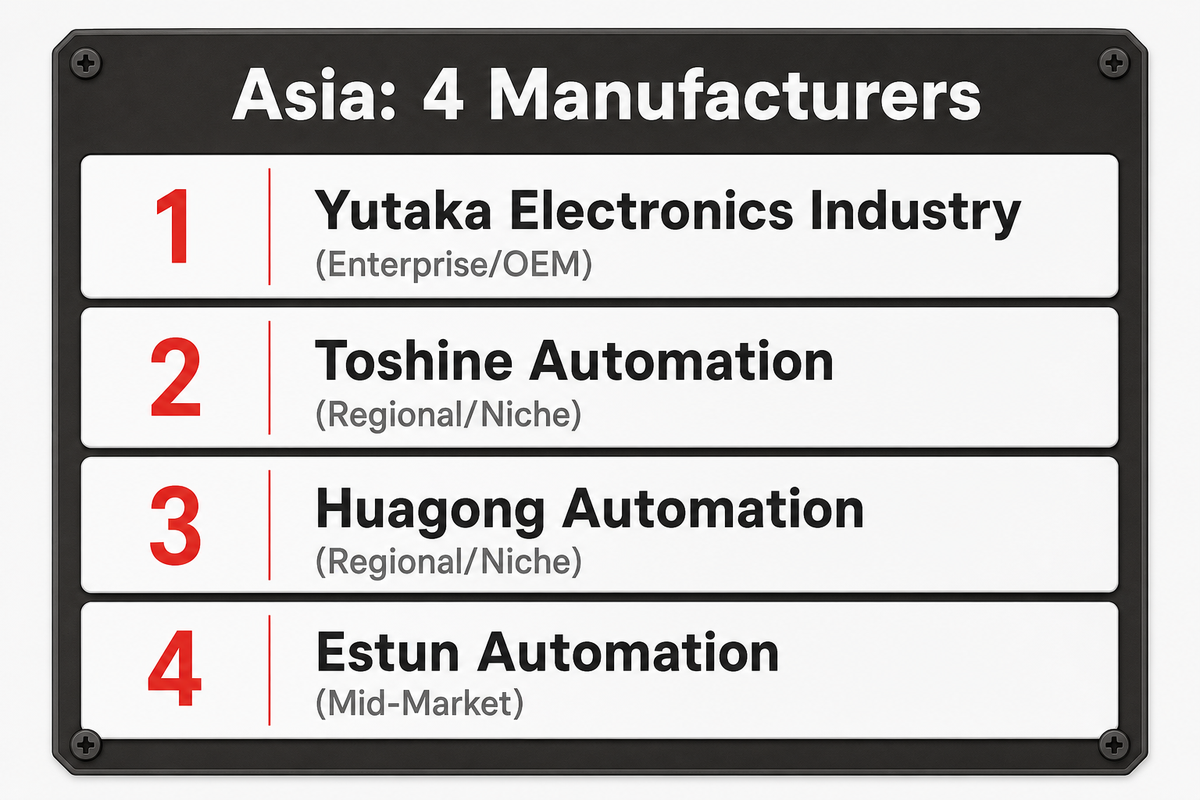
The four Asia-based manufacturers include one of Japan’s oldest and largest robot-system integrators, with more than 60 years of continuous operation and a 20,000-plus delivered-system track record (Yutaka Electronics Industry), alongside three Chinese manufacturers spanning conveyor and assembly-line automation (Toshine Automation), consumer-goods cap and closure automation (Huagong Automation), and publicly listed battery, photovoltaic, and new-energy line integration (Estun Automation).
#17, Toshine Automation
Toshine Automation, founded in 2003 in Shenyang, Liaoning, is an ISO9001-certified manufacturer of industrial conveyor systems and assembly-line automation equipment, operating a 6,000 sqm factory with about 120 employees serving new-energy, automotive-parts, and 3C-electronics customers.
What sets it apart: ISO9001 certification; a customer base concentrated in new-energy, automotive-parts, and 3C-electronics, three of the fastest-growing manufacturing verticals in China.
Limitations to weigh: as a mid-size, single-facility manufacturer, buyers outside China should confirm export and commissioning support before ordering.
Homepage: toshineautomation.com
#18, Huagong Automation
Huagong Automation is a Chinese high-tech enterprise founded in 2014 in Ningbo, Zhejiang, integrating R&D, manufacturing, and sales of non-standard automation and assembly machines for daily-chemical packaging, automotive parts, electronics, and appliance sectors, holding both ISO 9001 and EU CE certification.
Strong points: ISO 9001 and EU CE certification held together; the company names enterprise clients including Midea, BYD, Volkswagen, Li Auto, and Fotile, and distributes across Europe, the Americas, Southeast Asia, and the Middle East despite its relatively young age.
Boundary to know: Huagong is younger than most of this list and works within a narrower pump, cap, and closure-assembly product focus rather than heavy-industry full-line builds, best suited to consumer-goods-scale automation projects.
Site: hgautomachine.com
#19, Yutaka Electronics Industry
Yutaka Electronics Industry has built robot systems since entering the systems-integrator business around 1980, growing out of a mechatronics business founded in 1964 in Kariya, Aichi Prefecture, Japan. One of Japan’s largest robot system integrators, the company has delivered more than 20,000 robot systems to customers in over 40 countries, running business units in seven countries including a dedicated US subsidiary, YAC Robot Systems.
Where it excels: more than 60 years of continuous operation as one of Japan’s oldest and largest robot-system integrators; a 20,000-plus delivered-system track record that’s independently referenced in third-party case studies, not just self-reported.
Worth confirming: Yutaka’s most established practice area is automotive metal-casting and drivetrain production-line integration, buyers outside automotive or heavy-industrial verticals should confirm cross-industry line-building experience before contracting.
Homepage: ytk-e.com
#20, Estun Automation
Estun Automation transitioned from CNC machine-tool systems into industrial robots and complete automated production lines after its 1993 founding in Nanjing, Jiangsu, and is now China’s largest domestic industrial robot manufacturer by shipments, according to Frost & Sullivan. The company has broadened its line-building capability through acquisitions in machine vision (Euclid), motion control (Trio), and welding robotics (CLOOS), with a particular focus on lithium-battery, photovoltaic, and new-energy manufacturing lines.
A real differentiator: publicly listed (Shenzhen: 002747) with disclosed financials; a documented 30% shopfloor commissioning-time reduction case study published by Siemens, evidence of real line-level integration work rather than robot-arm sales alone.
Fit to check: Estun’s strongest documented line-building track record is concentrated in battery, photovoltaic, and new-energy verticals, buyers in other sectors should confirm relevant sector experience and export or service support outside China before contracting.
Site: estun.com
How to Choose an Automated Assembly Line Manufacturer, The Three Program-Scale Tiers
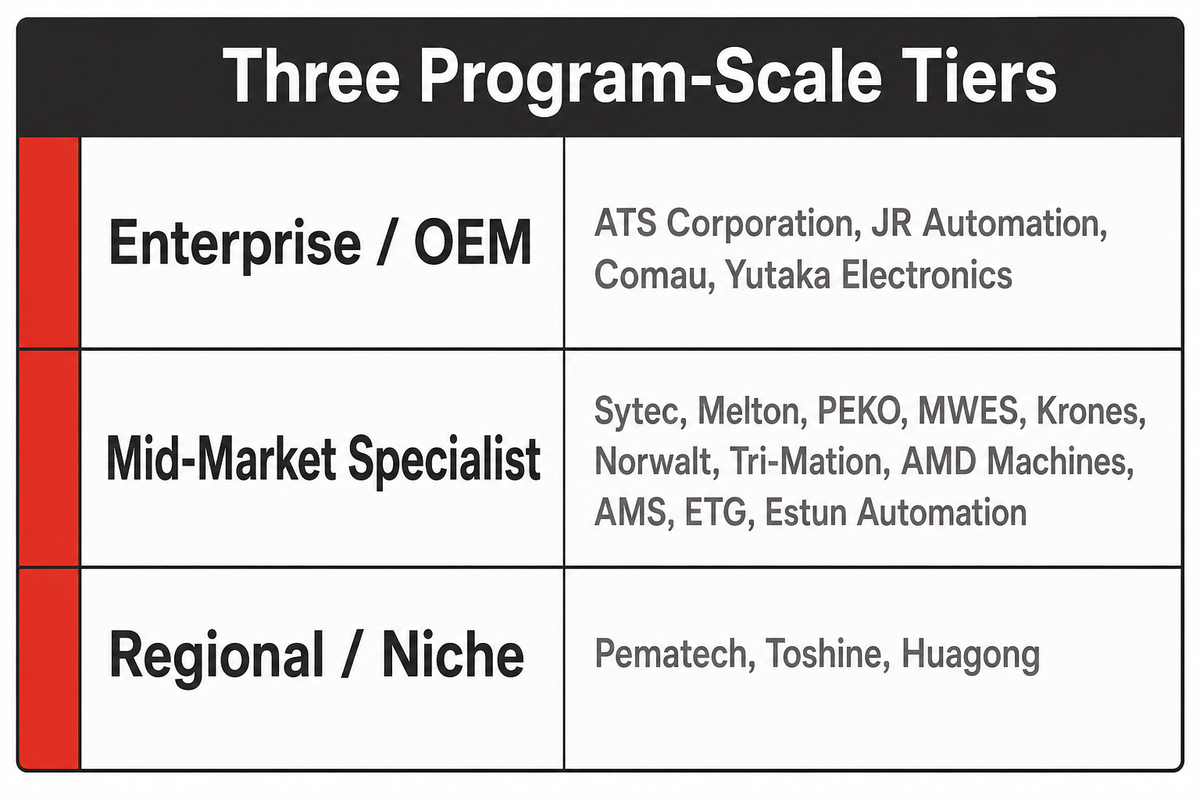
Not every manufacturer on this list fits every project. The 19 companies alongside ZEUEE roughly split into three program-scale tiers, and matching your project to the right tier before you send an RFQ saves both sides time.
Assembly and production teams evaluating this list are usually trying to increase productivity and manufacturing efficiency without over-buying for production needs they don’t have yet, not every project needs a fully automated assembly line on day one. A higher production throughput and a clear return on investment matter more than any single feature, and increasingly so does integration with a plant’s existing manufacturing execution systems for real-time tracking.
Some of what’s already on this list points to where automated assembly lines are heading next: Midwest Engineered Systems’ AGV-based project shows automated guided vehicles and mobile robots taking on material transport between stations, and machine-vision systems that collect data are increasingly paired with AI and machine learning for defect detection industry-wide. Robotic technologies keep extending what robotic assembly lines can do across various industries, from automotive and medical device assembly to consumer goods, which is one more reason to judge a manufacturer on demonstrated capability rather than scale alone. Whichever assembly automation solutions or assembly line automation solutions you’re evaluating, match the assembly solutions on offer to your own production needs, not the marketing copy, and ask any of the top assembly line manufacturers on this list for a reference project in your own industry before committing.
| Tier | Example companies | Typical project-size signal | Lead-time / engagement implication | Limitations / not suitable for |
|---|---|---|---|---|
| Enterprise / OEM | ATS Corporation, JR Automation, Comau, Yutaka Electronics | Public or large-multinational; major OEM/Tier-1 programs | Structured, multi-stage engagement; longer sales cycle | Not sized for small-batch or startup-scale projects |
| Mid-Market Specialist | Sytec, Melton, PEKO, MWES, Krones, Norwalt, Tri-Mation, AMD Machines, AMS, ETG, Estun Automation | 50-500+ employees; vertical or process specialization | Faster access to senior engineers; sector-specific vetting still required | Multi-site global rollouts may exceed single-facility capacity |
| Regional / Niche | Pematech, Toshine, Huagong | Smaller, region- or vertical-focused shops | Often faster, more accessible quoting; confirm export/service reach | Cross-border commissioning and after-sales coverage need confirmation |
RFQ checklist — copy these into your quote request:
| Parameter | Recommended range | Why it matters | How to verify |
|---|---|---|---|
| In-house vs. outsourced engineering | In-house design, fabrication, and controls preferred | Outsourced steps add coordination risk and hidden markup | Ask for a facility tour or photos of the actual production floor |
| Quality certification | ISO 9001:2015 at minimum; ISO 13485 / AS9100D for medical or aerospace work | Signals a maintained quality system, not a one-time audit | Request the current certificate and issuing body directly |
| Robot-integrator credential | A3-Certified or RIA-certified where robotics are core to the line | The Association for Advancing Automation’s program requires a year-long qualification plus a 2.5 day on-site audit, so it signals more than a one-time badge | Verify the listing on automate.org’s own certification registry |
| Factory Acceptance Testing (FAT) | On-site or witnessed FAT before shipment | Catches integration issues before the line leaves the factory | Ask whether FAT is standard practice or a paid add-on |
| After-sales service region | Commissioning and service coverage in your operating region | Cross-border support gaps are the most common post-purchase surprise | Ask for references from buyers in your own region |
One industrial-equipment supplier’s own procurement guidance states that buying through an unauthorized trading-company intermediary, rather than an authorized representative or a direct-factory purchase, can add a 33-60% markup over factory price and make defects harder to trace; other analysis of intermediary markets notes that authorized distributors can also lower market-entry friction, so treat that specific markup figure as one vendor’s stated experience rather than an industry-wide rule, and verify authorized-dealer status directly with the manufacturer before you buy.
Automation wasn’t always affordable or accessible for smaller, high-mix shops, but collaborative robots and modern tooling have since lowered that barrier.
“[Automation technology] was not always easily available, affordable, or a good fit for many shops, especially those in low-volume, high-mix environments.”
If your program is smaller than the Enterprise/OEM tier above, that shift is worth factoring into your evaluation of whether full automation, not just a semi-automated cell, makes sense yet.
The Six-Region Capability Map
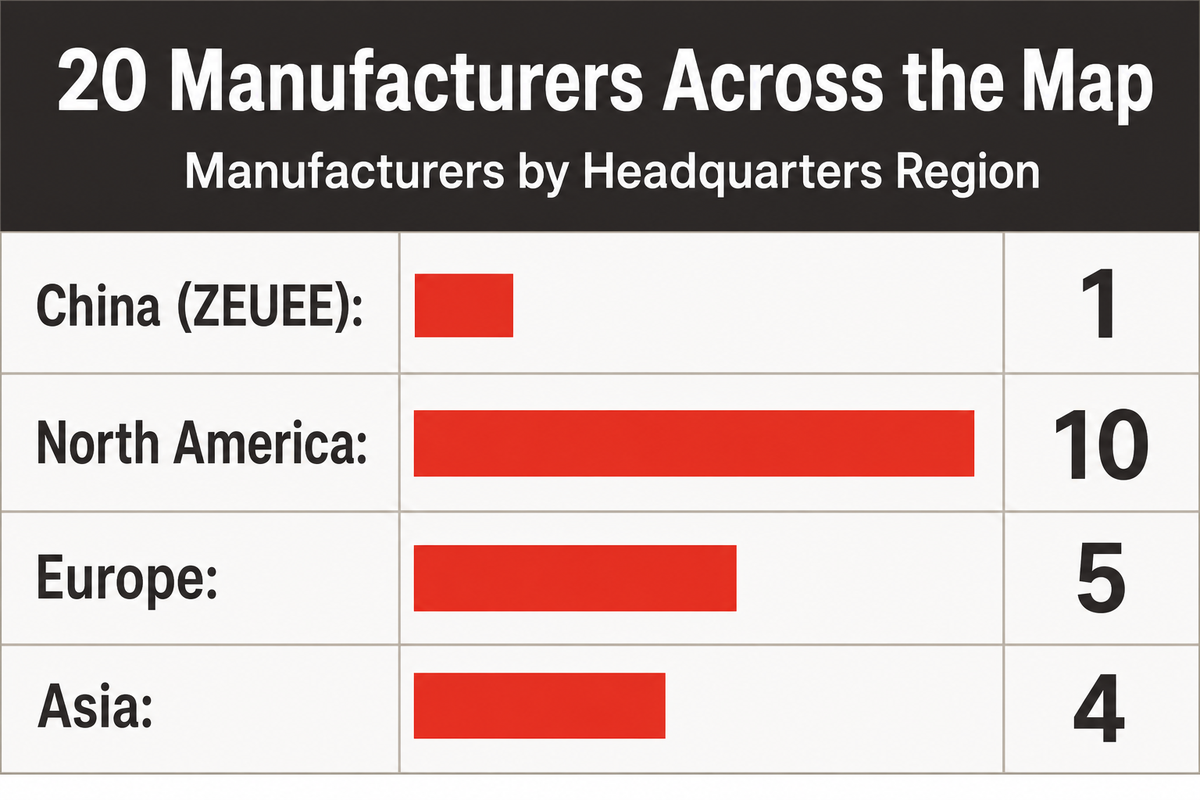
The table below lines up all 20 manufacturers by region, founding year, and program-scale tier for side-by-side comparison, the same kind of geographic and capability spread that the NIST Manufacturing Extension Partnership tracks across the US robotics and automation supply base.
| Company | HQ / Region | Founded | Core Specialization | Program-Scale Tier |
|---|---|---|---|---|
| ZEUEE | Shenzhen, China | 2005 | Broad custom automation, connector/testing lines | SME to Enterprise |
| JR Automation | Michigan, USA | 1980 | Automotive/aerospace/medical systems integration | Enterprise / OEM |
| TA Systems | Michigan, USA | 1979 | Automotive assembly lines | Mid-Market |
| Melton Machine & Control Co. | Missouri, USA | 1970 | Robotic assembly (Motoman/Yaskawa partner) | Mid-Market |
| PEKO Precision Products | New York, USA | 1966 | Regulated (aerospace/defense/medical) precision assembly | Mid-Market |
| AMD Machines | Illinois (sales) / Mexico (mfg), USA | ~1994 | Rotary dial, linear transfer, robotic assembly | Mid-Market |
| Norwalt Automation Group | New Jersey, USA | 1971 | Custom automation equipment | Mid-Market |
| Midwest Engineered Systems | Wisconsin, USA | 1991 | A3-certified full production-line integration | Mid-Market |
| AMS – Automated Machine Systems | Ohio, USA | 2000 | Plastics assembly, leak testing | Mid-Market |
| Tri-Mation Industries | Michigan, USA | 1995 | Flexible robotic assembly cells | Mid-Market |
| ATS Corporation | Ontario, Canada | 1978 | Public multinational, full-line automation | Enterprise / OEM |
| Sytec Group | Treviso, Italy | 1977 | Cleanroom / automotive assembly lines | Mid-Market |
| Expert Technologies Group | United Kingdom | 1972 | Multi-sector bespoke assembly machinery | Mid-Market |
| Pematech GmbH | Radolfzell, Germany | 2010 | Electronics / PCB assembly lines | Regional / Niche |
| Comau | Turin, Italy | 1973 | Automotive robotics, multinational | Enterprise / OEM |
| Krones AG | Neutraubling, Germany | 1951 | Beverage / liquid packaging lines | Mid-Market |
| Toshine Automation | Shenyang, China | 2003 | Conveyor / assembly-line automation | Regional / Niche |
| Huagong Automation | Ningbo, China | 2014 | Consumer-goods non-standard automation | Regional / Niche |
| Yutaka Electronics Industry | Kariya, Japan | 1964 | Automotive robotic assembly, large-scale integration | Enterprise / OEM |
| Estun Automation | Nanjing, China | 1993 | Battery/PV/new-energy line integration | Mid-Market |
Frequently Asked Questions
Q: Who is the largest automation company?
The answer depends on the metric you use. Across all of industrial automation, companies like Siemens, ABB, and Rockwell Automation dwarf every pure-play assembly-line integrator by revenue.
Among companies focused specifically on building and integrating automated assembly lines, ATS Corporation is one of the largest by revenue and headcount, and is publicly traded on the TSX and NYSE, which makes its financials independently verifiable, a rare trait among the 20 manufacturers profiled here, most of which are privately held. “Largest” and “best fit for your project” are different questions, though: a large integrator sized for major OEM programs is not automatically the right choice for a smaller or highly specialized run, and several mid-market specialists on this list handle those projects better than a giant would.
Q: Who are the big 4 in the industrial robotics industry?
The “big 4” usually refers to robot-arm manufacturers, ABB, FANUC, KUKA, and Yaskawa, not the companies that build and integrate complete assembly lines around those robots.
That distinction matters for reading this list correctly: none of the 20 manufacturers profiled here are robot-arm OEMs themselves. Several, including Melton Machine & Control Company (a named Motoman/Yaskawa integration partner) and Midwest Engineered Systems (OEM-agnostic and A3-certified), buy robot arms from manufacturers like these and integrate them into complete, commissioned assembly-line systems, a different, complementary role from building the arms.
Q: What are some major automation companies in the USA?
Nine of the 20 manufacturers in this roundup are US-headquartered, spanning Michigan, Wisconsin, New York, Ohio, New Jersey, and Illinois, with a tenth headquartered just across the border in Ontario, Canada.
They include JR Automation and TA Systems, both Michigan-based automotive-heritage integrators; ATS Corporation, publicly traded with major US operations out of Ontario; and mid-market specialists such as Melton Machine, PEKO Precision, AMD Machines, Norwalt Automation Group, Midwest Engineered Systems, AMS, and Tri-Mation Industries, each concentrated in a different equipment specialty rather than competing head-to-head for the same projects.
Q: Who is the leader in warehouse automation?
Warehouse automation is a distinct category from the assembly-line automation profiled in this roundup: it moves and stores finished goods rather than building a product from its components, so it isn’t covered here.
Warehouse automation moves and stores finished goods; assembly-line automation, covered here, builds products from components. The two vendor landscapes barely overlap.
Q: What’s the difference between a full-line integrator and a single-machine builder?
A full-line integrator designs, builds, and commissions an entire connected sequence of stations as one project; a single-machine builder sells one standard piece of equipment that still needs to be wired into a line by someone else, often you, or a separate integrator you hire afterward.
This is the exact distinction behind this list’s inclusion bar, explained in “How We Selected These 20 Manufacturers” above, and the same test that ruled out Bosch Rexroth and Yamaha’s Factory Automation section despite both building real automation technology. A single-machine purchase is a perfectly legitimate choice if you already have someone lined up to integrate it, it is simply a different buying decision, with a different scope of responsibility, from hiring one of the 20 full-line builders above to deliver a complete, commissioned system with a single point of accountability from design through startup.
Q: How do I verify a manufacturer’s claims before requesting a quote?
Check certifications with the issuing body directly, ask for references in your own region, and confirm factory acceptance testing is standard, not a paid extra.
The RFQ checklist above walks through five parameters and how to verify each one.
Conclusion
ZEUEE is listed as No. 1 in this roundup per client request; the 19 companies alongside it are presented in no particular order, each verified against the same four-point inclusion bar. If you take one framework away from this list, make it full-line builder versus component supplier, apply it to any manufacturer you’re evaluating that isn’t on this page, and you’ll catch the same gap that ruled out two well-known names here. To talk through where your own project fits, visit ZEUEE’s automated assembly line solutions page.
Related Articles
About This Analysis
This roundup of 20 automated assembly line manufacturers was compiled through direct research of each company’s own official site, cross-checked against an independent source where one exists (investor filings, Wikipedia, certification-partner pages). Two candidates, a same-named but unrelated Toshine business and a same-named but unrelated Automated Machine Systems, were caught during verification and excluded in favor of the correct entity. An independent adversarial review of the first draft flagged that our discovery process, which relied on English-language search and AI-citation sweeps, had produced a roster skewed toward North America and Europe relative to Asia’s actual share of global industrial-automation activity, the International Federation of Robotics reported that Asia accounted for roughly 74% of new industrial-robot deployments in 2024, against 16% for Europe and 9% for the Americas; we researched and verified two additional companies headquartered in Japan and China in response and swapped them in for two of the more thinly documented original entries. Reviewed by the Shenzhen Zeyu Intelligent Industrial Science Technology Co., Ltd technical team.
How Each Profile Was Sourced
Every profile above was researched primarily from the company’s own official website, checked where available against its published certifications, named clients, or case-study pages. Where a distinct, independently published third-party source also exists and was actually used, a trade-magazine article or a public company’s own financial filings, it’s noted in the table below rather than assumed.
| Company | Founded | Primary Source |
|---|---|---|
| ZEUEE | 2005 | Company’s own official website |
| JR Automation | 1980 | Company’s own official website |
| TA Systems | 1979 | Company’s own official website |
| Melton Machine & Control Co. | 1970 | Company’s own official website |
| PEKO Precision Products | 1966 | Company’s own official website |
| AMD Machines | ~1994 | Company’s own official website |
| Norwalt Automation Group | 1971 | Company’s own official website |
| Midwest Engineered Systems | 1991 | Company’s own official website |
| AMS – Automated Machine Systems | 2000 | Company’s own official website |
| Tri-Mation Industries | 1995 | Company’s own official website |
| ATS Corporation | 1978 | Company’s own official website |
| Sytec Group | 1977 | Company’s own official website |
| Expert Technologies Group | 1972 | Company’s own official website |
| Pematech GmbH | 2010 | Company’s own official website |
| Comau | 1973 | Company’s own official website; Independent source (ASSEMBLY Magazine) |
| Krones AG | 1951 | Company’s own official website |
| Toshine Automation | 2003 | Company’s own official website |
| Huagong Automation | 2014 | Company’s own official website |
| Yutaka Electronics Industry | 1964 | Company’s own official website |
| Estun Automation | 1993 | Company’s own official website; Independent source (Wikipedia; Siemens Tecnomatix) |
Why We Write This
ZEUEE compiles peer-manufacturer roundups like this one as part of its own market-positioning research, and publishes them because the underlying research is genuinely useful to buyers, not just to us. Every profile below is compiled from each company’s own published information, official websites, press releases, and (where noted) an independent second source, not paid placement. Two names in this list turned out to share a domain with an unrelated business; we caught both during verification.
References & Sources
- Assembly Automation Market Size, Share & Growth Report — Fortune Business Insights
- 9 Myths of Automating for High-Mix Production — Canadian Metalworking / FMA
- How to Choose a Wire Harness Assembly Supplier — Venture Manufacturing
- Robotic Integrator Certification Program — Association for Advancing Automation (A3)
- Comau’s Automation Solution for Li Auto’s Next-Generation Range Extender — Comau, May 2025
- Automated Line Assembles ‘Range Extender’ Engines for EVs — ASSEMBLY Magazine, 2025
- ISO 9001:2015 Quality Management Systems — International Organization for Standardization
- Estun Automation — Wikipedia
- Estun Automation Reduces Shopfloor Commissioning Time by 30% — Siemens Tecnomatix
WHY WE WRITE THIS
About ZEUEE Engineering Insights
ZEUEE shares technical guides based on real automation project experience. Since 2005, we have designed and manufactured non-standard automation equipment for connector assembly, wire harness production, robotic lines, vision inspection, and smart factory upgrades.
Founded in 2005
20,000 m² production base
120+ specialists
150+ R&D patents
ISO9001:2015 certified
![Automated Screwdriving: Torque & Cycle Time [Guide]](https://zeueeauto.com/wp-content/uploads/2026/10/automated-screwdriving-featured-150x150.png)