Get in touch with Zeyu lntelligent Industrial Company
How to Choose the Right Optical Connector Assembly Line Manufacturer

Updated August 2026 · By XCX
How to choose an optical connector assembly line manufacturer is a question of comparing evidence at your product boundary, not the length of a factory tour. The right supplier can show how your connector and cable variants move through each station, how results are measured, and how accepted output will be witnessed before shipment.
Large plants, patent counts, customer lists, and quality-management certificates may support due diligence. None of them proves that one proposed configuration can assemble, inspect, test, change over, and document your products. Use the framework below to turn every attractive claim into a testable requirement.
1. Start with the product and acceptance boundary, not a factory tour
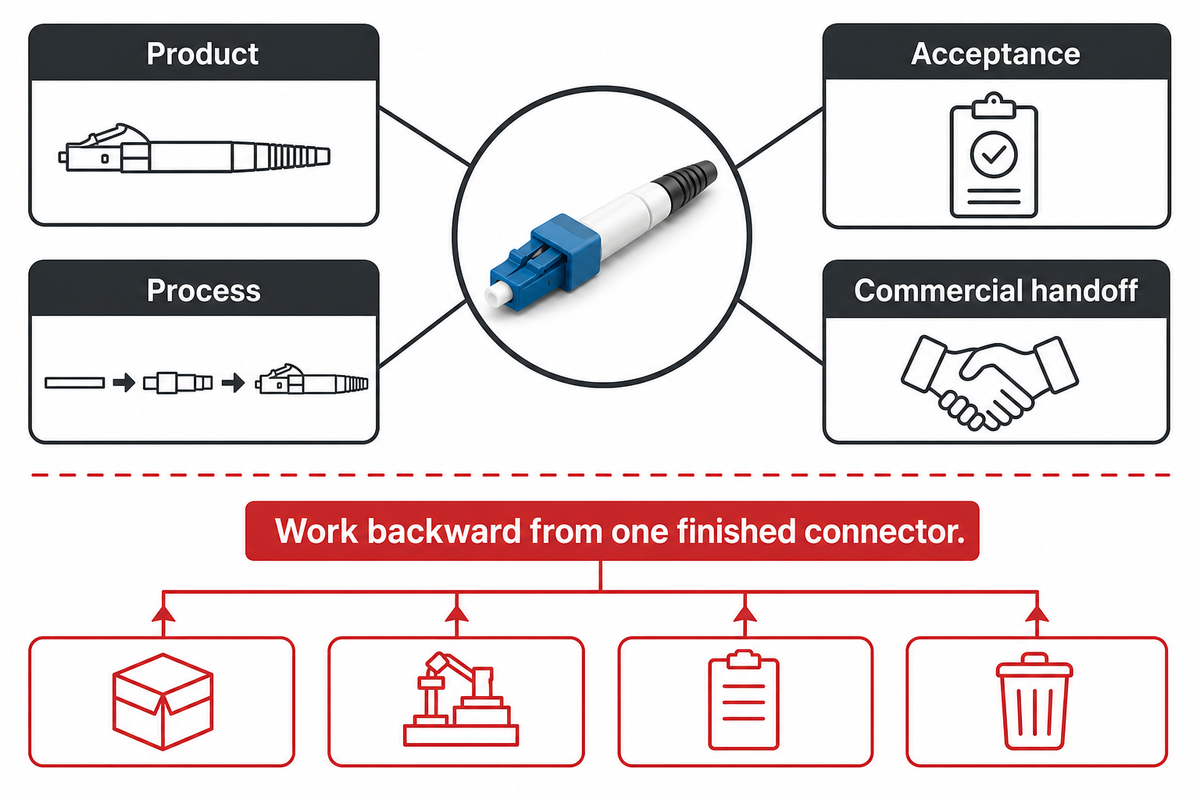
The scope boundary starts here: “complete line” is not a useful purchasing boundary. Write down the connector families, ferrule form, polish style, cable constructions, lot traceability, marking, packing, and destination market. Then define where the supplier’s responsibility starts and ends: prepared cable, raw connector components, finished cable assembly, or packed product.
- Product: drawings, approved samples, connector/cable variants, critical materials, and finish.
- Process: automatic, assisted, manual, and buyer-supplied operations.
- Acceptance: characteristics, instruments, sample rules, raw data, and disposition.
- Commercial handoff: training, spares, software, documents, site work, and open deviations.
This boundary also separates the procurement scope of an automation equipment manufacturer from the scope of a cable-assembly producer. Treat them as different sourcing roles. A capable proposal states which role the supplier is taking instead of allowing those responsibilities to blur.
Boundary test: take one finished connector and work backward. For every operation, ask who supplies the input, who owns the fixture, what record proves completion, and who disposes of a failure. If one answer is “the buyer handles that later,” place the operation outside the supplied line and price the labor, equipment, floor space, and validation separately. This exercise can expose the difference between a complete machine list and a complete production responsibility.
Buyer briefs often arrive from adjacent fiber optic applications: data center interconnects, outside plant telecommunications, industrial optical networks, or wireless networks backhaul. Those labels describe use, not assembly evidence. Translate them into product and test inputs instead of assuming the supplier understands the intended fiber path.
| Fiber scope | fiber optic, optical fiber, fiber optic connector, fiber optic cable, fiber cable, glass fiber, single-mode, multi-mode, cladding, light signals |
|---|---|
| Connector scope | connector type, types of connectors, types of fiber optic connectors, SC and LC connectors, fiber optic adapters, connector plugs, form factor, designation, mating cycles |
| Application scope | high-speed data transfer, data connections, signal integrity, optical communications, communication networks, telecommunications industry, electromagnetic interference, rack space |
| Production scope | factory automation, manufacturing processes, manufacturing facility, connector manufacturing, process control, tolerance, technological advancements, power meter |
| Compliance scope | industry standards, international standards, Telcordia, RoHS, environmental conditions, environmental resistance, harsh industrial environments, safety and regulatory duties |
2. Use a Four-State Line-Fit Screen
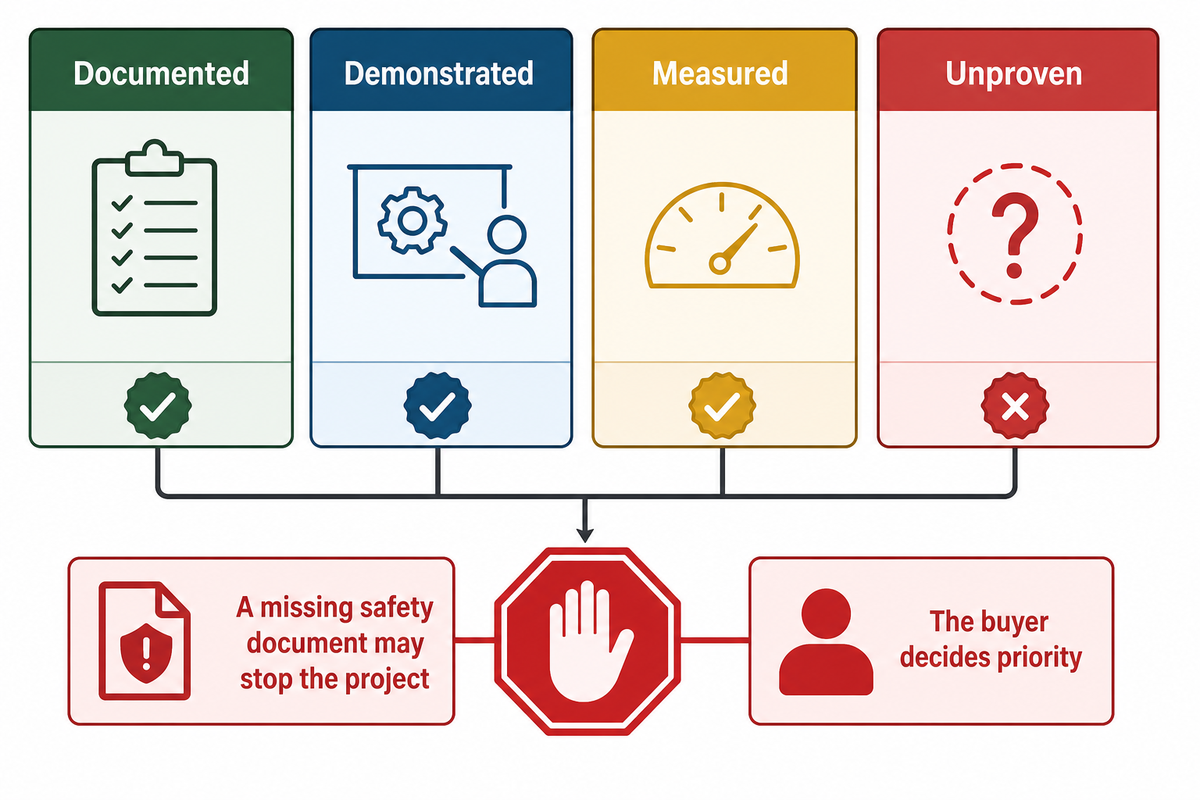
Once the product and test inputs are explicit, classify each requirement as documented, demonstrated, measured, or unproven. Do not add the statuses into a universal score. A missing safety document may be a stop condition, while a missing convenience feature may simply remain open; the buyer decides that priority.
| Requirement | Evidence to request | Weak substitute | Project pass condition | Limitation |
|---|---|---|---|---|
| 1. Product boundary | Signed variant and input list | “Supports many models” | Every release variant is named | A list does not prove output |
| 2. Station map | Operation, owner, input, output, buffer | Machine photograph | No hidden manual step | Layout may change after trials |
| 3. Tooling | Fixture list, drawing, ownership, life | Connector name in a brochure | Each family has a tooling route | Consumables remain lot dependent |
| 4. Control plan | Critical input and defect controls | Generic quality certificate | Reaction plans have owners | A plan still needs execution records |
| 5. Measurement | Method, instrument, traceability, data | Clean microscope image | Every characteristic has a disposition | Methods are not interchangeable |
| 6. Output protocol | Witnessed lots and raw event log | Empty-machine cycle time | Accepted output is reproducible in the trial | Trial is not long-term capability |
| 7. Changeover | Timed switch and first-off approval | Recipe menu screenshot | Worst-case variant is witnessed | Material clearance must be included |
| 8. Safety and documents | Risk file, drawings, manuals, validation | Supplier declaration alone | Destination duties are assigned | Local law depends on final configuration |
| 9. Service handoff | Backups, spares, access, training, escalation | Warranty duration | Recovery is tested and owned | Support terms remain contractual |
3. Match connector families to stations, fixtures, and consumables
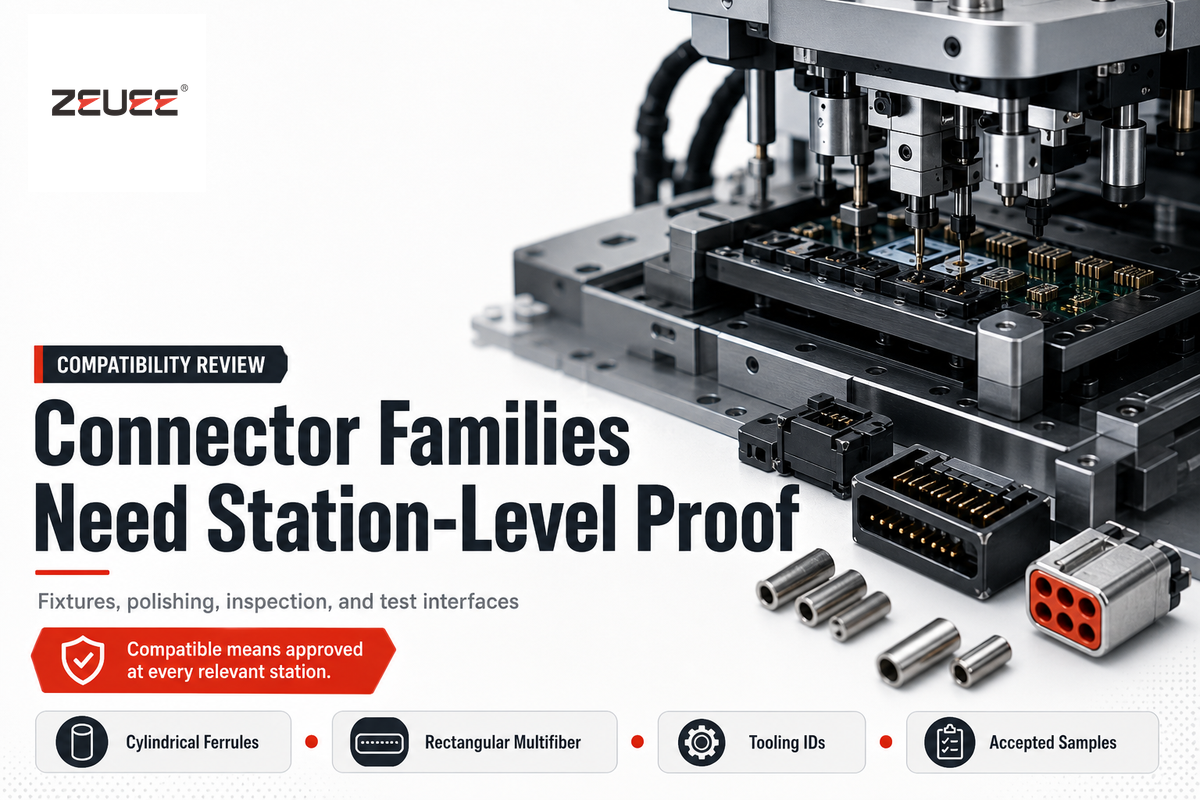
Each unproven product-family requirement then moves into the compatibility review; family names start that review but do not conclude it. Cylindrical single-fiber ferrules and rectangular multifiber ferrules can use different fixtures, polishing geometries, inspection fields, and test interfaces. IEC 61300-3-30:2026 has a distinct scope for rectangular multifiber end-face geometry, which is enough reason to ask for a family-specific interface sheet.
| Cluster | Verify at the station level | Evidence |
|---|---|---|
| LC | Ask the supplier to declare the station, fixture, consumable, inspection, and test route | Witnessed setup, tooling ID, and accepted sample |
| SC | Ask the supplier to declare the station, fixture, consumable, inspection, and test route | Witnessed setup, tooling ID, and accepted sample |
| FC | Ask the supplier to declare the station, fixture, consumable, inspection, and test route | Witnessed setup, tooling ID, and accepted sample |
| UPC finish | Ask the supplier to declare fixture, consumable, process, and measurement differences | Approved setup and accepted samples |
| APC finish | Ask the supplier to declare fixture, consumable, process, and measurement differences | Approved setup and accepted samples |
| Simplex cable | Ask the supplier to declare handling, marking, traceability, and packing requirements | Lot traveler and accepted packing sample |
| Duplex cable | Ask the supplier to declare handling, marking, polarity, and packing requirements | Lot traveler and accepted packing sample |
| MPO-style multifiber | Ask the supplier to declare the station, fixture, consumable, inspection, and test route | Witnessed setup, tooling ID, and accepted sample |
| Custom or hybrid assembly | Manual exceptions and buyer-supplied operations | Redlined station boundary |
For every row, mark whether loading, stripping, adhesive handling, curing, cleaving, polishing, inspection, optical testing, marking, and unloading are automatic, assisted, manual, or outside the supply. That prevents “compatible” from hiding a labor-intensive exception.
Consumables belong on the same sheet. Record adhesive or curing family, polishing film and replacement rule, cleaning materials, crimp tooling, reference cords, adapters, and any supplier-controlled recipe. A line can mechanically accept a connector yet still require different handling, cure, polish, inspection, or mating conditions. Compatibility is therefore a chain of station-level approvals, not a yes/no property of the frame.
4. Verify the complete measurement chain
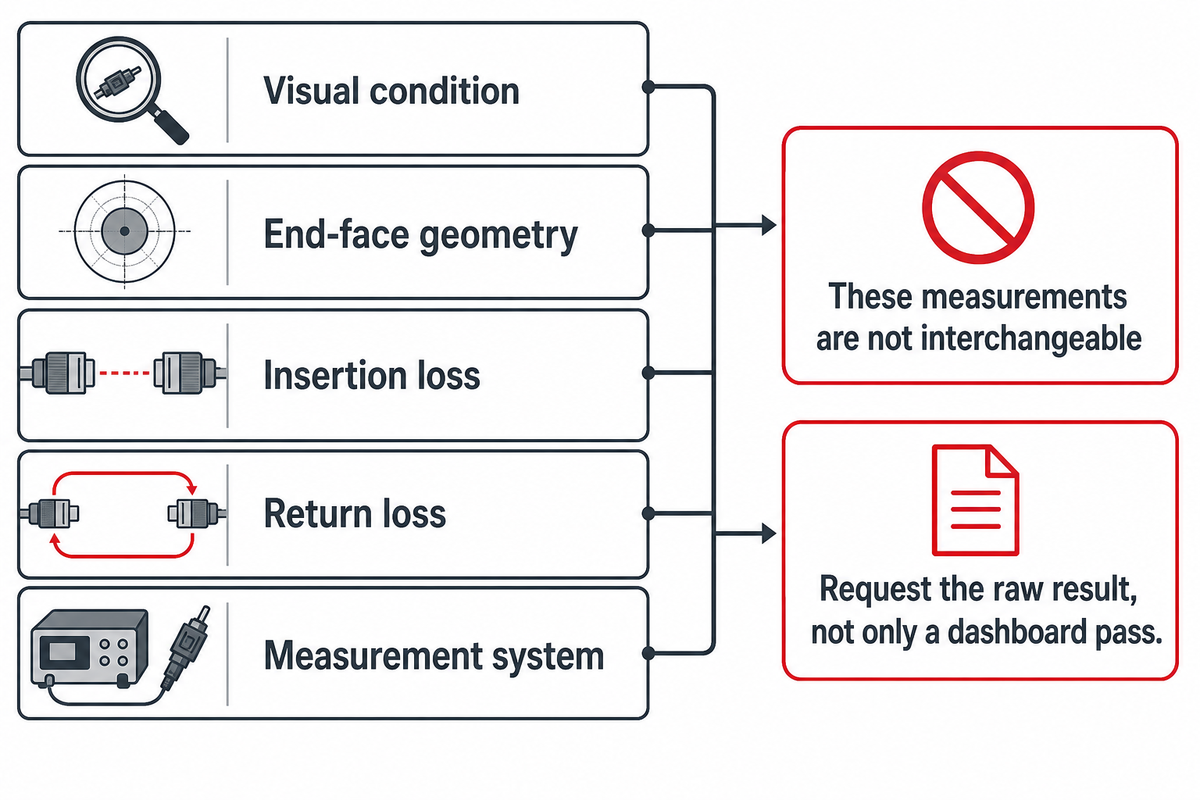
A clean end-face image is useful, but it is not an optical-performance result. The official scope of IEC 61300-3-35:2022 says visual inspection is additional to and does not replace attenuation, return loss, or end-face-parameter measurement. Ask the supplier to separate what is seen, what is measured, and what is qualified.
| Measurand | Define | Record | Do not substitute |
|---|---|---|---|
| Visual condition | Zone, recipe, connector state | Image and disposition | Insertion loss |
| End-face geometry | Ferrule family and interface | Raw geometry file | Cleanliness image |
| Insertion loss | Wavelength, reference, mating method | Result and sample identity | Appearance |
| Return loss | Wavelength and test configuration | Result and instrument ID | Insertion loss |
| Measurement system | Traceability, uncertainty, repeatability | Calibration and verification | Instrument brand name |
Where repeatability and reproducibility matter, define the study and acceptance before the trial. A calibration sticker proves neither the chosen adapter nor the entire measurement method is suitable for the product.
Request the raw result, not only a dashboard pass. The file should preserve product identity, time, recipe, instrument and adapter configuration, operator or station, wavelength where relevant, measured value, applicable rule, and disposition. Then repeat a small set of known samples after a fixture, adapter, recipe, or software change. This does not by itself validate the measurement system, but it reveals whether the result can be traced and compared.
5. Compare witnessed output across three agreed lots
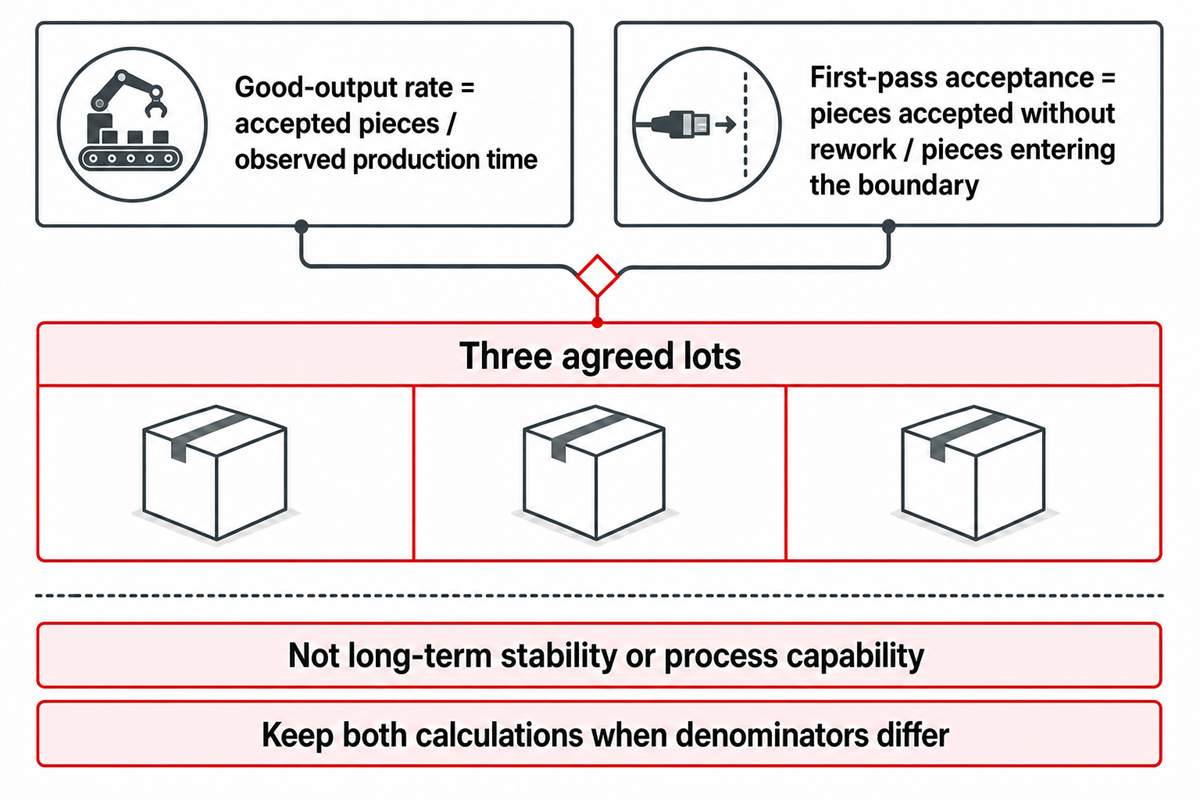
With the product measurement method fixed, a quoted cycle time may exclude loading, warm-up, inspection, rejects, rework, planned stops, and changeover. Freeze those rules, then calculate good-output rate = accepted pieces / observed production time. Under the same product measurement and acceptance method, report first-pass acceptance = pieces accepted without rework / pieces entering the boundary separately.
Hypothetical teaching example — not ZEUEE or industry performance:
| Lot | Entered | First-pass accepted | Accepted after rework | Observed time | Good-output rate | First-pass acceptance |
|---|---|---|---|---|---|---|
| A | 240 | 222 | 8 | 120 min | 115.0/hour | 92.5% |
| B | 240 | 218 | 12 | 125 min | 110.4/hour | 90.8% |
| C | 240 | 225 | 6 | 118 min | 117.5/hour | 93.8% |
The three-lot comparison can reveal variation that one polished demonstration may hide. It does not establish long-term stability, process capability, confidence limits, future yield, or plant capacity. NIST statistical guidance treats those as larger, time-dependent questions about independent observations and an in-control process. The purchase agreement must therefore describe this as a witnessed acceptance comparison, not a capability study.
Use buyer-controlled incoming material where practical, or freeze supplier material by batch and inspection status. Record starved time, blocked time, planned breaks, minor stops, and manual recovery instead of quietly removing them from the denominator. If the supplier proposes a different boundary, keep both calculations. A disagreement about the denominator is a commercial difference that should be visible before the purchase order, not discovered during ramp-up.
6. Challenge changeover and traceability promises
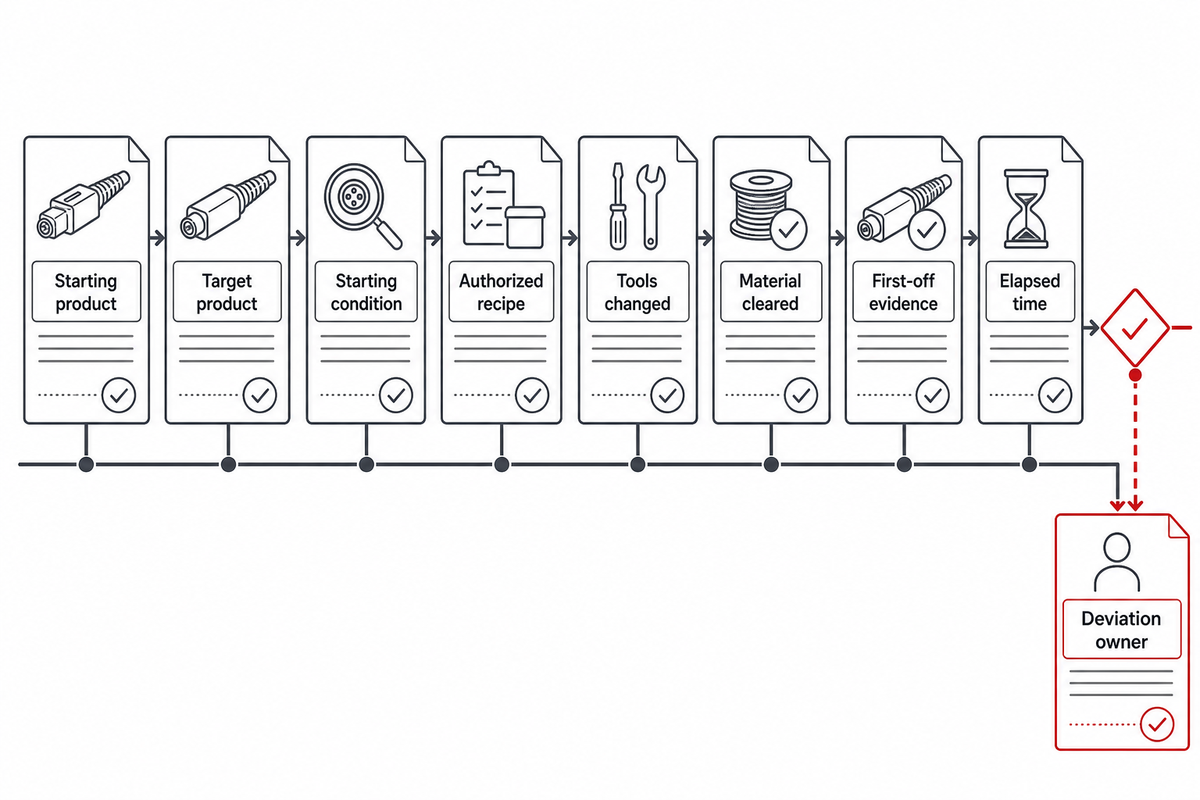
A recipe button is not a changeover result. Witness a switch from the starting configuration to a commercially important or difficult variant. Record tool exchange, material clearance, recipe authorization, human interventions, first-off inspection, first approved piece, elapsed time, and unresolved deviations.
Changeover acceptance row: starting product → target product → starting condition → authorized recipe → tools changed → material cleared → first-off evidence → elapsed time → deviation owner.
Then follow one serial or lot identity through incoming material, station events, inspection files, optical results, rejects, rework, and packing. If a component or software revision changes after factory acceptance, identify the affected evidence and repeat the relevant tests.
Do not test only the easiest direction. A change from a complex setup to a simple one may hide cleaning, alignment, or first-off problems that appear in the reverse direction. Include a cold start if startup recovery matters, and agree what stops the clock: operator confirmation, first mechanically complete part, or the first part accepted by every required measurement. The chosen endpoint can materially change the reported changeover time.
7. Assign machine safety and destination responsibilities
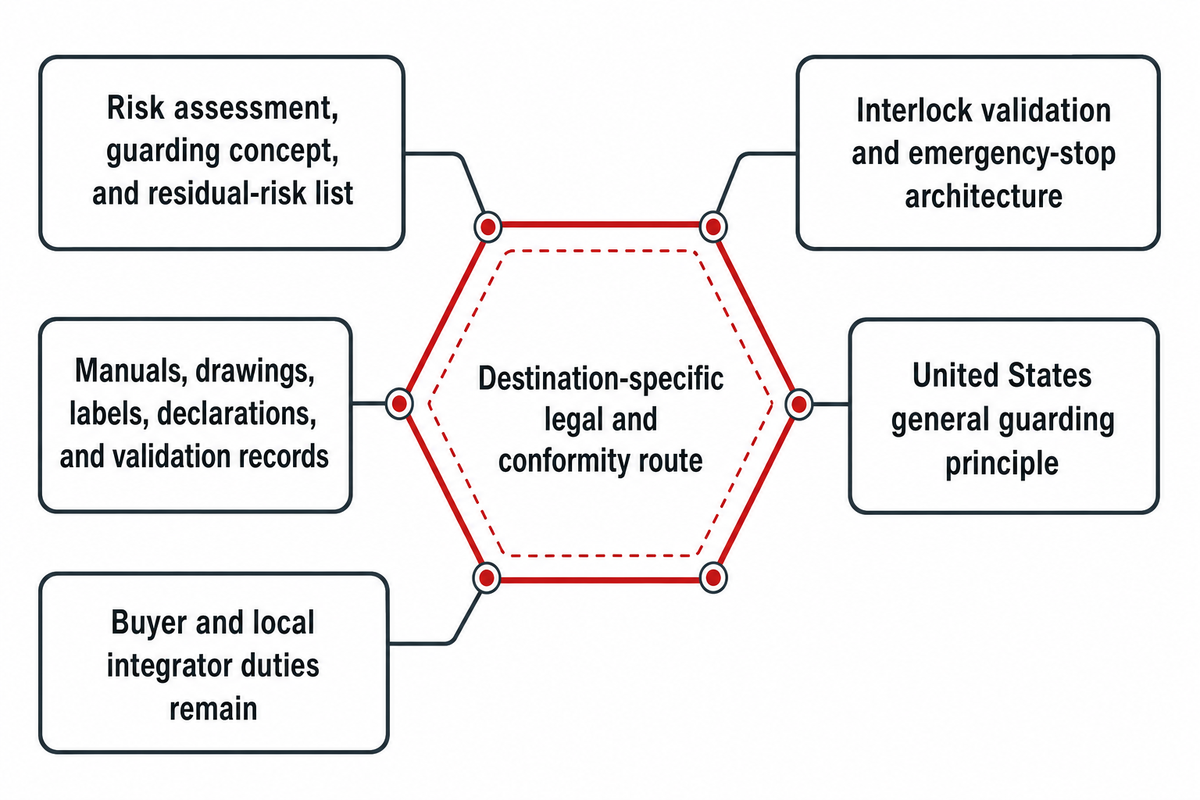
After change and startup conditions are defined, machine safety still needs its own boundary. For a United States installation, OSHA 29 CFR 1910.212 provides a general guarding principle for points of operation, ingoing nip points, rotating parts, and flying chips or sparks. That rule is not global certification, and ISO 9001 management-system certification is not approval of a particular machine or product.
“One or more methods of machine guarding shall be provided to protect the operator and other employees in the machine area.”
OSHA 29 CFR 1910.212(a)(1)
- Request the risk assessment, guarding concept, interlock validation, emergency-stop architecture, and residual-risk list.
- Name who supplies manuals, drawings, labels, declarations, validation records, and local integration work.
- Confirm the destination-specific legal and conformity route against the final configuration before shipment.
A supplier declaration, customer logo, or general certificate may be part of the file. None replaces the project-specific evidence or the duties of the buyer and local integrator.
8. Audit utilities, data ownership, spares, and software lifecycle
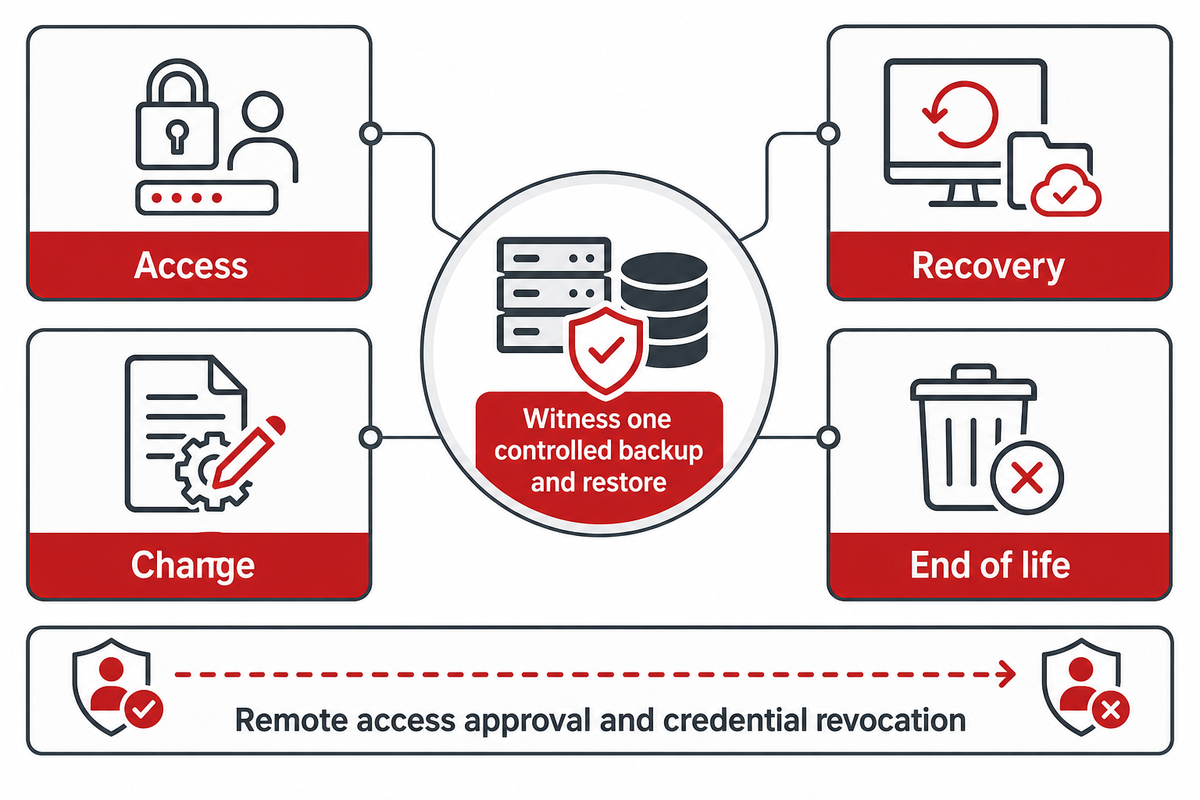
Supportability is designed before purchase. Freeze power, air, exhaust, floor loading, network interfaces, user roles, raw-data format, retention, backup location, and restoration method. Ask whether the buyer can restore the line without the original engineer and how a failed industrial computer or discontinued component will be replaced.
Access
Accounts, password custody, remote-session approval, revocation, logs.
Accounts, password custody, remote-session approval, revocation, logs.
Recovery
Program, recipes, parameters, data schema, backup and witnessed restore.
Program, recipes, parameters, data schema, backup and witnessed restore.
Change
Update delivery, release notes, substitute parts, regression tests, rollback.
Update delivery, release notes, substitute parts, regression tests, rollback.
End of life
Obsolete software, unsupported hardware, source-code boundary, migration owner.
Obsolete software, unsupported hardware, source-code boundary, migration owner.
NIST operational-technology guidance supports treating connected equipment as a lifecycle security concern. It does not prescribe your architecture or transfer source-code ownership; those details belong in the contract, with training, spares, escalation, and response expectations.
Ask the supplier to demonstrate one controlled backup and restore on the released configuration. Record the software versions, checksums, licenses, account custody, restore duration, and functions retested afterward. Also decide whether remote access is normally disabled, who enables it, how approval is recorded, and how credentials are revoked when personnel or service partners change. A backup file that has never been restored is only an assertion.
9. Put the RFQ-to-FAT Evidence Register into the purchase package
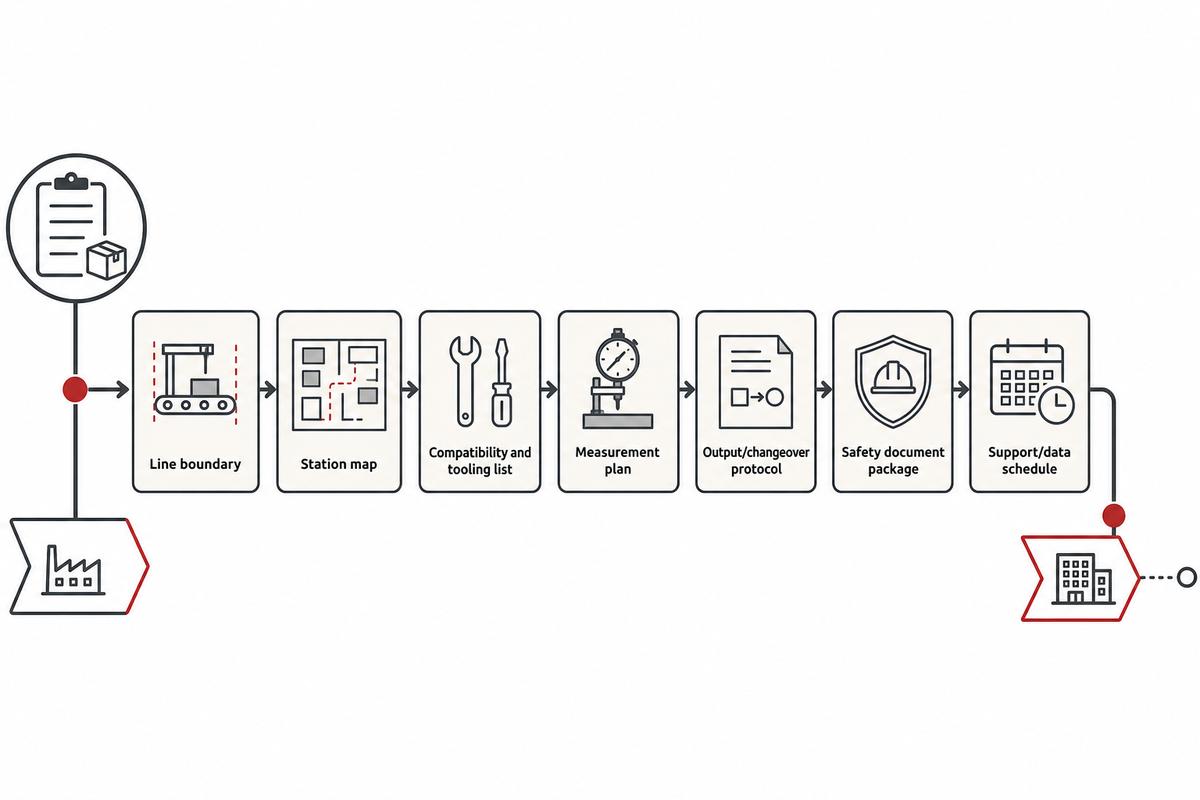
After backup and restore duties are set, the request-for-quotation document and factory acceptance plan should carry them under the same requirement IDs. Every promise then has an evidence method, sample or lot, data file, witness, result, limitation, and owner for deviations. Use this register as an article-specific buyer tool; do not present it as an IEC or ISA form.
| ID | Requirement | Product/variant | Target or rule | Evidence method | Sample/lot | Data file | Witness | Deviation owner | Limitation |
|---|---|---|---|---|---|---|---|---|---|
| P-01 | Station boundary | All release variants | Signed station map | Document review | N/A | Approved PDF | Buyer + supplier | Project manager | Revision controlled |
| T-02 | Tooling compatibility | Each family | Approved tooling route | Witnessed setup | One setup/family | Tool list | Process engineer | Mechanical lead | Wear excluded unless agreed |
| M-03 | Measurement chain | Critical variants | Approved method | Method demonstration | Defined sample | Raw result export | Quality engineer | Metrology owner | Uncertainty declared |
| O-04 | Good output | Agreed variant | Contract rule | Three witnessed lots | Buyer-defined | Event + test logs | Acceptance team | Production lead | Not capability evidence |
| C-05 | Changeover | Worst-case pair | Agreed elapsed boundary | Witnessed switch | One or more trials | Change log | Buyer engineer | Controls lead | Material clearance included |
| S-06 | Safety documents | Final machine | Destination file list | Document + function review | N/A | Signed package | Safety owners | Named party | Local review remains |
| L-07 | Lifecycle recovery | Released software | Restore succeeds | Backup/restore test | One clean system | Receipt + checksum | IT/OT owners | Software lead | Credentials controlled |
Close factory acceptance with seven controlled deliverables: the line boundary, station map, compatibility and tooling list, measurement plan, output/changeover protocol, safety document package, and support/data schedule. Carry any unfinished item into site acceptance with an owner and due date.
10. When ZEUEE belongs on the shortlist
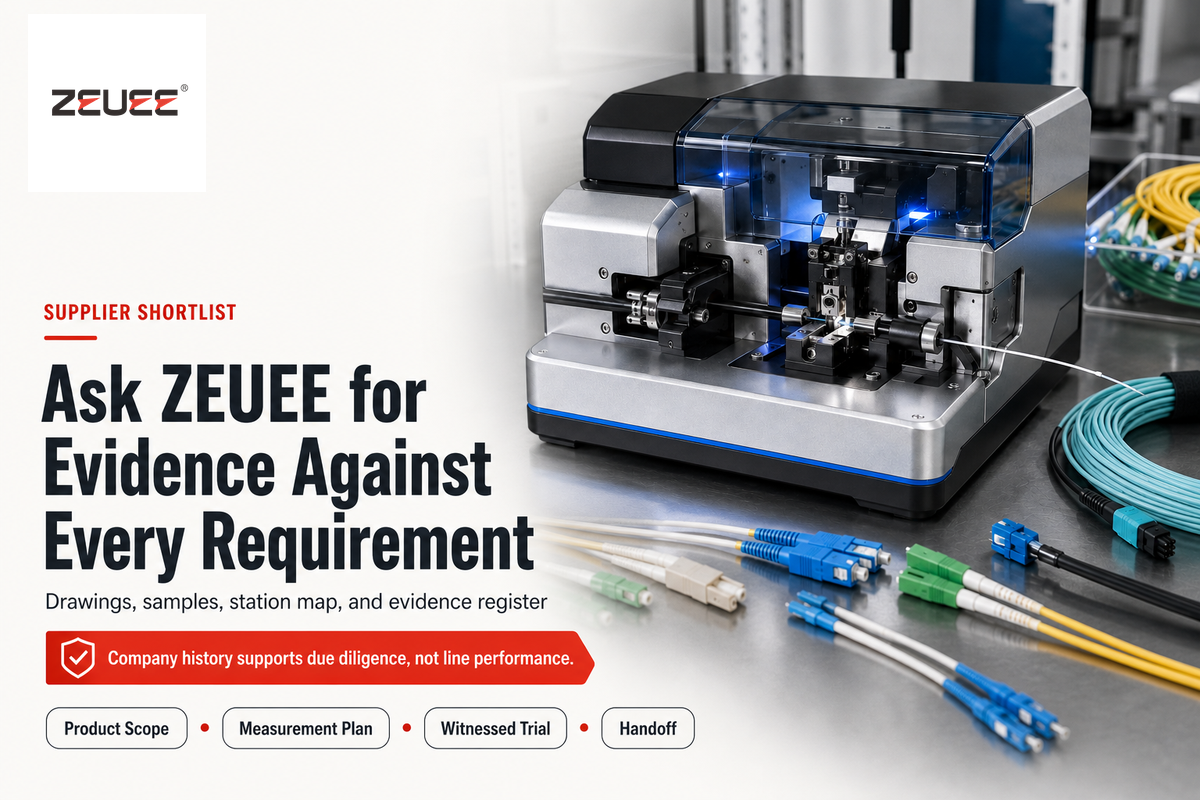
ZEUEE states that it was founded in 2005 and operates a 20,000-square-metre Jiangxi production base with 120+ specialists and 150+ research and development patents. It also states ISO 9001:2015 certification. These are first-party company facts and due-diligence context, not proof that a proposed line meets your connector, output, test, or destination requirements.
Use ZEUEE’s product page to review ZEUEE’s stated line boundary as a starting point for a scoped engineering discussion. Send drawings, samples, expected variants, the station boundary, and the evidence register above. Ask ZEUEE to return evidence against each requirement rather than treating a general product-page description as configuration proof.
Turn your product boundary into an acceptance-ready proposal
Share the connector families, cable constructions, sample products, inspection rules, output boundary, destination, and RFQ-to-FAT evidence register with ZEUEE.
11. What the 2026 standards activity means for buyers
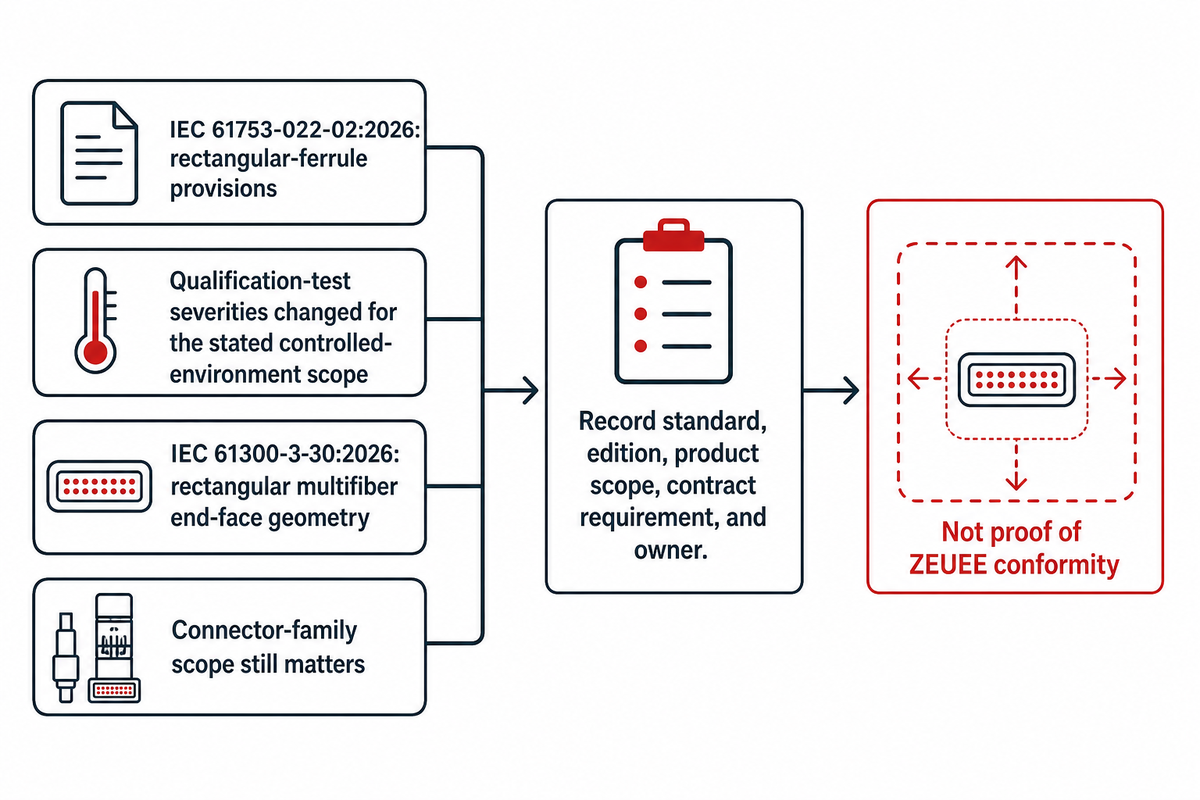
After the destination and connector-family scope are set, the applicable standards editions still need to be named. IEC published IEC 61753-022-02:2026 with rectangular-ferrule provisions and changed qualification-test severities for its stated controlled-environment scope. IEC 61300-3-30:2026 separately addresses rectangular multifiber end-face geometry. The purchasing implication is narrow but useful: connector-family scope still matters, and a generic promise of future flexibility should be replaced by witnessed family, fixture, measurement, and changeover evidence.
This standards activity is not a market-growth forecast, proof of ZEUEE conformity, or a statement that every project must use the same edition. Record the standard, edition, product scope, contract requirement, and owner that apply to your final assembly.
Frequently asked questions
How do you choose the right optical connector assembly line manufacturer?
Choose the supplier that can prove fit for your connector families, cable constructions, station boundary, measurement plan, witnessed output comparison, changeover, safety deliverables, and support model. Ask for drawings, tooling IDs, accepted samples, raw test records, and an evidence register. Corporate history and quality-system certification can support due diligence, but they do not prove cycle time, yield, optical performance, or final conformity. Reject proposals that leave blocking requirements without an evidence method or accountable owner before signing the purchase order.
What tests should an optical connector assembly line include?
The answer depends on the product specification and process boundary. The plan may include visual inspection, end-face geometry, insertion loss, return loss, dimensional or retention checks, and traceability. These measurements are not interchangeable. Define the applicable method, instrument, wavelength, reference artifact, calibration traceability, uncertainty, sample rule, raw-data format, and pass/fail disposition for each required characteristic. Also identify which tests run on every piece, which are sampled by lot, and what happens when a sampled result fails.
Can one line support LC, SC, FC, and MPO connectors?
Possibly, but a brochure list is not proof. Treat LC, SC, FC, and MPO as separate declared variants in the request. Ask the supplier to show the station, tooling, consumable, inspection, and test route for every commercially important variant, supported by witnessed changeovers, first-off records, and accepted samples. Mark any manual exception and its staffing, quality, and cycle-time effect.
How should throughput be verified before purchase?
Use a witnessed production trial that counts accepted pieces at the agreed endpoint, not empty cycles. Freeze product, incoming material, lot size, staffing, warm-up, planned stops, rejects, rework, test duration, and changeover treatment. Compare good-output rate and first-pass acceptance separately.
Preserve both the supplier’s denominator and the buyer’s contractual denominator when they differ. Comparing three agreed lots can expose an unusually clean demonstration, but it cannot establish long-term process capability, confidence limits, future yield, or plant capacity. Keep the raw event, stop, reject, rework, and test records so the calculation can be reconstructed.
What should an RFQ for an optical connector assembly line include?
Include the product boundary, variants, station map, automation responsibility, tooling, measurement plan, output and changeover protocols, safety documents, utilities, data ownership, backups, training, spares, support, acceptance, and deviation rules. Assign every requirement an evidence method, sample or lot, data file, witness, limitation, and owner.
References & Sources
- IEC 61300-3-35:2022 official catalogue — visual inspection scope and measurement boundary.
- IEC 61300-3-30:2026 official catalogue — rectangular multifiber ferrule geometry.
- IEC 61753-022-02:2026 official catalogue — current stated scope and technical changes.
- OSHA 29 CFR 1910.212 — United States general machine-guarding requirements.
- NIST: Multi-Job Production Systems — product mix, processing time, throughput, and bottleneck context.
- NIST process-stability guidance — observation and time boundaries.
- NIST process-capability guidance — in-control-process and data sufficiency boundary.
- NIST SP 800-82 Rev. 3 — operational-technology security lifecycle guidance.
- ISO 22400-1:2014 — manufacturing performance-indicator framework.
- ISA-105 standards overview — adaptable acceptance-test planning context.
WHY WE WRITE THIS
About ZEUEE Engineering Insights
ZEUEE shares technical guides based on real automation project experience. Since 2005, we have designed and manufactured non-standard automation equipment for connector assembly, wire harness production, robotic lines, vision inspection, and smart factory upgrades.
Founded in 2005
20,000 m² production base
120+ specialists
150+ R&D patents
ISO9001:2015 certified