Get in touch with Zeyu lntelligent Industrial Company
10 Hinge Assembly Machine Manufacturers to Compare in 2026

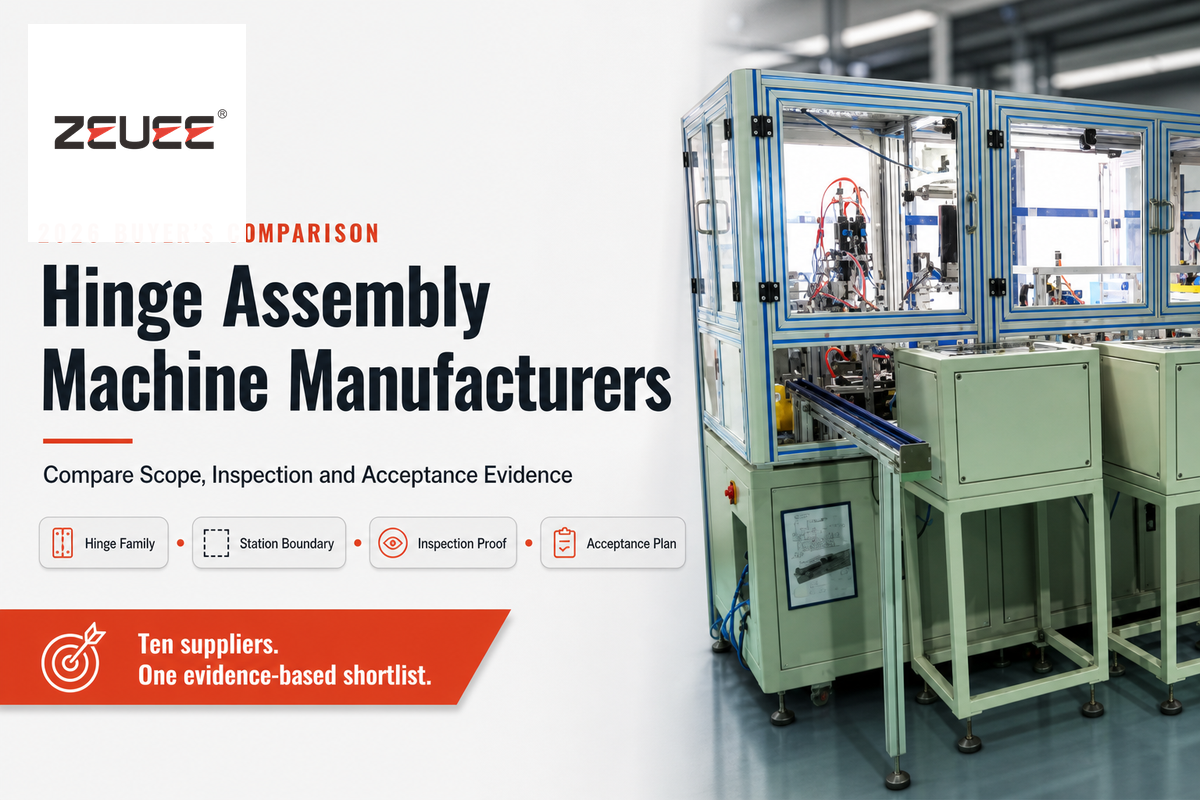
Hinge assembly machine manufacturers are automation builders serving very different jobs, from door and cabinet hinges to automotive hood hinges and miniature torque-controlled assemblies. This comparison uses hinge-specific public machine or case-study pages checked on August 24, 2026; it does not treat a general automation claim as evidence of fit.
Publisher disclosure
ZEUEE publishes this article and is one of the ten listed suppliers. The sequence isn’t a performance ranking, the list isn’t exhaustive, and every commercial specification below is supplier-stated unless explicitly identified as an independent source.
Quick answer: shortlist a builder by hinge family, product mix, station boundary, inspection and reject evidence, then define a factory and site acceptance plan. Public rates become useful only after the part, included operations, loading, quality definition and measurement period match. One mechanism’s fast figure cannot rank a different assembly process.
For ZEUEE product configuration and quotation intent, use the hinge assembly machine page; this article stays focused on comparing supplier evidence across the market.
How This Manufacturer Comparison Was Built
The inclusion rule is simple: each company needed a public page for a hinge-specific assembly machine, line or case study. That rule filters out finished-hinge brands and general integrators with no visible hinge reference, but it does not independently validate a supplier’s capability, installed base or current commercial offer.
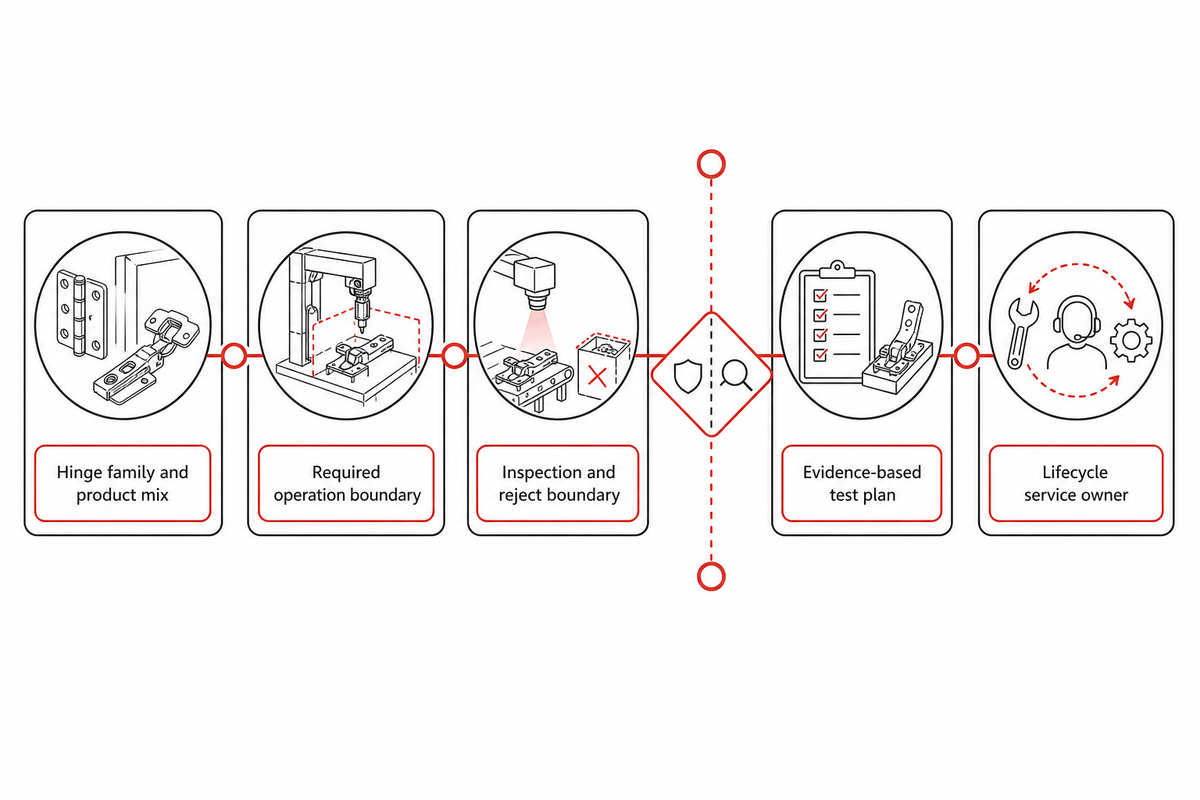
Use the 5-Link Hinge Proof Chain before comparing layout or price. Each candidate first has to match the hinge family, cover the required operations, show the inspection and reject boundary, accept an evidence-based test plan and name responsibility for service through the equipment lifecycle.
Do
- Compare the same hinge family and operation boundary.
- Ask what is loaded, assembled, inspected and rejected.
- Separate public claims from witnessed results.
- Write acceptance conditions before the order.
Do not
- Award a speed winner from unlike parts.
- Read “fully automatic” as a complete station list.
- Treat a named sensor as inspection proof.
- Assume factory acceptance covers site integration.
Start With the 4-Family Station Canvas
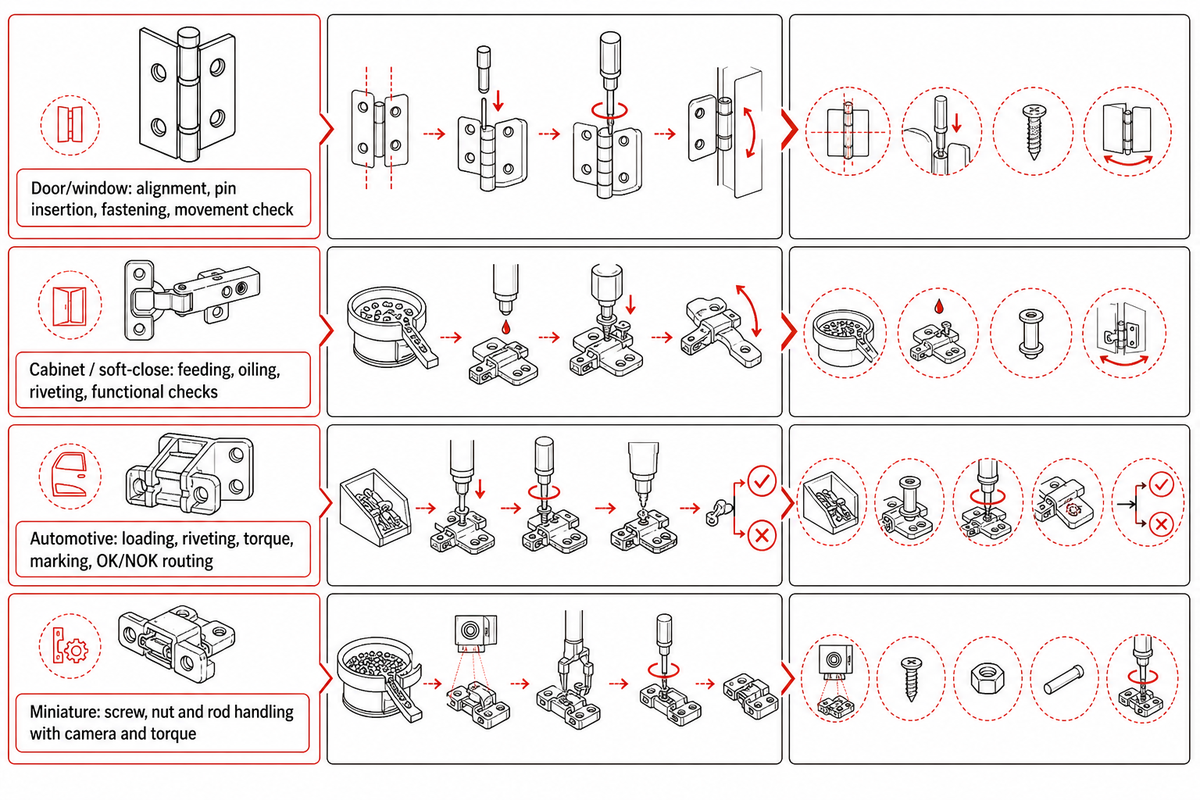
The first supplier gate is the work itself: hinge geometry, components, joining method, functional checks and the desired start and end points. Product mix, build schedule, station processing times and likely bottlenecks also matter because a line that fits one stable model may perform differently across frequent variants.
NIST’s multi-job production research analyzes throughput and bottlenecks as functions of product mix and build schedule. It is not hinge-specific, but it corrects a common procurement shortcut: matching the hinge name alone is not enough to establish system fit.
| Hinge family | Likely assembly work | Public supplier evidence in this set | What still needs proof |
|---|---|---|---|
| Door/window | Wing alignment, pin or shaft insertion, fastening, movement check | ZEUEE and Hingehinges pages | Exact profiles, finish protection, changeover and functional limits |
| Cabinet / soft-close | Small-part feeding, spring or damper work, oiling, riveting, functional checks | Sinuowei, Guangdong Yijie, Yanman and Leatop pages | Variant matrix, feeder escape handling and test definition |
| Automotive | Controlled loading, riveting, torque, marking and OK/NOK routing | AGME automotive hood-hinge page | Approved part family, traceability, interface and validation plan |
| Miniature | Screw, nut and rod handling with torque and camera checks | Pinnacle machine page | Part tolerances, tool access, data retention and measurement study |
If no public machine matches the part, ask for a custom cell built around your part and require a concept that marks every excluded, optional and buyer-supplied station. The concept drawing should define interfaces; it should not be mistaken for validated performance.
Normalize Catalog Language Before You Compare
Catalog wording is not standardized across the industry, and buyers searching for “hinges manufacturing” often receive mixed forming and assembly results. An automatic assembly machine, hinge production line, hinge assembly line, production line, machine line, making machine, making machinery, door hinge making machine, fully automatic hinge assembly machine and door hinge assembly machine can describe overlapping scopes, so translate every title into stations.
Marketplace wording can be even less precise. Phrases such as hinge automatic assembly, automatic assembly making machine, machine automatic assembly, machine hinge assembly machine, hinge assembly machine high speed and full automatic are search or listing strings, not separate architectures and not proof of production efficiency.
For cabinet hardware, identify whether automatic cabinet hinge assembly or cabinet hinge making covers a soft-close arm, cup, clip, slide, overlay, opening angle and adjustment for the actual kitchen box. Listings for 3d soft close cabinet, machine for cabinet or drawer slide machine may describe adjacent equipment rather than the required hinge process.
Keep forming and assembly boundaries separate. Stamping dies, stamping molds or presses may make a leaf before assembly; stainless steel hinges may require different finish protection from cold-rolled parts; and inch dimensions, part size or concealed-hardware features must be shown on the controlled drawing. For the leaf-material enquiry, compare stainless steel materials from TiAlloy and specify the grade, thickness and finish independently of the assembly-machine acceptance plan.
Finally, treat phrases such as machinery supplier, supplier in China, customize, advanced solution, high accuracy, efficient, automatically, cost advantage and “contact us” as commercial language. None replaces a cycle breakdown, accepted sample, interface record or measurable requirement.
10 Hinge Assembly Machine Manufacturers to Compare
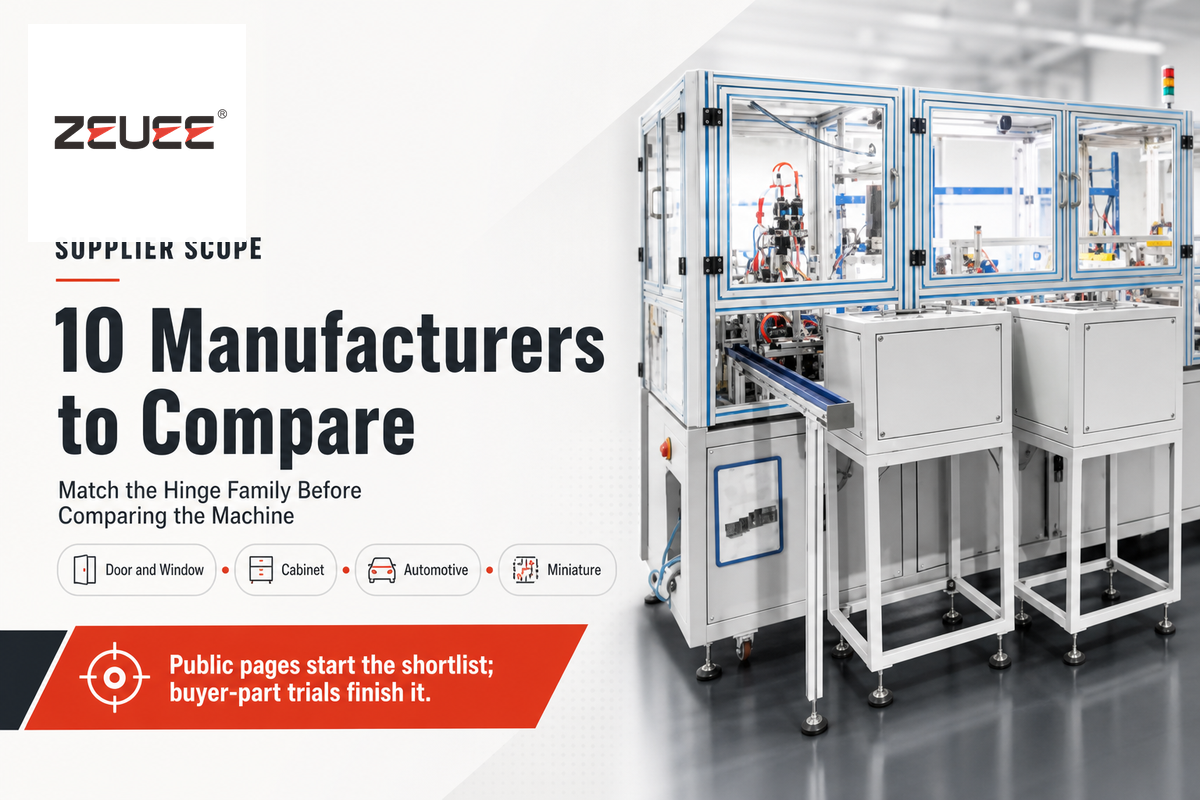
This comparison set is a starting point, not the entire market and not an endorsement list. Company pages change, so confirm the current model, legal supplier identity and proposal scope directly before qualification.
Public pages answer only the discovery question: whether a supplier shows a relevant hinge process and what it says the machine includes. They usually do not establish the revision of the tested part, sustained accepted output, measurement capability, current software, exact component brands, spare availability or support response for the buyer’s location.
That evidence gap should change how the table is used. Even a close public match earns a supplier a technical discussion, not an automatic place on the final bid list; the next gate is a proposal tied to drawings and samples, followed by design review and witnessed acceptance.
| Supplier | Hinge type and public machine scope | Useful evidence to request next |
|---|---|---|
| ZEUEE | Door/window 2-wing, 3-wing and custom-profile assembly | Station map, fixture coverage, inspection and buyer-part trial |
| Sinuowei | American self-closing hinge assembly | Riveting, briquetting and spring-assembly boundary |
| Addtronics / ACA | Rotary-dial damper-hinge case study | Part definition, inspection logic and rate measurement |
| Guangdong Yijie | Full and semi-automatic cabinet-hinge catalogue | Oiling, test, riveting and tooling responsibility |
| Futuer | Automatic hinge shaft-loading machine | Upstream loading, downstream checks and utilities |
| Yanman | Hydraulic hinge assembly workflow | Feeding, positioning, camera check and reject route |
| Leatop | Soft-closing hinge assembly | Test method, variant matrix and changeover evidence |
| Hingehinges | Semi-automatic hinge assembly | Operator work, included tooling and quality checks |
| Pinnacle | Miniature screw, nut and rod hinge assembly | Camera, torque, traceability and part-window evidence |
| AGME | Automotive hood-hinge assembly, control and marking | Load checks, torque, marking, OK/NOK and validation |
1. ZEUEE
ZEUEE’s product page describes door and window hinge equipment for 2-wing, 3-wing and custom profiles. It reports 10–12 pieces per minute, 10.5 kW, 380 V/50 Hz and 0.5–0.8 MPa; these are first-party values and need confirmation against the buyer’s exact part and station boundary.
2. Xiamen Sinuowei
Sinuowei’s public page focuses on an American self-closing hinge assembly machine and names riveting, briquetting and spring assembly in its product description. Buyers should ask which part variants share tooling and how the line detects a missing or incorrectly oriented spring.
3. Addtronics / ACA
The ACA case study describes a rotary-dial system with two bowl feeders, outside assembly, inside inspection and synchronized pick-and-place. The page reports more than 40 hinges per minute, but the number belongs to that damper-hinge case and is not a door-, cabinet- or automotive-hinge benchmark.
4. Guangdong Yijie
Yijie’s marketplace catalogue presents full and semi-automatic hinge-machine variants, with descriptions covering oiling, testing, riveting and molds. The catalogue is useful for discovery, but the quotation still needs a model-specific station list, current manufacturer identity and acceptance evidence.
5. Futuer
Futuer’s product page describes automatic hinge shaft loading and reports 20–25 pieces per minute, 220 V and 0.5–0.8 MPa. Ask where its scope begins and ends, because a shaft-loading rate does not establish the rate of a complete hinge line with inspection and functional testing.
6. Yanman
Yanman’s workflow page outlines feeding, positioning, assembly and camera checking for hydraulic hinges. The page can support a station discussion, while the proposal should still identify the camera decision, reject diversion, reinspection rules and evidence retained for each batch.
7. Leatop
Leatop’s ZP02 page presents a fully automatic soft-closing hinge machine with testing and a supplier-stated rate of 35–42 pieces per minute. Qualification should define which soft-close variants were tested, the acceptable functional window and what happens when a part fails.
8. Hingehinges
Hingehinges describes a semi-automatic machine and reports 30 pieces per minute. The semi-automatic label makes operator work especially important: document manual loading, mistake-proofing, ergonomic tasks and whether the reported rate includes handling and checks.
9. Pinnacle
Pinnacle’s miniature hinge page covers screw, nut and rod handling with camera and torque control, and reports less than eight seconds per sample. That cycle belongs to a small controlled assembly and should be compared only after the buyer confirms component presentation, torque definition, data capture and fault handling.
10. AGME
AGME’s automotive page lists automated feeding, presence lasers, poka-yoke load checks, CNC riveting, torque control, marking and OK/NOK selection for hood hinges. It offers a useful example of a broad control boundary, but the page does not independently prove performance on a new buyer’s part.
When Reported Speeds Become Comparable
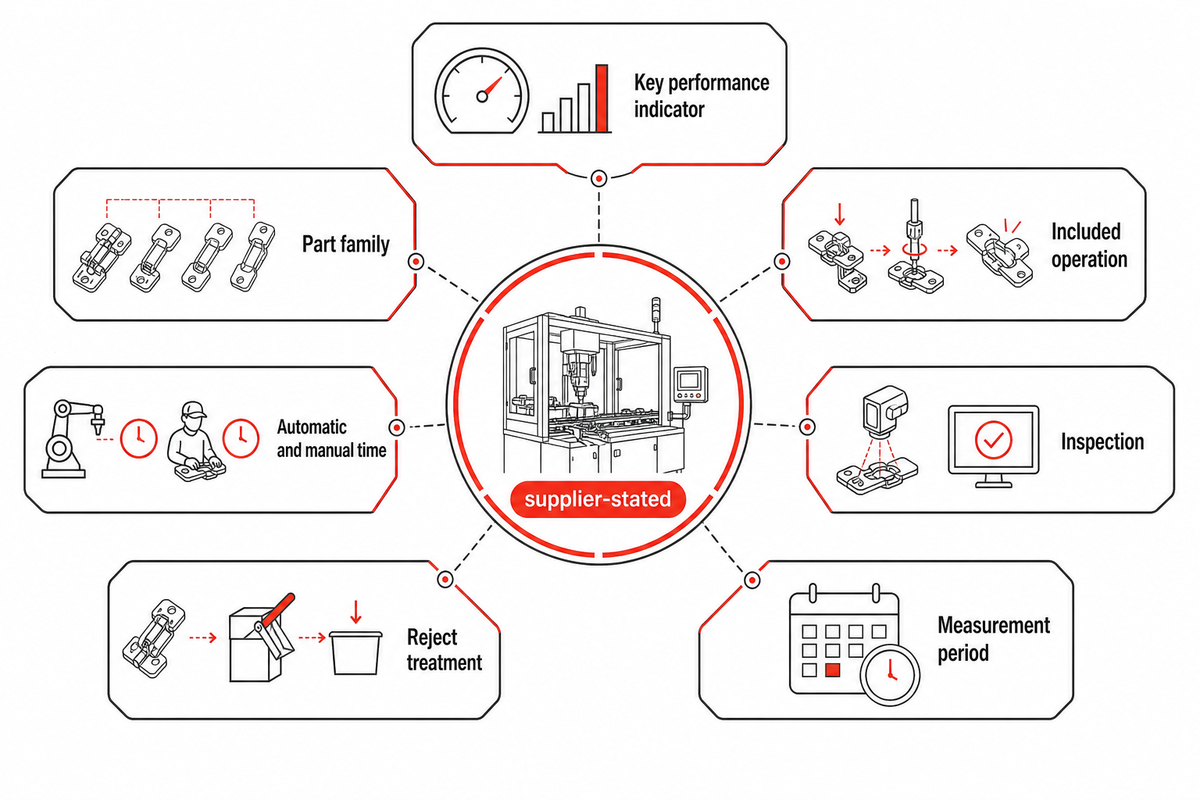
Public rate figures are context, not a league table. They become comparable when the key performance indicator, part family, included operation, automatic and manual time, inspection, reject treatment and measurement period are defined the same way and reported against the same buyer-approved test window.
10–12/minZEUEE door/window page
>40/minACA damper-hinge case
20–25/minFutuer shaft-loading page
<8 secPinnacle miniature sample
| Supplier | Reported rate | Hinge type / operation | Inspection disclosure |
|---|---|---|---|
| ZEUEE | 10–12 pcs/min | Door/window hinge assembly | Confirm in proposal |
| Addtronics / ACA | >40 hinges/min | Damper-hinge rotary-dial case | Inside inspection described |
| Futuer | 20–25 pcs/min | Shaft loading | Not established by rate |
| Leatop | 35–42 pcs/min | Soft-closing hinge assembly | Testing stated |
| Hingehinges | 30 pcs/min | Semi-automatic assembly | Confirm in proposal |
| Pinnacle | <8 sec/sample | Miniature screw/nut/rod assembly | Camera and torque stated |
All four figures are supplier-stated and were not independently cross-tested. The units alone do not reveal whether feeding, assembly, inspection, unloading, faults, changeover or rejected parts are inside the measurement.
ISO 22400-1 provides concepts, terminology and criteria for constructing manufacturing indicators. Its public scope supports a constructive conclusion: rates are not inherently incomparable, but the definition and measurement context must be aligned before comparison.
Give every shortlisted supplier the same approved samples and written operation boundary. Record warm-up, planned stops, faults, rejects and manual intervention separately, then compare the accepted result against the agreed definition rather than a brochure headline.
Inspection and Station Scope That Should Appear in the Quote
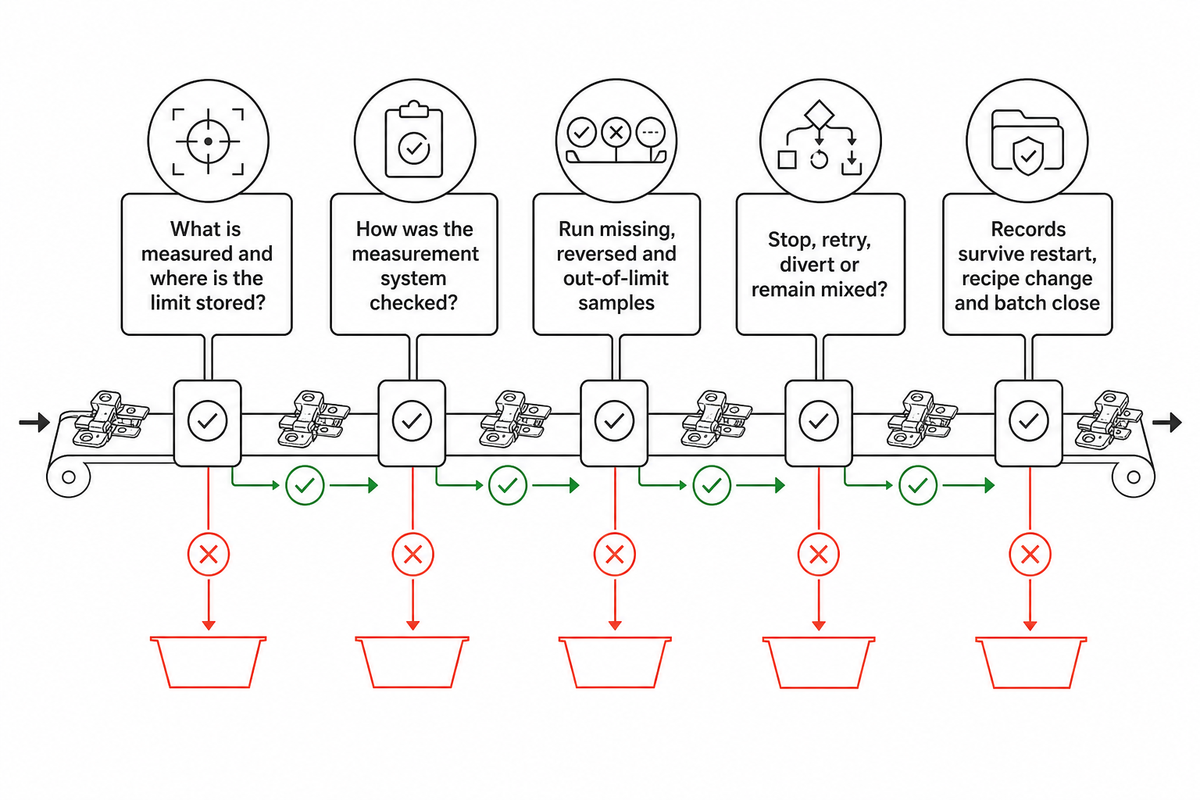
The quotation should read like a process map. List part presentation, orientation, presence checks, pin or shaft insertion, riveting or screw fastening, lubrication, torque or load verification, functional testing, marking, data capture, reject decision and physical reject diversion.
AGME publicly names presence lasers, poka-yoke load checks, torque control, marking and OK/NOK selection; Pinnacle names camera and torque control; Yanman describes camera checking. These examples show possible station scope, not equivalent methods or proven measurement capability.
Evidence request for every inspection
- What characteristic is measured, and where is the limit stored?
- How was the measurement system checked for the actual part and finish?
- Can the supplier run a deliberate missing, reversed or out-of-limit sample?
- Does a failed part stop, retry, divert or remain mixed with good output?
- Which records survive a restart, recipe change and batch close?
Naming a sensor does not prove the decision logic, repeatability or accepted result. Use this custom assembly machine guide to turn the station list into a machine brief before requesting quotations, and ask each supplier to mark exceptions against the same document.
Safety, Electrical and Operational-Technology Handover
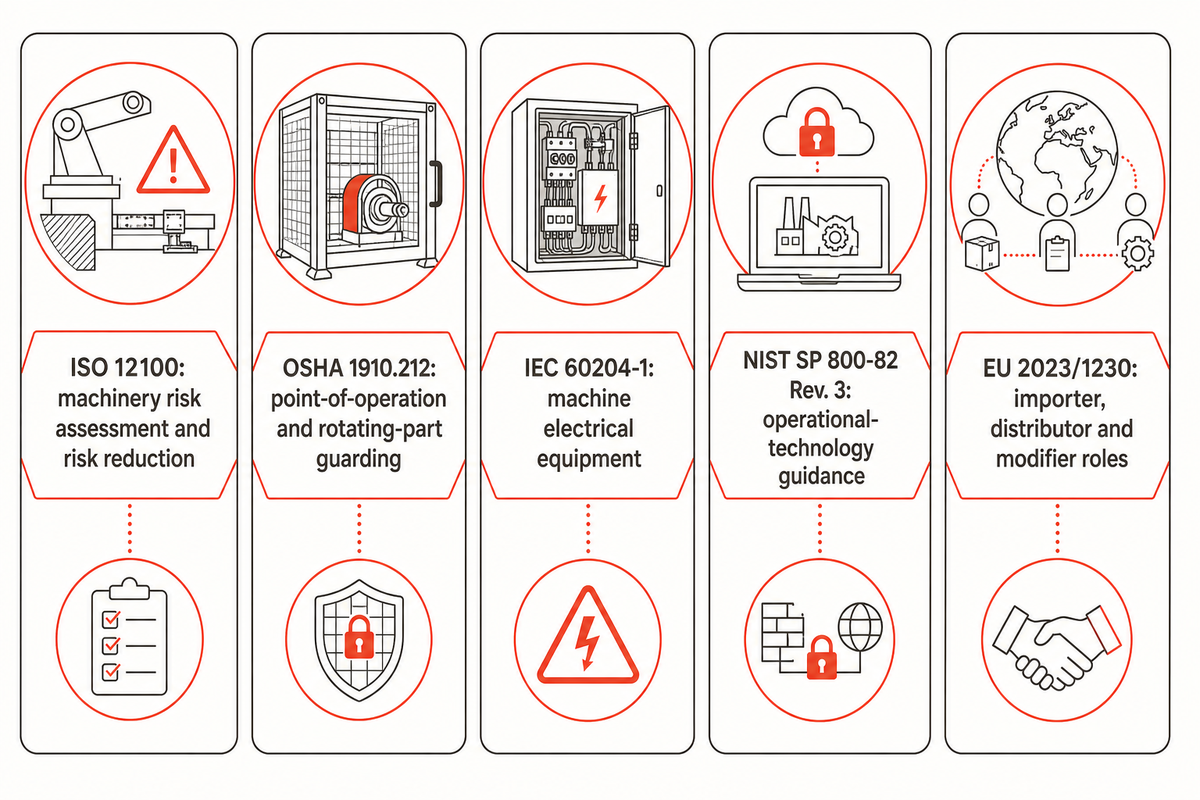
Safety, electrical work and connected-system security need separate evidence. A standard’s scope is not a marketing badge, and a supplier’s certificate or component label does not prove that the integrated line meets the buyer’s destination, installation or operating requirements.
ISO 12100:2010 provides principles for machinery risk assessment and risk reduction. Use it to ask for the machine’s hazard analysis and risk-reduction record across intended use, foreseeable misuse, changeover, cleaning, maintenance and fault recovery; do not turn the citation into a claim that any listed supplier is certified.
For United States workplaces, OSHA 1910.212 addresses guarding against hazards such as point-of-operation and rotating-part exposure. The buyer still has to evaluate the actual cell, access points, modes and local workplace obligations.
IEC 60204-1 covers electrical, electronic and programmable electronic equipment for non-portable machines within its scope. Put supply, short-circuit information, protective bonding, disconnects, control circuits, documentation and test records into the specification, and verify the applicable edition and regional adoption at project freeze.
If the line has remote service or a plant-network connection, use NIST SP 800-82 Rev. 3 as operational-technology guidance. Define approved remote access, named accounts, privilege, logging, configuration integrity, backups, tested recovery, update responsibility and removal of supplier access; keep those controls distinct from machine safety functions.
Destination and project roles also matter. As one regional example, Articles 17 and 18 of EU Regulation 2023/1230 specify cases in which an importer, distributor or person making a substantial modification can assume manufacturer obligations. This is not universal legal advice; allocate conformity, integration and later-modification responsibility for the actual destination with qualified support.
A Factory Acceptance Test That Makes Claims Comparable
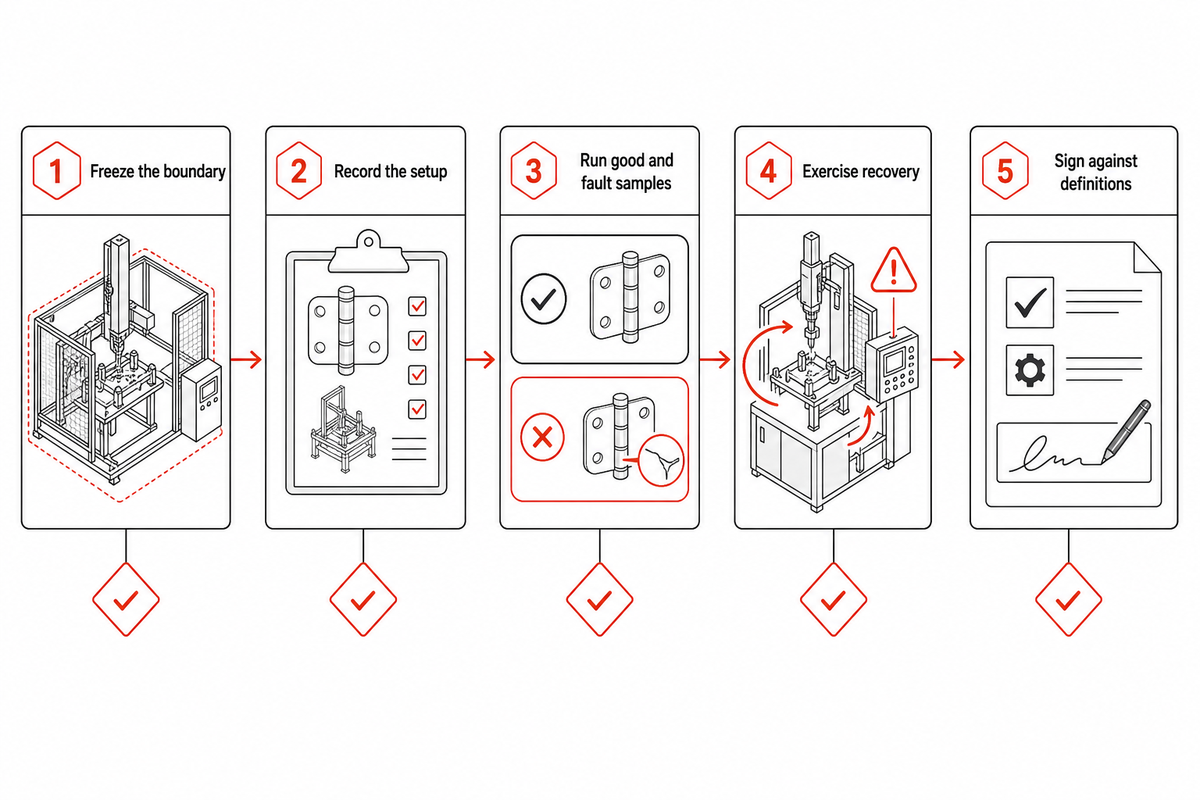
The factory test should convert the quotation into observable evidence, using buyer-approved parts and deliberate fault samples. Sample quantity, run duration, output target, quality limits and changeover acceptance are project-specific, so agree them in the request for quotation instead of borrowing universal numbers.
- Freeze the boundary — identify part revisions, approved samples, process start and end, excluded stations and buyer-supplied items.
- Record the setup — list fixtures, feeders, recipes, software version, utilities and measuring equipment used for the trial.
- Run good and fault samples — demonstrate normal output, detection, alarms, reject diversion and prevention of mixed output.
- Exercise recovery — show changeover, jam clearing, controlled restart, data retention and the response to power or air interruption.
- Sign against definitions — compare the result with agreed output and quality indicators, then name every open item, owner and due date.
A factory test with buyer-approved parts can be a useful project gate, but it is not the final proof of installed performance. Add a separate site-acceptance plan for actual utilities, guards, floor conditions, upstream and downstream interfaces, environmental conditions and network connections, followed by continuing validation when recipes, parts, software or safeguarding change.
For robot-containing systems, OSHA’s technical guidance states: “It is the responsibility of integrator to ensure that an RA is completed and documented prior to commissioning.” Treat that as a risk-assessment responsibility, not as proof that a factory rate will carry over to the site.
When a Fully Automatic Line Is Not the Right Next Step
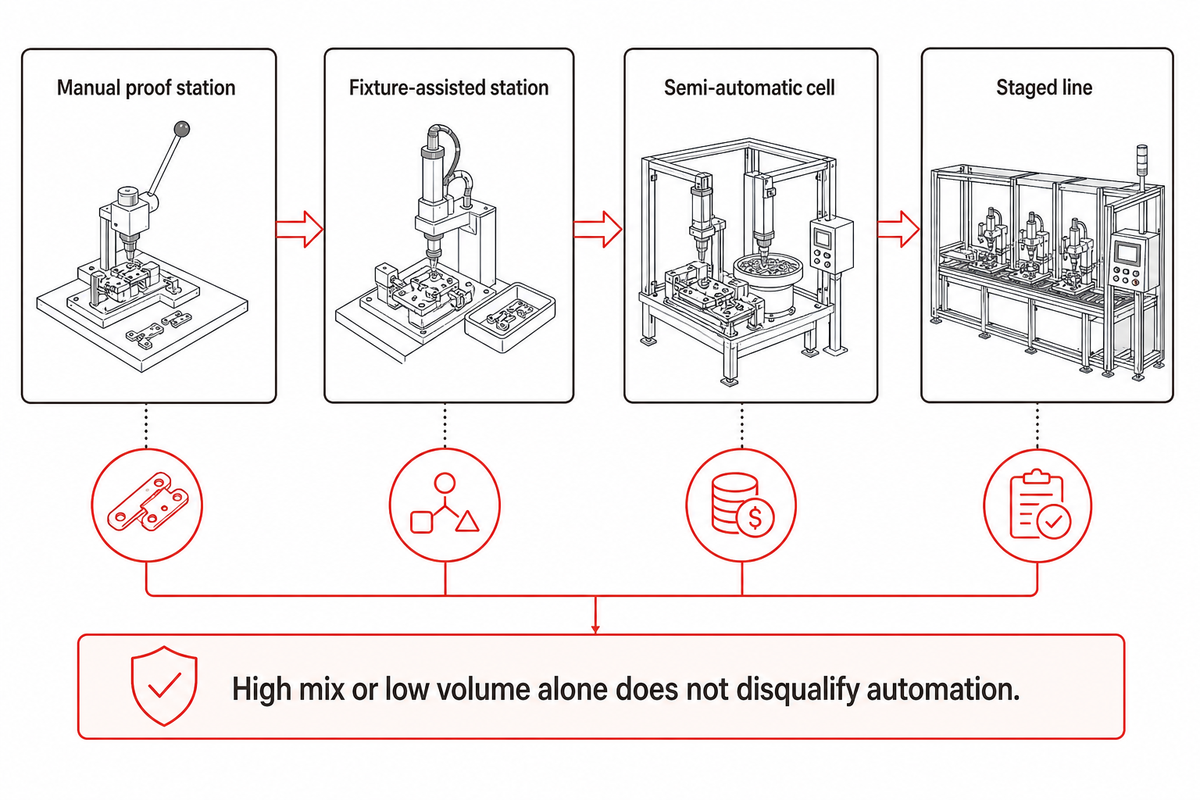
Delay or stage the project when the part geometry or bill of materials is changing, no approved sample exists, the process window is unresolved, interfaces have no owner, or maintenance responsibility is undefined. Uncertain product mix, build schedule, station processing time and bottleneck behavior also make a fixed high-speed concept hard to validate.
High mix or low volume alone does not disqualify automation. NIST describes flexible collaborative robots as one possible route for high-mix, low-volume manufacturers, so the decision should combine process stability, flexibility, capital, system efficiency and acceptance evidence instead of using a single volume threshold.
A manual proof station, fixture-assisted station, semi-automatic cell or staged line may expose process variation before a larger commitment. Buyers can choose an automation stage for their volume and variation and review the wider automated assembly machine range without assuming that the largest machine is the lowest-risk answer.
Decision Framework: Shortlist With Evidence, Not Adjectives
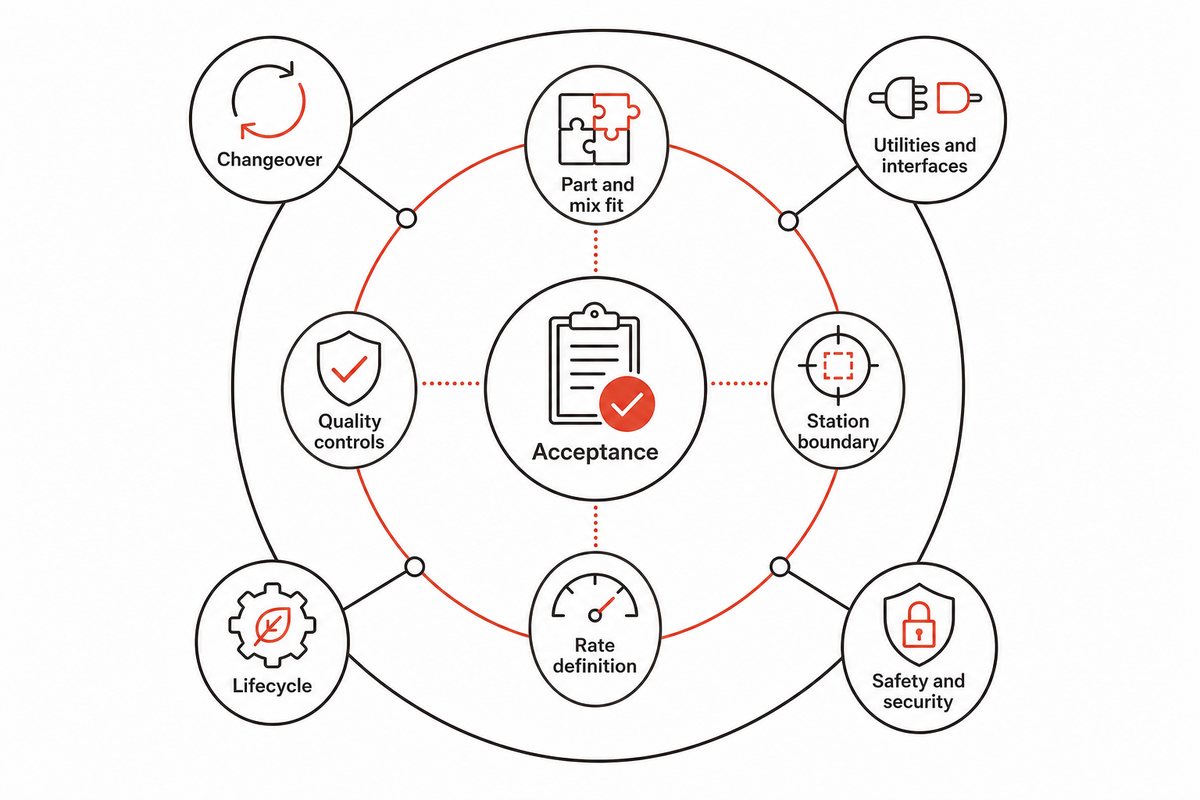
Run the 5-Link Hinge Proof Chain in two stages. Stage one is pass/fail: correct hinge family and product mix, complete station boundary, inspection and reject evidence, acceptance plan and a named lifecycle owner.
Stage two is buyer-prioritized: layout, changeover, data interface, regional support, spare-parts strategy and commercial terms. Do not invent generic weights; a plant with frequent variants may value changeover evidence differently from a dedicated line with a stable schedule.
| Gate | Evidence seen | Evidence requested | Open risk / owner |
|---|---|---|---|
| Part and mix fit | Public reference or trial | Variant and schedule model | Unproven geometry / buyer |
| Station boundary | Process map | Inclusions, options, interfaces | Scope gap / supplier |
| Quality controls | Screen or record sample | Fault demonstration | Mixed output / joint |
| Rate definition | Supplier-stated cycle or output | Written time, part and inclusion basis | Unlike measurement / joint |
| Changeover | Method or video | Witnessed variant change and restart | Hidden manual work / supplier |
| Utilities and interfaces | Preliminary list | Frozen power, air, data and floor plan | Site mismatch / buyer |
| Safety and security | Risk and access concept | Destination-specific review and recovery test | Unassigned obligation / joint |
| Acceptance | Draft procedure | Factory, site and change plan | Undefined criterion / buyer |
| Lifecycle | Service proposal | Spares, backup, recovery, access removal | No owner / supplier |
Keep a separate worksheet for each supplier and record the date of every public page or document. For company-wide due diligence beyond hinge process fit, continue with the automation supplier vetting checklist; this worksheet stays limited to hinge scope, rate, inspection and acceptance. If useful, review another supplier-comparison example, while treating handle equipment as a different process family.
What to Send a Manufacturer for a Useful Proposal
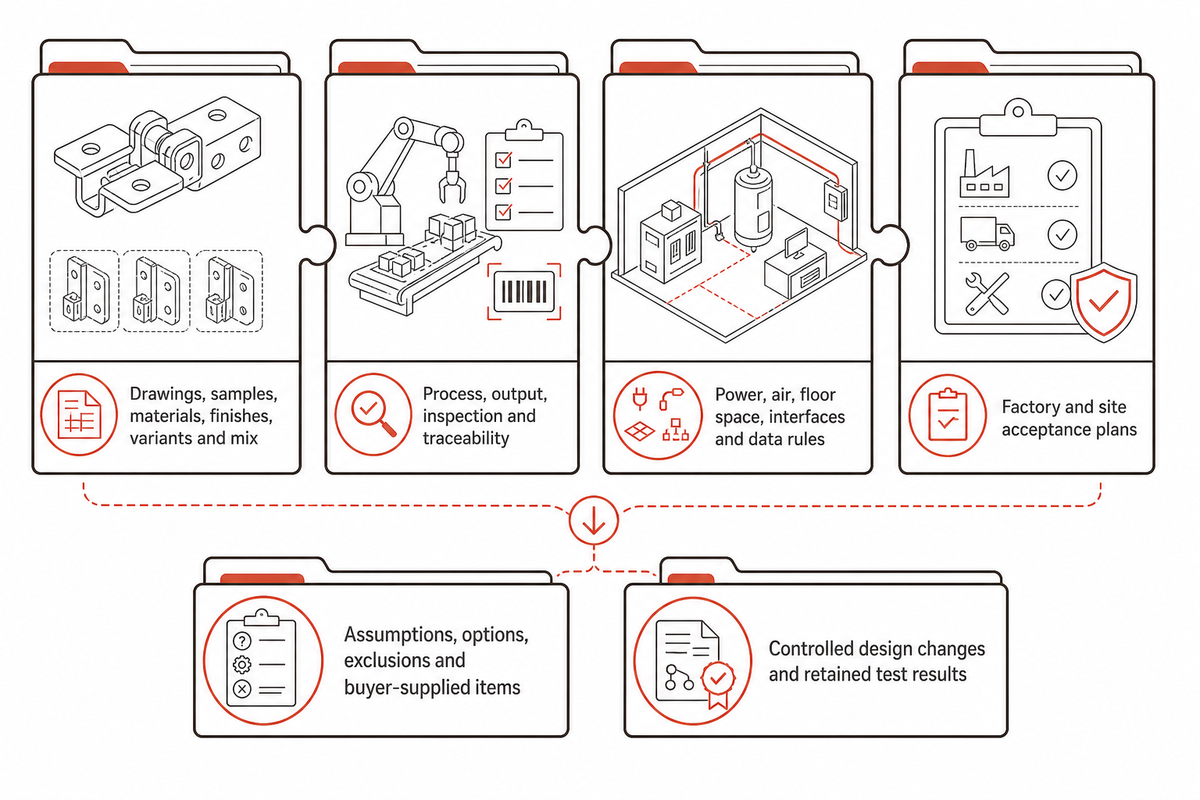
Send part drawings, approved samples, materials and surface finishes, product variants, forecast mix and build schedule. Add the intended process sequence, buyer-defined output, inspection and traceability needs, plant power and air, floor space, interfaces, data rules and separate factory and site acceptance plans.
Require the supplier to mark assumptions, options, excluded stations and buyer-supplied items directly on the brief. Ask for a utilities list, layout, cycle breakdown, inspection narrative, fault-recovery concept, spare-parts plan, documentation list and ownership matrix rather than a single “turnkey” sentence.
Also state how design changes will be controlled. Name who may approve part, recipe, guard, software and network changes; require an impact review when a change can affect safety, quality or accepted output; and keep the revised drawings, risk record, backups and test result under the same change reference.
As publisher context, Shenzhen Zeyu Intelligent Industrial Science Technology Co.,Ltd states that ZEUEE was founded in 2005 and develops non-standard industrial automation equipment. It also reports a 20,000-square-meter Taihe base, more than 120 employees and ISO 9001:2015 certification; these are first-party company statements and are not used to score the ten suppliers.
Define the same boundary before requesting prices
A useful quotation begins with your samples, operations, inspection rules, utilities, interfaces and acceptance plan.
Frequently Asked Questions
Which company is best for hinges?
View Answer
The question can mean a finished-hinge brand or a company that builds hinge assembly equipment. For equipment, there is no defensible universal winner: door-hinge lines, cabinet-hinge lines, automotive control cells and miniature torque stations have different process boundaries. Start with your hinge family, product mix, required operations and acceptance evidence, then compare only suppliers whose proposal matches those requirements.
Who are the best door hinge manufacturers?
View Answer
Finished door-hinge manufacturers and assembly-machine manufacturers belong to different supplier categories. If you need equipment, shortlist builders that can show a door- or window-hinge reference, identify every included station, demonstrate inspection and reject handling, and run approved parts during factory acceptance. A familiar hinge brand does not prove that an automation builder can feed, assemble, inspect and change over your geometry.
Who are the leading continuous hinge manufacturers?
View Answer
A continuous hinge is a finished product, so a list of continuous-hinge brands does not answer who should build its production equipment. First define how long leaves and pins are prepared, aligned, inserted, cut, inspected and handled. Then ask builders for a comparable public reference or documented concept study; do not substitute a cabinet-hinge machine page for that evidence.
How are hinges manufactured?
View Answer
The route depends on hinge type. It can include forming or machining leaves, preparing knuckles, adding a pin, sleeve, spring or crank, lubrication, riveting or screw fastening, functional testing, inspection and marking. An assembly machine may cover only part of that chain, so the quotation must identify its exact start and end points.
What should a request for quotation for a hinge assembly machine include?
View Answer
Include drawings, approved samples, station boundaries, target output, inspections, utilities, interfaces and acceptance tests. Mark optional and buyer-supplied items.
References & Sources
WHY WE WRITE THIS
About ZEUEE Engineering Insights
ZEUEE shares technical guides based on real automation project experience. Since 2005, we have designed and manufactured non-standard automation equipment for connector assembly, wire harness production, robotic lines, vision inspection, and smart factory upgrades.
Founded in 2005
20,000 m² production base
120+ specialists
150+ R&D patents
ISO9001:2015 certified
![Automated Screwdriving: Torque & Cycle Time [Guide]](https://zeueeauto.com/wp-content/uploads/2026/10/automated-screwdriving-featured-768x512.png)
![Automated Screwdriving: Torque & Cycle Time [Guide]](https://zeueeauto.com/wp-content/uploads/2026/10/automated-screwdriving-featured-150x150.png)