Get in touch with Zeyu lntelligent Industrial Company
10 Turnkey Automation Systems Manufacturers to Compare in 2026

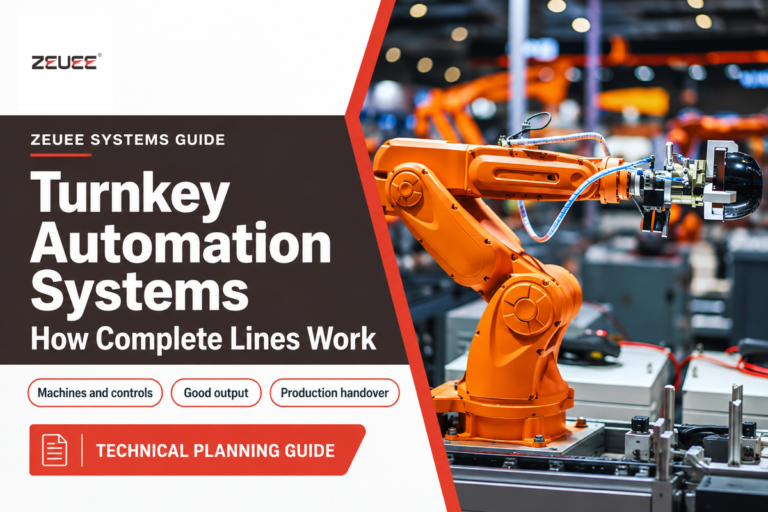
Turnkey automation systems manufacturers are companies that coordinate defined design, build and integration responsibilities, although their exact project boundaries can differ. One company may design and build the complete machine, another may lead controls and coordinate a mechanical partner, and a third may concentrate on robotics or material handling.
Publisher disclosure
ZEUEE publishes this article and is one of the ten providers discussed. The entries are alphabetical public-evidence profiles, not audited rankings, paid awards or endorsements. Company pages were reviewed on August 26, 2026, and first-party statements remain attributed.
Quick answer: compare manufacturers by the exact work they accept, the interfaces they own, the evidence they will witness, and the support they provide after installation. The “turnkey” label is useful only when the proposal identifies every inclusion, exclusion, buyer duty and third-party dependency.
How This Manufacturer Comparison Was Built
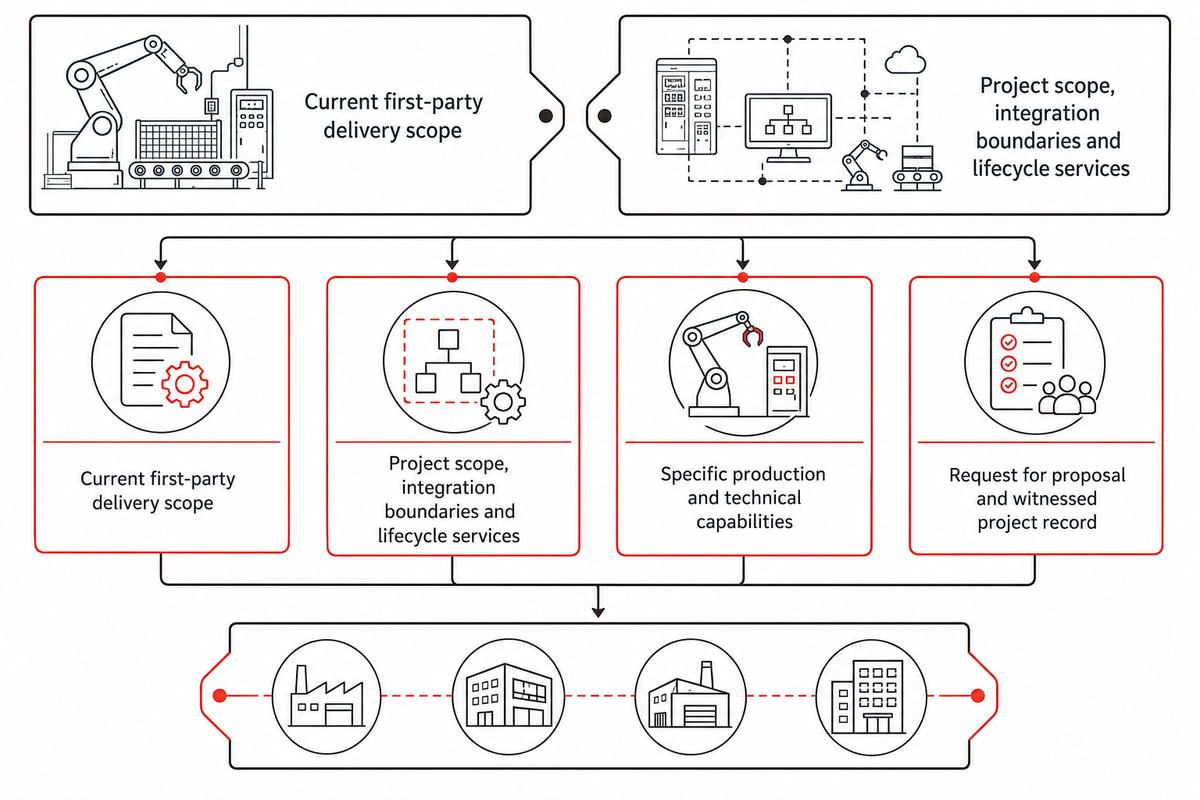
Each included company needed a current first-party page that described turnkey, end-to-end or full-service industrial automation delivery. Component catalogues, software-only offers or directory listings were not enough. The review recorded publicly stated project scope, integration boundaries and lifecycle services; it did not infer capacity, financial strength, certifications or results that were not shown.
The resulting Ten-Supplier Scope Crosscheck is a discovery set rather than a complete market map. NIST’s Manufacturing Extension Partnership describes supplier scouting as a search for manufacturers with the specific production and technical capabilities requested. That supports an important limitation: no fixed list can replace qualification against your parts, process, site and acceptance requirements.
Use the list to
- Identify publicly documented project boundaries.
- Prepare the same evidence request for every bidder.
- Find interfaces that need a named owner.
- Build a requirements-specific shortlist.
Do not use it to
- Declare a universal “best” manufacturer.
- Convert company size into proof of project fit.
- Treat a factory test as the only risk signal.
- Assume an unmentioned service is included.
Provider names are only the start of a shortlist. Treat every unverified scope claim as a question that must be answered by a controlled proposal, named owner and acceptance artifact.
Public pages answer a first question: “Is this provider worth a technical conversation?” They rarely establish the exact people assigned, the approved parts, installed-site performance, remote-access controls, software custody or commercial exclusions. Those items belong in the request for proposal and the witnessed project record.
What “Turnkey” Must Cover Before You Compare Suppliers
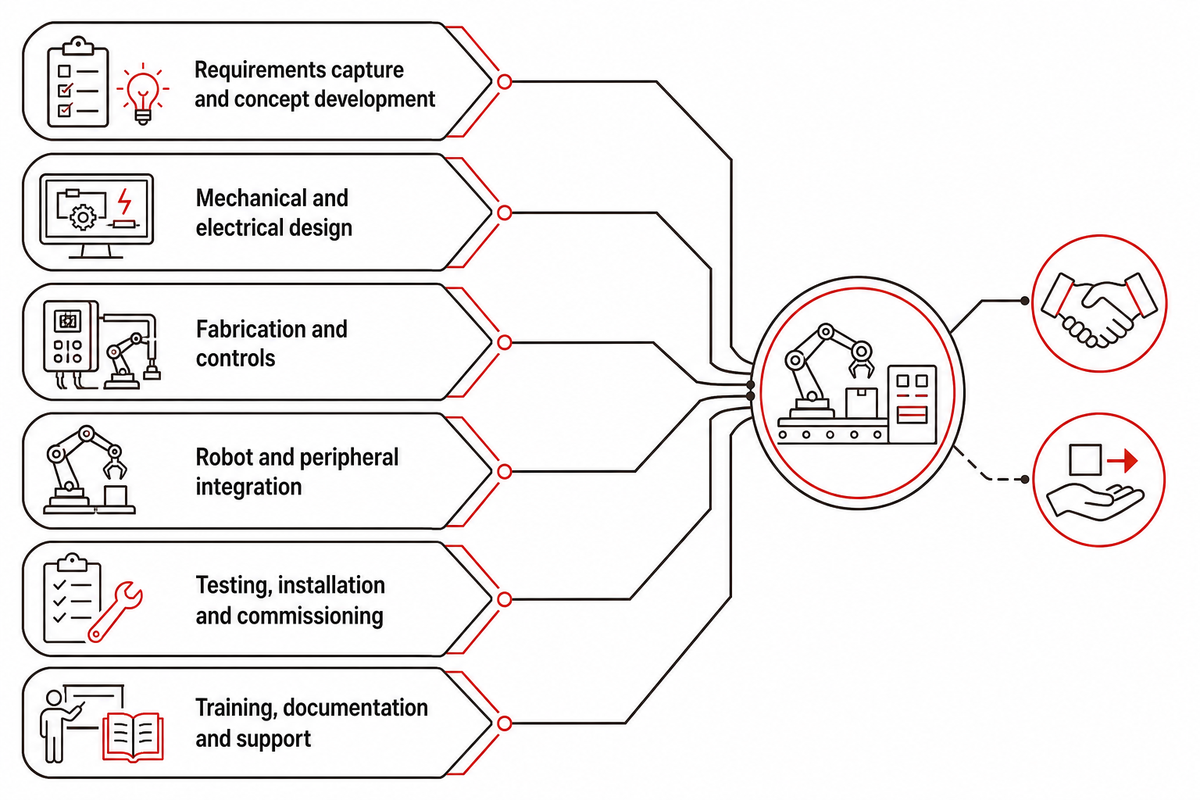
A practical turnkey boundary can include requirements capture, concept development, mechanical and electrical design, fabrication, controls, robot and peripheral integration, testing, installation, commissioning, training, documentation and support. One provider does not have to employ every discipline, but the prime contractor, partner roles and handoffs must be visible before totals are compared.
For a concrete owner-page example, see which project layers ZEUEE coordinates. That page carries product configuration and quotation intent; this article keeps the wider provider comparison and procurement framework separate.
10public provider profiles
10responsibility layers in the buyer worksheet
20 Jan 2027EU Machinery Regulation mandatory application date stated by the Commission
The two counts above describe this article’s comparison tools, not market totals. The date is a destination-market planning signal; it is not evidence that any provider or finished system conforms to the regulation.
Modular or reconfigurable architectures illustrate technical options, not a separate turnkey grade. Patent US10372115B2, for example, describes rearrangeable manipulation components. That architecture record does not prove commercial availability, patent ownership or performance for any company listed here.
Normalize Commercial Language Before Comparing Evidence
Search pages use turnkey automation solutions, turnkey solution, customized automation solutions and tailored automation solutions as overlapping commercial phrases. Translate each one into machine design, fabrication, control systems, motion control, conveyor work, process control, control panel design and human-machine interface (HMI) responsibilities. The phrase does not establish a single point of accountability until the contract names it.
The same caution applies to successful automation, advanced automation, peak performance, precision and efficiency, efficiency and safety or promises to boost productivity and improve quality control. Treat these as objectives. Define productivity, downtime, traceability, overall equipment effectiveness (OEE), optimization and return on investment (ROI) against the buyer’s baseline before using them to judge an automation provider.
Industry names identify context, not proof of transfer. Aerospace, food and beverage, pharmaceutical manufacturing, electronics manufacturing, logistics and warehousing, inventory management and order fulfillment can involve different materials, regulations, cleaning, records and operating risks. Ask the automation partner for a comparable manufacturing process and evidence from relevant manufacturing environments.
Likewise, an automated manufacturing offer may cover machine tending, assembly lines or end-of-line material handling. Such a custom turnkey concept may connect older equipment, existing systems and existing infrastructure from multiple vendors. The proposal should explain the bottleneck, hardware and software interfaces, adaptable tooling, rigorous testing and who will maintain the system after implementation.
These distinctions keep turnkey custom automation, automated systems and automated solutions tied to evidence. They also keep equipment effectiveness and post-implementation support visible across modern manufacturing processes instead of assuming that commissioning alone will deliver efficiency and productivity. No supplier slogan can ensure compliance; destination, application and employer duties still require project-specific review.
Ten Turnkey Automation Systems Manufacturers to Compare

Disclosure before the profiles: ZEUEE is the publisher. The order is alphabetical, and inclusion means only that a current public page described relevant delivery scope. A provider’s absence would not prove a lack of capability, while inclusion does not establish fit for your project.
1. Automation NTH
Automation NTH presents consulting, custom automation, controls, inspection, training and support. A separate first-party discussion says it may lead a turnkey project by combining controls and project management with a certified mechanical partner, which makes the partner boundary part of qualification.
Verify: who owns mechanical design, installation, editable source code, site acceptance and ongoing service for the proposed location?
2. DRM, L.L.C.
DRM’s turnkey systems page describes one accountable team across power distribution, mechanical and electrical engineering, controls, robotics, data, fabrication, commissioning and support. That is broad first-party scope, not independent proof that every discipline will be in-house for every order.
Verify: ask for a responsibility schedule and a witnessed factory- and site-acceptance example relevant to your process.
3. E Tech Group
E Tech Group’s current turnkey factory-automation page describes discovery, design, panel fabrication, installation, commissioning, factory acceptance, site acceptance and ongoing support. During research, the page body was visible through public discovery while two direct opens timed out, so this profile stays within that captured scope.
Verify: how plant data, network access, mechanical interfaces and continuing controls support are divided for the specific site.
4. Eclipse Automation
Eclipse Automation describes full turnkey automation, tooling, integration, pre-automation engineering, vertically integrated build and post-launch support. Promotional homepage outcome percentages were excluded because they are not a common, independently tested comparison basis.
Verify: which phases, facilities and service teams will be responsible for the buyer’s region, industry and product family?
5. Factory Automation Systems
Factory Automation Systems presents itself as a United States full-service integrator covering programmable controllers, manufacturing information systems, motion and robotics. That public scope can start a controls-and-integration conversation but does not define a particular machine’s mechanical boundary.
Verify: request a comparable application, the exact build responsibility, and the acceptance basis for output, inspection, recovery and site interfaces.
6. Integrated Industrial Technologies (I2T)
I2T’s turnkey page names hardware and software specifications, bills of material, drawings, factory-acceptance procedures, installation support and operator, maintenance and engineering training. Those deliverables are useful because they can be placed directly into a proposal checklist.
Verify: how mechanical build, controls, commissioning, training completion and post-handover support are contracted.
7. ONExia / Doosan Robotics Americas
The current ONExia page identifies ONExia as the automated-production-solutions brand of Doosan Robotics Americas and describes turnkey or custom robotic systems for material handling, machining, assembly and packaging. The name transition should be reflected in current contracting and support documents.
Verify: which robot, end-of-arm tooling, material handling, guarding, service and spare responsibilities remain with named third parties.
8. RMH Systems
RMH Systems describes turnkey manufacturing automation centered on material handling, packaging, palletizing and project support beyond installation. This makes it relevant where movement and end-of-line scope dominate, but it should not be presumed to match every process-automation requirement.
Verify: who owns process risk, upstream and downstream interfaces, production ramp and service response after the installed line enters routine use?
9. TEAL Automation Solutions / Titan
TEAL Automation Solutions describes concept-to-completion engineering, system integration, controller and operator-interface programming, robotics, supervisory and manufacturing-execution layers, commissioning and support. The breadth is first-party scope rather than an audited project result.
Verify: ask for evidence tied to the buyer’s product family, inspection requirements, controls environment and validation obligations.
10. ZEUEE
ZEUEE’s owner page states that it designs, builds, tests, installs and supports custom automated lines with an in-house build and factory-acceptance stage. The company identifies itself as Shenzhen Zeyu Intelligent Industrial Science Technology Co.,Ltd and states that it was founded in 2005.
Verify: apply the same responsibility, acceptance, installed-site validation, connected-system and lifecycle questions used for every other provider. ZEUEE’s first-party company claims are publisher context, not a scoring advantage.
Manufacturer, Systems Integrator or Controls Specialist?
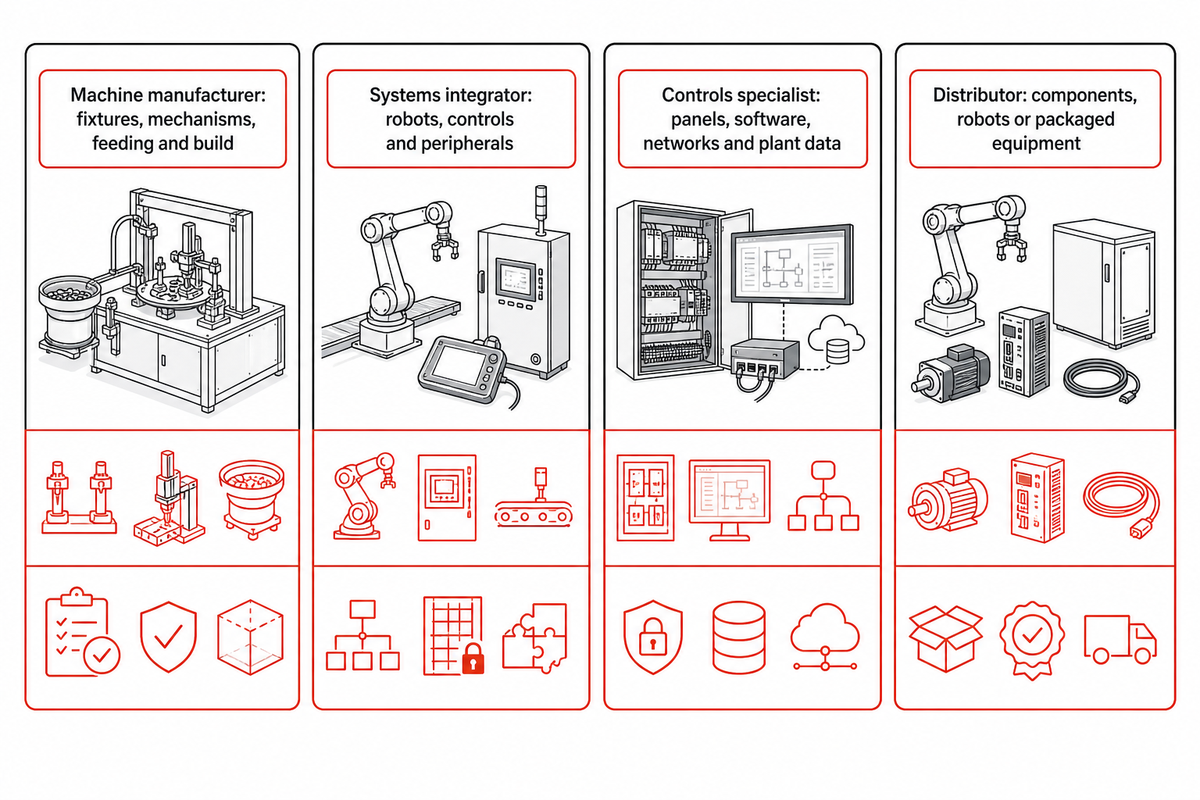
The label should describe responsibility, not prestige. A machine manufacturer normally owns mechanical design and build. A systems integrator coordinates robots, controls, peripherals and plant interfaces, sometimes across several vendors. A controls specialist may own panels, controller programming, supervisory systems or data while another party builds the machine.
| Role | What it may own | Verify in the proposal |
|---|---|---|
| Machine manufacturer | Fixtures, mechanisms, feeding and build | Controls, site work, data and lifecycle boundary |
| Systems integrator | Coordination across robots, controls and peripherals | Prime accountability and partner work packages |
| Controls specialist | Panels, software, networks and plant data | Mechanical design, fabrication and acceptance owner |
| Distributor | Components, robots or packaged equipment | Application engineering, installation and warranty interfaces |
A supplier can span several rows. A3’s Certified Robot Integrator program can be one qualification signal for robotics-heavy work because A3 says it includes an on-site audit, practical personnel assessment and safety training, with renewal after two years. It is not a general turnkey certification and does not prove fit for the proposed line.
Likewise, company scale is not a substitute for a relevant technical team, but organizational evidence still matters. Ask who the responsible engineers are, how drawings and software are controlled, what comparable systems can be examined, how service continuity is managed, and which business entity signs the contract.
Use the Interface Responsibility Stack to Find Handoff Gaps
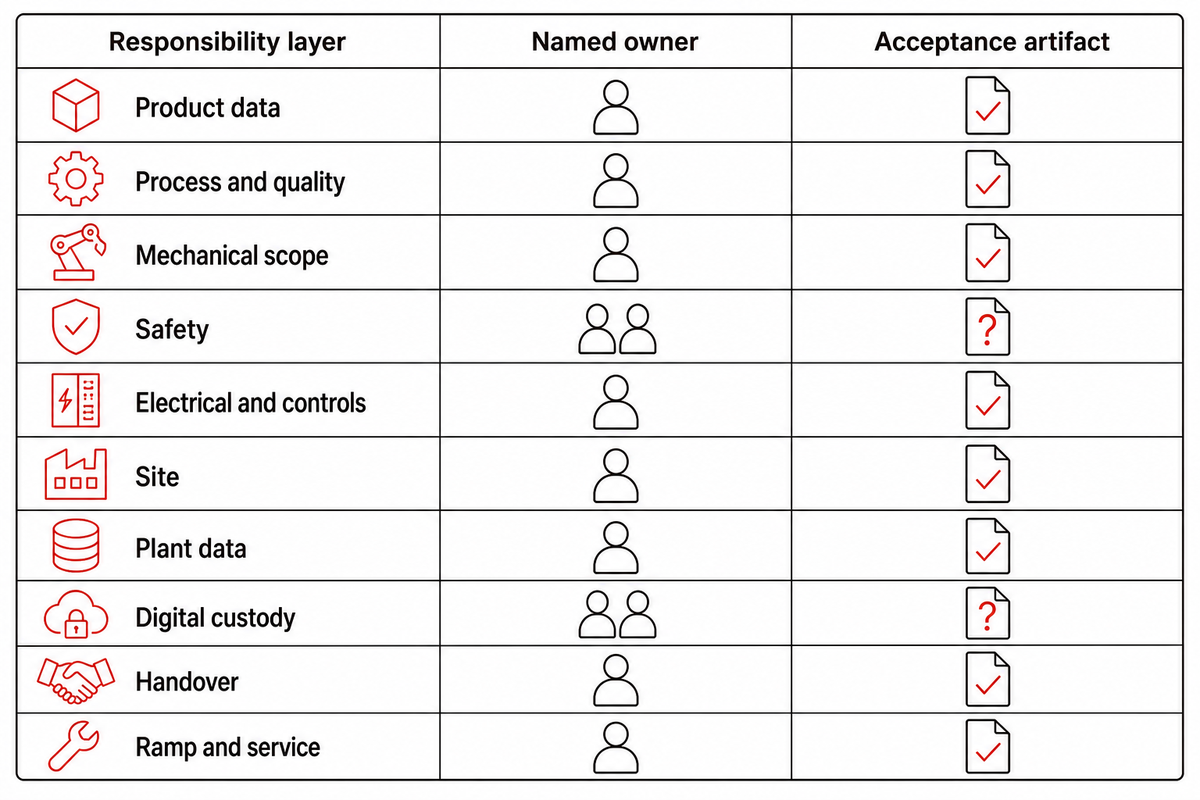
The Interface Responsibility Stack is a buyer worksheet. Assign each layer to the supplier, the buyer or a named third party, then attach one acceptance artifact. Any blank, shared or contradictory row becomes a clarification item before prices are compared.
| Responsibility type | Name one accountable owner | Attach acceptance evidence |
|---|---|---|
| 1. Product data | Drawings, variants, samples | Approved revision set |
| 2. Process and quality | Sequence and critical characteristics | Process map and evidence method |
| 3. Mechanical scope | Stations, fixtures, handling | Design review and build record |
| 4. Safety | Risk reduction and guarding | Risk record and validation |
| 5. Electrical and controls | Panels, robots, vision, software | Drawings, versions and tests |
| 6. Site | Utilities, floor, access, environment | Readiness and site-acceptance record |
| 7. Plant data | Networks, recipes, historian, cybersecurity | Interface and access test |
| 8. Digital custody | Source, backups, licenses, recovery | Restore demonstration |
| 9. Handover | Manuals, spares, training, maintenance | Controlled document pack |
| 10. Ramp and service | Installation, commissioning, support | Open-item and service record |
The worksheet also reveals buyer-side work. Name who provides approved samples, product decisions, utilities, information-technology review, operator access, maintenance staff and change approval. NIST’s high-mix/low-volume guidance notes that a clearly defined outcome is essential and that manufacturers may lack dedicated programming resources; a capable supplier cannot repair an undefined operating model alone.
For adjacent scope, trace the upstream line-automation hierarchy and follow the equipment-family branch below line level. These category pages help separate line-wide interfaces from one machine or station.
Compare Controls, Data and Lifecycle Support, Not Logo Lists
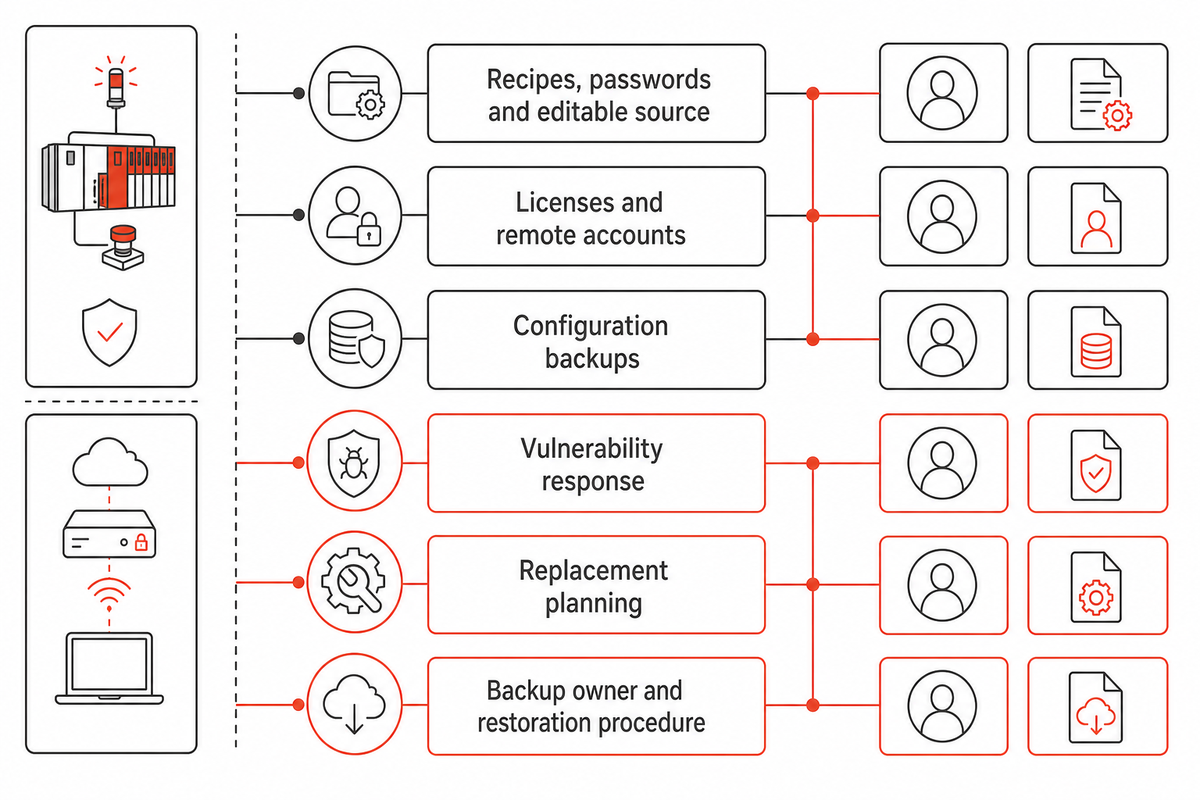
Preferred controller, robot, vision and operator-interface brands matter when a plant already stocks spares and trains technicians around them. They do not settle who owns recipes, passwords, editable source, licenses, remote accounts, configuration backups, vulnerability response or replacement planning.
NIST SP 800-82 Rev. 3 addresses security for operational technology while recognizing performance, reliability and safety constraints. Use it as lifecycle guidance for a connected system, not as a supplier certification.
NIST SP 1339, published in June 2026, emphasizes regular operational-technology backup creation, testing and recovery-exercise review. The handover should therefore identify the backup owner, storage location, restoration procedure, required credentials and evidence that the delivered configuration can actually be recovered.
Remote service deserves its own row: who approves access, how sessions are logged, which accounts are personal, when access expires, and who removes it after support ends? Keep these controls distinct from safety functions, then control changes that could affect both systems.
For European deployment, verify the current destination and project roles with qualified support. The European Commission says Regulation (EU) 2023/1230 applies mandatorily from January 20, 2027, while the regulation assigns manufacturer obligations in specified role and substantial-modification cases. That is a planning prompt, not legal advice or proof of conformity.
Make Factory Acceptance Evidence Comparable

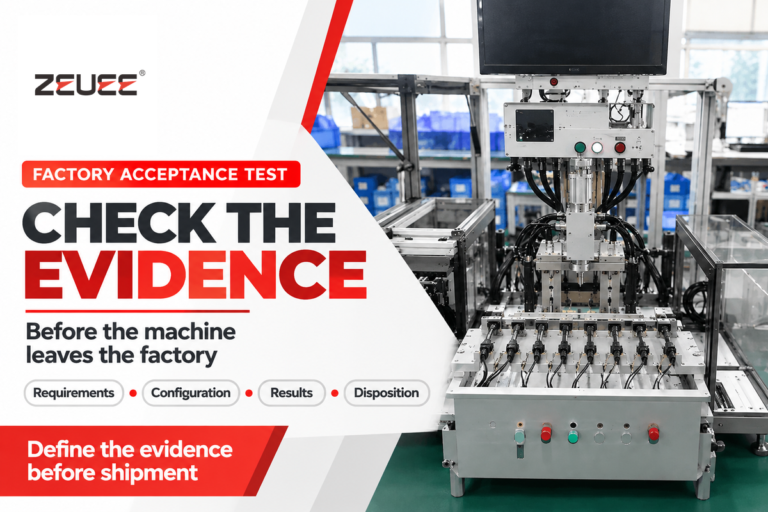
A factory-acceptance test converts claims into observations on a defined system. It should use buyer-approved parts and document the exact setup, included operations, acceptable limits, faults, restarts, data, open items and owners. The sample size, run duration, output target and quality limits remain project-specific.
- Freeze parts and boundaries — list controlled product revisions, variants, approved samples, start and end points, exclusions and buyer-supplied items.
- Record the test configuration — capture fixtures, feeders, recipes, software versions, utilities and measuring equipment.
- Challenge normal and abnormal states — run accepted parts plus deliberate missing, reversed or out-of-limit conditions; observe alarms, interlocks and reject routing.
- Exercise changeover and recovery — demonstrate clearing, controlled restart, recipe change, backup restoration and retention of required records.
- Close against agreed definitions — compare results with the written criteria, then assign every deviation and punch-list item to one owner and due date.
This is the Witnessed Acceptance and Handoff Map: approved inputs, exact operation boundary, changeover evidence, alarm and restart challenges, output basis, quality evidence, connected-system recovery, manuals, training, spares and open-item ownership. It is more useful than an adjective, but it does not prove everything about the supplier or future installed performance.
For United States industrial robot applications, OSHA’s technical guidance explains that site acceptance confirms performance with the site’s utilities, services, machine interfaces and environmental characteristics. It also says the employer retains responsibility for maintaining a compliant application and describes periodic validation after acceptance.
Separate factory acceptance from site acceptance. Include actual utilities, floor and guarding conditions, upstream and downstream equipment, environmental limits, network connections, worker tasks and continuing validation. A turnkey contract coordinates work; it does not transfer every employer safety or operating duty to the integrator.
Cost and Schedule Questions That Expose Scope Gaps
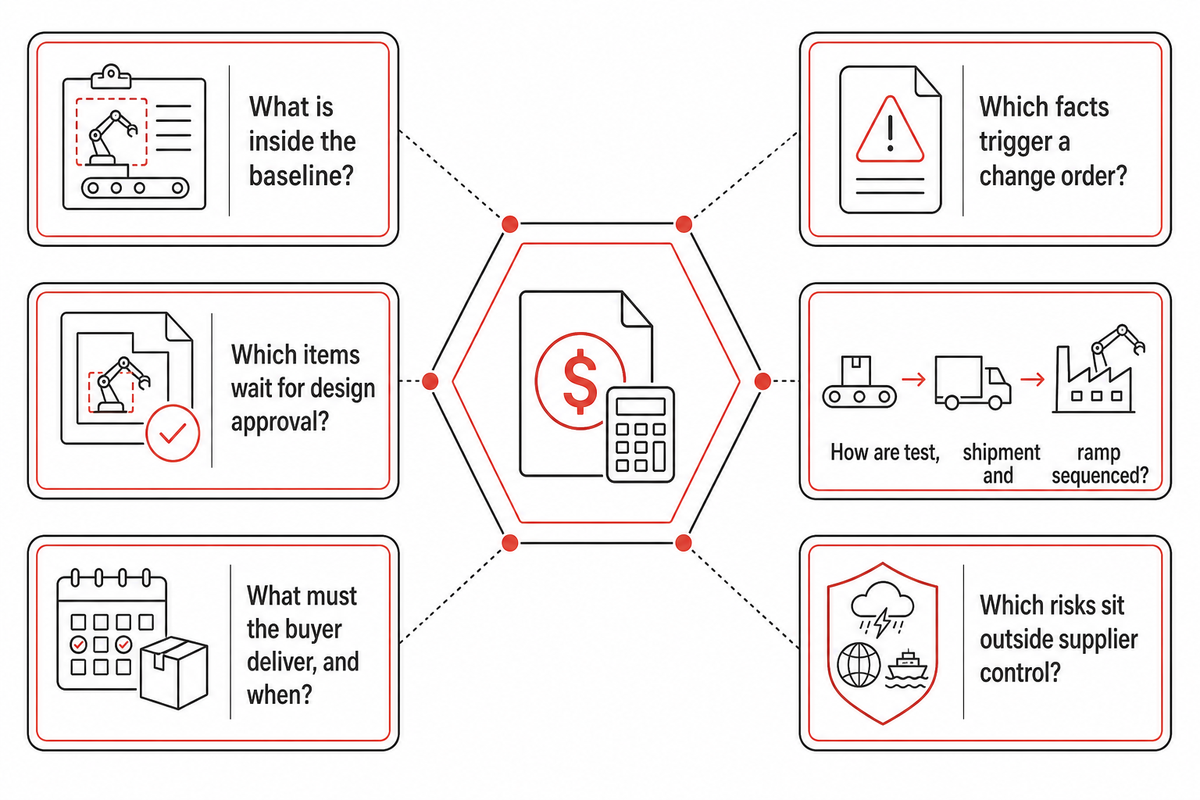
Break each proposal into engineering, fabrication, purchased equipment, tooling, controls, validation, installation, travel, training, spares and support. Mark every line as fixed, estimated, optional, excluded, buyer-supplied or subject to change. A low total can simply describe less work.
GAO’s official cost-estimating guide is aimed at government programs, not private factory procurement, but its general warning transfers: reliable estimates need a defined purpose and scope, technical baseline, work breakdown, assumptions, data, methods, risk analysis and updates. This article does not import federal procurement rules; it uses the baseline principle to make commercial quotes intelligible.
Questions that make a total interpretable
- Which stations, inspections, changeovers, utilities and data interfaces are inside the baseline?
- Which long-lead items can be released only after design approval?
- What information or equipment must the buyer deliver, and by what date?
- Which assumptions trigger a change order if product or site facts differ?
- How are factory test, shipment, site readiness, commissioning and ramp sequenced?
- Which schedule dependencies and risks sit outside the supplier’s control?
Questions can expose missing scope; they cannot produce a reliable forecast by themselves. NASA’s public planning glossary illustrates the deeper point by defining schedule-risk analysis as probabilistic work that incorporates duration uncertainty and discrete risks. Most automation purchases do not need a NASA model, but every date needs visible assumptions, dependencies, milestones and risk owners.
No generic system price, minimum order, lead time, payback or return period is published here. Those numbers would be misleading without a common part family, station boundary, site, acceptance plan and commercial basis.
Decision Framework: Build a Shortlist From Evidence
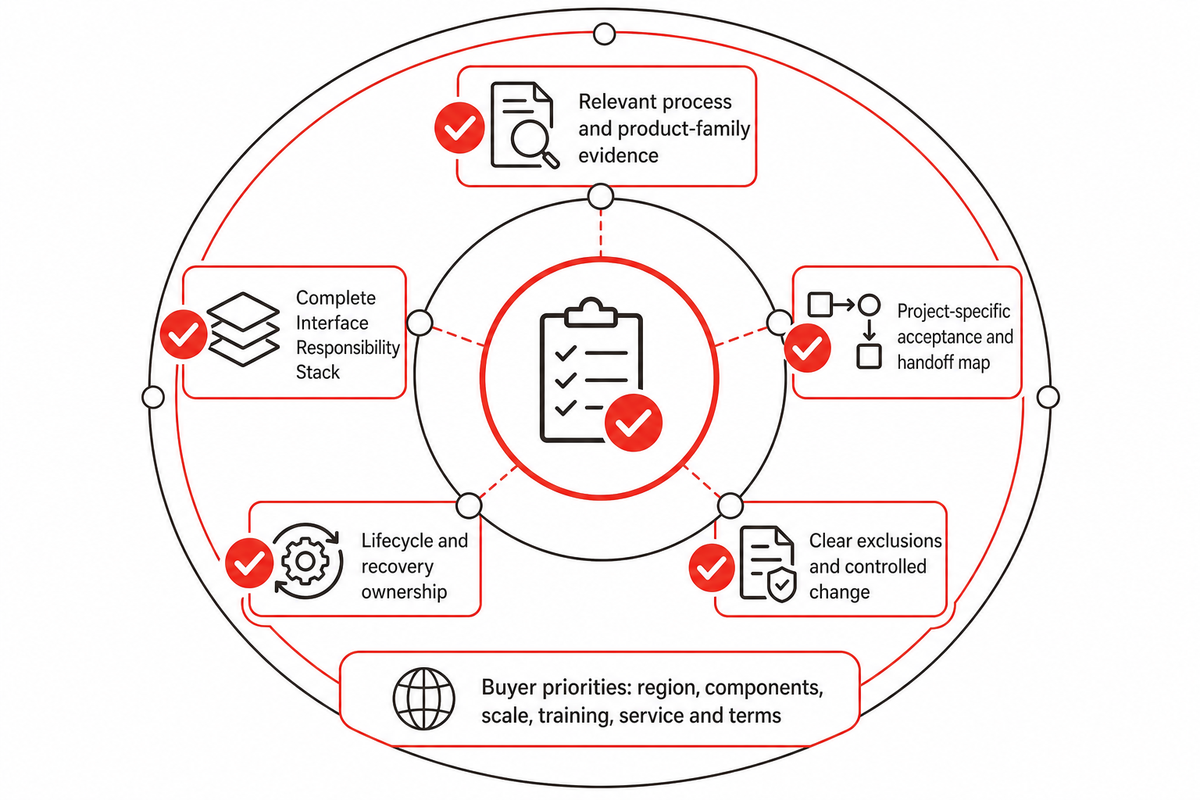
Apply five must-pass gates before weighting preferences: relevant process and product-family evidence; a complete Interface Responsibility Stack; a project-specific Witnessed Acceptance and Handoff Map; named lifecycle and recovery ownership; and clear exclusions with a controlled change method.
Only then compare regional coverage, preferred components, scalability, training, service approach and commercial terms. The buyer chooses the priorities. A plant with frequent product change may value change control and flexible tooling differently from a dedicated line with a stable product.
| Gate | Evidence seen | Evidence requested | Open risk / owner |
|---|---|---|---|
| Application fit | Public scope or reference | Controlled parts and process proof | Unproven variant / buyer |
| Responsibility | Proposal boundary | Ten-layer ownership matrix | Dual-owned interface / joint |
| Acceptance | Draft procedure | Factory, site and change plan | Undefined criterion / buyer |
| Lifecycle | Service statement | Source, backup, recovery, spares | No durable owner / supplier |
| Commercial | Quoted total | Assumptions and exclusions ledger | Unpriced dependency / joint |
For a deeper comparison, trace an optical-line bid from scope to acceptance and compare how hinge suppliers substantiate rate claims. Those articles cover separate processes; repeat the evidence process, not their supplier judgments.
What to Send Shortlisted Manufacturers
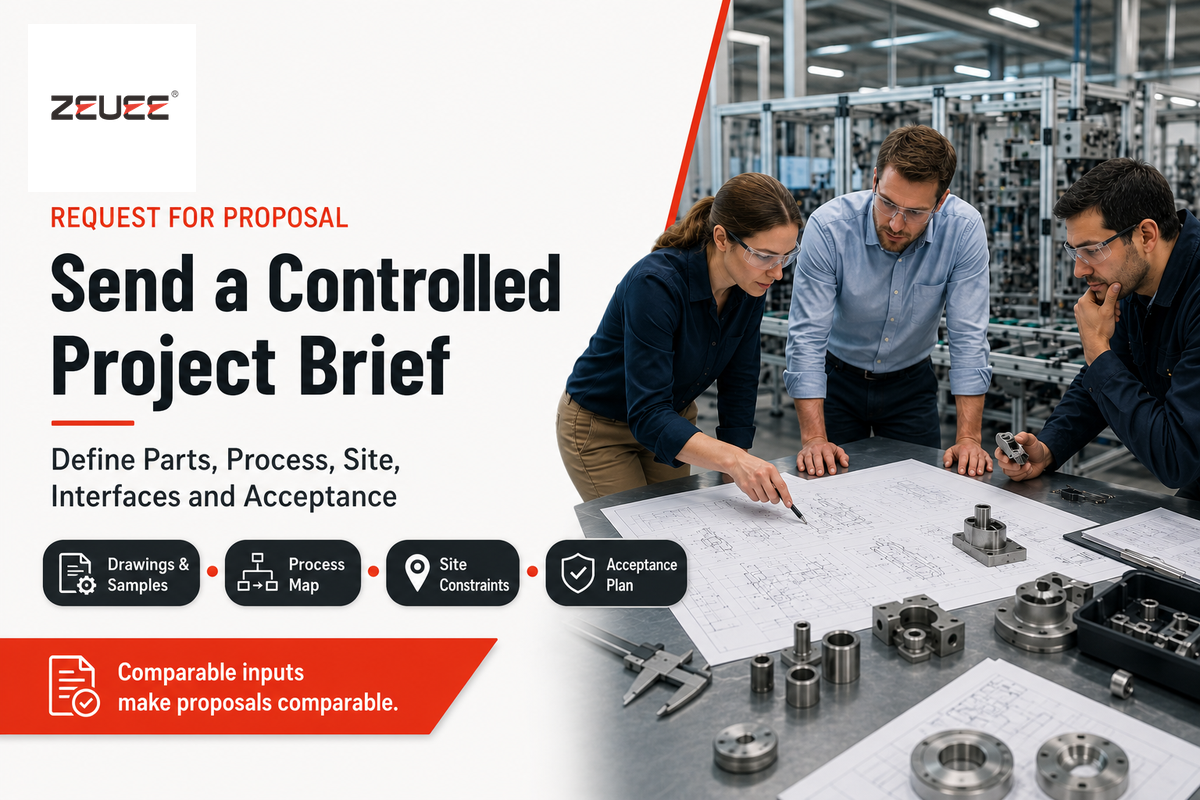
Send controlled product drawings, approved samples and the variant list. Add the current process map, manual work content, target output definition, product-mix assumptions, critical quality characteristics and the evidence method for each requirement. Identify the required document revision and approval owner.
Document utilities, floor, access and environmental limits; existing controllers, robots, plant data and cybersecurity constraints; applicable company and destination standards; separate factory- and site-acceptance approaches; and required manuals, training, spares and service.
Require bidders to mark assumptions, options, exclusions, buyer duties and third-party dependencies directly on the same brief. Ask for a responsibility matrix, project organization, design-review sequence, controlled drawing list, test plan, software and backup handover, training completion record and support escalation path.
ZEUEE states that it has developed non-standard industrial automation equipment since its 2005 founding and serves multiple industrial sectors. Those are first-party publisher statements. A useful engineering review still begins with the same controlled inputs and evidence questions applied to every provider.
Define the project boundary before requesting a price
Send ZEUEE your drawings, samples, process, interfaces and acceptance expectations for a scoped engineering review.
Frequently Asked Questions
What are the top 10 automation companies in the world?
View Answer
There is no universal top-ten list for turnkey manufacturing projects. Large controls and robot companies may supply essential components, while a turnkey manufacturer or systems integrator must also engineer fixtures, material flow, safety, inspection, software, installation and acceptance. Build a shortlist around a comparable application, explicit interface ownership, witnessed evidence and support in the deployment region, not size alone.
Who is the largest automation company?
View Answer
“Largest” can refer to revenue, employees, robot shipments, installed controllers or regional service coverage, and the answer changes with the metric and year. None of those measures establishes fit for a custom line. A large component brand may not own mechanical fixtures, feeding, inspection, plant interfaces or site acceptance, while a smaller integrator may lead those tasks for a defined application. Start with controlled parts, process requirements, site constraints and evidence expectations. Then compare which legal supplier accepts the complete responsibility boundary, assigns qualified people and can support the installation after handover. Document the metric and date before using size as a procurement filter.
Does a Robot Brand Prove Turnkey Project Fit?
View Answer
A robot is one subsystem; its brand does not automatically cover fixtures, material presentation, guarding, inspection, plant data or factory acceptance. Large controls and robot companies may supply essential components, while a turnkey manufacturer or systems integrator must also engineer fixtures, material flow, safety, inspection, software, installation and acceptance. Evaluate the integrator’s application engineering, organizational evidence and lifecycle accountability alongside the robot platform.
What is included in a turnkey automation system?
View Answer
A turnkey scope normally coordinates requirements, design, fabrication, controls, integration, testing, installation, commissioning, training, documentation and support. The contract should name who owns product assumptions, plant interfaces, source code, safety evidence, factory and site acceptance, spare parts and post-installation service. Unnamed work is a scope risk, even when one prime contractor leads the project.
What should a turnkey automation request for proposal include?
View Answer
Include product drawings and variants, current process steps, target output basis, critical quality characteristics, utilities, floor and access limits, preferred controls and data interfaces, applicable standards, acceptance methods, documentation, training, spares and service expectations. Ask every bidder to mark inclusions, exclusions, buyer responsibilities and third-party dependencies against the same controlled brief.
References & Sources
- NIST MEP Supplier Scouting
- A3 Certified Robot Integrator program
- GAO Cost Estimating and Assessment Guide
- NIST SP 800-82 Rev. 3
- NIST SP 1339 OT Backup Quick Start Guide
- OSHA 1910.212 machine guarding
- OSHA industrial robot systems guidance
- ISO 12100:2010 public scope
- IEC 60204-1 publication page
- Regulation (EU) 2023/1230
- European Commission machinery transition
- Automation World machine-builder project guide
- Automation World / CSIA automation project guide
- CSIA best-practices overview
WHY WE WRITE THIS
About ZEUEE Engineering Insights
ZEUEE shares technical guides based on real automation project experience. Since 2005, we have designed and manufactured non-standard automation equipment for connector assembly, wire harness production, robotic lines, vision inspection, and smart factory upgrades.
Founded in 2005
20,000 m² production base
120+ specialists
150+ R&D patents
ISO9001:2015 certified