Get in touch with Zeyu lntelligent Industrial Company

Medical Device Manufacturing: A 2026 Control Guide

Updated August 2026
Medical Devices are products intended for a medical purpose under the definition and rules of the relevant market. Medical device manufacturing translates intended use and product requirements into repeatable production outputs, with records showing what was built, how the process was controlled, and who accepted the result. It covers more than assembly: classification context, design transfer, supplier controls, verification, validation, traceability, release, and change control all shape the production system.
This guide is for engineering, quality, operations, and procurement teams planning new medical devices or revising an existing process. It explains a U.S.-focused control framework and links to current FDA and ISO sources. It is educational manufacturing information, not legal or regulatory advice. Product classification, market requirements, and applicability must be confirmed for the specific device and manufacturer.
Direct answer
Production-line readiness is not established by fast assembly. It exists when product requirements, acceptance methods, process limits, traceability, change control, and release authority form one evidence system.
Readers seeking equipment configurations rather than the control logic in this guide can review ZEUEE’s medical device assembly automation solutions. Keeping that commercial decision on the solution page prevents this guide from competing for the same inquiry intent.
What Counts as a Medical Device, and Why Does Classification Matter?
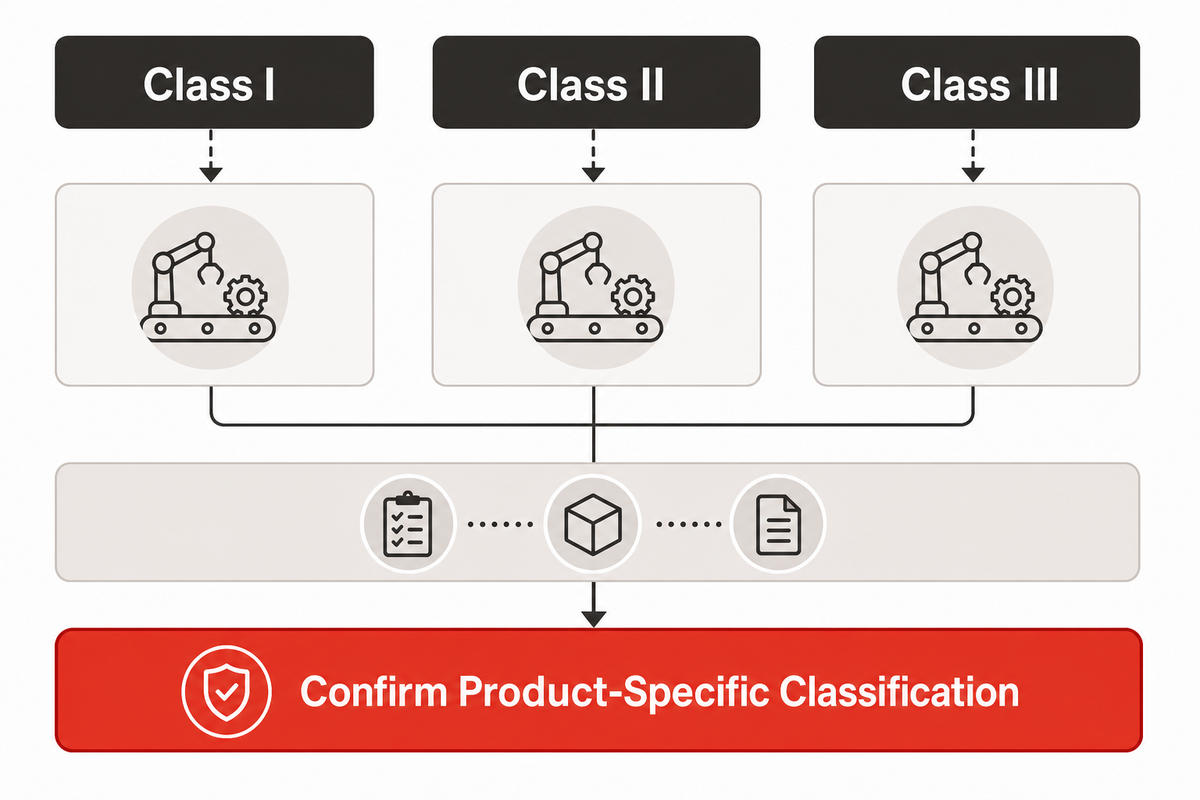
Intended use, not appearance, defines a medical device. Diagnostic equipment, surgical instruments, in vitro diagnostic products, software as a medical device, and implantable devices can all fall within device regulation, yet their manufacturing evidence can differ widely. Classification helps frame the controls, but product-specific analysis is still required.
Intended-use changes matter because the same hardware can be regulated differently when its purpose changes. Across the medical device industry, teams encounter many types of medical devices, from non-invasive diagnostic devices to high-risk medical devices. Their design and manufacture affect patient care, but manufacturing records alone can’t show that a product is safe and effective.
FDA assigns U.S. devices to Class I, II, or III according to the controls needed to provide reasonable assurance of safety and effectiveness. Its current classification guide says the agency has classified roughly 1,700 generic device types across 16 medical-specialty panels. Product code, intended use, indications, and applicable regulations still need to be checked. Lists of examples of Class II devices or examples of Class III devices cannot classify a new product.
| Context | Manufacturing question | What the label does not decide |
|---|---|---|
| Class I devices | Which general controls and product-specific requirements apply? | That every low-risk device is exempt from every requirement |
| Class II devices | Which special controls and performance evidence affect production? | A universal inspection or validation plan |
| Class III devices | How do higher-risk outputs and submission commitments bind the process? | That all implantable medical devices use the same process |
| In vitro diagnostic medical products | Which reagent, specimen, software, and instrument interfaces are critical? | The product’s market pathway |
| Single-use medical devices | How are material, cleanliness, packaging, and lot controls connected? | Sterility or shelf life from assembly evidence alone |
| Non-invasive devices | Which contact, measurement, or mechanical outputs matter? | That risk is always low |
| Software as a medical device | How are software versions, configuration, and released binaries controlled? | A physical assembly-line requirement |
| Combination or connected systems | Which interfaces and constituent-part controls cross organizational boundaries? | Which authority or rule controls every part |
| Accessories and components | What role, labeling, and finished-device relationship applies? | Automatic treatment as a finished device manufacturer |
This table is orientation, not a classification tool. In the U.S., the three classes of medical devices are only one part of the framework; other markets use different rules. For facilities planning, use ZEUEE’s medical device cleanroom class selector as a question-framing aid, then have the responsible quality and regulatory teams determine the actual environmental requirements.
The 6-Gate Design-to-Production Handoff
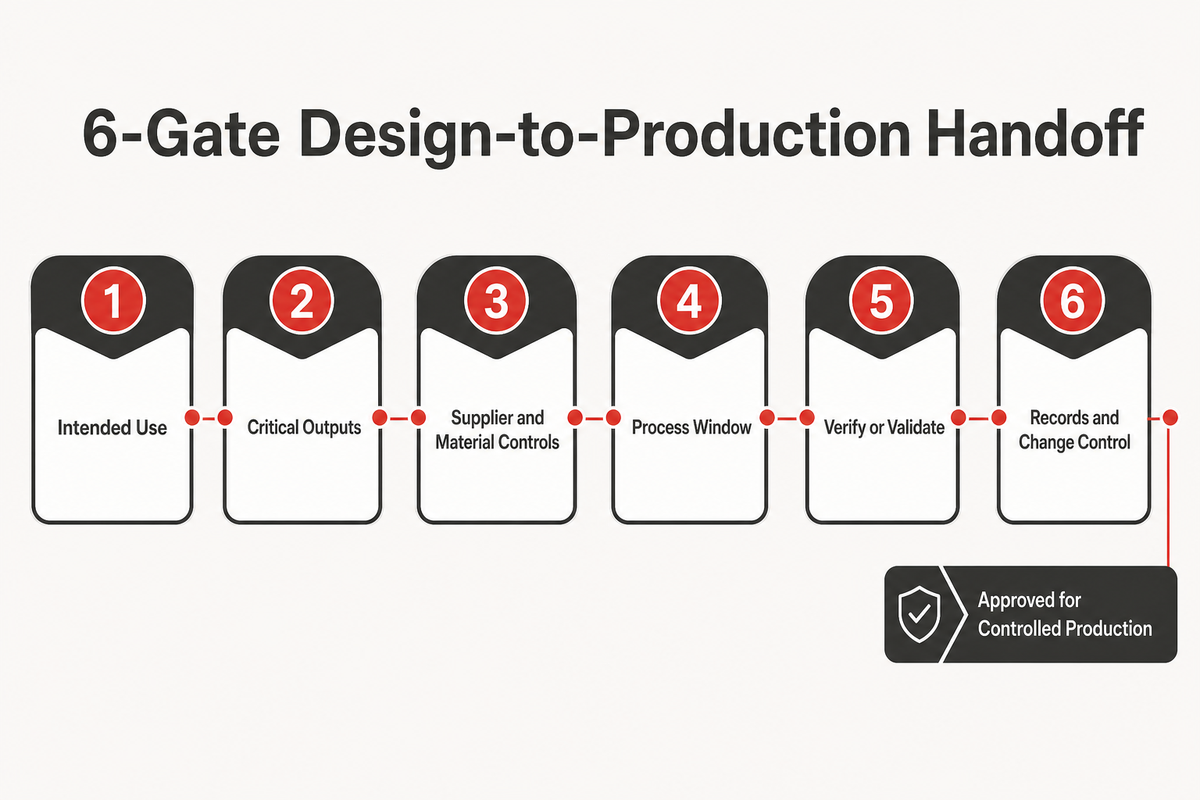
The 6-Gate Design-to-Production Handoff turns design transfer into six evidence questions. Each gate closes only when its input, owner, acceptance rule, and unresolved exceptions are visible. This prevents production from inheriting a drawing while missing the rationale, limits, and records needed to control the process.
- Freeze the intended-use boundary — identify the released product, variants, markets, labeling, interfaces, and device classification assumptions.
- Translate requirements into critical outputs — connect drawings and specifications to characteristics that affect function, identity, cleanliness, packaging, or device safety.
- Control suppliers and materials — define approved sources, incoming evidence, status identification, substitutions, and escalation for variability.
- Define the process window — identify equipment states, parameters, fixtures, recipes, environmental inputs, and operator decisions that can change output.
- Choose verification or validation — decide which results can be fully checked and which process outcomes need prospective evidence because later inspection is inadequate.
- Bind records and change control — connect revisions, access, calibration, nonconformance, release, and retained evidence before routine production.
These gates are independent of machine type. They apply whether medical device manufacturers use manual workstations, semi-automatic fixtures, diagnostic equipment with software loading, or fully automated assembly. They also reveal uncertainty: an unresolved material interface or acceptance method is a stop condition, not a reason to request a faster machine.
Do
- Assign an owner to each gate.
- Record open assumptions and deviations.
- Make acceptance methods traceable to released requirements.
Do not
- Treat a signed drawing as complete design transfer.
- Use equipment capability to invent a product tolerance.
- Begin validation before the process definition is stable.
What Changed Under QMSR in 2026?
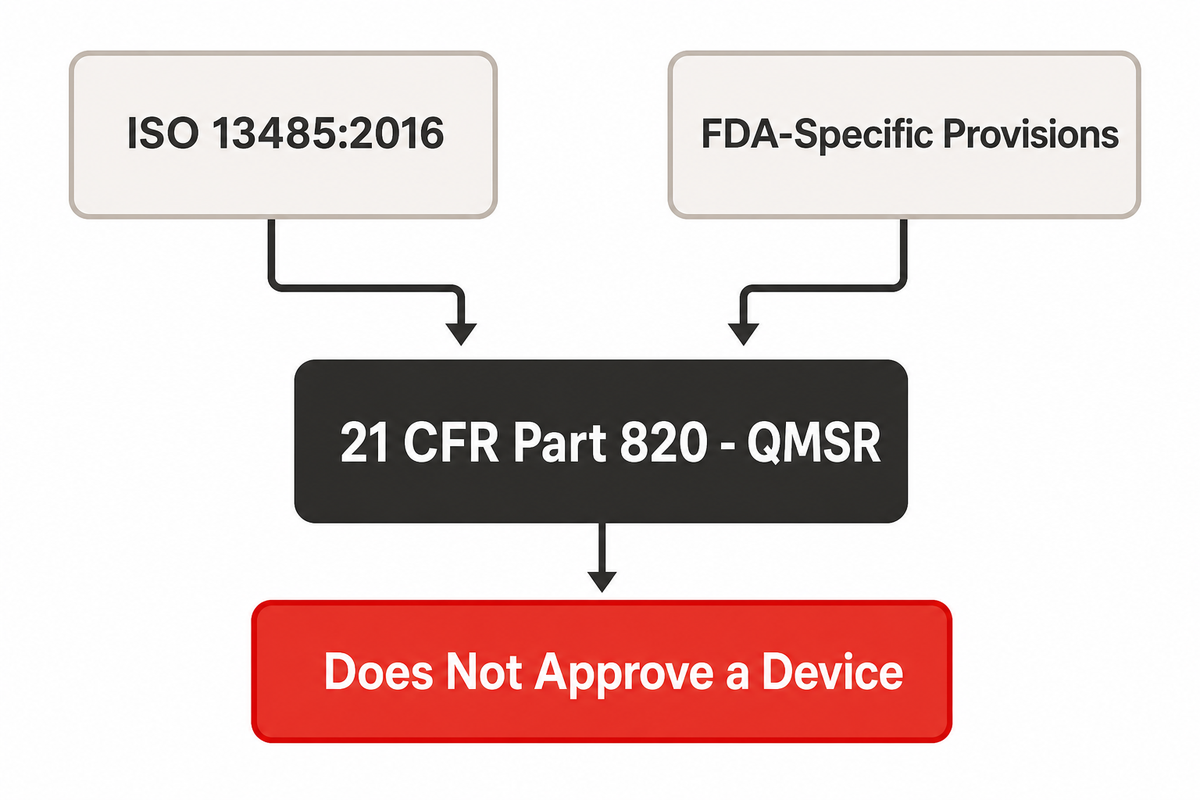
FDA’s Quality Management System Regulation became effective on February 2, 2026. QMSR incorporates ISO 13485:2016 by reference into 21 CFR Part 820 and adds FDA-specific provisions. It changes the regulatory framework and inspection approach; it does not approve medical products, erase other applicable requirements, or turn a certificate into product acceptance.
FDA’s current QMSR page states the effective date and explains the alignment. Current 21 CFR Part 820 is the operative legal text. FDA also identifies its current inspection program and says the former QSIT approach has been retired. Teams should update procedures, audit criteria, training, and references that still speak as though the previous QS regulation were current.
Scope matters as well. Part 820 addresses manufacturers of finished medical devices, while the treatment of components, services, and other roles depends on the facts and applicable requirements. ISO’s official ISO 13485 overview describes a lifecycle quality-management model that includes risk, supplier controls, verification, validation, transfer, and feedback. Neither document replaces product-specific guidance documents, submission commitments, or other market rules.
During development of medical devices, an FDA regulatory requirement may enter the manufacturing plan through classification, special controls, guidance, submission commitments, or Part 820. Trace each requirement to a controlled product or process output rather than copying it into a generic checklist.
Regulatory boundary: alignment of the quality-system framework does not mean identical product rules across markets. Confirm the device, role, jurisdiction, and current regulatory text before setting production requirements.
Verification or Validation? Use the 9-Row Inspectability Test
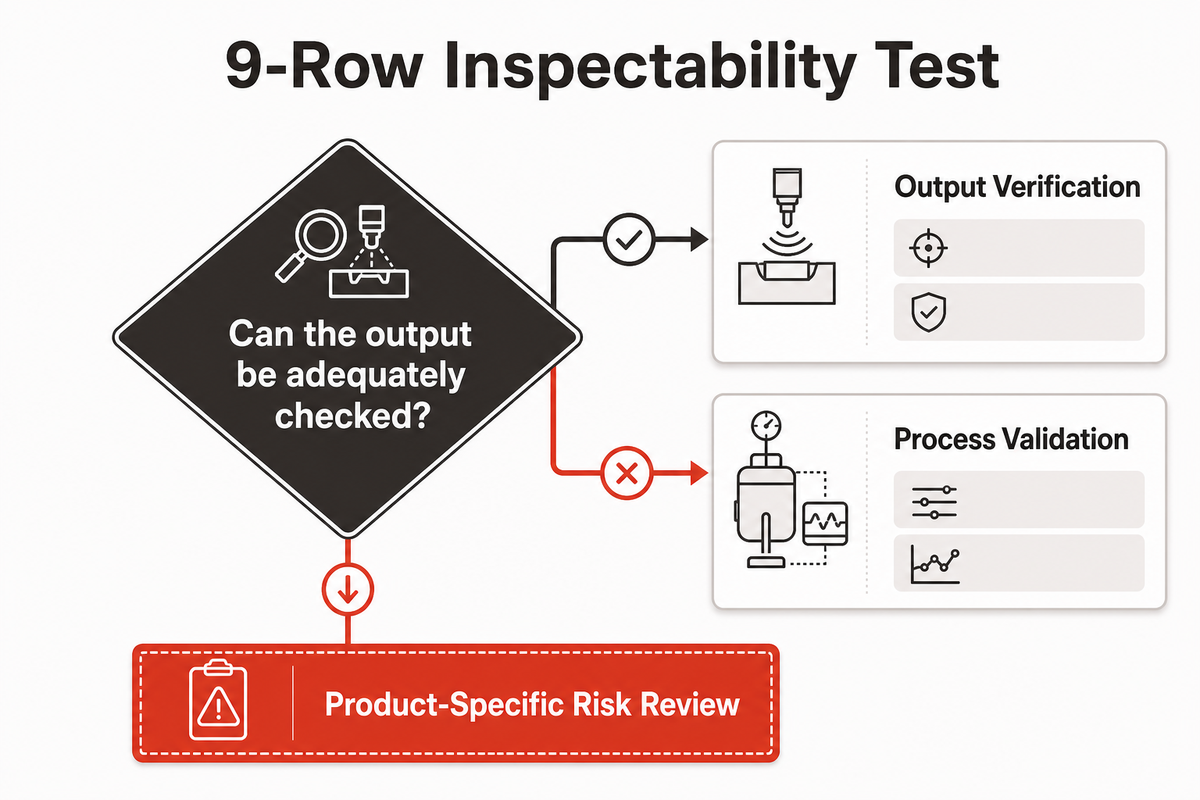
Verification asks whether an output satisfies specified requirements; process validation establishes evidence for a process result that can’t be fully verified later. Inspectability is the practical choice: can the characteristic be measured afterward with sufficient coverage and without destroying the output to be released? If not, process controls and validation shoulder more of the assurance burden.
FDA explains this logic on its medical-device additive manufacturing process page: some characteristics can be verified, while destructive or impractical inspection can make validation necessary before production. Apply that principle through a product-specific risk and quality-system process rather than copying this table as a protocol.
| Characteristic type | Can every released output be adequately checked? | Likely evidence emphasis | Important limitation |
|---|---|---|---|
| Part identity and orientation | Often, with validated sensing and reject logic | Output verification plus equipment qualification | Detection capability must match real defects |
| Accessible dimensions | Often, if the method is suitable | Measurement-system evidence and inspection records | Sampling may not prove every unit |
| Hidden bond or weld strength | Usually not without destructive testing | Validated process window plus monitored parameters | A surface image may not prove internal strength |
| Seal integrity | Depends on method and package design | Method validation, process validation, and defined sampling | One test may not cover every failure mode |
| Software or recipe loading | Often through checksum, version, and functional evidence | Configuration control and verified load record | Correct version does not prove every function |
| Particulate or cleanliness outcome | Rarely on every unit | Environmental and process controls with qualified methods | Facility class alone does not prove product cleanliness |
| Label content and readability | Often with controlled vision inspection | Master-data control, inspection challenge set, and rejection record | Readable text may still be the wrong approved text |
| Package configuration | Partly, depending on hidden interfaces | Verified components, assembly checks, and qualified packaging process | Appearance does not establish shelf life |
| Sterilization outcome | Not by routine final inspection alone | Validated process, controlled load, and required release evidence | Assembly records do not prove sterility |
Mixed strategies are normal. Vision can verify presence and orientation while validation covers a hidden joining process. Functional testing may confirm one output while supplier controls and calibration protect the inputs. ZEUEE’s vision inspection systems for production verification page describes the equipment category; the validation strategy remains the manufacturer’s responsibility.
How Should Traceability Work Without Data Theater?
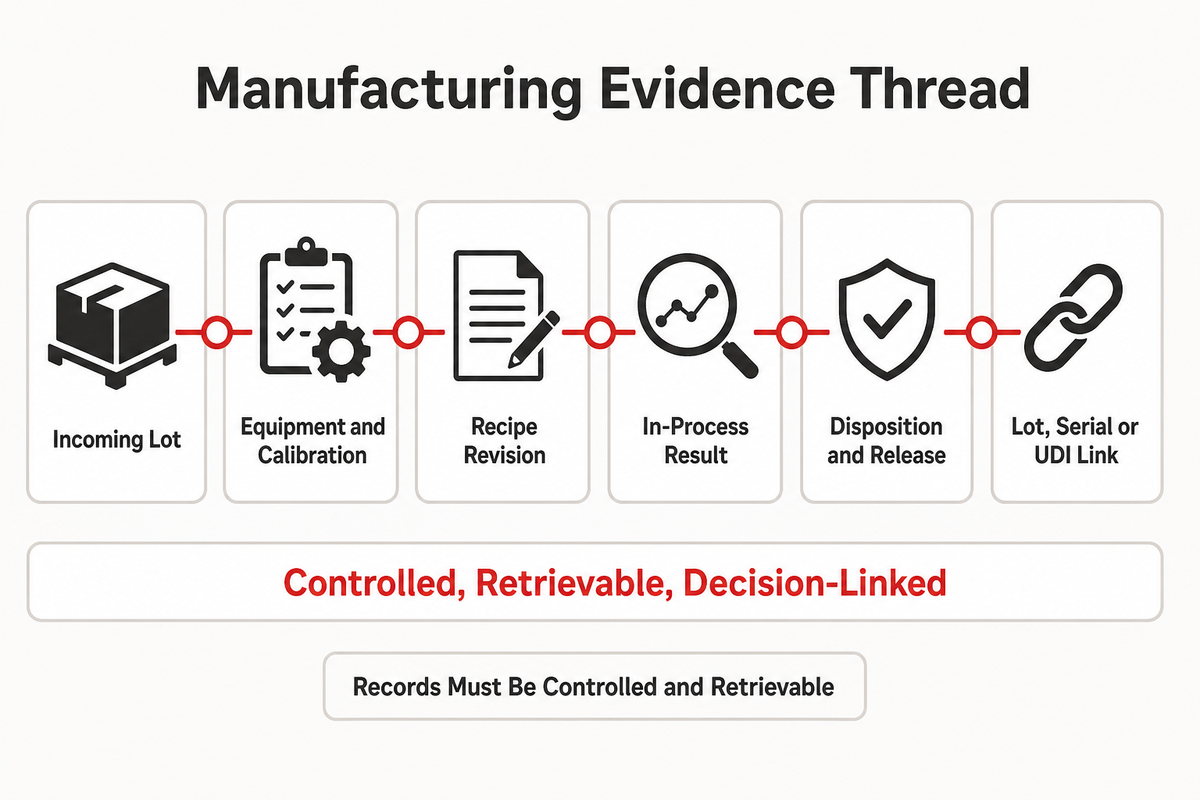
Effective traceability builds an evidence thread from incoming material to released product. Each record should identify a controlled object, a decision point, an owner, and a revision or time context. Accumulating thousands of readings without clear status, limits, or retrieval rules creates data volume, not assurance.
| Evidence type | Record should answer | Control needed | Failure if missing |
|---|---|---|---|
| Incoming lot | Which approved material entered the process? | Supplier, lot, status, and receipt evidence | Affected products cannot be bounded reliably |
| Material status | Was it accepted, held, or rejected at use? | Electronic or physical status control | Unreleased material can enter production |
| Equipment identity | Which machine, station, fixture, or tool was used? | Unique identity and approved state | Events cannot be linked to equipment history |
| Calibration or maintenance state | Was the resource within its approved status? | Due dates, status, exceptions, and impact review | Measurement confidence is unclear |
| Recipe revision | Which released parameters and software version ran? | Access, approval, checksum, and revision history | A result cannot be tied to the intended process |
| In-process result | What was measured and against which limit? | Units, method, limit, timestamp, and disposition | A number exists without meaning |
| Nonconformance disposition | Why did a failed or suspect unit move forward or stop? | Segregation, authorization, reason, and linkage | Rejects can mix with accepted output |
| Final release | Who confirmed required evidence was complete? | Release authority and exception review | Production completion is mistaken for acceptance |
| UDI, serial, or lot link | Which production history belongs to the distributed identity? | Applicable identity rules and controlled master data | Field issues cannot be bounded efficiently |
FDA’s UDI Basics page explains how the system is intended to identify devices through distribution and use. That does not mean every component or production event receives a UDI. Applicability still belongs to the responsible team, while the manufacturing system preserves the lot, serial, or other link needed for its controlled records and medical device recalls.
For more detail on turning inspection results into controlled decisions, see ZEUEE’s vision inspection systems evidence guide and automated testing equipment guide.
When Is a Medical Device Process Ready for Automation?
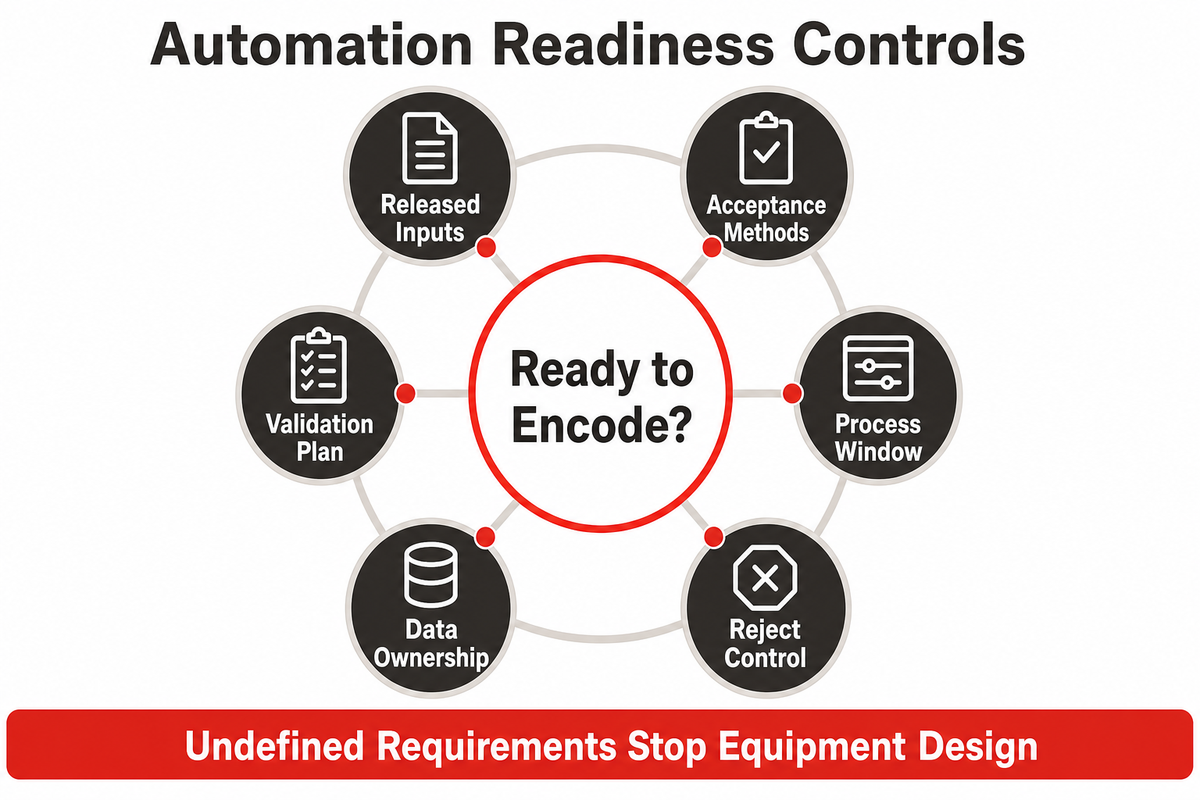
Readiness for automation begins when inputs, outputs, limits, exceptions, and record rules are stable enough to encode. Automation can improve consistency and data capture, but it can’t set product requirements, fix an undefined acceptance method, or make a process compliant by itself.
Before equipment design begins, confirm these conditions:
- Released inputs: product variants, drawings, bills of material, approved raw materials, and interface requirements have owners and revision control.
- Acceptance methods: each critical characteristic has an appropriate method, limit, sample or unit-level coverage, and final disposition.
- Process window: joining, dispensing, handling, software loading, or test parameters have an evidence-based operating range.
- Reject controls: detection, segregation, rework, override, and recovery modes can’t silently reintroduce suspect material into the accepted flow.
- Data ownership: users can identify official records, know how long they’re kept, and how revisions, timestamps, and access are controlled.
- Validation plan: responsibilities, prerequisites, challenge conditions, deviations, acceptance criteria, and revalidation triggers are defined before execution.
Teams exploring the equipment layer can compare these controls with ZEUEE’s custom automated assembly machine capabilities and the automated assembly machines planning guide. Those pages address system design; this article remains the quality-control framework.
What Are the Most Common Control Failures?
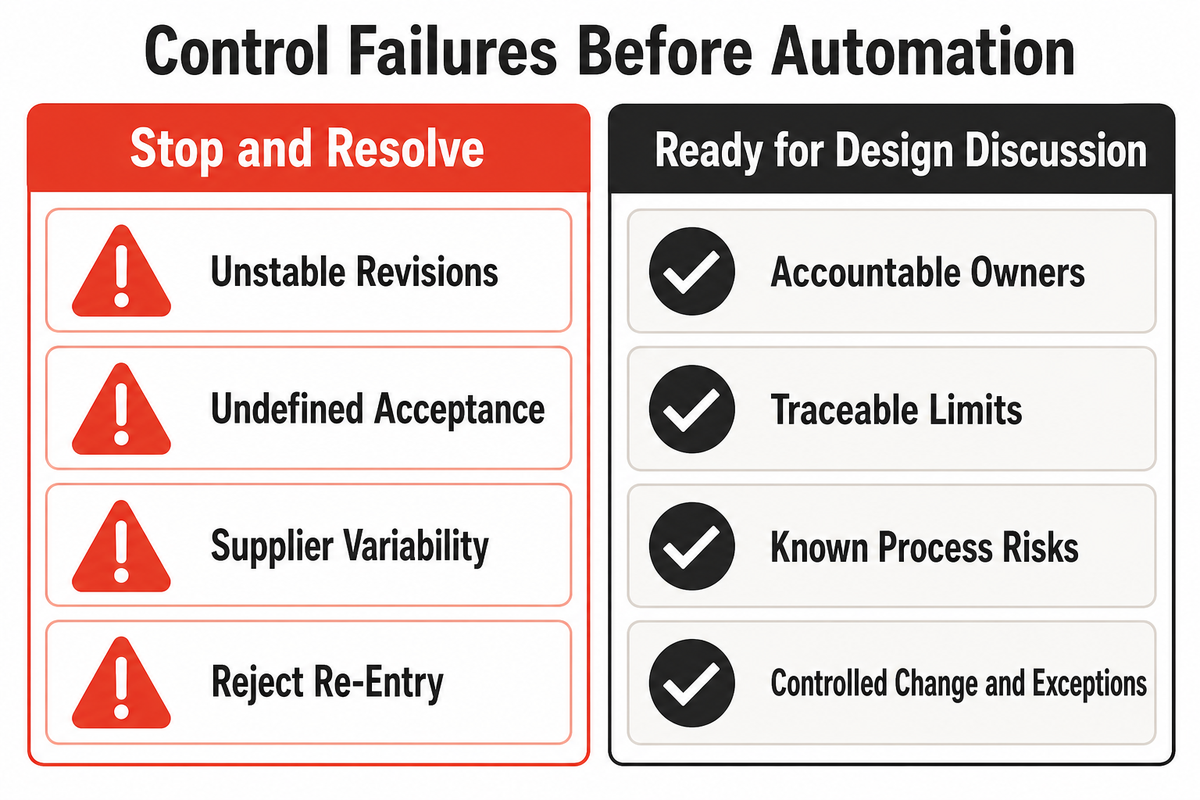
Most damaging failures occur before factory acceptance. They happen when a project captures an assumption as though it were a released requirement. Even if the machine runs, the evidence package may not show whether the output is the intended product or how an exception was controlled.
Not ready to automate
- Device revisions are still changing without a freeze point.
- A critical characteristic has no accepted measurement method.
- Supplier variability is unresolved.
- Destructive-only checks have no validation strategy.
- Recipe changes lack access and approval control.
- Rejected units can re-enter the flow without a controlled disposition.
Ready for design discussion
- Requirements and variants have accountable owners.
- Critical outputs and limits are traceable.
- Process risks and inspection limits are known.
- Records, retention, and review authority are defined.
- Change and exception paths are visible.
- Validation prerequisites can be written before execution.
Certification can also be confused with production evidence. A quality-management-system certificate may be relevant to supplier oversight, but it doesn’t prove a device, lot, process, or medical device safety outcome. Likewise, one successful demonstration doesn’t establish routine control unless the challenge conditions, configuration, methods, and acceptance criteria represent intended production.
What Should a Team Prepare Before Speaking With an Automation Partner?
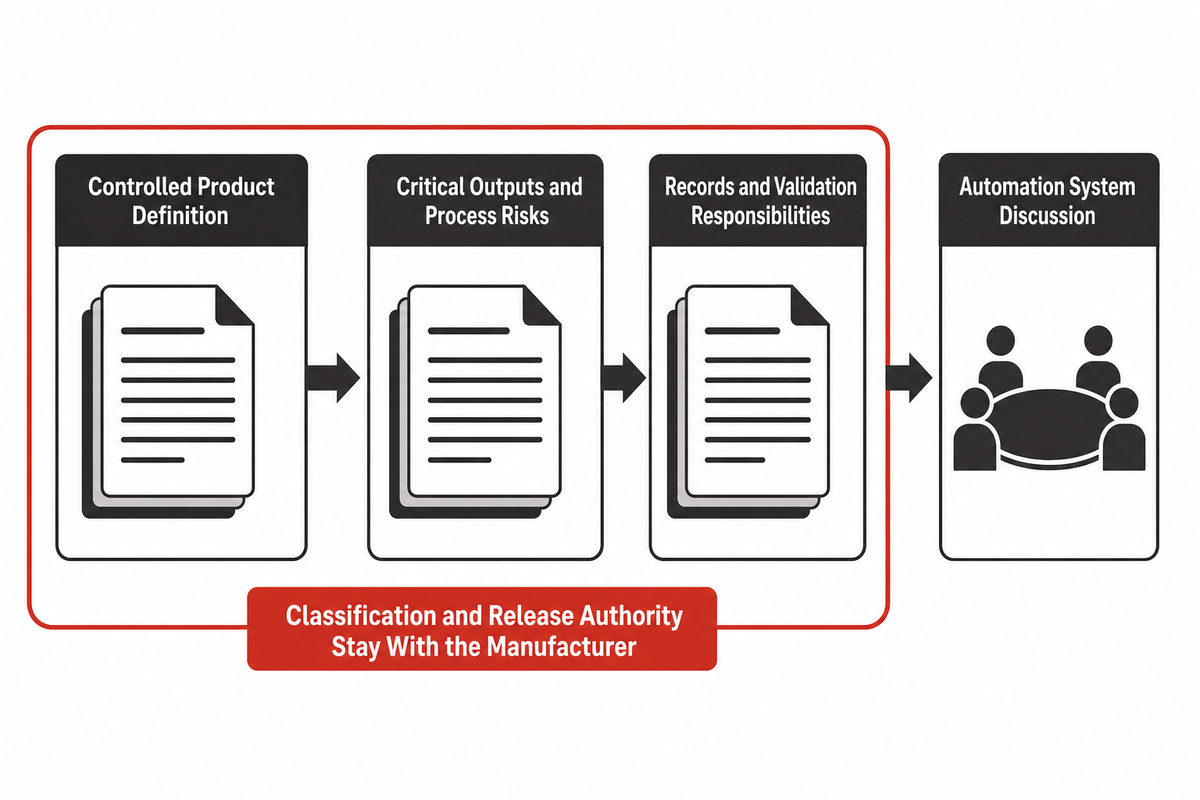
Develop a controlled problem statement, not a machine feature wish list. Your package should identify the product family, current revision, critical outputs, parts and raw materials, process sequence, known risks, required records, facility constraints, validation responsibilities, and unanswered questions. Clearly mark assumptions so they aren’t mistaken for approved inputs.
ZEUEE’s automation engineering team can use that package to discuss fixtures, motion, feeding, joining, inspection, testing, reject handling, and data interfaces. Learn about ZEUEE’s automation engineering team, then review the medical device automation solution scope for the commercial handoff. Product classification, quality-system decisions, and release authority remain with the responsible manufacturer and qualified specialists.
Have a stable process definition and an evidence plan?
Frequently Asked Questions
What is medical device manufacturing?
Medical device manufacturing converts released product requirements into repeatable, documented outputs. It includes supplier controls, production methods, verification, validation, traceability, nonconformance handling, release, and change control. The work starts before assembly and continues through retained evidence and controlled process changes.
How do Class I, II, and III affect manufacturing?
U.S. classifications reflect the level of control needed, but class alone doesn’t create a production plan. Intended use, product code, applicable regulations, special controls, submission commitments, and process risks determine the detailed evidence. Confirm the product-specific classification rather than relying on a generic example list.
What is the difference between process verification and process validation?
Verification checks whether specified outputs meet requirements. Process validation establishes documented evidence that a defined process can consistently produce acceptable results when those results can’t be fully verified later. Product risk, inspectability, test coverage, and the consequences of destructive or incomplete inspection determine the appropriate mix.
Does automation make a medical device process compliant?
No. Automation can improve repeatability, inspection, and record capture, but compliance still depends on suitable requirements, methods, controls, validation, records, qualified review, and current medical device regulations. Equipment doesn’t assign regulatory responsibility or approve the released product. Those duties remain with the manufacturer.
What traceability records should an automated line retain?
Retain the records required by the applicable quality system, product plan, and market rules. Common links include material lot and status, equipment identity, calibration state, recipe revision, measured result and limit, user or system action, nonconformance disposition, final release, and the applicable lot, serial, or UDI identity. Define ownership, access, retention, retrieval, backup, and change control so each record supports a real decision. Test retrieval against a representative event before release; a record that can’t be found can’t support containment.
References & Sources
- FDA, Quality Management System Regulation (QMSR)
- eCFR, 21 CFR Part 820, Quality Management System Regulation
- FDA, Classify Your Medical Device
- FDA, UDI Basics
- FDA, Process of 3D Printing Medical Devices
- ISO, ISO 13485, Medical devices
- FDA, Frequently Asked Questions: QMSR
Key takeaway
Defensible medical-device production makes requirements, process limits, evidence, exceptions, and release decisions traceable to the same controlled product definition.
WHY WE WRITE THIS
About ZEUEE Engineering Insights
ZEUEE shares technical guides based on real automation project experience. Since 2005, we have designed and manufactured non-standard automation equipment for connector assembly, wire harness production, robotic lines, vision inspection, and smart factory upgrades.
Founded in 2005
20,000 m² production base
120+ specialists
150+ R&D patents
ISO9001:2015 certified
![Automated Screwdriving: Torque & Cycle Time [Guide]](https://zeueeauto.com/wp-content/uploads/2026/10/automated-screwdriving-featured-150x150.png)