Get in touch with Zeyu lntelligent Industrial Company
Aerospace & Defense Manufacturing: Quality, Traceability and Automation


Updated August 2026
Aerospace & defense manufacturing covers products and systems made for civil aviation, space and defense programs. On the factory floor, its defining challenge isn’t one universal certificate. Manufacturers must identify the quality, product, contract, information-security and export-control requirements that actually apply, then preserve evidence that the approved revision was built under a controlled process and accepted with a suitable measurement method.
Planning follows four parts: scope the requirements, build the manufacturing evidence chain, choose automation according to evidence and risk, and agree how the result will be proved before release. Equipment configurations and commercial options belong on ZEUEE’s aerospace and defense manufacturing automation solutions page. Here, the discussion stays on the manufacturing-management side of that boundary.
Scope note: This article is a manufacturing-planning framework and isn’t a substitute for the applicable drawing, contract, approval basis, licensed standard or qualified professional review.
What Aerospace & Defense Means on the Factory Floor

Sector scope spans civil and commercial aviation, defense systems and space systems. That breadth matter because a connector, actuator, wire assembly, machined part, electronics module and ground-support assembly don’t inherit the same process plan merely by serving the same industry. Program context determines which definitions, controls and records matter.
What is aerospace and defense?
Aerospace covers aircraft, spacecraft, related systems and their supply chains; defense covers products and services intended for national-security missions. Some programs combine both fields, yet no single factory rulebook follows from the label. A satellite component, civil-aircraft part and ground-defense assembly can have different approval paths, customers and data controls. Manufacturing requirements vary by product, customer, approval status, contract, destination and information handled during the work. For broad orientation, consult the U.S. International Trade Administration; use the controlling program documents for shop-floor obligations.
Three consequences follow. Requirements can change from one program to another. Across the aerospace industry, new-production, acquisition and overhaul programs can pass different flow-downs to the same supplier, so the program file rather than the sector label must control the process plan. A missed characteristic or wrong revision can propagate beyond the station where it originated. Evidence also needs to remain interpretable through supplier changes, maintenance, rework and long product lifecycles.
| Program context | Likely owner | Manufacturing consequence | Evidence question |
|---|---|---|---|
| Approved design | Design or approval authority | Revision and configuration control | Which approved definition governed the unit? |
| Customer contract | Contract and quality owners | Flow-downs, records and notifications | Which clauses reached the process and suppliers? |
| Controlled program data | Security and trade-control owners | Access, transfer and system boundaries | Who may receive each file and record? |
Build a Requirements Stack Before Designing the Process
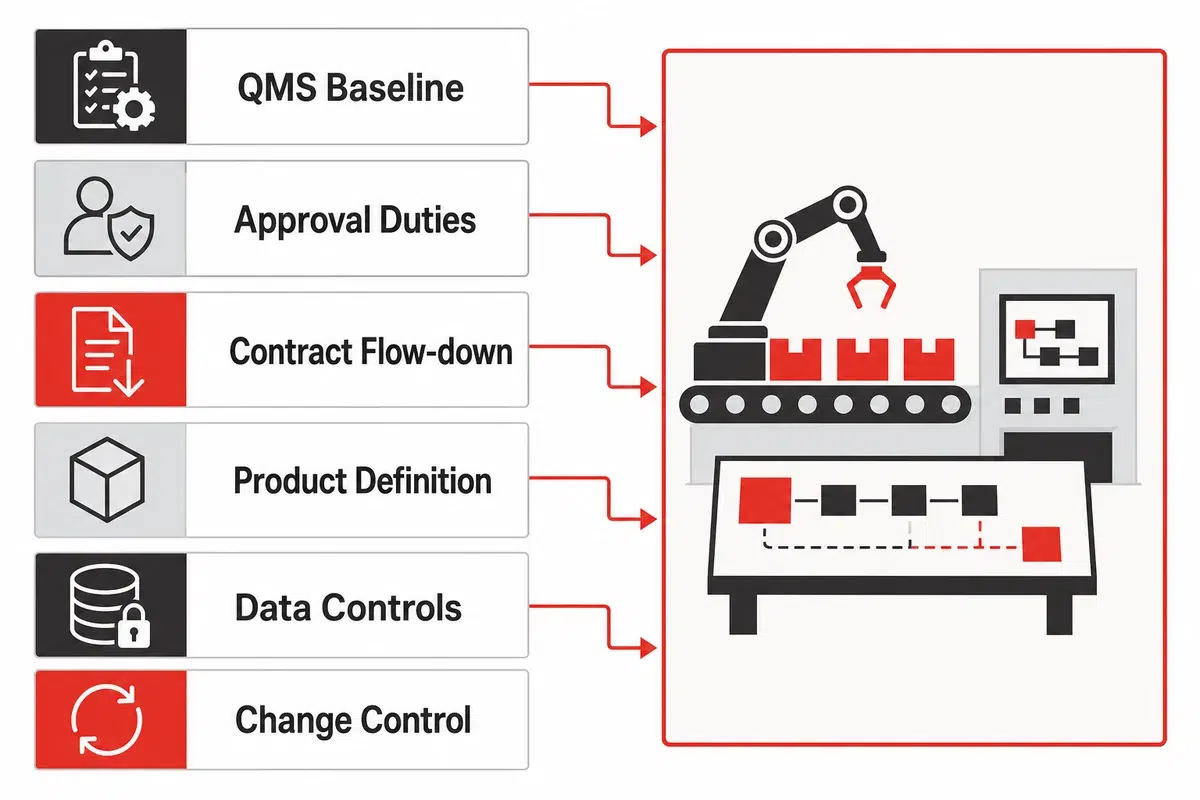
A Requirements Stack separates obligations by source and owner before a user requirement specification, machine concept or data flow is frozen. Mixing the layers can create a polished specification that answers the wrong authority. It can also make a supplier promise conformance to requirements the buyer hasn’t yet identified.
| Layer | Controlling input | Owner to confirm scope | Output for manufacturing |
|---|---|---|---|
| QMS baseline | Applicable quality-system commitments | Quality leadership | Controlled procedures and responsibilities |
| Approval duties | Approval basis and regulation | Approval or regulatory owner | Required controls and records |
| Contract flow-down | Purchase order, clauses and customer documents | Contracts and customer quality | Supplier, notification and evidence duties |
| Product definition | Drawing, BOM, model, software and specifications | Design authority | Characteristics, limits and approved revisions |
| Process definition | Work instructions and approved methods | Manufacturing engineering | Sequence, parameters, tooling and checks |
| Measurement | Inspection or test method and acceptance rule | Quality and metrology | Measurement method, equipment and decision owner |
| Cybersecurity | Contract and information inventory | Security and contracting officials | Approved systems, users and transfer paths |
| Trade controls | Item, activity, destination and data scope | Empowered official or qualified counsel | Handling and authorization boundaries |
| Change control | Program change and notification rules | Cross-functional change board | Review, revalidation and release triggers |
The International Aerospace Quality Group describes 9100 as a harmonized quality-management-system standard for aviation, space and defense organizations, with additions beyond ISO 9001. That describes its purpose; it does not turn every contract, product rule or regulatory duty into the same requirement.
For a narrower example, 14 CFR 21.137 applies to applicants for or holders of an FAA production certificate. Its quality-system provisions therefore shouldn’t be presented as a universal checklist for every aerospace supplier. In the same way, AS9102C establishes First Article Inspection documentation requirements, while customer and contract flow-down still determine where that standard apply.
Is AS9100 certification required for every aerospace and defense supplier?
No universal mandate applies. Customer qualification rules, contracts, approval status and the market being served determine whether certification is required. IAQG’s public summary explains the QMS role; confirm the actual flow-down before deciding.
Turn Mission Assurance into a Manufacturing Evidence Chain
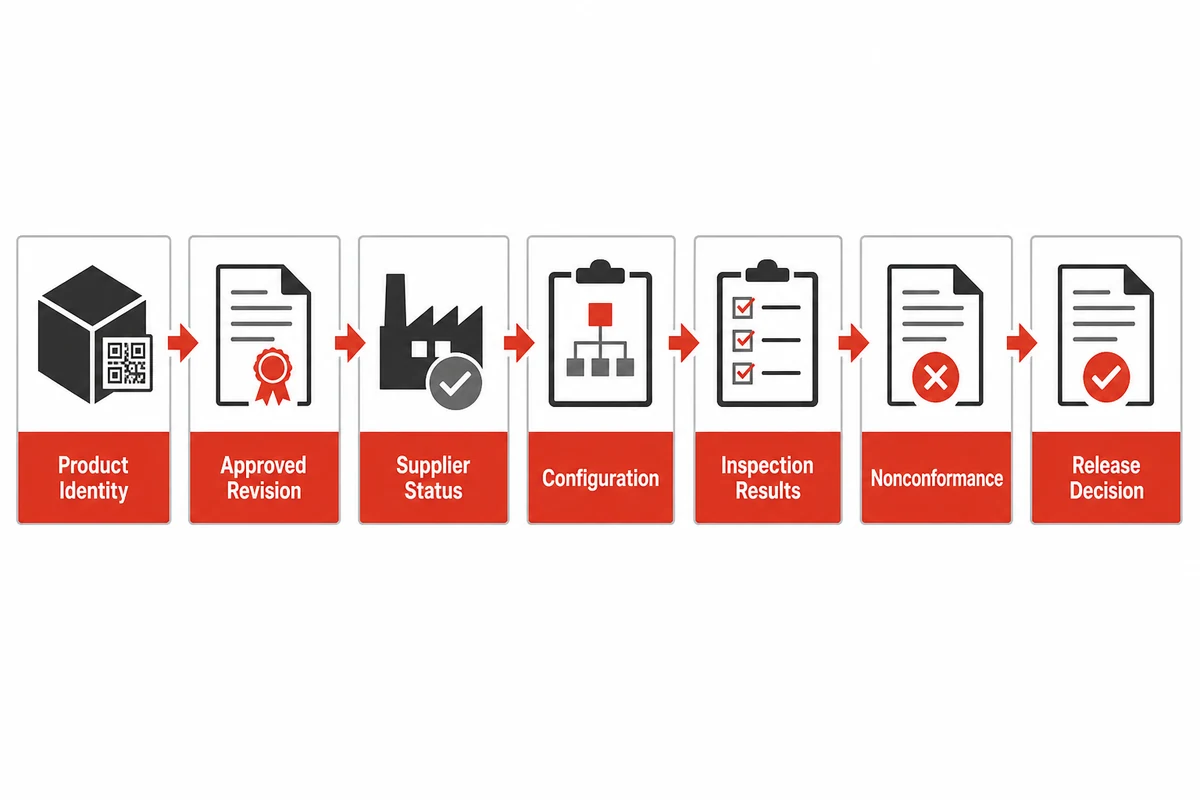
Mission-assurance language becomes useful to production only when it’s translated into linked evidence. Manufacturing Evidence Chain is the name used here for the links connecting product identity and approved definition to the process, measurement, exceptions and release decision. Meanwhile, a machine’s “cycle complete” signal records one event; it doesn’t automatically prove that the product met its acceptance requirement.
Manufacturing Evidence Chain
- Identify the product, serial or lot, and applicable material or component identity.
- Bind the unit to approved drawing, BOM, software and work-instruction revisions.
- Attach supplier, certificate and incoming-status evidence where required.
- Record the tooling, recipe, process parameters and relevant equipment state.
- Preserve operator or authorization identity and timestamps where required.
- Link inspection or test results to measurement-equipment identity and calibration or verification status.
- Connect nonconformance, review, disposition, rework, reinspection and final release.
For FAA production certificate applicants and holders, 14 CFR 21.137 illustrates how supplier control, manufacturing-process control, inspection and test, calibration, status, nonconforming items, corrective action, records and quality escapes form a connected system. The regulation’s limited scope matters, but the relationship among those controls is a useful architecture lesson.
First article evidence versus ongoing control
AS9102C’s public purpose is to establish documentation requirements for First Article Inspection. FAI can demonstrate that defined planning and production processes produced an item meeting specified requirements at that point. Ongoing control still needs revision management, stable processes, calibrated or verified measurement, exception handling and evidence for later units. An accepted first article doesn’t freeze every supplier, tool, recipe or inspection condition forever.
Design Traceability That Survives Change
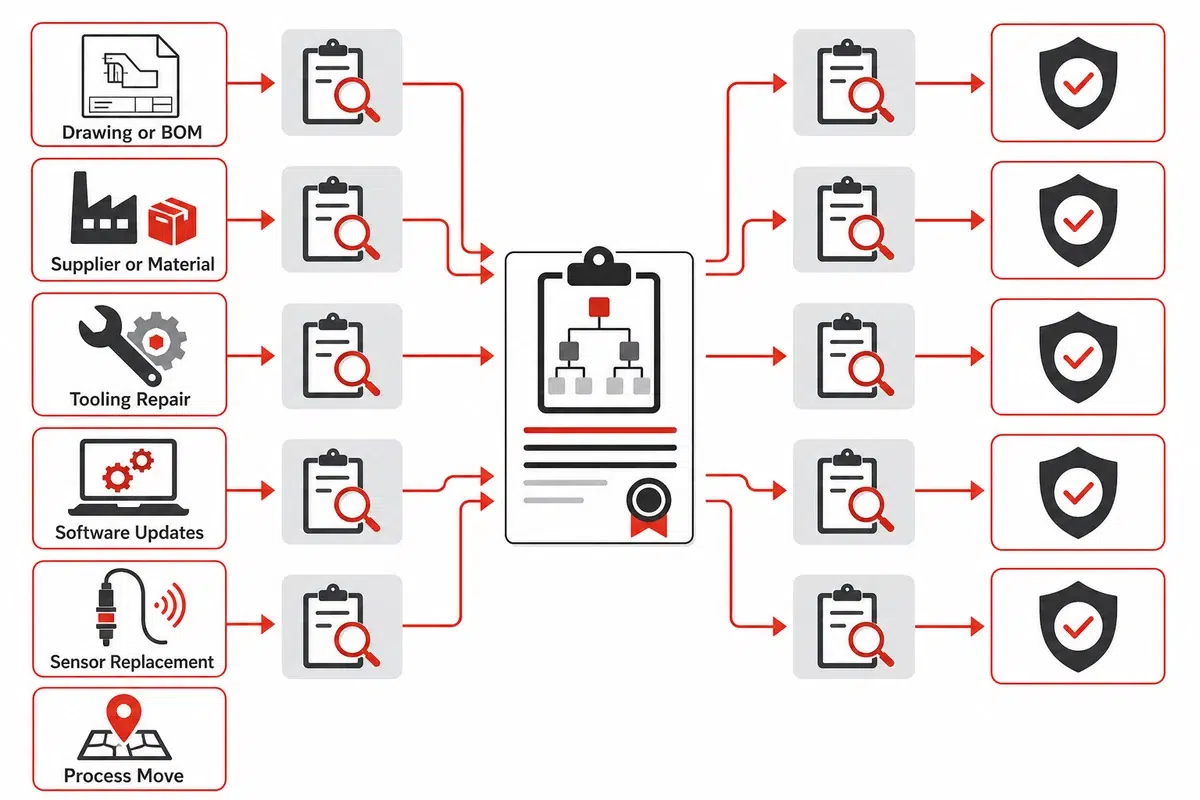
Traceability should answer decisions after a change, not merely locate a folder. Every product record need to reveal what unit or lot was involved, which approved revision applied, what process and evidence supported acceptance, and who released the work under what status. By itself, a serial number is an identifier rather than a complete traceability system.
Useful relationships link genealogy to product definition, supplier status, recipe or tooling state, inspection results, measurement equipment, disposition and release. They also make change impact visible. Drawing or BOM revisions, supplier or material changes, tooling repair, software updates, sensor replacement, process relocation and maintenance that may affect capability should each have a defined review path.
| Change | Review owner | Affected evidence | Revalidation question |
|---|---|---|---|
| Drawing or BOM revision | Design and manufacturing engineering | Program, tooling, recipe, inspection | Which characteristics or methods changed? |
| Supplier or material | Supplier quality | Approval, incoming evidence, process window | Does the new source alter risk or validation? |
| Tool, sensor or software | Equipment and quality owners | Configuration, measurement, prior results | What evidence proves equivalent performance? |
| Process move or maintenance | Operations and manufacturing engineering | Setup, environment, capability, release | What was disturbed and what must be rechecked? |
NIST’s digital-thread program links product-definition standards, model-based integration, conformance testing, cybersecurity and lifecycle traceability. Practical value comes from relationships: storing more files doesn’t help unless a reviewer can connect the applicable definition to the exact process and acceptance evidence. Retention periods remain program-, approval-, contract- and product-specific.
Decide What to Automate with an Evidence-Risk Matrix
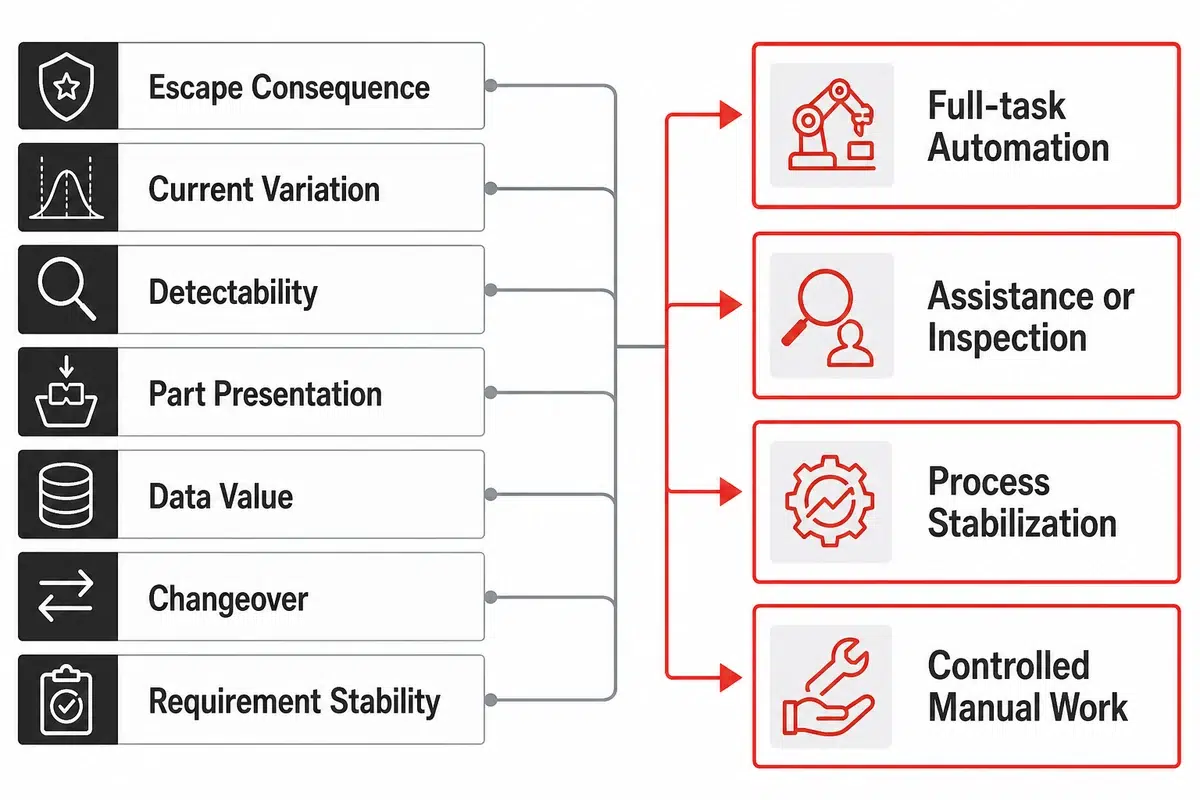
The best first automation candidate isn’t always the process with the most labor. An Evidence-Risk Automation Matrix asks whether a stable, repeatable task can reduce escape risk and create trustworthy evidence. It also allows a legitimate outcome of stabilizing the process or keeping controlled manual work instead of forcing every operation into a machine concept.
| Decision dimension | Evidence to review | Proceed signal | Pause signal |
|---|---|---|---|
| Escape consequence | Failure analysis and control plan | A defined characteristic needs stronger prevention or detection | Consequence and acceptance rule are still unclear |
| Current variation | Defect modes and process history | Dominant variation sources are understood | Incoming or process conditions shift without control |
| Detectability | Station and downstream inspection coverage | The method can detect the defined failure | A sensor output is being treated as acceptance without correlation |
| Part presentation | Datum, orientation and handling trials | Presentation is repeatable across approved variants | Geometry or condition defeats reliable location |
| Data value | Release, containment and traceability needs | Automation can preserve reviewable raw evidence | Only a pass bit will remain |
| Changeover | Variant and recipe matrix | Recipes, tooling and access can be controlled | Variant coverage depends on unrecorded operator knowledge |
| Requirement stability | Revision history and open engineering decisions | Acceptance criteria and interfaces are released | Dedicated hardware would freeze unresolved requirements |
Which aerospace manufacturing processes should be automated first?
Start with operations that are repetitive, measurable and stable, where an escape carries a defined consequence and the current process produce weak evidence. Full-task automation fits when presentation, method and acceptance are controlled. Assistance or inspection may be the better boundary when judgment remains essential. Requirements or incoming conditions that still move point to process stabilization first. For every outcome, name the raw record that supports release and the owner who reviews an exception.
Cycle time and labor saving are valid business inputs, but neither proves that a cell will protect product quality. Once the decision logic is sound, equipment architectures can be compared on the dedicated aerospace and defense manufacturing automation solutions page.
Validate Automation from URS to Acceptance
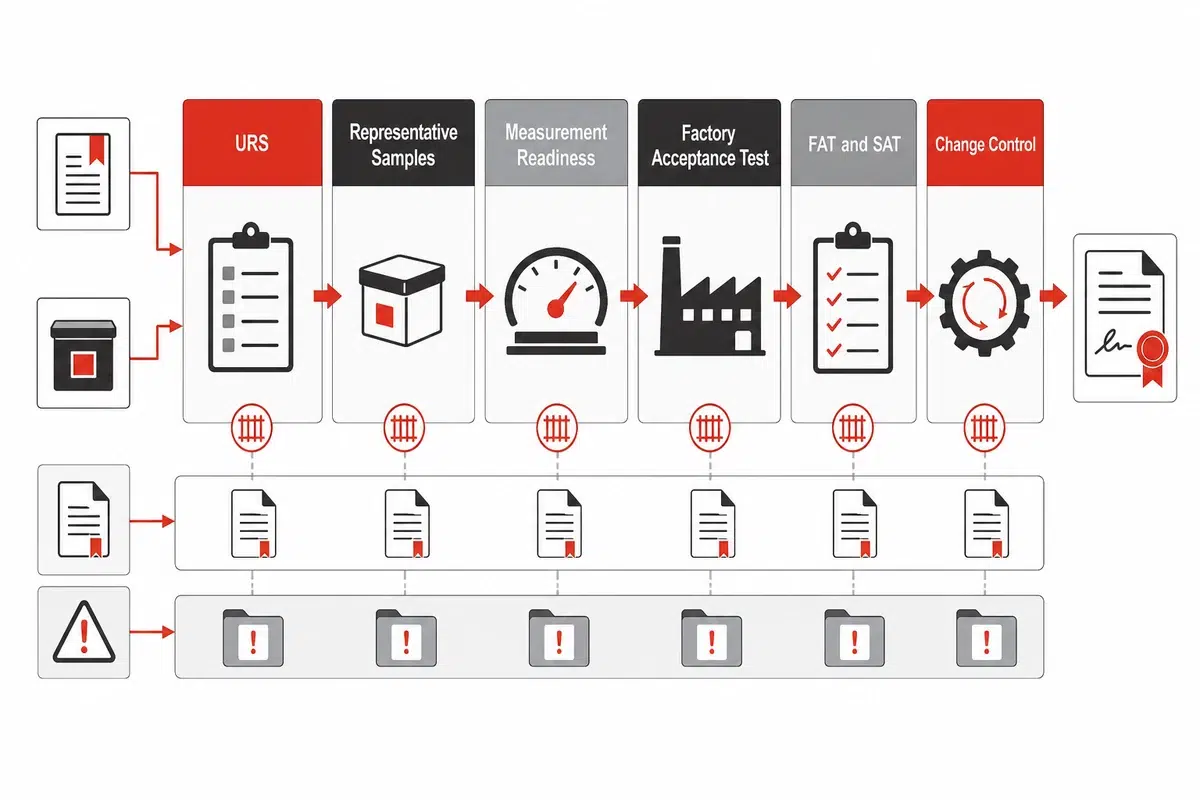
Automation acceptance should be designed before the demonstration. The user requirement specification, representative samples, measurement method and decision owners need to point to the same acceptance basis. Otherwise, a factory acceptance test may prove that the machine moved through a nominal cycle while leaving product conformity unresolved.
URS-to-acceptance path
- Freeze the approved product and revision matrix, process boundary and applicable characteristics.
- Define normal, boundary and meaningful variant samples, their provenance and any exclusions.
- Agree the measurement method, equipment status and owner of each acceptance decision.
- Write FAT and SAT preconditions, run order, stop, reject, retest and deviation rules.
- Bind open actions, evidence, approvals and later change triggers to the released configuration.
A useful URS covers incoming condition, product variants, process limits, tests, reject and rework paths, data access, interfaces, safety, utilities, training, maintenance, documentation and acceptance ownership. Sample planning should include approved revisions and meaningful boundary conditions rather than a convenient set of nominal parts. Challenge parts can be valuable when their status is known, their use is safe and their purpose is agreed.
Measurement readiness means more than listing a gauge. The buyer and supplier should know the method, equipment identity, calibration or verification state, relevant resolution or capability, raw result format and authority for the pass/fail decision. Detailed equipment-selection questions belong in the automated testing equipment guide and vision inspection systems guide.
What evidence should an automation FAT include?
Record the preconditions, approved product and revision, sample provenance, configuration, run order, raw results, exceptions, decision and signatories. Project requirements, not a generic machine rule, set sample quantity and performance targets.
Evaluate an Automation Supplier on Proof, Not Promises
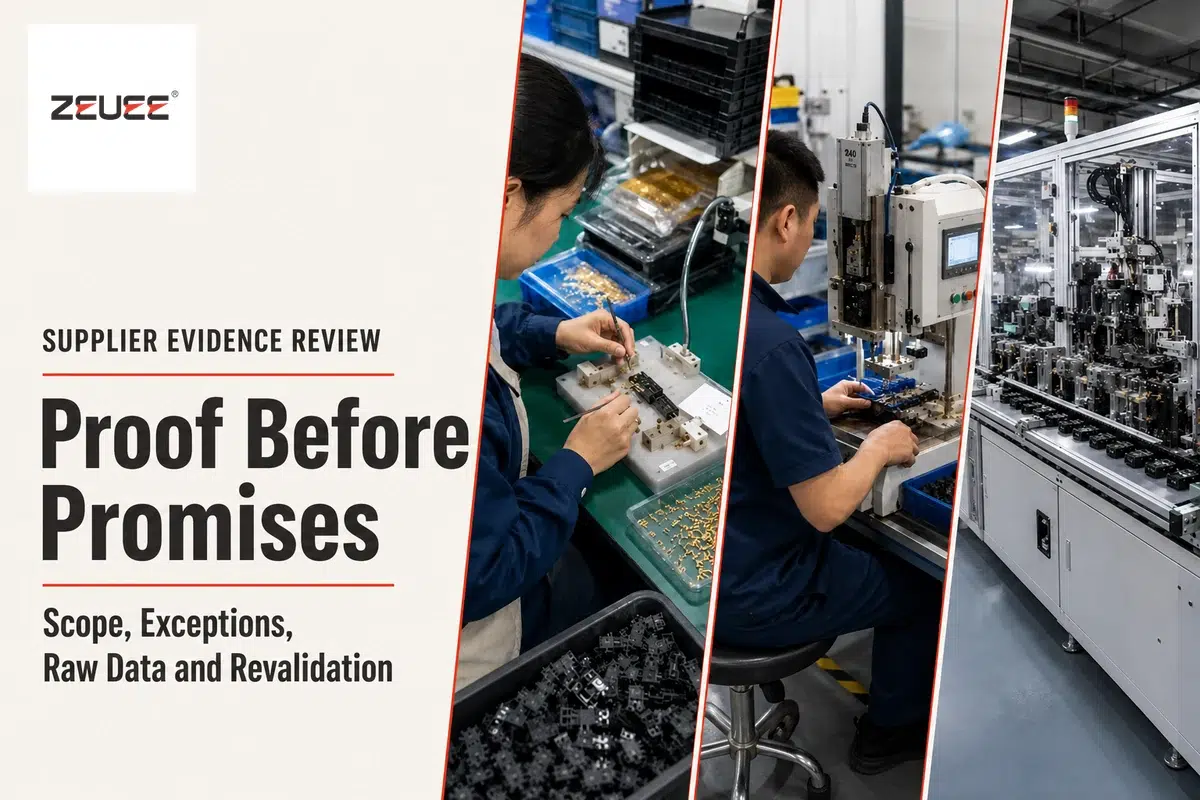
A credible proposal make assumptions and evidence ownership visible. A polished nominal demo may show that a station can perform its motion, yet leave two different questions unanswered: did the process characteristic remain inside its defined window, and did the product meet the applicable acceptance requirement?
Compare proposals on stated scope and exclusions, revision coverage, sample provenance, part-presentation risk, tooling and changeover, sensor proof limits, raw-data access, recipe permissions, reject containment, measurement responsibility, documentation, training, spares and revalidation support. Ask what happens when a part is missing, reversed, damaged, unreadable, outside the acceptance limit or paired with the wrong recipe.
Ask for
- Assumptions tied to named owners
- Raw evidence and exception paths
- Approved variants and exclusions
- Change and revalidation responsibilities
Do not accept as proof
- A nominal cycle video alone
- An unexplained pass indicator
- Undefined “all parts” coverage
- A conformance promise without scoped inputs
No supplier can responsibly guarantee that a line meets every requirement without the buyer’s applicable inputs, representative parts and agreed evidence plan. The custom automation equipment guide covers the broader equipment-planning questions that follow once those inputs are controlled.
Control Manufacturing Data Across Different Requirement Regimes
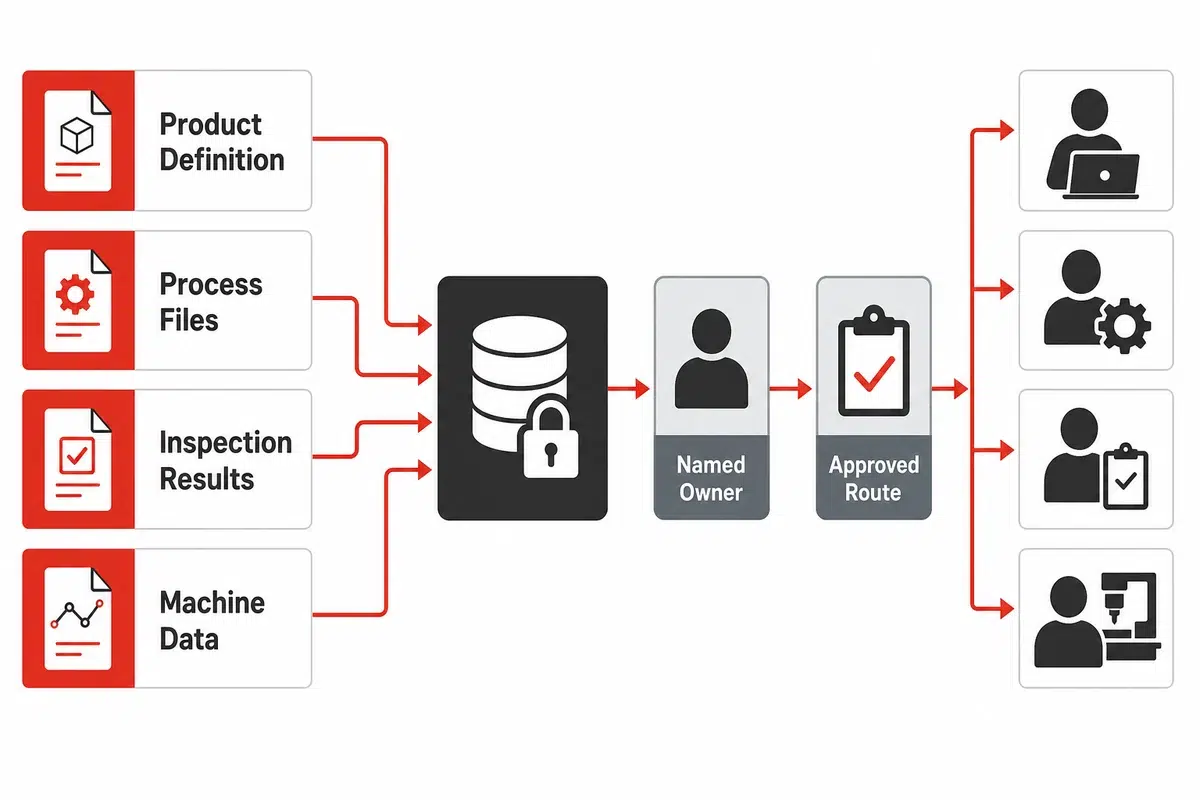
Drawings, process files, inspection results and machine data should be routed to the correct contract, cybersecurity and trade-control owners before they’re shared with an integrator or cloud service. Quality certification, CMMC, EAR and ITAR address different subjects; treating them as interchangeable badges can create both gaps and unnecessary restrictions.
NIST SP 800-171 Rev. 3 provides recommended requirements for protecting Controlled Unclassified Information in nonfederal systems for use in federal contractual vehicles or other agreements. 32 CFR Part 170 establishes the CMMC program around Federal Contract Information and CUI handled in DoD contract performance. Neither source means that every aerospace supplier or every machine record has the same status.
Export scope requires its own determination. EAR Part 734 is a starting point for deciding whether items and activities are subject to the EAR. 22 CFR 120.33 defines categories of ITAR technical data, including specified information for manufacturing and testing defense articles.
Build a data inventory with the file or data type, program owner, control status, approved recipients, storage and transfer route, machine or supplier access, retention basis and deletion authority. Classification, jurisdiction, licensing and contractual cybersecurity decisions belong to the organization’s empowered official, contracting authority and qualified counsel.
Use Digital Thread and AI Where They Improve Evidence
Digital tools earn their place when they strengthen a relationship, detection or decision. A relationship links product definition, process, inspection and disposition data. Detection finds drift, a part-recipe mismatch or missing evidence. A decision routes the exception to a named owner while preserving status, raw basis and audit trail.
NIST’s digital-thread work emphasizes product-definition standards, model-based integration, conformance testing, cybersecurity and traceability. That direction can support supply-chain resilience because evidence can remain connected across systems and changes. It doesn’t make every dashboard trustworthy by default.
Artificial intelligence may assist inspection review, anomaly triage or maintenance prioritization. Product acceptance still needs an approved method, traceable data, explicit authority and controlled change. An AI score or digital-twin display shouldn’t be treated as conformance evidence unless its relationship to the acceptance rule has been defined and validated.
Build a Manufacturing Readiness Pack
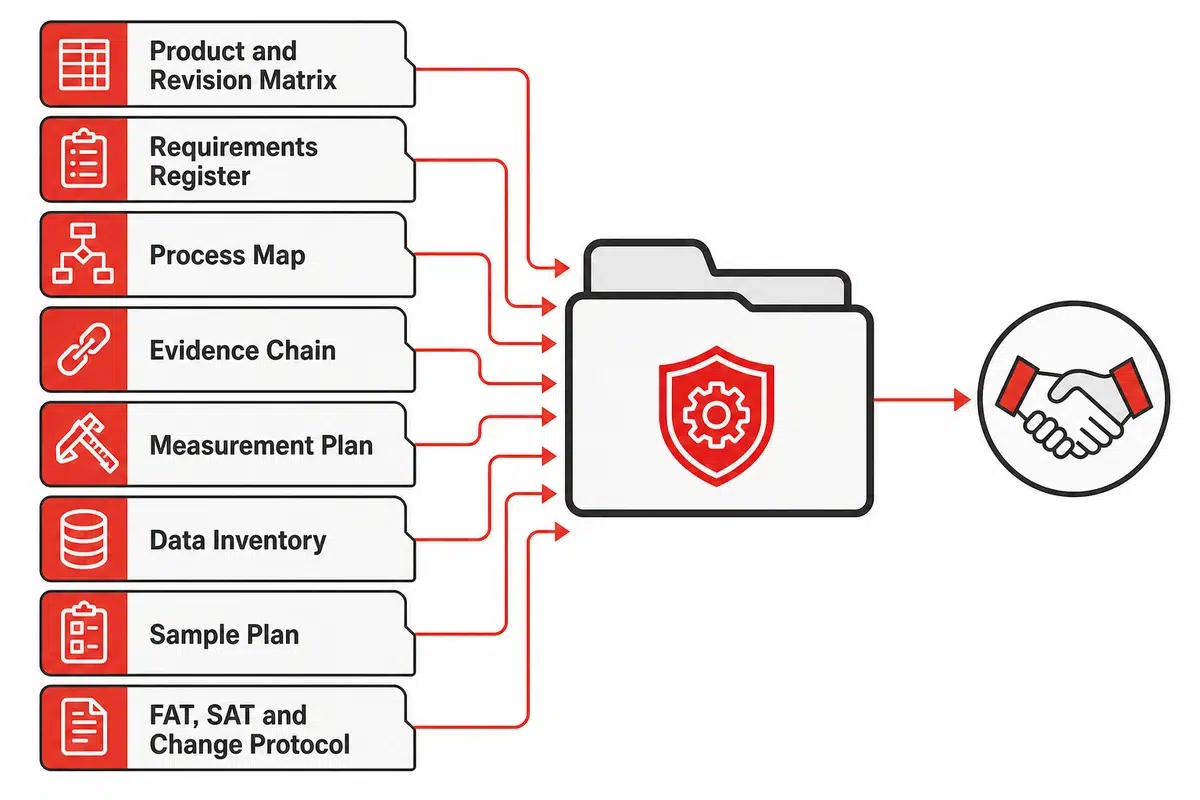
A Manufacturing Readiness Pack gives the buyer and automation supplier one revision-controlled handoff before concept work begins. Its purpose isn’t to make uncertainty disappear. It identifies what’s approved, what remains open, who owns each decision and how the eventual result will be verified.
| Item | Current revision or owner | Why it matters | Verification method |
|---|---|---|---|
| Product and revision matrix | Design authority | Defines approved coverage | Configuration review |
| Requirements register | Cross-functional owners | Separates scope and authority | Owner approval and trace review |
| Process map and evidence chain | Manufacturing and quality | Shows controls and record links | Walkthrough against real records |
| Incoming condition and defect taxonomy | Supplier quality | Prevents hidden variation from entering the concept | Sample and defect review |
| Measurement plan | Metrology owner | Defines how acceptance is decided | Method and equipment readiness review |
| Data and access inventory | Security and trade-control owners | Controls system and supplier boundaries | Approved route and recipient check |
| URS and sample plan | Project owner | Binds scope to representative evidence | Requirements and sample trace |
| FAT, SAT and change protocol | Acceptance owners | Defines release and later revalidation | Witnessed execution and closure |
The ZEUEE automation engineering team can use a buyer-controlled pack to discuss manufacturability and equipment boundaries without displacing the buyer’s design, quality or regulatory authorities. When your pack is ready, review the established solution page or open a project discussion below.
Discuss Your Aerospace Manufacturing Project
Frequently Asked Questions
What is aerospace and defense?
Aerospace includes aircraft, spacecraft and related systems; defense includes products and services supporting national-security missions. Overlap is common, especially where aviation, space and defense supply chains share technologies or suppliers. Shop-floor obligations still differ by product, program, approval, contract, customer, destination and controlled information. Before a process or system is specified, identify which authority owns each requirement and which record will demonstrate that it was met.
Is AS9100 certification required for every aerospace and defense supplier?
Not automatically. Customer qualification, contractual flow-down, approval status and market access can make certification necessary. IAQG’s summary explains the standard’s purpose; the actual customer and contract requirements control the decision.
What should aerospace manufacturing traceability include?
Traceability should link the product, serial or lot identity to the approved drawing, BOM, software and work instructions. Where the program require them, include supplier and incoming status, material identity, operator authorization, tooling, recipe, process parameters, inspection or test results, measurement-equipment status, nonconformance, disposition and release. Exact fields and retention come from the contract and approval basis. Without these relationships, a serial number identifies the unit but can’t explain why it was accepted.
Which aerospace manufacturing processes should be automated first?
Favor repetitive, measurable and stable work with a defined escape consequence and weak current evidence. If inputs, presentation or acceptance criteria remain unresolved, stabilize the process or automate only the controlled portion.
What evidence should an automation FAT include?
Begin with preconditions: utilities, safety state, released software, approved recipe and measurement readiness. Identify every product revision and sample, including provenance, normal or boundary role and exclusions. During execution, preserve run order, raw readings, alarms, stops, rejects, retests and any operator intervention. Close the record with the requirement-level decision, deviations, unresolved actions, owners and approvals. The project’s acceptance plan supplies sample quantity and performance limits; a supplier shouldn’t invent a universal value for the demonstration.
References
- International Trade Administration: Aerospace and Defense Industry
- IAQG: 9100 QMS Requirements for Aviation, Space and Defense Organizations
- 14 CFR 21.137: Quality System
- SAE: AS9102 Aerospace First Article Inspection Requirement
- NIST: Digital Thread for Manufacturing
- NIST SP 800-171 Rev. 3
- 32 CFR Part 170: CMMC Program
- EAR Part 734: Scope of the Export Administration Regulations
- 22 CFR 120.33: Technical Data
Publisher: Shenzhen Zeyu Intelligent Industrial Science Technology Co., Ltd., the company behind ZEUEE.
WHY WE WRITE THIS
About ZEUEE Engineering Insights
ZEUEE shares technical guides based on real automation project experience. Since 2005, we have designed and manufactured non-standard automation equipment for connector assembly, wire harness production, robotic lines, vision inspection, and smart factory upgrades.
Founded in 2005
20,000 m² production base
120+ specialists
150+ R&D patents
ISO9001:2015 certified

![Automated Screwdriving: Torque & Cycle Time [Guide]](https://zeueeauto.com/wp-content/uploads/2026/10/automated-screwdriving-featured-150x150.png)