Get in touch with Zeyu lntelligent Industrial Company

Automotive Manufacturing: Quality & Traceability Guide

Updated August 2026
Automotive manufacturing is not only the work of forming, joining, assembling, and testing automotive components. Its discipline connects a product requirement, the risk of missing it, the control used on the production line, the evidence retained, and the decision made when that evidence shows a problem. That connection matters whether the output is a vehicle, a module, or a supplied component.
Start with the deliberately unglamorous work: before a team automates a task, it should be able to explain the current work sequence, the critical inputs, the measurement method, the reaction to an out-of-condition result, and the records needed to reconstruct what happened. Repeatable machine movement is valuable, but repeatability alone does not prove that a process is capable or that a quality decision can be defended later.
In brief
- Equipment repeatability is not the same as process capability.
- Traceability should answer a defined failure question, not merely store scan events.
- Automation work should begin with an evidence audit, then move to an application-specific concept review.
This guide is educational support content for quality, traceability, and readiness decisions. It doesn’t select machinery or set product specifications. For automation applications and equipment discussions, see ZEUEE’s automotive manufacturing automation solutions.
What Automotive Manufacturing Actually Includes
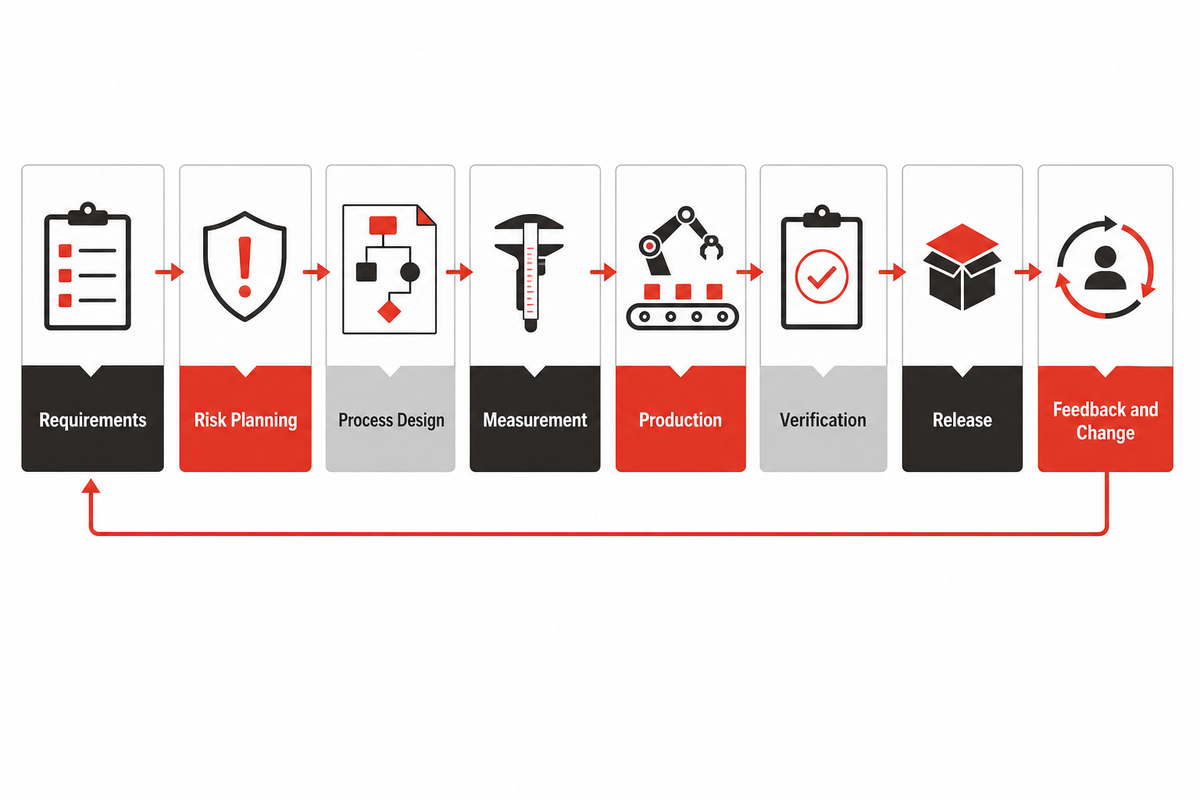
Automotive manufacturing is a closed information loop: product requirements are translated into risks and process plans; production and verification create records; release decisions use those records; and feedback or approved changes update the next cycle. Physical work may take place across an assembly line, a machining cell, a test station, or a supplier network, but the decision logic should remain connected.
Across an automobile or electric vehicle (EV) program, an automaker may own final assembly while suppliers produce modules, motors, connectors, and other automotive components. The evidence loop still has to retain identity and version relationships across those handoffs.
At quality-management framework level, the official IATF 16949 overview explains that the standard remains aligned with ISO 9001. It separately describes the historical ISO/TS 16949 aim of common automotive techniques and methods for product and process-development. Framework alignment does not replace application-specific engineering evidence. Each plant still needs to show how its own requirements, controls, records, and decisions fit together.
Seven linked handoffs clarify the automotive manufacturing process:
- Start with the requirement: define the characteristic, function, or condition that matters.
- Then assess risk: identify how that requirement could be missed or changed.
- Document process design: state how the work is intended to occur.
- Establish measurement: show how the result will be checked and whether the measurement is fit for its purpose.
- Retain a production record: preserve the identity and process evidence needed for later reconstruction.
- Make a release decision about whether the product, lot, or process state can proceed.
- Connect feedback and change to the next controlled action after a finding, deviation, or approved revision.
NIST’s digital-thread work describes the same broad need for product definition, manufacturing information, quality information, and feedback to remain connected through a lifecycle. In a local factory context, the important question is simpler: can the team follow a current requirement to the exact records that support a release decision?
Boundary to keep: A process map identifies handoffs and evidence responsibilities. This map is not a substitute for a control plan, customer-specific requirement, safety assessment, or approval package.
How the Automotive Core Tools Connect
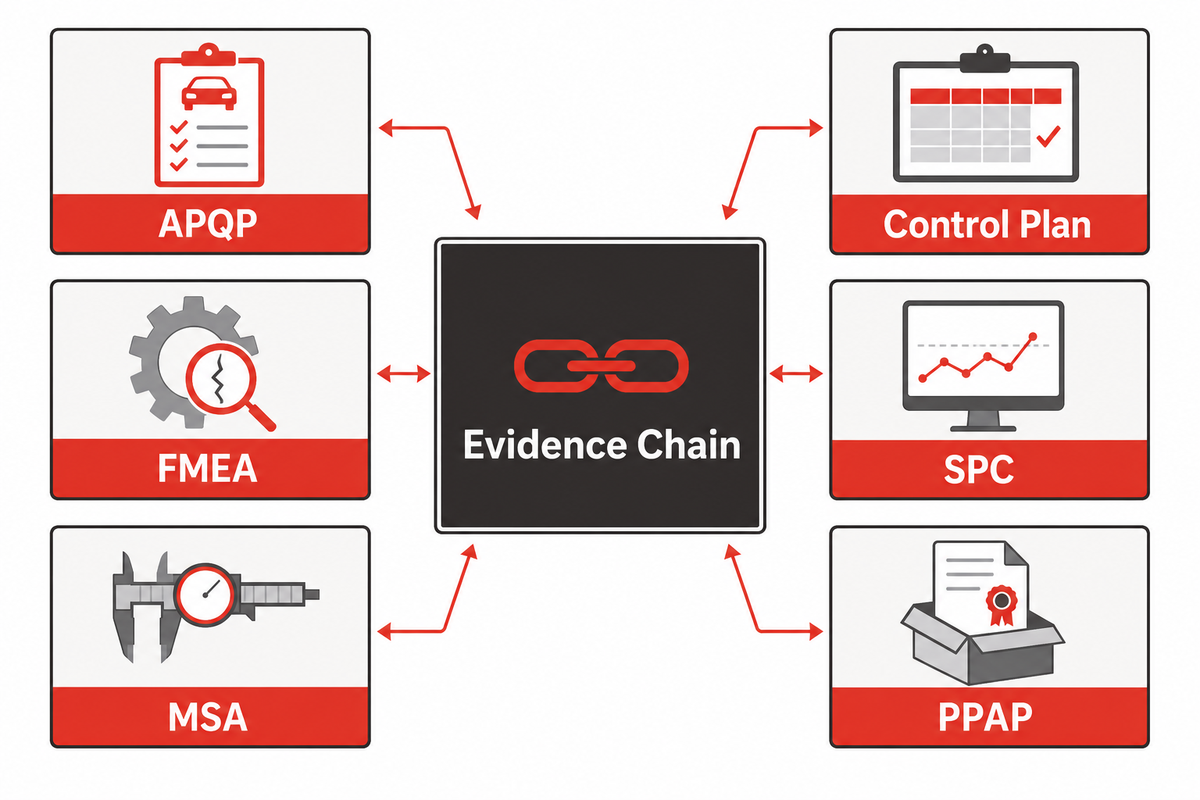
Automotive quality control becomes actionable when planning, risk prevention, measurement, monitoring, and approval are treated as one evidence chain. The AIAG Core Tools identify APQP, Control Plan, PPAP, FMEA, SPC, and MSA as distinct but related tools. Their detailed use is governed by the applicable manuals and customer requirements; the table below is an editorial decision map rather than a compliance method.
| Tool | Decision supported | Evidence produced | Common misuse | Boundary |
|---|---|---|---|---|
| APQP | What must be planned before launch | Cross-functional deliverables and timing | Treating it as a meeting calendar | Does not prove a station is controlled |
| FMEA | Which failures need prevention or detection | Risk logic and actions | Leaving actions disconnected from controls | Does not itself monitor production |
| Control Plan | How a process will be controlled | Characteristic, method, frequency, reaction linkage | Copying a generic plan across different stations | Needs current process knowledge |
| MSA | Whether a measurement can support a decision | Measurement-system evidence | Assuming an instrument label proves measurement fitness | Does not define the requirement to measure |
| SPC | Whether observed process behavior needs action | Process-behavior records | Collecting charts with no reaction rule | Requires a defined characteristic and measurement |
| PPAP | Whether launch evidence can support submission or approval | An organized approval package | Treating it as permanent proof after a changed process | Customer and program requirements govern its content |
Handoffs are more important than names. Each failure mode should lead to a controlled feature or action; that control should have a measurement or verification plan; that record should retain the condition and result; and the release decision should use the same identifiers. If a risk entry, control-plan row, station instruction, and production record use different names for the same feature, people may finish their documents while the evidence chain breaks.
For an automotive supplier, that observation creates a useful audit prompt: choose one critical characteristic and follow it from requirement through risk, work instruction, measurement status, inspection record, and release. Missing links are more useful than a stack of completed forms because they identify where a later investigation could lose context.
Build a Requirement-to-Evidence Matrix Before Adding More Data
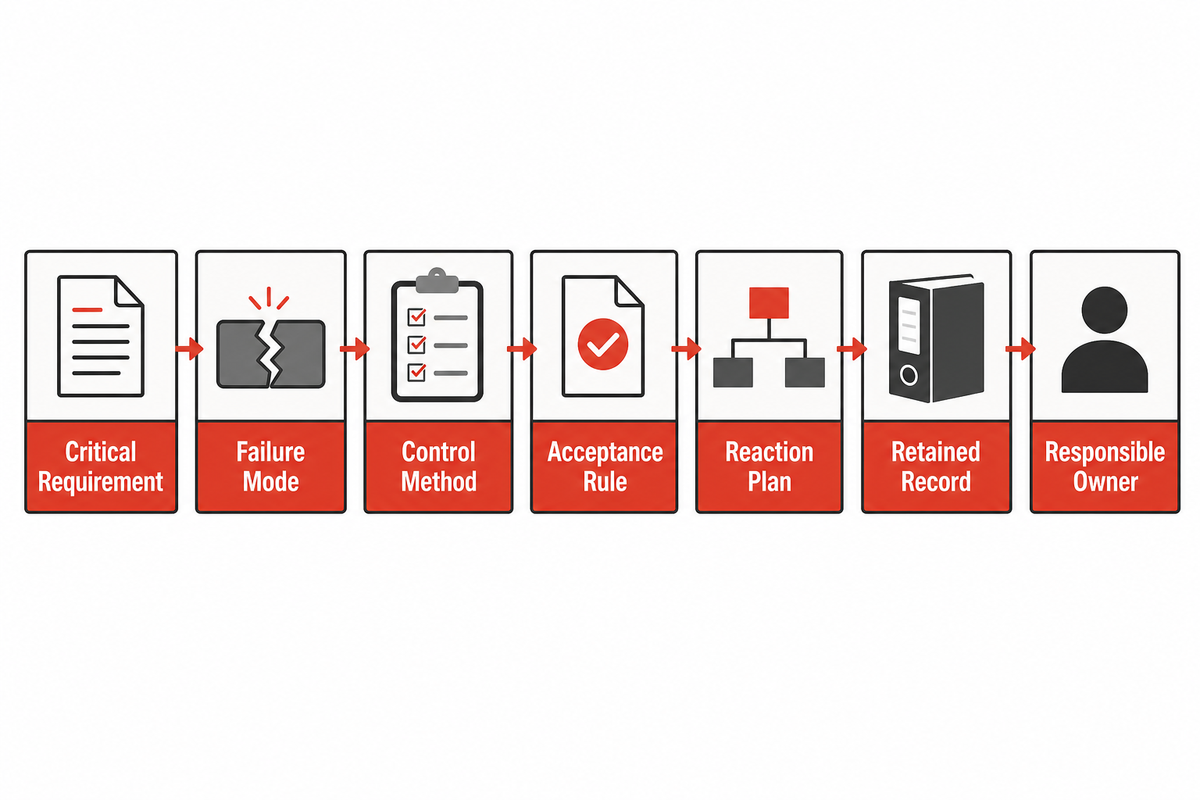
A Requirement-to-Evidence Matrix links each critical requirement to its failure mode, control method, acceptance rule, reaction plan, retained record, and responsible owner. This is an editorial planning tool, not an automotive standard. Its goal is to reveal an evidence gap before a team adds a scanner, dashboard, database, or automated station.
The matrix is useful because it starts with the decision that must be supported. Instead of asking, “What data can this station collect?”, ask, “What would we need to know if this unit, lot, or process state were questioned later?” The answer often includes an identity relationship, a process state, a verification result, and a disposition—not merely a timestamp.
| Requirement or risk | Evidence to retain | Release question | Owner | Limitation to state |
|---|---|---|---|---|
| Product characteristic | Current requirement reference and verification result | Was the right feature checked against the right revision? | Quality or process owner | The matrix does not set an acceptance value |
| Incoming material or component identity | Supplier, lot, serial, or other approved identifier relationship | Which inputs entered this population? | Materials or receiving owner | Identity rules must match the actual supply chain |
| Process parameter | Recorded state, applicable version, and exception status | Was the process in its approved state? | Process owner | No universal parameter list exists |
| Error-proofing status | Check result, bypass status, and response record | Was the intended prevention or detection active? | Station owner | A pass indication needs context and testability |
| Measurement-system status | Method identity and applicable status evidence | Could this result support a release decision? | Measurement owner | Fitness depends on the intended decision |
| Inspection result | Result, method, unit or lot relationship, and reviewer where applicable | Which items met the defined rule? | Inspection owner | The record must identify the applicable rule |
| Rework or deviation | Original status, disposition, approved action, and re-verification link | What changed, and how was it re-evaluated? | Disposition authority | Authority and retention rules are program-specific |
| Changeover release | Setup confirmation, version relationship, and release record | Did the new state begin under the intended conditions? | Production owner | The required checks vary by process |
| Final release | Release decision, population identity, exceptions, and accountable authority | What exactly was released, and on what evidence? | Authorized release owner | Customer-specific submission and retention rules apply |
Work through the matrix one station at a time. Large production-line maps can obscure the gap between local control and a final release. Station-level drafts make it easier to verify that a scan is tied to the right item, that an inspection result is tied to the right requirement, and that a rework record is tied to the original disposition.
Decision point: Add a data field only after the team can name the release or investigation question it will answer. Otherwise, the factory may accumulate records without gaining a usable traceability relationship.
Design Traceability Around Failure Questions
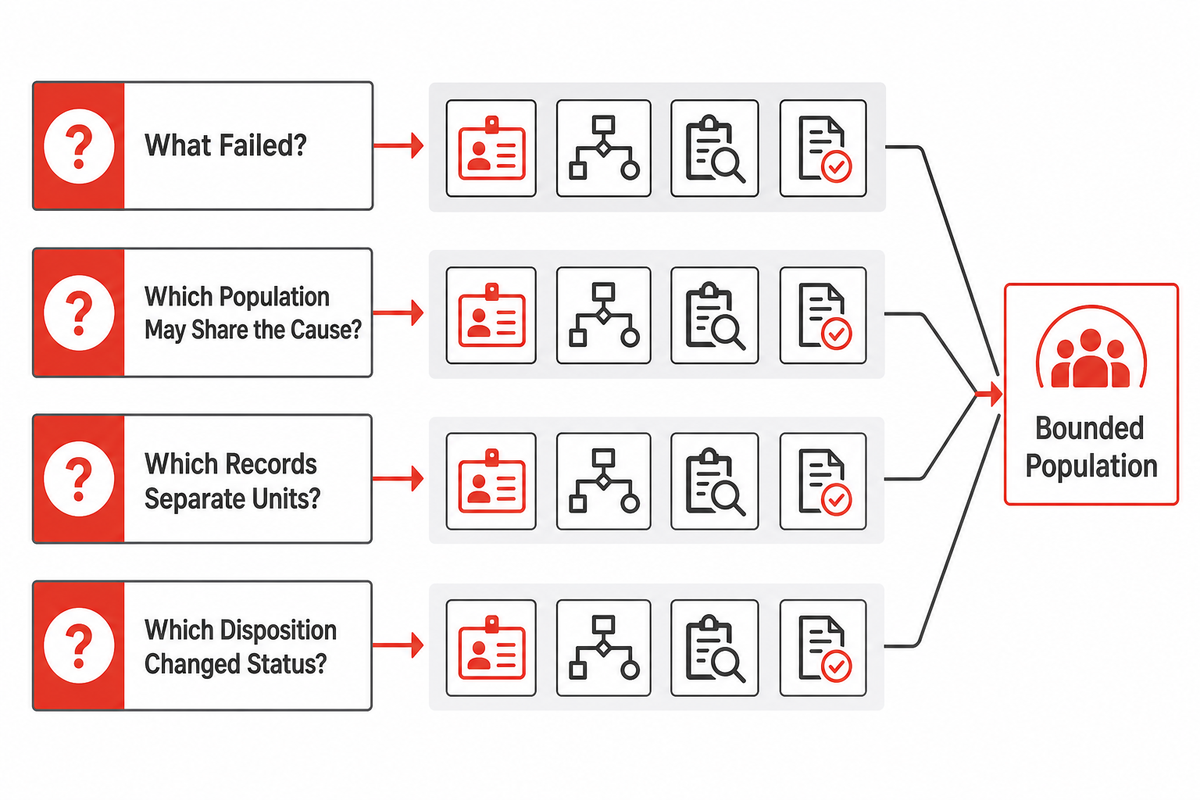
For purposes of this guide, usable traceability means being able to reconstruct which product, material, process state, station, inspection, and disposition records belong to a defined unit or lot. This working definition is intentionally broader than label scanning. Code capture records an event; the captured event becomes useful for this guide’s traceability method when its relationships can be retrieved and tested against a real failure question.
VINs have an important but narrower function. For covered U.S. vehicles under 49 CFR Part 565, a one-stage manufacturer assigns the VIN; for a multi-stage vehicle, the incomplete-vehicle manufacturer assigns it; and a vehicle alterer uses the VIN assigned by the original manufacturer. The VIN has regulated content. NHTSA recall resources use VIN-level identification to help determine whether a specific vehicle has an unrepaired safety recall. Factory traceability normally needs a more granular view: component or material identity, lot or serial relationships, station history, inspection outcomes, process state, and disposition history.
Start traceability design with four failure questions:
- What failed? Define the observed condition without assuming the cause.
- Which population may share the cause? Decide which shared identities or process states could matter.
- Which records separate affected from unaffected units? Identify the station, material, process, measurement, and inspection relationships needed to make that distinction.
- Which disposition changed status? Preserve rework, deviation, containment, or release relationships so the history is not overwritten.
Make the result testable. Choose a realistic investigation scenario, then ask whether the retained relationships can identify a bounded population without relying on memory, spreadsheet reconstruction, or an assumed timestamp. If they cannot, the gap is not a reporting inconvenience; it is a design input for the process and traceability system.
NIST’s digital-thread framing is useful here because it treats trusted, traceable information as a lifecycle requirement rather than a single application purchase. Rather than asking whether one platform contains all data, determine whether the current product definition, manufacturing state, quality evidence, and feedback can retain their version relationships when a team needs them.
Use an Automation Readiness Scorecard as an Evidence Audit
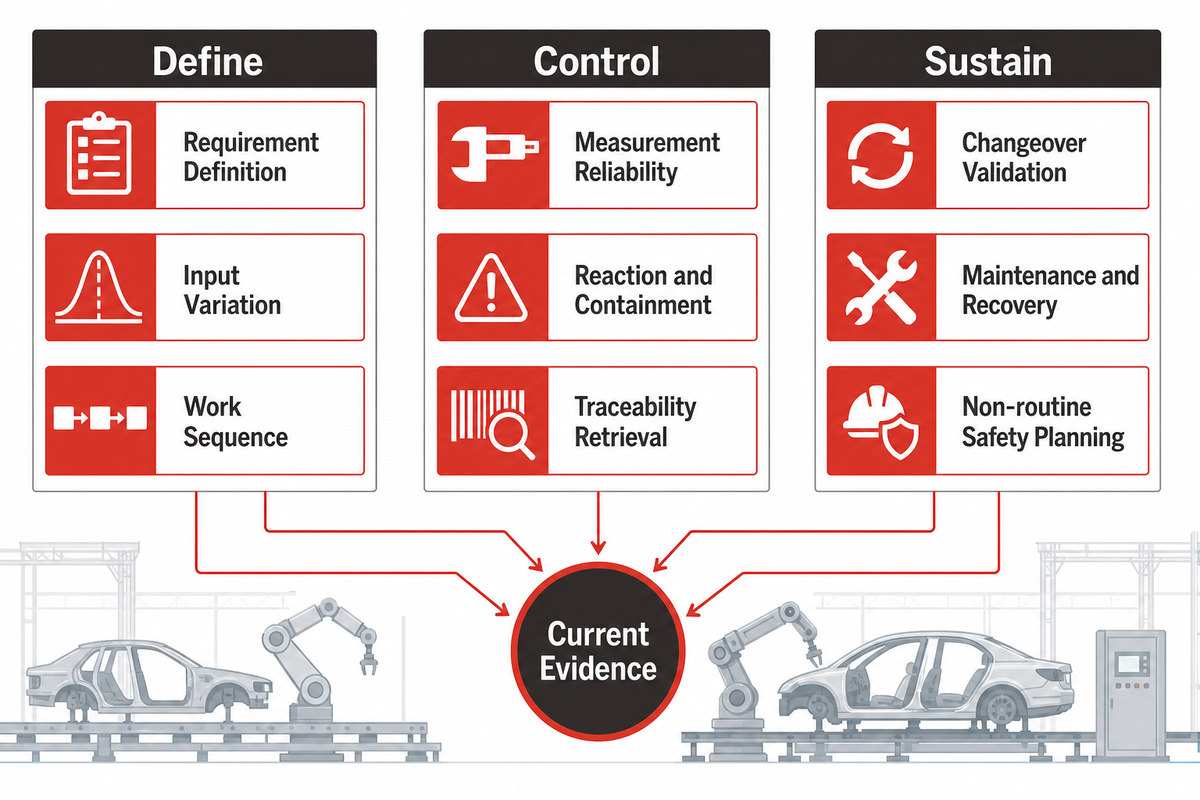
An Automation Readiness Scorecard tests whether a process is defined, measurable, controllable, traceable, maintainable, change-ready, and safe during both routine and non-routine work. This 0–18 score is editorial guidance only. It is not an industry standard, certification rating, compliance assessment, or substitute for an application-specific engineering and safety review.
Score each row from 0 to 2 using evidence rather than optimism: 0 means the condition is undefined or unproven; 1 means it is partly defined but has a known gap; and 2 means a current, retrievable record supports the stated condition. Its value depends on notes that explain why a row received its result.
| Evidence question | 0: not evidenced | 1: partly evidenced | 2: current evidence |
|---|---|---|---|
| Requirement definition | Critical requirements are unclear | Some requirements are known | Current requirements and release rules are identified |
| Input variation | Material or part variation is unknown | Known variation is not consistently handled | Variation and response boundaries are documented |
| Work sequence | Actual work differs from an undefined sequence | A sequence exists but exceptions are unclear | Normal and exception paths are described |
| Measurement reliability | The decision method is untested | A method exists with unresolved fitness questions | Applicable measurement evidence is retrievable |
| Reaction and containment | No clear response to an abnormal result | Response depends on local knowledge | Reaction, ownership, and status control are stated |
| Traceability retrieval | Records cannot reconstruct a failure question | Some relationships can be retrieved | A test scenario retrieves the needed relationships |
| Changeover validation | Change state is not documented | Some setup checks occur | Version, setup, and release relationships are clear |
| Maintenance and recovery | Recovery depends on individual memory | Recovery steps exist but evidence is incomplete | Recovery conditions and verification are described |
| Non-routine safety planning | Non-routine work is not considered | Some activities are identified | Planning addresses the applicable non-routine work |
How to interpret the total: As an original editorial prompt, 0–6 suggests defining and stabilizing the process before equipment selection; 7–12 supports a limited pilot only with a written evidence-closure plan; 13–18 supports a detailed automation concept review, subject to application-specific validation. These bands have not been validated as predictive thresholds. Use the row evidence and unresolved gaps—not the total—as the decision basis. High numbers do not permit teams to skip engineering, quality, customer, or safety requirements.
Value lies in the notes, not the arithmetic. Every row should point to a current process document, record, test, or observed gap that a cross-functional team can examine. “We have always done it this way” is not evidence. Nor is an old file whose revision relationship is unclear. When a row earns a 1, name what prevents it from earning a 2: an untested measurement method, an exception path known only by experienced operators, a release check that is not tied to the right identity, or a recovery step that has not been rehearsed.
The scorecard framing also prevents a common sequencing error. Teams may see a manual task, decide it is repetitive, and begin discussing automation before they agree on the variation that must be handled or the response to an abnormal result. In that situation, automation can make the same uncertainty occur faster and make later investigation harder. Scorecard conversations change the order: define the requirement and the failure boundaries first, then decide what assistance, inspection, handling, or information capture an application must support.
Use a small, mixed review group whenever possible. Process engineers may understand the intended sequence; operators may know the actual exception path; quality may own the release evidence; maintenance may understand recovery; and safety personnel may identify non-routine exposure. Their views should not be averaged away. Where they disagree, record the disagreement as a gap to close. Aim for a process definition that can survive shift changes, a quality hold, a supplier question, or a planned changeover.
Pilots are most defensible when they have a written evidence-closure plan. That plan can state the unresolved readiness rows, the owner for each, the record or test that will close the gap, and the review point before the concept moves forward. Also state what will stop the pilot: for example, an inability to retrieve the required traceability relationship or an unresolved non-routine recovery condition. This is not a universal approval template; it is a way to keep learning from being mistaken for release authorization.
Safety deserves its own explicit row because automatic production is not the only operating condition. OSHA’s robotics guidance highlights programming, maintenance, testing, setup, and adjustment as non-routine activities during which workers may enter a robot envelope. This guide does not assess a site. Ask a narrower readiness question: has the team included the applicable non-routine work in its planning, recovery, and evidence design?
Teams that identify score gaps can then use related educational resources on automated assembly machines, vision inspection systems, and production line automation to frame the next technical discussion without turning this article into a machine-selection page.
- Choose one station — select a process where an evidence gap would materially affect release, investigation, or changeover decisions.
- Trace one requirement — follow it through risk, control, measurement, production record, and release.
- Test one failure question — use a realistic scenario to see whether affected and unaffected populations can be distinguished.
- Close the highest-risk gap — assign an owner, an evidence expectation, and a check that the new relationship can be retrieved.
- Review readiness again — rescore only after the evidence is current and testable.
Hand Off Evidence from Supplier to OEM Without Losing Version Identity
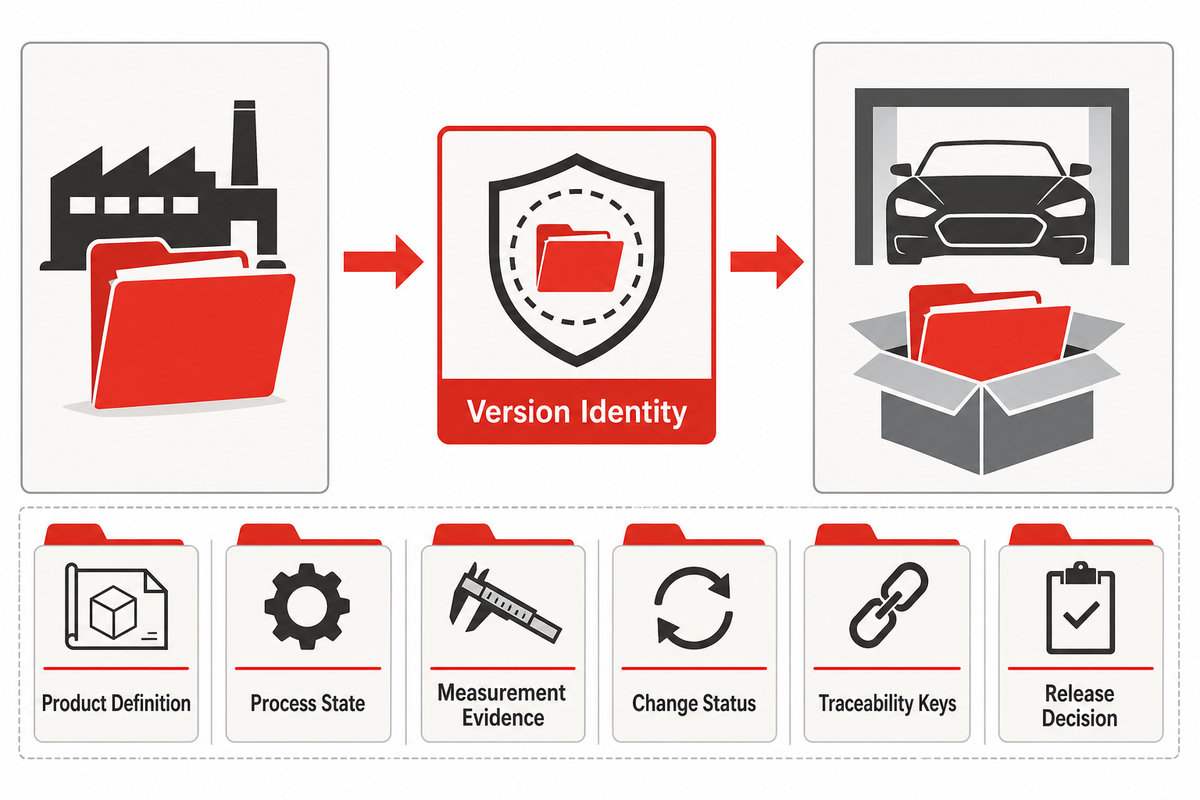
A useful supplier-to-OEM evidence handoff transfers the current product definition, approved process state, measurement evidence, change status, traceability keys, and release decision without losing version identity. Receiving organizations do not need every local data field. Needed records explain what was supplied, under which applicable state, and what decision released it.
A connected evidence path may be more useful than adding a larger data platform when the immediate problem is broken record relationships. NIST describes the digital thread as a way to connect model-based product data with manufacturing and quality information, then feed information back through the lifecycle. Preserve relationships: a revision should be distinguishable from a superseded revision, a process state from a later change, and a release decision from a later rework or disposition.
| Handoff item | Likely source | Receiving decision | Version or identity key | Limitation |
|---|---|---|---|---|
| Product definition reference | Controlled engineering source | Was the applicable definition used? | Approved revision relationship | Access and authority rules vary |
| Approved process state | Process-control records | Was the product made under the intended state? | Process and change reference | Not a substitute for customer approval rules |
| Measurement and verification evidence | Quality records | Can the release basis be understood? | Method and result relationship | The applicable evidence set is program-specific |
| Traceability relationship | Production and material records | Can a defined population be reconstructed? | Unit, lot, serial, or approved equivalent | Granularity must fit the failure question |
| Release and exception status | Authorized release records | What was released, withheld, or re-evaluated? | Disposition and release link | Retention duties are not universal |
For 2026–2027 planning, this guide recommends defining record ownership and version relationships before adding another integration layer. As dated U.S. context, the SelectUSA automotive overview describes automotive as a large, automation-intensive sector with meaningful production, research, export, and robot-adoption activity. That page is not a global forecast and does not prove that any individual plant is ready to automate.
When the evidence path is clear, a technical discussion can move from “What equipment should we buy?” to “What conditions, inputs, controls, and records must an application support?” That is the bridge to a focused discussion with the ZEUEE automotive automation team about a specific manufacturing application.
Frequently Asked Questions
What is automotive manufacturing?
Automotive manufacturing connects product requirements, production work, verification, release, and feedback for vehicles and automotive components.
The visible work can include forming, joining, assembly, inspection, testing, and material handling. Its management challenge is to preserve the evidence relationship between a requirement, the process used to meet it, the result observed, and the release or containment decision. That loop applies across OEM and supplier operations even when the records differ. A useful process map also includes approved change, rework, measurement status, and the identity of the product or population covered by a decision.
What are the main stages of an automotive manufacturing process?
The main stages are requirement definition, risk planning, process design, measurement, production, verification, release, and feedback or change control.
Physical stages vary by component and plant. The transferable structure is the information flow from requirement and risk through control, evidence, release, and approved change.
What is the purpose of quality control in automotive manufacturing?
Quality control provides evidence that a process and product were checked against applicable requirements and that abnormal results received a defined response.
Its purpose is not limited to sorting product at the end of a production line. Quality planning and control connect anticipated failure modes, measurement capability, process behavior, reaction actions, and release evidence. The applicable methods, records, and acceptance criteria come from the responsible organization, customer requirements, and the specific process.
How is automation used in automotive manufacturing?
Automation can execute or assist defined manufacturing, handling, inspection, and information-capture tasks when the process conditions and evidence needs are clear.
A useful review checks variation, sequence, measurement, reaction, traceability, recovery, and non-routine safety planning before the cell concept is selected.
What should an automotive traceability system retain?
An automotive traceability system should retain the identities and relationships needed to answer a defined failure, release, or change question.
Depending on the process, that can include unit or lot identity, incoming material relationships, station or process state, method and verification result, rework or disposition, release authority, and applicable version references. No universal field list or retention period fits every program. Test the design with a realistic failure question: the responsible team should be able to reconstruct a bounded population, separate affected from unaffected units, and explain which evidence supported the last status change.
How do manufacturers know whether a process is ready for automation?
A process is ready for an automation concept review when its requirements, variation, work sequence, measurement, reaction, traceability, recovery, and applicable safety planning have current evidence.
The editorial scorecard in this guide can help teams identify whether they should stabilize, pilot with an evidence-closure plan, or progress to a detailed concept review. It is not a compliance score. A technical application review must still validate the actual product, process, interfaces, quality expectations, operating conditions, and safety obligations.
Key takeaway
Automotive manufacturing teams should treat a 0–18 readiness score as an editorial prompt to close evidence gaps. A defined, measurable, traceable, and safely recoverable process gives a stronger basis for a meaningful automation concept review.
Move from a readiness finding to an application conversation. ZEUEE can discuss automotive manufacturing automation around your actual process, quality evidence, and integration context.
About this analysis — This research-based guide focuses on automotive manufacturing quality planning, traceability relationships, and automation readiness. ZEUEE develops automation solutions, so application-specific quality, compliance, safety, record-retention, and customer-submission requirements must be checked by the responsible organization. Learn more about ZEUEE engineering and automation experience.
References & Sources
- IATF 16949:2016 overview — IATF Global Oversight.
- Quality Core Tools — Automotive Industry Action Group.
- 49 CFR Part 565: Vehicle Identification Number Requirements — Electronic Code of Federal Regulations.
- Resources, Investigations & Recalls — National Highway Traffic Safety Administration.
- Digital Thread for Manufacturing — National Institute of Standards and Technology.
- SelectUSA Automotive Industry — U.S. International Trade Administration.
- Robotics — Occupational Safety and Health Administration.
WHY WE WRITE THIS
About ZEUEE Engineering Insights
ZEUEE shares technical guides based on real automation project experience. Since 2005, we have designed and manufactured non-standard automation equipment for connector assembly, wire harness production, robotic lines, vision inspection, and smart factory upgrades.
Founded in 2005
20,000 m² production base
120+ specialists
150+ R&D patents
ISO9001:2015 certified